Of course, Facebook ads work. But let's be honest—how you use them is what separates the money-makers from the money-pits. For millions of businesses, from scrappy startups to global brands, they remain one of the most powerful and scalable ways to grow. The trick is to stop guessing and start operating with a clear, data-backed strategy.
Answering with Data, Not Hype
To really answer the question "do Facebook ads work?" we have to look past the hype and dive into the hard numbers. The platform's staying power isn't a fluke; it's fueled by real results that keep advertisers coming back and investing billions. With Meta's colossal user base, you get a direct line to a global audience, making it a non-negotiable part of any modern marketing mix.
But reach alone doesn’t pay the bills. The real proof is in the performance. Facebook ads are a form of pay-per-click advertising, so their effectiveness is all about the return they generate. If you're new to this world, getting a handle on the basics of PPC for beginners is a great starting point.
Benchmarks That Prove the Value
The numbers consistently point to a positive return across the board. A Databox survey found that 54% of marketers see Facebook ads as 'very effective' for driving sales, with a tiny 8% calling them ineffective. On top of that, 29% of marketers report that Facebook delivers the highest ROI of any social platform. When you're talking about a platform with 3.07 billion monthly active users, that's some serious firepower.
These stats translate into real wins for businesses every single day.
The ultimate measure of success is Return on Ad Spend (ROAS). This simple metric tells you how much revenue you're generating for every dollar you put into your campaigns. It cuts through vanity metrics and focuses on what truly matters: profitability.
Understanding your ROAS is everything. For example, a median ROAS of 1.79 for B2C companies and 1.8 for B2B firms shows that advertisers are, on average, making their money back and then some. To really get a grip on this, check out our guide on how to calculate return on ad spend. Even with all the privacy changes, the platform's power to deliver is undeniable.
To give you a clearer picture, here's a quick look at what solid performance looks like for both B2C and B2B advertisers.
Facebook Ads Performance At a Glance
This table breaks down the key performance benchmarks you should be aiming for. It offers a clear, at-a-glance view of what's achievable and why mastering this channel is still a top priority for any company serious about growth.
| Metric | B2C Benchmark | B2B Benchmark | Key Takeaway |
|---|---|---|---|
| Return on Ad Spend (ROAS) | 1.79x | 1.80x | Both B2C and B2B see a positive return, making it a profitable channel for a wide range of business models. |
| Click-Through Rate (CTR) | 1.55% | 0.78% | B2C ads tend to be more "clickable" due to impulse buys, but B2B can still drive high-quality traffic. |
| Cost Per Click (CPC) | $1.64 | $2.52 | B2B clicks are pricier because the potential customer value is often much higher. It's an investment. |
| Conversion Rate (CVR) | 1.05% | 0.80% | Converting a B2B lead often takes more than one click, explaining the slightly lower direct conversion rate. |
Ultimately, these numbers prove that with the right strategy, Facebook ads are far more than just a way to get likes—they're a machine for generating real, measurable business results.
The Five Pillars of Profitable Meta Campaigns
Knowing that Facebook ads can work is one thing. Understanding how they work is where the real money is made. Success on Meta isn't about some secret hack or a magic button. It's a system, and that system is built on five core pillars that all have to work together.
Think of it like building a high-performance engine. If your spark plugs (Creative) are shot, it doesn’t matter how good your fuel (Audience) is—the engine is going to sputter and die. But when all five parts are dialed in and working in harmony, you get a powerful, efficient machine that drives consistent growth. This framework is the most durable mental model for building winning campaigns from scratch and, just as importantly, for figuring out why an old campaign is failing.
This is how you build an advertising engine that actually works, one that delivers a high ROI and opens the door to a massive global audience.
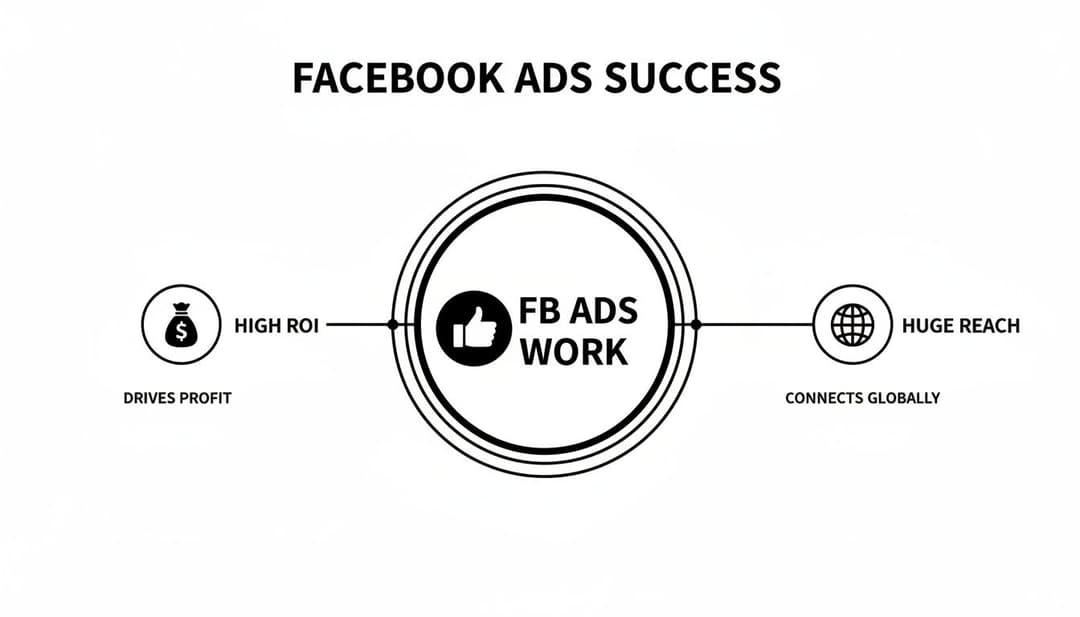
When these core pieces are functioning correctly, you don't just get clicks and impressions; you get tangible business results like profit and new customers.
Pillar 1: Creative That Stops the Scroll
Your ad creative is your first, and maybe only, shot at getting a potential customer's attention. In an endless feed of content, its number one job is to break their scrolling pattern and earn you three seconds of their time. But great creative does more than just grab eyeballs; it has to communicate real value and connect with the right person on an emotional level.
For instance, a polished, studio-shot video might look professional, but a raw, user-generated content (UGC) video could easily outperform it by 5x simply because it feels more authentic and trustworthy. The game is to test different formats, hooks, and messages to figure out what truly lands with your audience.
- Tell a Story: Don't just list features. Frame the customer's problem and show them how your product is the only logical solution.
- Be Authentic: Ads that don't look like ads almost always win. Think testimonials, behind-the-scenes clips, or simple selfie-style videos.
- Get to the Point: Can someone understand what you offer within three seconds? If not, your value prop isn't clear enough.
Pillar 2: Precision Audience Targeting
The most amazing ad in the world will fall completely flat if it's shown to the wrong people. Meta’s targeting engine is its true superpower, letting you zero in on users based on their interests, online behaviors, demographics, and, most importantly, their past interactions with your brand.
Your audience strategy should never be a "set it and forget it" task. It's something that needs constant attention and refinement. Start by sketching out a few ideal customer personas, then translate those traits into Meta's targeting options.
Key Insight: Stop focusing all your energy on cold audiences. Your most profitable segments are almost always your Lookalike Audiences (people who "look like" your existing customers) and your Retargeting Audiences (people who've already visited your site or engaged with your page).
These "warm" audiences have already raised their hand and shown interest, which makes them far more likely to convert. Structuring your campaigns with distinct ad groups for different audience temperatures is a fundamental step toward spending your budget efficiently. For a deeper look, our guide on a winning Facebook ad group structure breaks this down further.
Pillar 3: A Cohesive Funnel Strategy
One of the most common—and costly—mistakes is sending all your traffic to the same landing page with the same generic message. A truly successful strategy guides users through a journey, moving them from initial awareness all the way to a final conversion. This is your marketing funnel.
- Top of Funnel (TOFU): Introduce your brand to cold audiences who’ve never heard of you. The goal here isn't a hard sell; it's education and engagement.
- Middle of Funnel (MOFU): Retarget people who engaged with your TOFU ads or visited your site. Offer them something of value—like a case study or a detailed guide—to build trust and authority.
- Bottom of Funnel (BOFU): This is where you target your warmest leads, like cart abandoners or people who viewed specific product pages. Use direct calls-to-action, special offers, and dynamic product ads to close the deal.
This tiered approach ensures you’re hitting people with the right message at the right time. It dramatically lifts conversion rates and stops you from burning cash on mismatched offers.
Pillar 4: Intelligent Bidding and Budgeting
Your bidding strategy is how you tell Meta to spend your money to get what you want. While "Lowest Cost" is a simple starting point, strategies like "Cost Cap" or "Bid Cap" give you much more control over your cost per acquisition (CPA).
How you allocate your budget is just as important. Don't spread a small budget thinly across dozens of ad sets. It's better to concentrate your spending on the proven audiences and creatives that are delivering results. Use Meta’s Campaign Budget Optimization (CBO) to let the algorithm automatically push more money toward your top performers in real-time.
Pillar 5: Accurate Measurement and Attribution
You can't fix what you can't measure. The final pillar is all about tracking the right metrics to understand what's actually driving results. This means moving beyond vanity metrics like clicks and impressions and focusing on what matters: conversions, cost per acquisition, and Return on Ad Spend (ROAS).
Accurate measurement has gotten trickier, but that just makes it more critical. To get a clear picture of performance today, you need to understand and use the tools available, which is covered extensively in this guide on Unlocking the Power of Facebook CAPI. Implementing the Conversions API alongside the Meta Pixel is no longer optional; it's how you recapture data that would otherwise be lost, giving you a far more accurate view of how your campaigns are performing.
See How Winning Strategies Work in the Real World

Understanding the five pillars of a successful Meta campaign is one thing. Seeing them in action is what really proves that Facebook ads work. The platform’s real strength is how it adapts to wildly different business goals. So, let's move from theory to reality and look at how these principles are applied across different industries to drive real, measurable results.
These examples aren't just fluffy success stories. They’re practical blueprints showing how a well-structured strategy—combining the right audience with the right message—can turn ad spend into a powerful growth engine.
E-commerce: Winning Back Lost Sales with Dynamic Ads
For any e-commerce brand, a lost sale isn't a dead end. It’s a massive retargeting opportunity. In fact, one of the most profitable campaigns you can possibly run is designed to recapture customers who abandon their shopping carts.
Objective: The goal here is simple and direct: drive sales by recovering those abandoned carts. The metric that matters most is Return on Ad Spend (ROAS), which tells you the revenue generated for every dollar you put in.
Audience: This campaign laser-focuses on a high-intent, bottom-of-funnel audience. You're specifically targeting users who added a product to their cart in the last 7 to 14 days but never finished checking out. It’s a small group, but they’re incredibly valuable.
Creative: The magic ingredient is Dynamic Product Ads (DPA). These ads automatically show people the exact products they left behind, creating a hyper-personalized reminder. Pair that with simple, direct copy like, "Still thinking it over? Your items are waiting for you," and maybe a small 10% discount to nudge them over the finish line.
The result? A ROAS that blows campaigns targeting cold audiences out of the water. It's not uncommon for a well-tuned cart abandonment campaign to hit a ROAS of 5x or higher, making it one of the most reliable profit centers for any online store.
B2B SaaS: Generating High-Quality Leads
For a B2B SaaS company, the game is different. The sales cycle is longer, and the goal isn't an immediate purchase. It’s about starting a conversation with the right decision-makers. Facebook ads work exceptionally well for this when you use them to generate high-quality leads.
An effective B2B strategy on Facebook isn't about selling your software in the ad. It's about selling the next step in the journey—offering immediate value in exchange for a prospect's contact information.
This approach builds trust from the get-go and fills your sales pipeline with people who are actually interested.
Objective: The primary goal is lead generation. Success is measured by the Cost Per Lead (CPL), with a secondary focus on lead quality (for instance, how many of those leads end up requesting a demo).
Audience: The targeting gets a bit more nuanced here. A winning strategy often involves creating a Lookalike Audience based on a list of your existing high-value customers. This tells Meta's algorithm to go find new users who share key traits with your best clients.
Creative: The offer is the hero of the ad. The creative should center around a high-value piece of content, like a gated whitepaper or an exclusive industry report. You could use a static image of the report's cover, paired with copy that highlights a juicy statistic or finding, promising to solve a key pain point for your target professional. For more ideas, explore our complete guide to effective Facebook ad strategies.
By offering genuine value upfront, a SaaS company can achieve a low CPL while attracting prospects who are genuinely interested in their expertise—teeing up the sales team for success.
Mobile App: Driving Cost-Effective Installs
For mobile app developers, the core challenge is simple: acquire new users at a cost that makes sense for the business. Facebook's App Install campaigns are built specifically for this, optimizing not just for installs, but for valuable in-app actions.
The whole point is to find users who won’t just download the app and forget about it, but who will actually stick around and engage.
Objective: The main objective is to drive app installs. The key performance indicator (KPI) here is Cost Per Install (CPI), which ensures your user acquisition stays profitable.
Audience: A powerful approach is to use Value-Based Lookalike Audiences. This means you upload a list of users who have made in-app purchases or hit a key engagement milestone. The algorithm then finds new people who are statistically likely to take those same valuable actions after they install.
Creative: Short, snappy video ads are king. These videos need to showcase the app's most exciting features in the first 5-10 seconds, demonstrating the core user experience. The call-to-action is a simple and direct "Install Now," taking the user straight to the App Store or Google Play Store.
This targeted approach ensures your ad budget is spent acquiring high-quality users, not just downloads. It drives down your CPI while maximizing the lifetime value of each new user you bring on board.
To make this crystal clear, here’s how the strategy shifts depending on your business model.
Facebook Ad Strategy by Business Model
| Business Model | Primary Objective | Key Metric | Top-Performing Ad Formats |
|---|---|---|---|
| E-commerce | Drive Direct Sales & Purchases | ROAS (Return on Ad Spend) | Dynamic Product Ads (DPA), Carousel Ads, Video Ads |
| B2B SaaS | Generate Qualified Leads | CPL (Cost Per Lead) | Lead Form Ads, Static Image Ads (with value offer) |
| Mobile App | Increase App Installs & In-App Events | CPI (Cost Per Install) | Video Ads, Playable Ads, App Install Ads |
As you can see, the "best" strategy is never one-size-fits-all. It’s about aligning the platform’s powerful tools with your specific business goals, whether that's ringing the register today, filling your pipeline for tomorrow, or getting your app onto more home screens.
Building Your Framework for Continuous Improvement
The most successful advertisers I know aren't asking, "do Facebook ads work?" They're asking a much smarter question: "How do I figure out what works for my business, again and again?"
The answer is building a rock-solid testing engine. Just launching a campaign and crossing your fingers is a fast way to burn through your budget. The pros, on the other hand, build a system for constant learning and improvement.
It’s about moving away from random tweaks and getting methodical. Think like a scientist in a lab. You wouldn't throw a dozen different chemicals into a beaker at once and hope for the best, right? You isolate one variable, test it, log the results, and then move on. That’s the heart of A/B testing, and it’s your key to unlocking profitable growth on Meta.
Prioritizing Your Tests for Maximum Impact
With so many things you could test—headlines, images, audiences, offers—it's easy to get paralyzed. The trick is to start with the levers that can create the biggest swings in performance. Not all tests are created equal.
Focus your energy on these three areas, in this order:
- Audience: Seriously, this is almost always the fastest way to find a huge win. You can have the most brilliant ad in the world, but if it's shown to the wrong people, it's going to flop. Pit a Lookalike Audience against a broad, interest-based one and see which one delivers a lower Cost Per Lead.
- Offer/Creative Concept: Once you have an audience that shows promise, test fundamentally different creative angles. This isn't about changing a button color from blue to green. It's about testing a raw, UGC-style testimonial video against a polished product demo. Or finding out if a 20% Off offer pulls better than a Free Shipping incentive.
- Ad-Level Elements: After you've dialed in a winning audience and concept, then you can start refining the small stuff. This is where you test different headlines, tweak your primary text, or swap out calls-to-action to squeeze a bit more performance out of your winner.
This hierarchy ensures you’re always working on the changes most likely to actually move the needle, saving you a ton of time and money.
Escaping the Manual Testing Bottleneck
So, here’s the real-world problem. The strategy for robust testing is straightforward, but the execution is a nightmare. Manually building out dozens—or even hundreds—of ad variations to test every possible combination of creative, copy, and audience is a mind-numbing, soul-crushing task.
This operational bottleneck is exactly where most advertisers give up. They settle for "good enough" instead of pushing for "great."
The difference between a 2x ROAS and a 4x ROAS is often hidden inside a creative and audience combination you never had the time to build and test. Manual limitations directly cap your potential for profit and scale.
This is precisely the problem AdStellar AI was built to solve. Instead of drowning in spreadsheets or spending hours inside Ads Manager cloning ad sets and swapping assets, AdStellar automates the entire process. You can generate hundreds of unique ad variations in minutes and launch comprehensive tests with just a click.
It transforms testing from a dreaded manual chore into a streamlined, strategic advantage. By removing that operational friction, you can finally run the volume of tests needed to discover your most profitable ad combinations. It opens the door to exploring powerful approaches like what is multivariate testing at a scale and speed that's simply impossible to do by hand. You gather more data, learn faster, and ultimately find the winning formulas that prove Facebook ads can and do work for you.
Moving from Manual Work to AI-Powered Growth
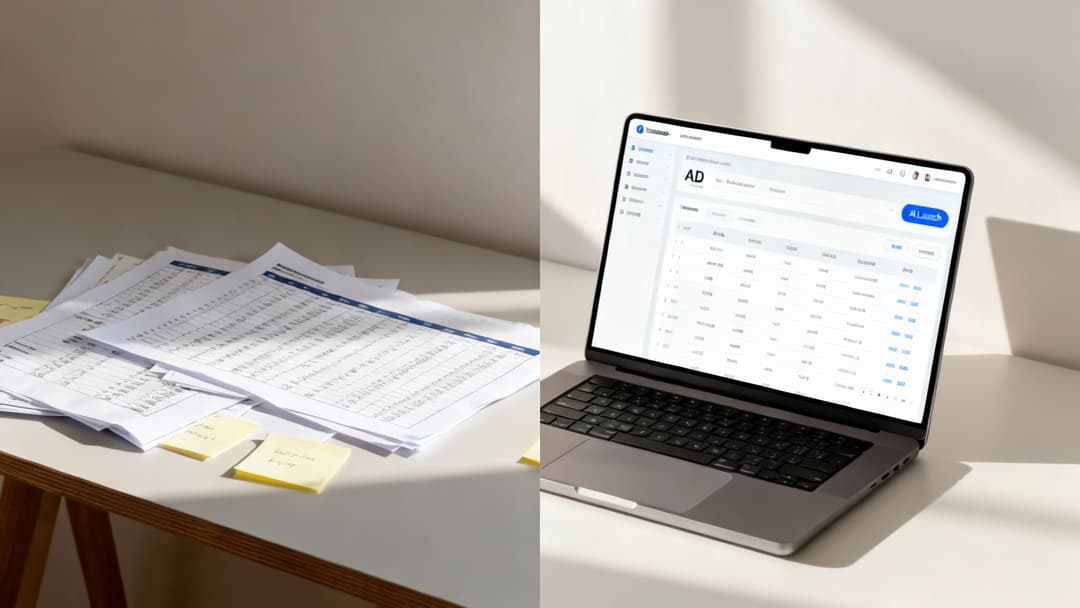
That image perfectly captures the shift we're seeing in paid media. Moving from piles of paperwork to a clean digital interface isn't just about looking modern—it's about survival. It's the exact change you need to make if you want your Facebook ads to actually work.
For too many performance marketers, the real enemy isn't a bad strategy; it's the soul-crushing weight of manual tasks. The old way of running Meta campaigns is a slow, painful grind that actively sabotages your chances of finding what's profitable. Think endless spreadsheets, mind-numbing ad cloning, and hours burned just trying to get a simple test out the door.
This old-school approach creates a massive operational bottleneck. You know you should be testing more creative angles and audiences, but the sheer time it takes to build and launch every variation makes it impossible. You end up making calls with half the data you need, leaving a ton of potential revenue on the table.
The AdStellar Way: Centralized and AI-Driven
This is where a purpose-built, AI-powered platform like AdStellar changes the entire game. It completely replaces the slow, inefficient "Old Way" with a single system designed for speed and data-backed decisions. Instead of fighting the platform, the technology finally starts working for you, automating the repetitive grunt work that kills all momentum.
This isn't just about doing things faster; it's about doing them smarter. By getting rid of the manual friction, you free up your team to focus on high-impact strategy—digging into results, brainstorming new creative concepts—instead of getting lost in the weeds of campaign setup. It's how you scale your ad spend without having to scale your headcount.
The core idea is simple: turn campaign management from a manual, error-prone chore into a repeatable, data-backed process. This shift is what separates advertisers who struggle to break even from those who consistently drive profitable growth.
With this kind of workflow in place, the question changes from "do Facebook ads work?" to a much more exciting one: "how fast can I scale what's working?"
Turning Data into Actionable Outcomes
AdStellar AI is built to solve the specific operational headaches that hold marketers back. The features aren't just fancy add-ons; they are intelligent tools designed to turn your historical data into better future performance, taking the guesswork out of the equation.
Two features really nail this new way of working:
AI Launch: This is so much more than a "launch campaign" button. AI Launch digs through all your past campaign data to figure out which creative and audience pairings delivered the goods. It then uses those proven winners as the starting point for new campaigns, giving you a huge head start right out of the gate.
AI Insights: Think of this as your own personal analyst, working 24/7. It constantly watches your live campaigns, flagging your highest-ROAS assets and audiences in real-time. This lets you immediately put more budget behind what’s working and cut the losers before they burn too much cash.
The data doesn't lie: 67.55% of advertisers find that videos get more clicks, and with an average conversion rate of 9.21%, your creative choices are everything. But manually testing every variable is a surefire way to stall your growth. AdStellar AI automates this by launching campaigns with proven creative-audience combos and then uses continuous learning to scale the top performers.
Ultimately, adopting this AI-powered approach frees up your most valuable resource: your time. It lets you move past manual execution and focus on the strategic thinking that actually drives profitable growth from your Meta ads. To learn more, check out our guide on how to best use AI for Facebook ads.
Your Action Plan for Launching a High-Impact Test
All the theory in the world doesn't mean much until you put it into practice. Moving from "do Facebook ads work?" to "Facebook ads work for me" requires a real-world test. Let's walk through a clear, step-by-step plan to get a pilot campaign off the ground, designed to give you maximum learning with minimum risk.
Think of this less as a massive commitment and more as a focused experiment. Our goal is simple: gather actual performance data to inform where you put your money next. We're officially moving from reading to doing.
Define Your Pilot Campaign Parameters
Before you spend a single dollar, you need a blueprint. A well-defined test is your best defense against wasted ad spend, ensuring you get clean, actionable data back. Your first test should be simple and measurable, avoiding the complexity you might see in a full-blown campaign.
Here’s a simple four-step launch plan to get you started:
- Set a Single, Measurable Objective: Don't try to solve for brand awareness and sales at the same time. Pick one thing. It could be generating leads for under $50 (CPL) or hitting a 2x Return on Ad Spend (ROAS).
- Identify Three Audience Hypotheses: Who are your top three guesses for your ideal customer? Maybe you test a 1% Lookalike Audience of your best customers, an interest-based group like "digital marketing," and a broader demographic segment. List them out.
- Develop Three Creative Concepts: Brainstorm three genuinely different angles. You could test a user-generated-style video testimonial against a clean static image with a bold offer, and top it off with a carousel ad that shows off different product features.
- Establish a Firm Budget and Timeline: You need a container for your experiment. Set a firm test budget, something like $500, and a specific duration, like 7-14 days. This creates a controlled environment where you can fairly judge what's working without breaking the bank.
Executing this multi-layered test manually can be a real headache. You’re looking at hours of cloning ad sets and swapping out creative assets just to get it live. This is exactly where the right tools give you a serious competitive edge, making complex testing simple and fast.
Using a platform like AdStellar AI completely changes the game. What used to be a multi-hour setup becomes a few clicks. It automates the creation of every audience and creative combination, letting you launch a comprehensive test almost instantly. This is how you move from planning to profitable advertising faster than anyone else.
Common Questions About Meta Ads
Even the most seasoned marketers have questions when it comes to Meta's ever-changing ad platform. Let's tackle some of the most common ones that come up.
How Much Should I Budget for Facebook Ads?
There’s no one-size-fits-all answer here, but a great place to start is with a test budget of $500 to $1,000, spread out over 7 to 14 days. This gives you enough runway to see which audiences and creatives are getting traction without risking a huge amount of capital upfront.
Think of this initial budget as buying data, not just sales. Your goal is to learn what resonates with your audience so you can scale the winners with confidence.
How Long Until My Facebook Ads Are Profitable?
Don't expect overnight success. It usually takes about 30 to 90 days to go from the first tests to a campaign that's consistently profitable. Those first few weeks are all about learning—for you and for Meta's algorithm.
Give it time. Pulling the plug too early, maybe after a couple of off days, is a classic mistake. You need enough data for the algorithm to find its groove and for you to make smart, informed decisions.
Do Facebook Ads Still Work for B2B?
They absolutely do, but you have to play the game differently. Forget trying to get an immediate demo or sale from a cold ad. The real power of Facebook for B2B lies in lead generation. Think high-value content offers—whitepapers, webinars, exclusive case studies.
Your targeting strategy is key. Use features like Lookalike Audiences built from your existing customer list to find more decision-makers just like them. The goal isn't to close the deal right away; it's to start a valuable conversation that your sales team can nurture.
Ready to stop guessing and start growing? AdStellar AI automates the entire testing process, letting you launch hundreds of ad variations in minutes to find your most profitable combinations faster. Discover how AdStellar can transform your Meta ad performance.