Let's be honest—launching ad campaigns can feel like a shot in the dark. You pour time, energy, and a whole lot of budget into what you think will work, only to be met with unpredictable results and a disappointing Return on Ad Spend (ROAS).
It’s a frustrating cycle. One week, your Cost Per Acquisition (CPA) looks great. The next, it’s through the roof, and you’re left scrambling to figure out why your lead costs are suddenly unsustainable.
The good news? You can trade that uncertainty for a reliable, data-backed process. A systematic ad testing framework isn't just another task on your to-do list; it's the clearest path to improving your bottom line and making every ad dollar count.
From Guesswork to a Growth Engine
So many ad accounts I see are stuck in a “set it and forget it” rut. But the reality is, a successful campaign needs a constant feedback loop to thrive. A disciplined testing program is that feedback loop, turning every impression and click into a valuable lesson.
Here’s what that shift really looks like:
- End the inconsistency. By testing systematically, you pinpoint the exact creatives, copy, and audiences that deliver, making your performance far more predictable.
- Drive down acquisition costs. Once you identify the top performers, you can scale what works and cut what doesn't, steadily lowering your Cost Per Lead (CPL) and CPA.
- Actually maximize your ROAS. Every winning test gives you the confidence to shift budget toward your best assets, directly boosting your overall return.
This strategic approach is more critical than ever. Even the ad platforms themselves are built on constant experimentation. According to Meta's own Q4 2025 results, they achieved a 3.5% lift in ad clicks on Facebook and a 1% gain in Instagram conversions through their own systematic improvements. If the platform is obsessed with testing, we should be too.
Moving from random acts of marketing to a structured testing program is the single biggest unlock for sustainable growth. It's how you build a library of proven winners instead of relying on one-hit wonders.
Ultimately, the goal is to make decisions with data, not just your gut. And while it might sound like a lot of manual work, modern tools like AdStellar AI can automate the heavy lifting, taking the tedious parts of traditional testing off your plate.
This guide will walk you through the actionable steps you need to get started, whether you’re just trying to figure out if your Facebook ads are effective or you're ready to build a full-scale testing program.
Build Your Ad Testing Blueprint Before Spending a Dollar
Throwing money at ad tests without a plan is a fast way to burn your budget. We’ve all seen it happen. A successful ad test isn't a game of chance; it’s a disciplined experiment. Before you even think about hitting "launch," you need to map out exactly what you're doing. This simple prep work is what separates marketers who get consistent wins from those who just hope for the best.
The core of any good ad test is a strong, measurable hypothesis. This isn't just a vague idea. It’s a specific, testable question. Instead of wondering, "Do video ads work?", you should be asking something like, "Will user-generated video content drive more purchases for our new skincare line than our polished studio ads?"
See the difference? A clear question gives your test a purpose from the get-go.
Tie Your Hypothesis to a Hard Metric
Once you have your question, you need to decide how you'll measure the answer. This means connecting your hypothesis directly to a key business metric. The right one depends entirely on what you’re trying to achieve with the campaign.
For an e-commerce brand, the north star is usually Return on Ad Spend (ROAS). If you're a B2B company trying to fill the sales funnel, you're laser-focused on Cost Per Lead (CPL). And for a direct-to-consumer product, your world might revolve around Cost Per Acquisition (CPA).
Pick one primary goal. Seriously. Trying to optimize for clicks, conversions, and ROAS all at once is a recipe for messy data and inconclusive results. Focus on the single most important number for your business and let that guide you.
This whole process is a simple loop: question, experiment, and optimize toward a winner.
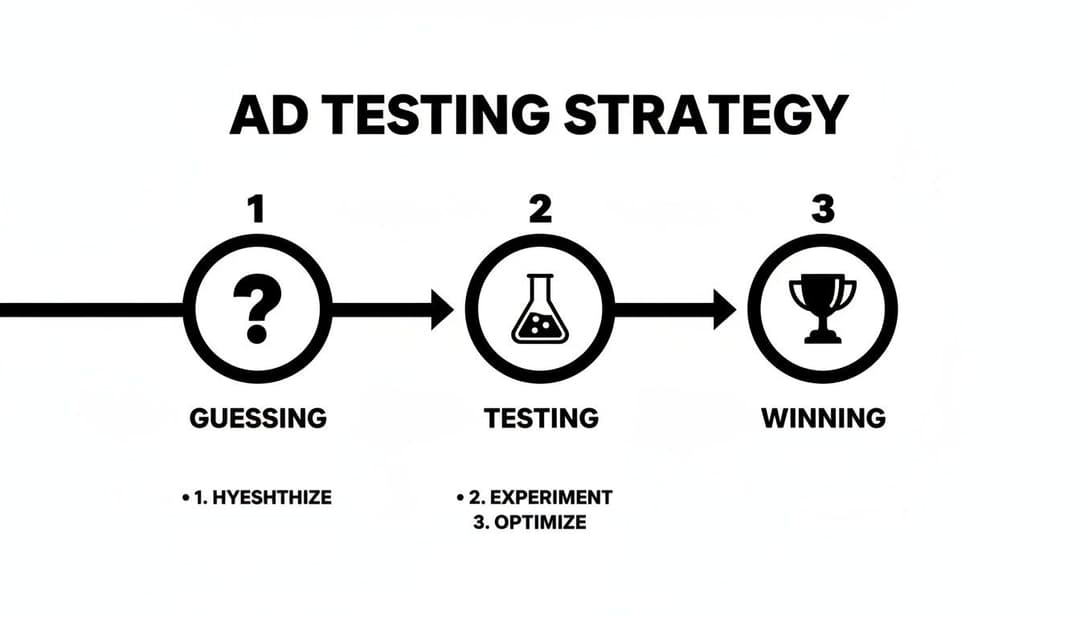
This turns random guesswork into a methodical process for finding what actually works.
A Real-World Planning Scenario
Let's walk through a practical example. Imagine an online clothing store is gearing up for a promotion. They come up with a clear hypothesis: “Will a ‘Free Shipping’ offer generate a higher ROAS than a ‘20% Off’ discount for our summer collection?”
Here’s what their testing blueprint looks like:
- Hypothesis: Free Shipping vs. 20% Off.
- Primary Metric: ROAS. They need to know which offer makes them more money for every dollar they spend on ads.
- Statistical Significance: They agree that they need at least a 95% confidence level to declare a winner. This stops them from jumping the gun after a random good day.
- Budget and Duration: They set aside a specific budget for each ad set and decide to run the test for two full weeks to average out any daily sales spikes or lulls.
With this blueprint in hand, the team isn't just guessing. They have a clear framework to figure out which promotion drives real, profitable growth. If you want to get deeper into structuring these experiments, we break it all down in our guide to building a solid Facebook ad testing framework.
Choose the Right Ad Test for Your Campaign Goal
Picking the right ad test is one of those things that seems simple until you're staring at a spreadsheet full of messy data. Choosing the wrong method is a fast track to burning cash and making bad decisions.
The whole point is to match your testing method to the question you’re trying to answer. A solid test for ads strategy isn't just about running experiments—it's about getting clean, reliable data you can actually use.
The most common starting point is the classic A/B test, or split test. This is your workhorse. Think of it as a straight-up duel between two options to see which one delivers better on your main goal, whether that’s ROAS, CPL, or something else.

For example, you could run a simple A/B test to see if a casual, emoji-filled headline gets more clicks than a formal one. Or maybe you're pitting two completely different landing pages against each other. It’s simple, direct, and perfect for isolating the impact of one big change.
Deciding Between Simple and Complex Tests
But what happens when your question gets more complicated? Maybe you’re past simple headline tests and want to know which combination of headline, image, and call-to-action button is the ultimate champion.
That’s where multivariate testing enters the picture. It’s designed to test multiple variables and how they interact with each other all at once. It’s incredibly powerful, but be warned: this type of test needs a ton of traffic to get a statistically significant result.
Pro Tip: Start with A/B tests to find big, directional wins. Once you have a few high-performing elements—a headline that works, an image that pops—use multivariate testing to find the perfect mix of those winners. You can explore a deeper dive into this approach in our article on what is multivariate testing.
Finally, we have the holdout test. This is the one you pull out for the big, existential questions, like, "Is this retargeting campaign actually driving new sales, or would these people have bought from us anyway?" You find the answer by creating a control group that is deliberately not shown your ads and comparing their behavior to the group that is.
Here’s a quick cheat sheet for when to use each:
- A/B Test: Use this for a direct comparison between two distinct options (e.g., Offer A vs. Offer B).
- Multivariate Test: Perfect for finding the winning combination of multiple ad elements (e.g., Headline 1 + Image A vs. Headline 2 + Image B).
- Holdout Test: Essential for measuring the true incremental lift of a campaign, especially for retargeting or always-on brand efforts.
Platforms like Meta make these tests more accessible than ever before. With over 10 million active advertisers on its platforms, the sheer scale provides a data-rich environment. This massive volume helps performance marketers get the sample sizes needed to run a statistically sound test for ads, whether you're testing creatives, audiences, or offers.
Execute Your Ad Test From Manual Setup to AI Automation
You’ve got a solid testing plan. Now comes the hard part: actually building the thing. This is where the enthusiasm of many marketers dies, buried under an avalanche of tedious, manual work.
Even a simple A/B test in Meta Ads Manager means duplicating ad sets, swapping out one tiny element at a time, and meticulously managing budgets to keep the playing field level.
It’s one thing to test two headlines. But what happens when you want to see how five headlines perform against five images and three different audiences? All of a sudden, you’re on the hook for creating 75 unique ads by hand. That’s not just a time sink; it’s a major roadblock to testing at the speed your business needs.
From Manual Clicks to AI-Powered Creation
Today’s performance marketing world moves way too fast for that kind of workflow. This is exactly where AI-powered tools like AdStellar AI come in and flip the script entirely. Forget about spending hours clicking around in Ads Manager. You can now generate hundreds of ad variations in minutes, turning what used to be a week-long task into a quick afternoon project.
The whole process kicks off with bulk ad creation. You just upload your creative assets—all your images and videos—and then feed the system your different headlines, primary text options, and calls-to-action. The platform then does the heavy lifting, automatically spinning up a complete set of ads with every possible combination.
This is what allows you to graduate from simple A/B tests to running complex multivariate experiments without breaking a sweat. You're no longer stuck building every single variation, which not only saves a ton of time but also slashes the risk of human error. It frees up your team to think about high-level strategy instead of being bogged down by repetitive setup tasks. If you're ready to make this leap, getting familiar with how to automate Meta ad campaigns is a great place to start.
The interface here shows just how quickly you can mix and match creative and copy elements to get dozens of ad permutations ready to go. This kind of setup makes a comprehensive test for ads across multiple variables a reality, minus all the manual drag.
Structuring Campaigns for Clean Data and Scale
Using an AI tool to create hundreds of ads is a huge win, but launching them in a way that gives you clean, trustworthy data is a whole different challenge. You have to be methodical.
Here are a few tips I've learned for launching tests that actually produce useful insights:
- Nail Your Naming Convention: Have the tool automatically generate ad names that spell out the variables, like
ImageA_Headline2_Audience_Broad. This makes sorting and analyzing your results infinitely easier down the line. - Know When to Use DCO: Meta's Dynamic Creative Optimization is great for letting the algorithm find winning combos on its own. But for controlled experiments where you need to isolate a single variable's impact, a structured setup (whether manual or AI-generated) will give you much clearer data.
- Isolate Your Audiences: This is a big one. Don't test new creative and new audiences in the same ad set. First, run your creative tests on an audience you already know works. Once you have a winning creative, use that to test new audiences.
The whole point is to create a sterile testing environment. The only thing changing between your ad variations should be the single element you meant to test. This methodological purity is the secret to getting reliable insights you can actually build on.
As you choose the right ad test for your goals, it's critical to understand the nuances of creative testing on each platform. This practical guide to Facebook Ad Creative Testing is a fantastic resource on the topic. By marrying that kind of platform-specific knowledge with the power of AI automation, you can finally test at the speed of the market and turn insights into performance wins faster than ever.
Analyze Results and Turn Insights Into Action
You've launched the test, the data is flowing in, and now the real work begins. A successful test for ads isn't over when you hit the stop button; it’s when you take what you've learned and build a concrete plan for what comes next.
It's easy to get lost in a sea of metrics like clicks or impressions. The first thing you need to do is cut through that noise and anchor yourself to the primary goal you set from the start. Was it ROAS, CPL, or CPA? That’s the number that matters.

Whether you’re digging through Meta Ads Manager or looking at a sleek AI dashboard, filter your view to focus only on that key metric. If ROAS was the target, sort your results and see which ad, ad set, or campaign actually delivered the best return.
Confirming a True Winner
Before you pop the champagne for a winning variant, you have to be sure the results are legit. This boils down to two critical factors: statistical significance and timing. When looking at your results, it's essential to understand concepts like statistical significance in A/B testing to make sure your findings are solid. A result with 95% confidence or higher means there's a very small chance the outcome was just a fluke.
Context is just as important. I’ve seen countless tests ruined by common timing mistakes that completely skew the data:
- Ending tests too early: Don't call it after just a couple of days, even if one variation seems to be miles ahead. You need enough data to iron out the daily ups and downs.
- Ignoring the weekly cycle: A test that only runs over a quiet weekend won't reflect real-world performance. You should always aim to run tests for at least one full week, but two is even better.
The goal isn't just to find a winner; it's to find a repeatable winner. A statistically significant result gathered over a sufficient timeframe gives you the confidence to bet on that learning for future campaigns.
From Data Points to Action Items
Finding a top-performing ad is a great first step, but that insight is worthless if it just gathers dust in a report. The final, most crucial part of the process is turning that knowledge into your next move. This is where modern tools really shine, often highlighting insights that would take hours to uncover in a spreadsheet.
Let's say your tests reveal that user-generated content (UGC) videos are consistently beating your polished studio ads with a 25% lower CPA. The next action isn't just to keep running that one winning ad. It's to build an entire creative strategy around that insight.
Here’s how you can turn those findings into a clear action plan:
- Iterate on the Winner: If a particular headline was a clear winner, start testing new variations built around that same powerful angle.
- Double Down on the Concept: If UGC was the winning format, it's time to get more UGC-style content from different creators to see if the trend holds.
- Scale the Winning Combination: Take your best-performing ad creative and begin testing it against brand new audiences.
By systematically analyzing performance and iterating, you slowly build a library of proven strategies that you know work for your brand. For a more detailed walkthrough on performance analysis, our guide on how to analyze ad performance can help you dig even deeper. This constant loop—test, analyze, act—is what transforms your ad account from a cost center into a predictable growth engine.
Frequently Asked Questions About Ad Testing
Even with a solid game plan, you're bound to have questions as you dive into ad testing. It's totally normal. Let's walk through some of the most common hurdles and questions that pop up when marketers start running systematic tests.
How Much Should I Spend on an Ad Test?
This is probably the number one question I get. While there's no universal dollar amount, your goal is to spend enough to reach statistical significance without draining your entire budget.
As a solid rule of thumb, budget enough to get at least 100 conversions per variation. So, if your target CPA is $25, you'll want to budget at least $2,500 for each variation you're testing. That’s how you get a confident read on performance.
If you're working with a smaller budget, don't sweat the small stuff. Forget testing five shades of blue on a button. Instead, go for big, impactful changes—think a completely different offer or a wild new creative concept. These larger swings are far more likely to give you a clear winner with less ad spend.
Don't spread your budget too thin across dozens of micro-tests. It's better to run one well-funded test that gives you a confident answer than ten underfunded tests that tell you nothing.
How Long Should My Ad Tests Run?
Patience is a virtue here. You’ll want to let your tests run for one to two full weeks. I know it's tempting to call it early, but sticking to this timeframe is crucial for a couple of big reasons:
- It evens out daily weirdness. User behavior on a Monday morning is worlds apart from a Saturday night. Running a test for at least seven days helps average out those natural peaks and valleys in traffic and engagement.
- It gives the algorithm time to learn. Platforms like Meta need time to get out of the "learning phase" and optimize delivery. If you end a test after only two or three days, you’re making a decision before the algorithm has even figured out who your best audience is.
Seriously, avoid the temptation to end a test early just because one variation shoots out of the gate. Early leads are often just random noise. Stick to your plan and let the data mature.
Can I Test Multiple Things at Once?
You can, but you have to be smart about it. If your goal is to test a headline, an image, and a CTA all at the same time, you need to run a proper multivariate test. This method is specifically designed to isolate which combination of elements delivers the best results.
What you can't do is just throw a new headline and a new image into a single ad and run it against your control in a standard A/B test. If that new ad wins, what did you actually learn? You have no idea if it was the headline, the image, or the combination of both that moved the needle.
For a clean, actionable test for ads, always isolate one variable at a time unless you’re intentionally running a multivariate experiment with enough traffic and budget to support it.
Common Ad Testing Questions Answered
To make things even clearer, here’s a quick-reference table that addresses some of the most common practical questions about running ad tests.
| Question | Quick Answer | Recommendation |
|---|---|---|
| What's the minimum daily budget? | Enough to get 1-2 conversions per day per ad set. | If your CPA is $50, aim for at least $50-$100/day per variation. Below this, the learning phase can stall out. |
| Should I use CBO or Ad Set Budgets? | Use Ad Set Budgets (ABO) for most tests. | CBO (Campaign Budget Optimization) will automatically push budget to the perceived "winner" early on, which biases your test results. ABO ensures each variation gets a fair shot. |
| When should I check my test results? | Don't check every hour. Look at the data once a day at most. | Constant checking leads to emotional decisions. Let the data accumulate for at least 72 hours before you even peek. |
| Is statistical significance all that matters? | No, business impact is just as important. | A test might be "significant" but only improve CPA by 1%. Focus on tests that can produce meaningful, not just statistical, wins. |
This table should help you navigate the day-to-day decisions and keep your testing strategy on track. Remember, the goal is to build a repeatable process that generates reliable insights.
Ready to stop guessing and start launching campaigns with data-backed confidence? AdStellar AI automates the entire ad testing process, from generating hundreds of variations in minutes to identifying your top-performing creatives and audiences. See how you can build winning campaigns 10x faster.