Of course. Here is the rewritten section, crafted to sound like an experienced human expert and incorporating all the specified requirements.
Let's get right to it: Do Facebook ads still work? It’s the question on every marketer’s mind, and the skepticism is understandable. But the data tells a clear and powerful story—yes, they absolutely do.
The trick is to stop thinking of Facebook as just a social network. Instead, see it for what it is: a massive digital marketplace with billions of active shoppers ready to discover new brands.
Yes, Facebook Ads Work. Here Is the Proof.
With all the talk of algorithm shifts and rising competition, it’s easy to wonder if the platform has lost its edge. But the evidence is overwhelming. When you know what you’re doing, Facebook remains one of the most potent tools for growing a business. The real question isn't if it works, but how to make it work for you.
The first piece of proof? Just follow the money. Meta pulled in a jaw-dropping USD 156.8 billion in ad revenue in 2025, a 5.8% jump from the year before. That kind of spending isn't blind faith; it's a calculated investment from businesses around the globe that are seeing real, tangible returns. Get more details on these Facebook ad statistics here.
Why Businesses Keep Investing
Confidence like that is built on solid performance. A broad survey of marketers found that a solid 54% believe Facebook ads are "very effective" at driving sales. Even more telling is that 29% said Facebook delivered the highest return on investment (ROI) compared to every other social platform out there.
These aren't just vanity metrics. Below is a quick look at the kind of performance you can expect, based on industry-wide benchmarks.
Facebook Ads Performance at a Glance
This table breaks down the average performance benchmarks for Facebook ads, giving you a clear picture of what's achievable when campaigns are run effectively.
| Metric | Average Benchmark | Top Performer Benchmark |
|---|---|---|
| Click-Through Rate (CTR) | 1.61% | 3.0% and above |
| Conversion Rate (CVR) | 9.21% | 15.0% and above |
| Cost Per Click (CPC) | $1.35 | Under $0.50 |
| Cost Per Acquisition (CPA) | $19.68 | Under $10.00 |
While averages provide a good baseline, top performers show what's possible with a smart, data-driven strategy. The gap between average and exceptional comes down to execution.
The question is no longer "do ads on Facebook work?" but rather "what strategy will make them work for my business?" Success hinges on understanding your audience, crafting compelling creative, and measuring the right metrics.
This is exactly where so many businesses stumble. They dive in, boost a few posts, and wonder why the results aren't there. A structured, intentional approach is non-negotiable.
This guide is designed to give you that structure. We’re going to walk through:
- How to define and measure what real success looks like.
- Matching your ads to where your customer is in their journey.
- Mastering the essentials: creative that grabs attention and targeting that finds the right people.
- Dodging the common mistakes that sink campaigns before they even get started.
Once you get a handle on these core principles, you can stop treating your ad spend like a lottery ticket and start building a predictable engine for growth. As you’ll see, the proof isn’t just in the global revenue numbers; it’s in the repeatable success of businesses that nail their strategy.
Speaking of which, a great place to start is by understanding the key performance marketing metrics that truly define success.
Defining Success with ROI and Ad Spend
So, you want to know if Facebook ads really work. To get to the bottom of that, we first have to agree on what "working" actually means for a business. It's easy to get a little dopamine hit from watching the likes and comments pile up, but those are often just vanity metrics. Real success? That's measured in the cold, hard numbers that actually grow your business.
Think of your ad spend on Facebook as an investment, not just another line item on your expense report. And like any smart investment, you need to see a return. The best advertisers aren’t just chasing clicks; they are obsessed with the financial metrics that prove their campaigns are creating real, tangible value.
This means we need to zero in on two key indicators: Return on Ad Spend (ROAS) and Cost Per Acquisition (CPA). These are the metrics that cut through all the noise and tell you exactly how much money you’re making for every single dollar you put into the platform.
Understanding Your Key Financial Metrics
ROAS is your ultimate measure of profitability. It’s a dead-simple ratio that answers the most important question: "For every $1 I spent on ads, how many dollars did I get back in revenue?" A ROAS of 3:1, for instance, means you generated $3 in sales for every $1 of ad spend.
CPA, on the other hand, tells you precisely what it costs to land one new customer. If you spend $100 and get five new customers out of it, your CPA is $20. Knowing this number is absolutely critical—it’s how you figure out if you can sustainably acquire customers based on your product margins.
Key Takeaway: Success isn't about going viral. It's about hitting a profitable ROAS and a sustainable CPA. These are the numbers that turn advertising from a high-stakes guessing game into a predictable engine for growth.
Once you have a handle on these, your next step is to establish some benchmarks. The data is pretty clear: Facebook ads can deliver some seriously impressive returns. In fact, 70% of businesses report getting their highest ROI from the platform, even outperforming Google Paid Search. Across hundreds of B2C companies, the median ROAS was 1.79, with the average cost-per-action sitting around $19.68. You can dig deeper into these Facebook advertising performance stats to see how things shake out across different industries.
Moving Beyond Simple ROAS to True Profitability
A positive ROAS is a great start, but it doesn't paint the full picture. To truly know if your ads are making you money, you have to look at your business's unique financial landscape. And to prove that Facebook Ads work, it's essential to understand how to measure advertising effectiveness with the right metrics and a bit of strategic analysis.
You need to factor in these crucial elements:
- Product Margins: A 3:1 ROAS might feel like a huge win for a digital product with 90% margins. But for an e-commerce store with 30% margins? You could actually be losing money. You have to know your break-even point.
- Customer Lifetime Value (LTV): A low ROAS on the first purchase might be perfectly fine if that customer comes back and makes several more purchases over the next year. Understanding your LTV lets you justify a higher initial CPA.
- Business Goals: Are you laser-focused on maximizing profit right now, or is the goal rapid growth and grabbing market share? Your core objectives will dictate what a "good" ROAS or CPA actually looks like for you.
By calculating these figures, you can set clear, meaningful goals for your Facebook campaigns. For example, you might decide that any campaign hitting a ROAS above 2.5 is profitable and ready to scale, while anything below that number needs to go back to the drawing board for optimization.
This framework completely changes your advertising strategy. You're no longer just throwing money at the wall and hoping something sticks. Instead, you're making calculated decisions based on data that directly connects your ad spend to your company's bottom line—and that's the only real way to prove your Facebook ads are working.
For a more detailed breakdown, you might also want to check out our guide on how to calculate return on ad spend.
Aligning Your Ads with the Customer Journey
Throwing a single, hard-sell ad at a cold audience is like asking for a stranger's hand in marriage five minutes after meeting them. It’s just too much, too soon. To really make Facebook ads work, you have to stop thinking about a single transaction and start building a relationship.
This is where the customer journey comes in. It's your most powerful strategy.
Think of it as a guided tour. You welcome new people at the front door (Top-of-Funnel), show them around and get to know them (Middle-of-Funnel), and only then do you ask for a real commitment (Bottom-of-Funnel). Each stage needs a different approach, a different conversation.
Ultimately, your success hinges on two core financial outcomes: Return on Investment (ROI) and Cost Per Acquisition (CPA).
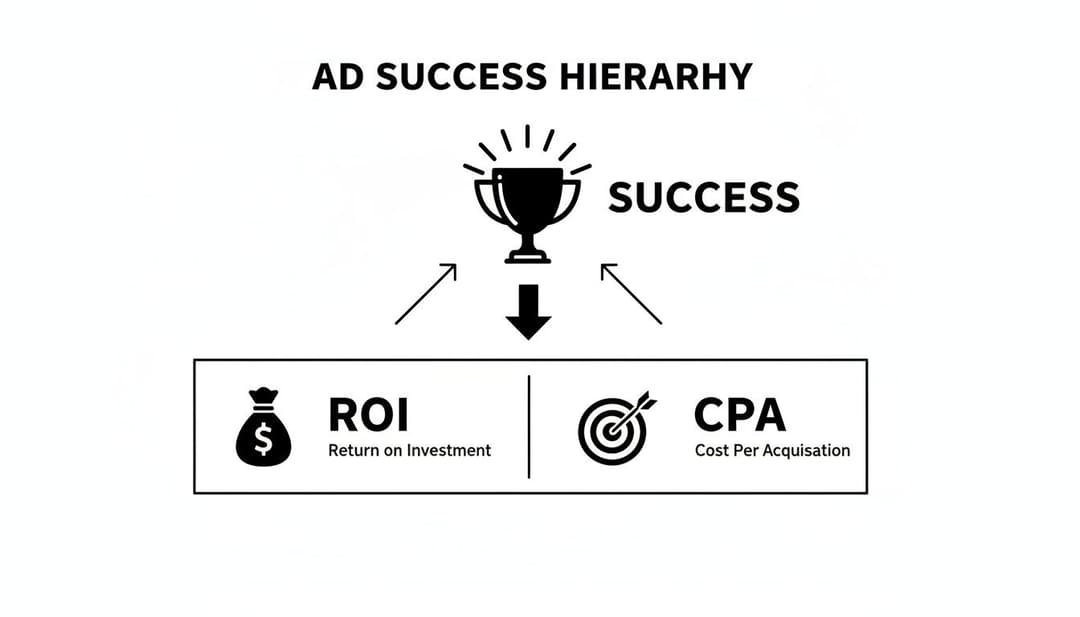
Every part of your funnel, from the first hello to the final sale, has to contribute to these bottom-line numbers. If it doesn't, it's not working.
Top of Funnel (TOFU): The First Handshake
The top of your funnel is all about awareness. Your goal here isn't to sell anything at all; it's to get on the radar of people who have no idea who you are. You're simply making a memorable first impression.
These potential customers are "cold"—they have no history with you. So, your ads need to be genuinely helpful, educational, or entertaining, with zero sales pressure.
Common TOFU Ad Formats:
- Engaging Video Ads: Short, scroll-stopping videos that solve a common problem or tell a quick story.
- Helpful Blog Posts: Promoting valuable content that educates your audience on a topic they already care about.
- Brand Story Ads: Creatives that share your mission or values to build an immediate emotional connection.
Forget sales for a moment. Your key metric here is engagement. You’re hunting for clicks, shares, and video views—anything that signals you’ve piqued someone’s interest.
Middle of Funnel (MOFU): Building Real Trust
Once someone has clicked, watched, or shared your TOFU content, they slide into the middle of the funnel. Now they know your name, but they're a long way from buying. The job of MOFU is to nurture that initial spark, build trust, and subtly position your brand as the answer to their problem.
This is where you ask for a small "yes"—not their credit card, but their email address.
Think of this as offering a free sample at a store. You're giving them something valuable upfront in exchange for a chance to keep the conversation going.
Effective MOFU Strategies Include:
- Lead Magnets: Offer a free e-book, checklist, or webinar that solves a specific pain point in exchange for an email.
- Case Studies & Testimonials: Use social proof to show how others have found success with your product or service.
- In-Depth Guides: Promote content that helps them dig deeper into their problem and understand the solutions available.
Here, your primary KPI shifts to Cost Per Lead (CPL). You’re not just getting attention anymore; you’re building a targeted list of warm prospects you can talk to directly.
Bottom of Funnel (BOFU): Closing the Deal
Finally, we're at the bottom of the funnel. This is where you ask for the sale. This audience is "hot." They've seen your content, they’ve given you their email, and they trust your brand. Now is the time to give them a compelling reason to buy.
This is where the magic of Facebook retargeting ads really shines. You're now serving highly specific ads only to the people who've shown the most interest. This laser-focused approach is precisely why BOFU campaigns almost always deliver the highest Return on Ad Spend (ROAS).
Powerful BOFU Tactics:
- Dynamic Product Ads (DPA): Automatically show people ads for the exact products they just looked at on your website.
- Special Offers or Discounts: Create a little urgency with a limited-time promotion aimed directly at your warm leads.
- Customer Testimonial Ads: Feature a glowing review from a happy customer to erase any last-minute doubts.
At this stage, your goals are crystal clear: drive conversions. Your most important metrics are Cost Per Acquisition (CPA) and ROAS. By structuring your campaigns this way, you create a system that smoothly guides people from total strangers to loyal customers, proving that Facebook ads absolutely do work when you do them right.
Mastering the Two Pillars of Ad Success: Creative and Audience
When you strip away all the jargon, campaign settings, and bidding strategies, the real answer to "do ads on Facebook work?" boils down to two things: showing the right message to the right people. That’s it. That's the whole game.
Your creative is your message—the image, video, and words you use to stop someone mid-scroll. Your audience is, well, who sees that message. If you get either one wrong, you might as well light your ad budget on fire.
Think of it like a stand-up comedian. An incredible joke (your creative) told to the wrong crowd (your audience) will get nothing but crickets. On the flip side, even the most enthusiastic audience won't laugh at a terrible joke. You absolutely need both working in harmony.
The Science of Scroll-Stopping Creative
In the endless river of content that is a social media feed, your ad has maybe three seconds to make someone care. The goal isn't just to be seen; it's to be felt. The ads that win today don't even look like ads. They feel authentic, relatable, and native to the platform.
One of the most powerful ways to do this is with User-Generated Content (UGC). These are the raw, unpolished videos and photos from actual customers, not a slick marketing team. They feel real because they are real, which builds trust almost instantly. Seeing someone who looks and sounds like you get excited about a product hits way harder than any corporate-speak ever could.
Of course, the visuals are only part of the equation. Your ad copy has to be just as sharp. It needs to:
- Hook them fast: Start with a question, a surprising stat, or a bold claim.
- Twist the knife: Pinpoint the exact pain point your audience is dealing with.
- Offer the cure: Show them precisely how your product solves that problem.
- Tell them what's next: Give a crystal-clear Call-to-Action (CTA) like "Shop Now" or "Learn More."
The best ads don’t just sell a product; they tell a story. They tap into an emotion and show, don’t just tell, how the offer makes someone’s life better. This is what separates an ad you scroll past from an ad you click on.
Finding Your Perfect Audience on Facebook
Okay, so you've got a killer ad. Now what? You have to get it in front of the right eyeballs. Facebook’s targeting tools are incredibly powerful, but you have to know which ones to pull from the toolbox. Getting a deep understanding of your customer is the first step, and it's worth exploring the different ways of finding your ideal audience on Facebook.
Facebook gives you a few primary ways to build your audience:
Interest and Behavior Targeting: This is your bread and butter. You can target people based on pages they’ve liked, groups they’ve joined, or online behaviors like being an "Engaged Shopper." It's the perfect place to start when you're looking for new customers.
Lookalike Audiences: This is where the magic really happens. You give Facebook a list of your best customers, and its algorithm goes out and finds millions of other people who share similar traits. It's one of the most reliable ways to find high-quality prospects at scale.
Broad Targeting: It sounds crazy, but sometimes the smartest move is to just trust the machine. With broad targeting, you set basic guardrails like age and location and let Facebook's AI figure out who is most likely to convert. For e-commerce, this can work shockingly well.
For a deeper dive into organizing these groups, check out our guide on powerful audience segmentation strategies that can make your campaigns more effective.
The Winning Formula Is Found in Testing
Here’s the secret that separates the amateurs from the pros: the winners are almost always discovered through relentless testing. You should never, ever assume you know which ad or audience will be the best. The only way to know for sure is to let the data speak.
This isn't about guesswork; it's about running a clean experiment. You create multiple versions of your ads and let them compete. You can test:
- Different Creatives: A UGC video vs. a static image vs. a carousel.
- Different Headlines: A benefit-driven headline vs. one that asks a question.
- Different Audiences: A Lookalike Audience vs. an interest-based group.
To put this into perspective, think about the old way versus the new way of approaching this. The manual "grind" can be a huge time-sink, whereas an AI-powered approach acts as an accelerator.
Creative and Audience Testing Framework
| Testing Variable | Manual Approach (The Grind) | AI-Powered Approach (The Accelerator) |
|---|---|---|
| Ad Copy | Write 3-5 headlines and descriptions by hand, based on intuition and past results. | Generate dozens of copy variations instantly based on top-performing ads, then automatically test them. |
| Visuals | Manually edit a few versions of an image or video to test different hooks or CTAs. | Systematically test hundreds of creative combinations (image + headline + copy) to find the absolute winner. |
| Audiences | Build 2-3 Lookalike or Interest audiences and run separate ad sets for each. | Dynamically allocate budget to the best-performing audience segments in real-time, without manual changes. |
By isolating one variable at a time, you can scientifically prove what works. For instance, you might discover that one specific UGC video shown to a 1% Lookalike Audience of past purchasers delivers a 30% lower Cost Per Acquisition than anything else you've tried.
That data-driven feedback loop is the engine of growth. You find a winner, make it the new champion, and then you try to beat it. This constant cycle of improvement is how you turn good campaigns into great ones—and prove, without a doubt, that Facebook ads absolutely work when you master creative and audience.
Spotting the Pitfalls: Why Most Facebook Ads Really Fail
When I hear someone say, "Facebook ads just don't work," my first thought is almost always the same: it’s not the platform, it’s the strategy. What they're often saying is, "I made a few common mistakes and burned through my budget."
The good news is that these failures aren't random. They leave a trail of clues. Once you learn to spot the most common tripwires, you can build a smarter, more resilient ad strategy that avoids wasted spend and starts delivering consistent results. Think of this as your field guide to troubleshooting your own campaigns.
Mismatched Expectations and Budgets
One of the fastest ways to fail is to start with the wrong mindset. Too many advertisers dip their toes in the water with a $50 budget and expect a tidal wave of profitable sales. When it doesn't happen overnight, they throw their hands up and blame Facebook.
But here’s the reality: your first ad dollars are an investment in data, not just customers. You're essentially paying to learn what your audience actually responds to. To do that, you need to give Facebook's algorithm enough runway to exit its "learning phase"—a process that typically needs about 50 conversions per ad set, per week to find its groove.
The Big Idea: Your initial budget isn't just for sales; it's tuition for learning what works. Expecting huge returns from a tiny budget is like trying to win a marathon after jogging once. Plan for a dedicated testing phase.
If your budget is too small, the algorithm starves for data. It never gets enough feedback to find the right people, and your campaign sputters out before it ever really gets started.
Weak or Irrelevant Ad Creative
Your ad creative has one job: stop the scroll. If it’s generic, boring, or looks out of place, it’s invisible. One of the most common mistakes is using slick, corporate-style stock photos that scream "I'M AN AD!" from a mile away.
The ads that win are the ones that feel native to the feed. They’re authentic, they offer real value, and they speak directly to a specific problem or desire. For instance, instead of a sterile ad that says "Buy Our Course," a better approach is to share a raw, compelling story about a real customer's transformation. This builds an emotional connection and trust before you ever ask for the click.
Another creative-killer is ad fatigue. This is what happens when the same people see your ad over and over again. Your performance will always, always tank as your frequency score climbs.
How to Spot and Fix Ad Fatigue:
- Keep an Eye on Frequency: Once this metric in Ads Manager creeps above 3-4, you're in the danger zone.
- Watch for Performance Dips: Look for a slow but steady decline in your Click-Through Rate (CTR) coupled with a rising Cost Per Acquisition (CPA).
- Have a Refresh Strategy: You should have new creatives ready to swap in every 2-4 weeks. Constantly test new angles, formats (video vs. image), and copy hooks to keep things fresh.
A Broken Post-Click Experience
You can have the most brilliant ad in the world, but if it sends people to a slow, confusing, or untrustworthy landing page, you’ve just paid for an abandoned click. The journey after the click is every bit as important as the ad itself.
The message on your landing page has to perfectly match the promise in your ad. If your ad screams about a 50% discount, that offer better be the very first thing people see when the page loads. Any disconnect creates friction and sends potential customers running for the "back" button.
Make sure your landing page is:
- Built for Mobile: The overwhelming majority of Facebook traffic is on a phone. Your page needs to load in a snap and be dead simple to use on a small screen.
- Crystal Clear: A visitor should know exactly what you're offering and what to do next within three seconds. No confusion, no clutter.
- Trustworthy: Pack it with social proof. Customer reviews, testimonials, and security badges go a long way in building the confidence someone needs to take action.
A Botched Meta Pixel Setup
The Meta Pixel is the central nervous system of your entire advertising operation. It’s a snippet of code on your website that tracks what people do, builds powerful retargeting audiences, and—most importantly—feeds conversion data back to Facebook so the algorithm can get smarter.
If your Pixel is broken or misconfigured, you're flying completely blind. You won't know which ads are actually driving sales, your retargeting audiences will be thin and ineffective, and Facebook’s AI will have no idea how to find more people like your best customers.
Always, always use the Events Manager tool to double-check that your key events—like ViewContent, AddToCart, and Purchase—are firing correctly. A broken Pixel is one of the most common, and most costly, technical mistakes you can make.
Your Blueprint for Launching and Scaling Campaigns
So, do ads on Facebook work? The answer is a resounding yes—but only if you have a clear, deliberate plan. Success isn't about getting lucky; it's about building a repeatable system for testing, learning, and scaling. Here's a blueprint to get you started.
Following this process is what turns advertising from a gamble into a calculated investment. You’ll finally stop guessing what works and start building a predictable engine for growth.
The Launch and Learn Phase
Your first priority isn't immediate profit. It's data acquisition. Think of it this way: you are paying to learn what your audience actually responds to. Start with a modest but sufficient test budget—enough to get at least 50 conversions per ad set so you can push past Facebook's tricky learning phase.
During this initial phase, your entire focus is on spotting the early winners.
- Define Your KPIs: Before you spend a single dollar, know your numbers. What is your target Cost Per Acquisition (CPA) or Return on Ad Spend (ROAS)? This is your north star.
- Test Broadly: Launch several ad sets to test different audiences (like Lookalikes vs. interest groups) and creative styles (UGC video vs. a sharp static image). Don't put all your eggs in one basket.
- Analyze Early Data: After a few days, take a look at the performance. Don't make knee-jerk changes, but keep an eye out for clear outliers. Which ad creative has the highest click-through rate? Which audience is bringing in the lowest cost per lead?
Your initial campaigns are experiments. The goal is to find a single high-performing combination of creative and audience. This will become the foundation for your growth.
The Scaling and Optimization Loop
Once you've identified a winning ad or audience, it's time to scale up. But this doesn't mean just cranking the budget dial to the max. Smart scaling is a methodical process designed to keep your campaigns profitable as you increase spend. The key is creating a data-driven feedback loop.
This cycle of identifying winners, investing more, and re-testing is the absolute core of a successful advertising strategy. For a deeper dive into mastering this critical phase, our guide on how to scale Facebook ads offers a more detailed, step-by-step approach.
The process looks something like this:
- Isolate the Winner: Take your top-performing ad creative and audience combination and move it into its own, brand-new campaign built specifically for scaling.
- Increase Budget Gradually: Nudge the budget up by no more than 20-30% every few days. Any sudden, massive increase can shock the algorithm and reset the learning phase you worked so hard to exit.
- Continue Testing: Use your original testing campaign to find the next winner. You should always be on the hunt for a new ad or audience that can outperform your current champion.
This blueprint ensures you're always putting your money behind what's proven to work, while simultaneously discovering new opportunities for growth. It’s how you make Facebook ads a reliable—and profitable—part of your business.
Got Questions? We've Got Answers
If you're still on the fence about whether Facebook ads are the right move for your business, you're not alone. Let's tackle some of the most common questions we hear from advertisers every day.
How Much Do Facebook Ads Actually Cost?
This is the million-dollar question, isn't it? The honest answer is: it varies. A lot. The cost depends entirely on your industry, who you're trying to reach, and how compelling your ads are.
You can technically get started with a budget as small as $5 a day, but think of that initial spend as buying data, not sales. The goal is to learn. On average, you might see a cost per click (CPC) around $1.35, but don't get hung up on that number—it can swing wildly in either direction. Most smart businesses set aside a dedicated testing budget to figure out what works before they even think about pouring serious money in.
Are Facebook Ads Still a Good Bet Today?
Absolutely, but the game has changed. The days of throwing up a simple ad and watching the sales roll in are long gone. Success today demands a more thoughtful, full-funnel strategy.
It's all about creating compelling ads that feel like they belong in a user's feed, not like a jarring interruption. And you have to be committed to testing. The real question isn't if Facebook ads work anymore, but rather how you can make them work for you with smart targeting, great creative, and solid measurement.
The advertisers who win on Facebook don't treat it like a billboard; they treat it like a conversation. They are relentless about testing to find the right message for the right person at just the right moment.
How Long Until I See Results?
You'll start seeing something—clicks, likes, comments—within the first 24-48 hours. But those are just vanity metrics. The real results, the conversion data you can actually make decisions with, take a bit more time.
Plan on at least a week or two of consistent testing to get a clear picture. Keep in mind that Facebook's algorithm needs time to work its magic. It typically requires around 50 conversion events in an ad set before it exits the "learning phase" and really starts to optimize effectively.
Patience is your biggest asset here. One of the most common mistakes is getting jumpy and making big changes too soon. Give the system time to learn before you pull the plug.
Ready to stop guessing and start scaling? AdStellar AI automates the tedious work of launching, testing, and optimizing your Meta ad campaigns. Generate hundreds of ad variations in minutes and let our AI identify the winning combinations that drive real results. Cut down on manual effort and discover what truly works 10x faster. Learn more and book your demo at AdStellar.ai.