Let's cut right to the chase: Yes, Facebook advertising absolutely works. When it's done right, it remains one of the most potent digital marketing channels out there, driving serious returns for everyone from tiny local shops to massive global brands.
The real question isn't whether the platform is effective—it's about how you wield its powerful, and sometimes complex, tools to your advantage.
The Short Answer Is Yes—and the Data Proves It
For anyone still wondering if Facebook (now Meta) ads can deliver the goods, the numbers tell a clear and compelling story. The platform has evolved far beyond just a place for social updates; it’s a finely tuned engine for acquiring customers and generating real revenue.
Success here isn't a matter of opinion or hoping for the best. It's built on measurable, data-backed performance that consistently proves its worth. This isn't about some vague, fuzzy potential; it's about hard, tangible results. The best way to see this is by looking at the core advertising benchmarks that actually matter to a business's bottom line.
Key Performance Benchmarks
The most direct way to answer the "does it work?" question is to look at the average performance across thousands and thousands of campaigns. The data paints a picture of a platform that reliably turns ad spend into meaningful customer actions.
For example, the proof is in the pudding with the platform's robust average conversion rates. In 2025, the average Facebook ad conversion rate was a solid 8.95%. Think about that for a second: nearly 9 out of every 100 people who clicked an ad went on to take the desired action, whether that was making a purchase, filling out a form, or signing up.
That figure has held steady around a historical benchmark of 9.21%, showing remarkable consistency even as the platform navigates privacy updates and algorithm tweaks.
For performance marketers and e-commerce brands, this translates directly into revenue. Some of the top-performing industries, like fitness, saw conversion rates soar as high as 14.29%. This proves that with the right creative and the right audience, Facebook can still knock it out of the park. You can dig deeper into how these performance metrics have evolved.
This graphic really helps visualize just how powerful those conversion stats are.
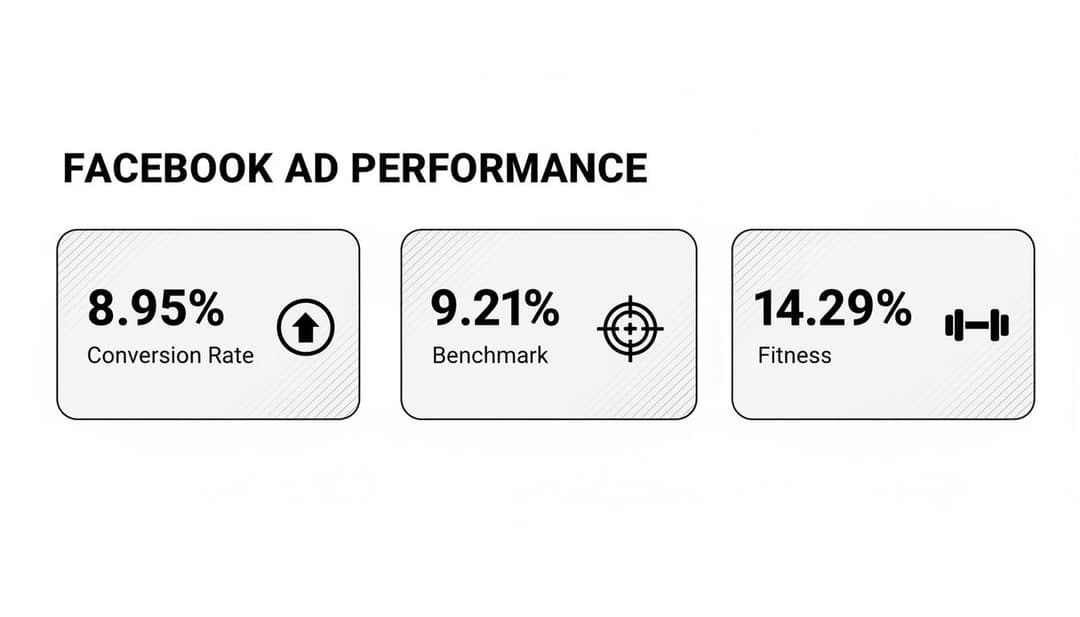
As you can see, when the average conversion rate is close to 9% and specialized niches like fitness are hitting over 14%, the data speaks for itself. Well-built campaigns get real results.
To make this even clearer, here’s a quick summary of the key performance indicators that show Facebook ads are still a force to be reckoned with.
Facebook Ads Performance At a Glance
This table breaks down the core metrics that prove the effectiveness of Meta advertising. These aren't vanity numbers; they represent real business impact.
| Metric | Benchmark Statistic | What This Means for You |
|---|---|---|
| Average Conversion Rate | 8.95% across all industries | Nearly 1 in 10 clicks leads to a desired action (purchase, lead, etc.). This is a strong baseline to measure your own campaigns against. |
| Top Industry Conversion Rate (Fitness) | 14.29% | Shows the platform's massive potential. With the right strategy, you can achieve exceptional results far above the average. |
| Historical Benchmark Rate | ~9.21% | Demonstrates consistent, reliable performance over time, even with platform changes. It's not a fleeting trend; it's a stable channel. |
These figures aren't just abstract percentages; they represent tangible business outcomes that prove the platform's ongoing value. They establish a clear baseline for what success can look like and confirm that, yes, Facebook ads continue to be an effective channel for growth.
How to Measure What Really Matters on Meta
 Answering "does Facebook advertising work?" with a simple 'yes' is just scratching the surface. Real success comes from knowing exactly how and why it works for your business. To get there, you have to look past the surface-level numbers and zero in on the metrics that tie your ad spend directly to revenue.
It's easy to get distracted by likes, comments, and shares. While these "vanity metrics" can tell you if your creative is hitting the mark, they don't pay the bills. Profitable campaigns are built on tangible business outcomes, not just social buzz.
This means shifting your focus to a handful of core Key Performance Indicators (KPIs). These are the numbers that tell the true story of your advertising's financial health, empowering you to make smarter, data-driven decisions with your budget.
Your Primary Profitability Metric: ROAS
For most advertisers, the single most important metric is Return on Ad Spend (ROAS). Think of it as the ultimate litmus test for profitability. It answers one simple, vital question: "For every dollar I put into this ad campaign, how many dollars did I get back in revenue?"
The math is simple: Total Revenue from Ads / Total Ad Spend.
If you spend $1,000 on a campaign and it brings in $4,000 in sales, your ROAS is 4x (or 400%). This one number tells you whether your advertising is a profitable engine or a money pit.
A median ROAS of 2.19x was a common benchmark in early 2025, meaning businesses typically generated $2.19 for every dollar spent. However, top-performing retargeting campaigns often soared to around 3.61x, showcasing the power of advertising to warm audiences.
Understanding Your Acquisition Costs
While ROAS is about the direct return, you also need to know how much it costs to actually get a new customer or lead. This is where Cost Per Acquisition (CPA) and Cost Per Lead (CPL) come into play.
Cost Per Acquisition (CPA): This is your average cost to win a single paying customer. You calculate it by dividing your total ad spend by the number of new customers. A low CPA is a sign of an efficient, well-oiled campaign.
Cost Per Lead (CPL): If you don't sell directly online (think SaaS or service-based businesses), CPL measures the cost to generate one qualified lead, like a form fill or a demo request.
These metrics help you set realistic budgets and see how efficient your funnel is. If your CPA is higher than the profit you make from that first sale, you've got a problem that needs fixing, fast. Efficiently tracking these costs is crucial, and understanding tools like the Meta Conversions API can improve data accuracy significantly.
The Long-Term View with LTV
Finally, the most sophisticated advertisers look way beyond the first purchase. Customer Lifetime Value (LTV) is the total profit a business expects to earn from a single customer over their entire relationship with the brand.
Why is this so important for Facebook ads? Because it completely reframes your CPA. An e-commerce store might have a CPA of $50 for a customer who only spends $40 on their first order. On paper, that looks like a loss.
But what if that same customer comes back to make five more purchases over the next year, bringing their total LTV to $250? Suddenly, that initial $50 acquisition cost looks like an incredibly smart investment. Understanding LTV gives you the confidence to spend more upfront to acquire high-value customers who will drive your growth for years to come.
Why Some Facebook Ad Campaigns Fail and How to Fix Them
Even with all its power, not every Facebook ad campaign strikes gold. Lots of businesses pour money into the platform only to get shrug-worthy results, feeding that frustrating belief that "it just doesn't work for me."
But here's the truth: when campaigns tank, it’s rarely Meta's fault. It’s almost always a breakdown in strategy.
Understanding why some campaigns take off while others nosedive is the key to turning your ad spend into an actual investment. Think of it like a car engine; all the parts need to work together. A powerful engine is useless if the tires are flat or you're pointed in the wrong direction.
The most common reasons for failure aren't some deep, complex algorithm secrets. They're usually fundamental mistakes. Let's break down the three biggest culprits and, more importantly, how to fix them.
Mismatched Audience Targeting
The number one reason campaigns fail is a simple mismatch between the ad and the audience. You could have the most beautifully designed, persuasive ad in the world, but if you show it to people who have zero interest in your product, you're just lighting money on fire.
Imagine trying to sell premium steak dinners to people leaving a vegan festival. No matter how good the steak is, the audience is just plain wrong. This happens on Facebook every single day.
How to Fix It:
- Go Beyond Demographics: Don't just target by age and location. Dig into Meta's detailed targeting options. Get inside your ideal customer's head—what are their interests, behaviors, and what pages do they follow?
- Leverage Custom Audiences: Your warmest audiences are people who already know you. Upload your customer lists, target website visitors, or create audiences of people who’ve engaged with your Facebook or Instagram page. These are your low-hanging fruit.
- Build Lookalike Audiences: Once you have a high-quality Custom Audience (like your best customers), ask Meta to find new people who look just like them. This is one of the most powerful tools in the entire platform for scaling up.
The Problem of Ad Fatigue
Ever see the same TV commercial so many times you just tune it out? That's ad fatigue, and it’s a silent campaign killer on social media. When users see the same creative over and over, they develop "ad blindness." Your click-through rates plummet and your costs skyrocket.
The Meta algorithm loves novelty. Stale, repetitive creative tells the system your campaign is no longer fresh, and it'll slowly stop showing your ads.
One of the most common issues we see is advertisers finding one ad that works and running it into the ground. A successful campaign requires a constant stream of fresh creative to keep the audience engaged and the algorithm happy.
A perfect example comes from a marketer who saw their cost-per-conversion jump to a painful $86 after an algorithm update. Instead of panicking and pausing everything, they just introduced eight new creative assets. By letting Meta’s algorithm do its thing across these new options, their cost-per-conversion dropped to $13.87 in less than 24 hours. You can read more about how creative refreshes impact performance.
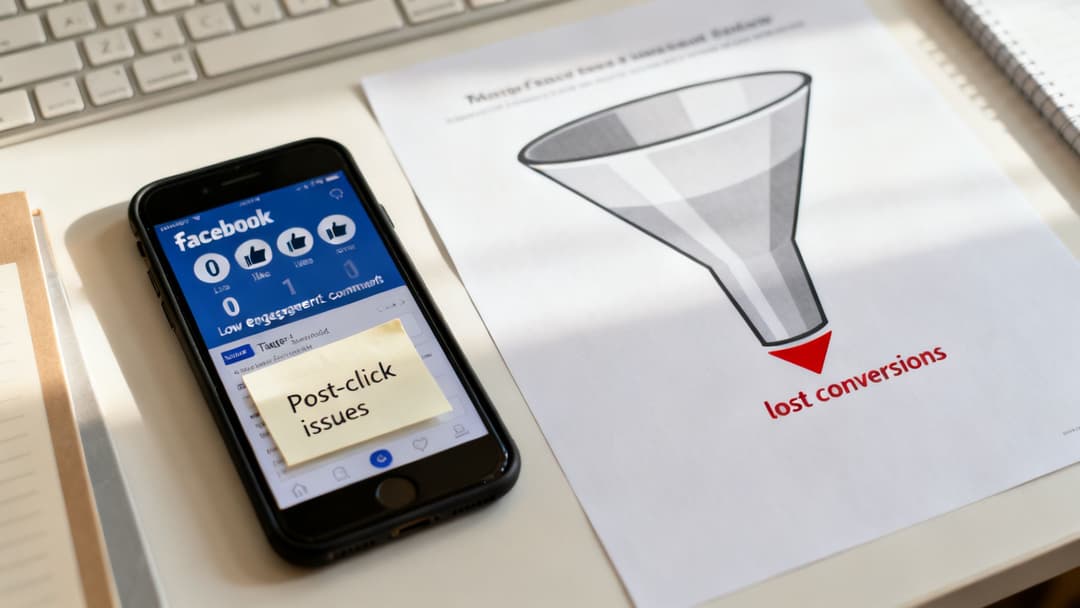
A Broken Post-Click Experience
Your ad's only job is to earn the click. But what happens after that click is just as important. I’ve seen countless fantastic ad campaigns fail because they lead to a slow, confusing, or untrustworthy landing page.
It's like a store having a brilliant window display that leads into a messy, disorganized shop—customers will just turn around and walk right back out.
Common issues include:
- Slow Page Load Speed: If your page takes more than a few seconds to load, especially on mobile, people are gone. They'll bounce before they even see your offer.
- Message Mismatch: The promise you make in your ad has to match the experience on your landing page. If your ad promotes a 50% discount, that discount better be the first thing people see on the page.
- Poor Mobile Optimization: The vast majority of Facebook users are on their phones. If your landing page isn't easy to navigate on a small screen, you are absolutely killing your conversion potential.
If you're seeing a high click-through rate but your conversions are low, the problem likely isn't your ad—it's your destination. For a deeper dive into troubleshooting, check out our guide on what to do when your Facebook ads are not delivering.
Combining Creative and Audience for Unbeatable Results
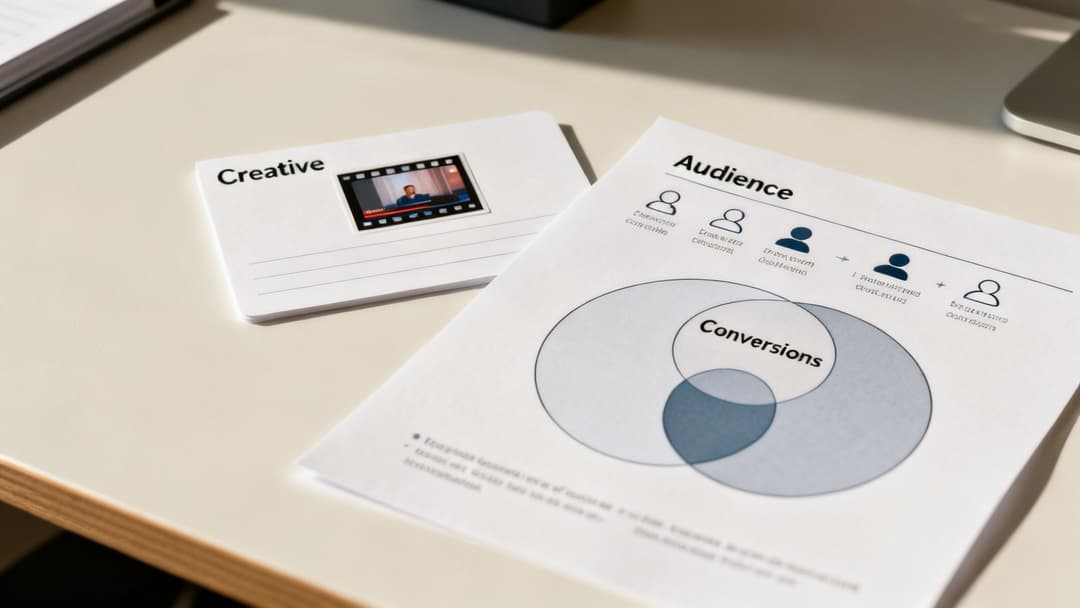
To really win on Facebook, you have to master the perfect match. Think of it like a lock and key: your ad creative is the key, and your audience is the lock.
It doesn’t matter how brilliantly designed your key is if it’s for the wrong lock. And the most receptive lock in the world is useless without the key that fits. This synergy is the engine behind every single high-performing Meta campaign.
A visually stunning ad will get ignored if it’s shown to people who couldn’t care less. On the flip side, the most perfect, ready-to-buy audience won't click if your ad is boring, confusing, or just plain untrustworthy. Success isn’t about picking one over the other; it’s about making them click together.
The Art of Precision Audience Targeting
Meta’s platform gives you an incredible toolkit for pinpointing the exact people who need what you're selling. Getting this right is the first half of the battle. Instead of spraying your message everywhere and hoping for the best, you can focus your budget with surgical precision.
This is where things get interesting. Meta offers three main audience types, and each serves a very different purpose.
Comparing Audience Targeting Options on Meta
Understanding which audience type to use—and when—is fundamental to building a scalable ad account. This table breaks down the three primary options to help you choose the right strategy for your campaign goals.
| Audience Type | Best For | Example Use Case |
|---|---|---|
| Saved Audiences | Reaching brand new people based on their interests, demographics, and behaviors. | A new vegan snack brand targeting users aged 25-45 who are interested in "plant-based diets" and "sustainable living." |
| Custom Audiences | Re-engaging warm leads who have already interacted with your business. | An e-commerce store retargeting people who visited their website in the past 30 days but didn't make a purchase. |
| Lookalike Audiences | Finding new, high-potential customers who share traits with your best existing customers. | A SaaS company creating a 1% Lookalike Audience based on a list of their highest-paying enterprise clients to find similar businesses. |
Mastering these audience types is non-negotiable. Your best bet is to build a funnel: start by retargeting warm Custom Audiences for quick wins, then use Lookalike Audiences to scale up with new, high-intent prospects. Finally, you can test broader Saved Audiences to explore new market segments.
Matching Creative to Your Campaign Goal
Once you know who you're talking to, you have to nail what you show them. The ad format you choose needs to be a direct match for your campaign objective. A video designed for brand awareness will flop if you're trying to drive direct sales, and a hard-sell image ad won’t build much brand affinity.
Even your placement choice can have a massive impact. Global data shows that Instagram Stories deliver 61% higher CTRs than the Facebook Feed. On top of that, mobile is king, with a 1.34% CTR versus desktop's 1.01%—that's a 33% advantage. If you're hunting for efficient clicks, testing placements is a must. You can dig into more of these Facebook ad performance benchmarks to get a better feel for the landscape.
Here are a few of the most popular formats and where they shine:
- Video Ads: These are unbeatable for telling a story and grabbing attention in a noisy feed. Use them to show a product in action, share powerful customer testimonials, or break down a complex service.
- Carousel Ads: Perfect for showing off multiple products or features in a single, interactive unit. E-commerce brands love these for creating mini-catalogs, and SaaS companies use them to walk through different benefits.
- Image Ads: The classic scroll-stopper. A single, powerful image can deliver a clear, punchy message in an instant. They're fantastic for driving traffic and promoting straightforward offers.
- Collection Ads: This is a mobile-first format that essentially creates an instant storefront inside the Facebook app. When someone taps the ad, a full-screen landing page opens, letting them browse and buy with almost zero friction.
Your creative is so much more than a pretty picture; it's the opening line of your conversation with a potential customer. For a deeper dive, check out our guide on the role of creatives in digital marketing. The real secret is to relentlessly test different formats against each of your audience segments until you find what truly connects.
How AI-Powered Testing Can Accelerate Your Wins
Trying to manually test dozens of ad variations is like trying to solve a massive, ever-changing puzzle with only a few pieces at a time. It’s slow, clunky, and simply can’t keep up with Meta’s algorithm. For most advertisers, this means missed opportunities and wasted ad spend.
This is exactly where AI gives you an unfair advantage. Modern automation tools completely change the game. Instead of drowning in tedious campaign setup, you can focus on strategy and making smart decisions, backed by the speed and scale needed to find what actually works.
From Manual Guesswork to Automated Discovery
Think about the old way of testing ads. You’d painstakingly build a few variations—maybe three headlines, two images, and a couple of audiences. Then you launch, wait for data to trickle in, and try to piece together what it all means. It's a linear, labor-intensive process that can burn through weeks and budget before you get any real answers.
Now, let's flip that script. With an AI-driven platform, you can generate and test hundreds of creative and audience combinations in the time it takes to build a handful by hand. This isn't just a small improvement; it's a fundamental change in how you manage your campaigns.
These systems analyze performance data in real-time, automatically spotting the winning patterns and shifting your budget to the best-performing ads. That means you can scale your campaigns with genuine confidence.
The real magic of AI in advertising isn't just speed—it's intelligence at scale. It automates the grunt work of testing and analysis, freeing you up to focus on what matters: strategy, messaging, and truly understanding your customer.
This approach directly tackles two of the biggest headaches in paid social: creative fatigue and audience discovery. And it does it at a speed no human ever could, systematically finding the specific ad combinations that will work for your business.
How AI Unlocks Faster Campaign Wins
The moment you integrate AI into your workflow, the impact is immediate. Your campaign lifecycle transforms from a series of educated guesses into a data-driven machine of continuous improvement.
For example, platforms like AdStellar AI can generate countless ad variations by mixing and matching headlines, body copy, images, and videos. This makes comprehensive testing possible—something that would be a logistical nightmare to manage manually. You can explore a deep dive into how AI for Facebook Ads is changing the industry in our guide.
This automated loop of creation, testing, analysis, and optimization is how you accelerate wins. It collapses a process that used to take weeks of manual effort into just a few days.
Here’s a practical breakdown of how that happens:
- Bulk Ad Generation: Forget building ads one by one in Ads Manager. AI tools let you upload your assets and copy elements to generate hundreds of unique combinations in minutes. This alone slashes your initial setup time.
- Automated A/B Testing: The platform can automatically structure campaigns to test specific variables, like different creative angles against various Lookalike Audiences. You get clean, statistically significant tests without the manual oversight.
- Real-Time Performance Analysis: As the campaign runs, the AI is constantly watching key metrics like ROAS, CPA, and CTR. It doesn't just show you the numbers; it pinpoints which specific creative elements or audience segments are driving the best results.
- Intelligent Budget Allocation: Based on that real-time analysis, the system automatically shifts budget away from underperforming ads and funnels it toward the emerging winners. This ensures your ad spend is always working as hard as possible, maximizing your return without you having to constantly check in.
Ultimately, this lets you find profitable campaign structures and scale them faster than ever before. It's the definitive answer to making Facebook advertising work consistently and profitably.
Your Action Plan to Launch a Winning Test Campaign
Alright, enough theory. It’s time to get your hands dirty. The only way to truly answer "does Facebook advertising work?" for your business is to run a smart, controlled test and see what the data tells you.
This isn’t about throwing thousands of dollars at the wall to see what sticks. The goal here is to build a simple, cost-effective framework to test your core assumptions. This test will give you the hard numbers you need to decide whether—and how—to scale your ad spend. Let's walk through it, step-by-step.
Step 1: Define a Sharp Objective and Budget
First things first: what are you actually trying to accomplish? Don't settle for a vague goal like "get more sales." Get specific. Are you aiming to generate qualified leads for a service business? Drive direct purchases for an e-commerce product? Get sign-ups for an upcoming webinar? Your objective is the north star for every decision you make from here on out.
Next, lock in a manageable budget. You don’t need a massive investment to get clear data. For most businesses, a starting budget of $25 to $50 per day is plenty to push Meta's algorithm past its initial "learning phase." Think of this not as an expense, but as an investment in market intelligence.
Step 2: Create Distinct Test Variables
A good test isolates variables. It's the only way to know what's actually moving the needle. A classic rookie mistake is testing too many things at once, which just muddies the results. For this first campaign, we'll focus on the two elements that have the biggest impact: audience and creative.
Here’s a simple structure to get you started:
- Audience A (Warm): Build a Custom Audience of your website visitors from the last 30-60 days. These people have already shown interest in your brand, making them your lowest-hanging fruit.
- Audience B (Cold): Create a 1% Lookalike Audience from your best customers (like a list of recent buyers). This tells Meta to find new people who share characteristics with your proven converters.
- Creative Variations: Come up with 2-3 distinct creative angles. Don’t just change the button color. Test different messages. For instance, one ad could be a customer testimonial video, another a static image highlighting product benefits, and a third could push a limited-time discount.
This setup lets you clearly see which audience responds best and which creative message hits home, giving you a solid foundation for your next move. For a deeper dive into this kind of structured experiment, you can learn more about what A/B testing in marketing involves.
Step 3: Launch and Let It Learn
Once you hit "Publish," step back. Resist the temptation to tinker with the campaign for at least 3-5 days. The algorithm needs uninterrupted time to gather data and figure out who to show your ads to for the best results. Every time you make a change, you reset that learning process.
Be patient. The learning phase is where Meta's system figures out who is most likely to respond to your ads. Interrupting it is like pulling a cake out of the oven every five minutes—it will never bake properly.
For DTC marketers especially, this disciplined approach is how you scale efficiently. Remember, you're tapping into a massive pool of potential customers. Facebook can reach 2.28 billion ad-eligible users, which is 74.3% of its monthly active user base. The key to unlocking that potential is starting with small, intelligent tests.
After about a week, you'll have real-world data on your CPA and ROAS. And with that, you’ll finally have your answer to whether Facebook ads can deliver for your business.
Your Top Facebook Advertising Questions, Answered
Even with all the data pointing to "yes," it's smart to have some practical questions before you start spending money. Let's tackle the most common ones that come up when marketers are on the fence about Facebook ads.
What’s a Good Starting Budget?
You don't need a massive war chest to get started. For most businesses, a test budget of $25 to $50 per day is plenty to get a campaign out of Meta's initial learning phase.
Think of this less as an ad expense and more as an investment in data. The goal isn't to strike gold on day one; it's to spend just enough to see which audiences and creatives are getting a response. That's the intel that tells you where to pour the real money.
How Long Until I See Results?
This is where patience becomes your superpower. You need to let a new campaign run for at least 3-5 days without touching it. Seriously, hands off. This gives the algorithm enough time to do its job, optimize, and figure out who actually wants to see your ads.
You’ll see clicks and impressions roll in within the first 24 hours, but that's just noise. You need a few solid days of data to make smart calls about what's a winner and what's a dud.
Does Facebook Advertising Actually Work for B2B?
Absolutely, but you have to play the game differently. While a B2C company might go straight for the sale, B2B campaigns on Facebook are all about generating high-quality leads.
The winning strategy here involves offering something genuinely valuable in exchange for contact info—think whitepapers, in-depth case studies, or sign-ups for an exclusive webinar. It’s about starting a conversation, not closing a deal on the first click.
What’s a Good Return on Ad Spend (ROAS)?
Profitability is going to look different depending on your industry and margins, but the benchmarks show just how effective the platform can be. When we look at return on ad spend (ROAS), the data shows the median ROAS in April 2025 was 2.19x. That means for every dollar spent, businesses got $2.19 back.
Looking at the bigger picture, broader 2024 averages hit 2.98x, and retargeting campaigns—where you're advertising to a warm audience—soared to around 3.61x. You can explore more Facebook ad benchmarks to see how these numbers stack up across different campaign types.
Ready to stop guessing and start scaling? AdStellar AI automates ad creation and testing, helping you find winning campaigns 10x faster. Launch, test, and scale your Meta ads with confidence.