Spending more on ads isn't the answer to lowering your customer acquisition cost. The real key is shifting from broad, hopeful spending to a smarter, data-driven system.
It all comes down to a commitment to precise measurement, relentless creative testing, and intelligent audience segmentation. Forget just boosting ad budgets; this is about making every single dollar work as hard as it possibly can.
Why Your Customer Acquisition Costs Keep Rising

If you've watched your Customer Acquisition Cost (CAC) creep up month after month, you're definitely not alone. The old playbook of just pouring more money into platforms like Meta and Google doesn't guarantee growth anymore. Today's battlefield is just too crowded for that to work.
We're in an era of market saturation. Consumers are absolutely bombarded with ads, which has led to widespread creative fatigue. An ad that crushed it last month can become completely invisible today. This constant demand for fresh creative puts a ton of pressure on marketing teams to keep up.
The Real Reasons Your CAC Is Soaring
More often than not, a few key culprits are behind those rising costs. Getting a handle on them is the first step toward building a more stable and profitable acquisition machine.
- Sky-High Competition: More brands than ever are bidding for the same limited ad space. It's a simple case of supply and demand, and it's driving auction prices through the roof.
- Creative Fatigue: People tune out what they’ve seen before. If you aren't feeding the algorithm a steady stream of new, engaging creative, your performance will inevitably tank.
- Inefficient Targeting: Casting a wide net feels safe, but you end up wasting a huge chunk of your budget on people who will never buy. It’s like fishing with a net full of holes.
- A Leaky Funnel: You might be paying a premium for clicks, but if your landing page is confusing or the checkout process is clunky, you're just throwing money away. You’re losing potential customers right at the finish line.
This isn't just a hunch; the data tells the same story. Since 2013, customer acquisition costs in ecommerce have exploded by a staggering 222%. Recent Shopify data even shows many brands are paying between $68 and $78 globally for a new customer.
Key Takeaway: Taming your CAC isn't about spending less—it's about spending smarter. You need to move from guesswork to a data-backed system that continuously finds what works and then scales it intelligently.
This guide is your playbook for getting back in control. We’ll walk through how to build a rock-solid measurement foundation, run high-velocity creative tests, and use automation to find your most profitable path to new customers. We'll also dive into the various costs of advertising online and how they all fit into the bigger picture.
Lay a Rock-Solid Foundation with Measurement and Attribution
You can't fix what you can't measure. It's a simple truth, but it’s the absolute bedrock of any smart strategy to lower your customer acquisition costs. If you're only looking at the metrics inside your ad platforms, you're flying blind. It's like trying to navigate a ship with just one instrument—you’re missing most of the picture.
Think about this all-too-common scenario: Meta’s dashboard is showing an ad set with a fantastic Cost Per Acquisition (CPA). Looks like a winner, right? You start pouring more budget into it, confident you've struck gold. But a month later, your finance team drops a bomb: overall profitability is down.
What happened? That "winning" ad set was attracting low-value, one-time buyers who never came back. Your true CAC for valuable customers actually skyrocketed. This happens all the time because ad platforms are built to take credit for conversions, which can seriously skew your perception of what's actually working.
To get a real handle on your spending, you need a measurement foundation that ties ad spend directly to real business outcomes and your own backend data.
Look Beyond In-Platform Metrics
First things first: you have to move past the isolated data from each ad platform and calculate your blended CAC. This is your north star metric. It gives you a holistic view by dividing your total marketing and sales expenses by the number of new customers you acquired across all channels in a given period.
It’s a simple but incredibly powerful calculation that cuts straight through the noise. Blended CAC forces you to account for every dollar—from ad budgets to marketing team salaries—and measures it against actual customer growth. This unified view is essential for making smart, high-level decisions about where your money is truly working.
Choose the Right Attribution Model
Attribution is just a fancy word for how you give credit for a sale to the different touchpoints a customer interacts with. Getting this right is critical. It directly influences which channels and campaigns you decide to fund and which you cut.
There are several models, and each tells a slightly different story:
- Last-Touch Attribution: This one is simple. It gives 100% of the credit to the very last thing a customer clicked before converting. The problem? It massively overvalues bottom-of-funnel channels like branded search and completely ignores the top-of-funnel ads that introduced the customer to your brand in the first place.
- First-Touch Attribution: The exact opposite. All credit goes to the very first interaction a customer had. It’s great for understanding which channels are driving initial awareness, but it tells you nothing about what convinced them to finally buy.
- Multi-Touch Attribution: These models (like linear, time-decay, or U-shaped) are where the magic happens. They distribute credit across multiple touchpoints, acknowledging that it usually takes several interactions to make a sale. A linear model, for example, gives equal credit to every single touchpoint.
For most businesses, a multi-touch model gives you the most balanced and realistic perspective. It helps you appreciate the full-funnel impact of your campaigns, so you don't accidentally kill a top-of-funnel campaign that's quietly feeding your entire pipeline.
Connect Ad Spend to Your Backend Data
The ultimate goal here is to connect your ad platform data directly with your backend systems, like your CRM or e-commerce platform (e.g., Shopify). This is how you unlock the next level of insight.
This connection lets you see not just which ads drove a purchase, but which ads drove purchases from your best customers—the ones with high lifetime value.
This is where server-side tracking becomes your best friend. By sending conversion data directly from your server to the ad platforms, you build a much more reliable and accurate picture of performance, bypassing many of the issues with browser-based tracking. For a deeper dive into the technical side, you can learn more about how to properly implement the Meta Conversions API in our detailed guide.
With this solid foundation in place, you can finally stop making decisions based on flimsy vanity metrics. Every choice you make—from budget allocation to creative direction—is now informed by data that reflects true business impact. You can confidently scale the campaigns that attract profitable, long-term customers and cut the ones that only look good on a platform dashboard.
Build a High-Velocity Creative Testing Engine
Once your measurement is dialed in, it’s time to shift focus to the single biggest lever you can pull to lower your acquisition costs: your creative.
Creative fatigue is the silent killer of campaign ROI. We’ve all seen it happen. An ad that was crushing it last month suddenly falls off a cliff as your audience gets overexposed. It’s not a matter of if it will happen, but when.

The only real defense is to build a systematic, high-velocity creative testing engine. This isn’t about running a lazy A/B test every few weeks. It’s about creating a workflow that lets you test hundreds of creative variations at scale, constantly feeding the ad platforms fresh content to find new winners and learn faster.
Without a solid testing system, you're just gambling with your ad spend, crossing your fingers that one or two ideas will stick. That reactive approach is a one-way ticket to rising CAC. A proactive testing engine, on the other hand, turns creative development from a guessing game into a science.
Laying the Groundwork: Your Testing Framework
A disciplined framework is what separates meaningful tests from just throwing spaghetti at the wall. You have to isolate variables and test them methodically to get clean, actionable results.
Your framework should be built to test key creative components on their own before you start mixing and matching. This is the only way to get a clear read on what’s actually driving performance.
- Start with a Hypothesis: Every good test begins with a clear idea. For instance, a B2B SaaS company might hypothesize that messaging focused on "saving time" will outperform messaging about "increasing revenue" for an audience of overworked operations managers. That's a testable idea.
- Isolate Key Variables: Break your ads down into their core elements—headlines, primary text, visuals (images vs. videos), and calls-to-action (CTAs)—and test them one by one. Find your winning headline first, then move on to the visual.
- Combine Winning Elements: Once you've identified winning headlines, visuals, and copy from your isolated tests, you can start combining them to create powerhouse ads. This is where you find the magic combinations that truly resonate.
This structured approach moves you from testing completely different ads against each other to a more scientific process that tells you why certain ads perform better, which is far more valuable than just knowing that they do.
Key Insight: The goal isn't just to find a single winning ad. It’s to build a library of high-performing components—headlines, images, copy—that you can mix and match to consistently produce effective creative and combat ad fatigue.
Scaling Up Production and Testing
The real challenge isn't the theory; it's the execution. Moving from testing a handful of ideas to testing hundreds is where most teams hit a wall. Manually creating ads in Meta Ads Manager becomes a massive bottleneck. It’s tedious, mind-numbingly slow, and riddled with opportunities for human error. It makes it nearly impossible to test at the speed required to actually move the needle on CAC.
This is where automation becomes a non-negotiable. Platforms like AdStellar are built specifically to break this bottleneck. You can generate hundreds of ad variations by combining different creative assets, copy, and audience segments in minutes, not hours. It changes the entire dynamic of your creative workflow.
Tools like these allow teams to ditch the slow, manual grind for a high-velocity workflow, dramatically increasing testing capacity without needing to hire more people. You can find out more about the impact of these creative automation tools in our comprehensive guide.
Let’s get practical and compare what this looks like for a typical marketing team.
Manual vs. AI-Powered Creative Testing Workflow
The difference between a manual workflow and an AI-powered one is stark. It’s not just about saving time; it's about fundamentally changing your ability to learn and adapt, which has a direct and immediate impact on your CAC.
| Task | Manual Process (per week) | AI-Powered Process (AdStellar) | Impact on CAC |
|---|---|---|---|
| Ad Variation Creation | 4-6 hours to build 10-20 variations | 15-30 minutes to generate 100+ variations | Faster identification of winning ads reduces wasted spend. |
| Campaign Launch | 1-2 hours of manual setup and checks | A few clicks to launch all variations | More time for strategy and analysis, leading to better decisions. |
| Performance Analysis | 3-5 hours pulling reports & consolidating data | AI-driven insights highlight top performers automatically | Rapidly scale what works and cut losers, directly lowering CAC. |
| Learning Speed | Low; insights are slow and limited | High; rapid feedback loop accelerates learning | Faster adaptation to audience preferences keeps costs down. |
By automating the repetitive, low-value tasks, your team can finally focus on what truly matters: developing strong creative hypotheses and interpreting the results.
A high-velocity testing engine isn’t just about making more ads. It's about learning faster than your competition to consistently find the most efficient paths to new customers. This systematic approach is one of the most reliable ways to drive down your CAC and, more importantly, keep it there.
Use AI for Smarter Audience Targeting and Personalization

If a high-velocity creative engine is the fuel for lowering your CAC, then intelligent audience targeting is the GPS. You can have the best ads in the world, but showing them to the wrong people is one of the fastest ways to burn through your budget.
Sticking with broad, generic targeting based on basic interests is a recipe for wasted spend and soaring acquisition costs. The real magic happens when you move beyond those surface-level segments and let your own first-party data guide you to your most profitable customers.
This means you stop guessing who might be interested and start building a crystal-clear picture of your ideal buyer based on actual sales and engagement data. This is where AI becomes a total game-changer, taking the manual guesswork out of audience building and letting you operate with a level of precision that’s nearly impossible to achieve by hand.
Evolving Beyond Basic Interest Targeting
The first step is graduating from basic interest targeting—like targeting users interested in "digital marketing"—to building high-intent custom and lookalike audiences. These are fundamentally more powerful because they’re based on actual user behavior, not just vague, assumed interests.
Start by creating custom audiences from your most valuable data sources:
- Customer Lists: Upload a list of your existing customers, especially your high-LTV (Lifetime Value) segment. This is your gold standard.
- Website Visitors: Target people who have visited key pages, like your pricing page or a specific product page. Their actions signal strong intent.
- Engagement Audiences: Build audiences from users who have watched your videos, engaged with your Instagram profile, or interacted with your lead forms.
Once you have these foundational custom audiences, you can create lookalikes. This lets ad platforms like Meta find new users who share the same characteristics as your best customers. A 1% lookalike of your top-spending customer list is often one of the most powerful prospecting audiences you can build, right out of the gate.
Using AI to Match Creative with Audiences
Building better audiences is only half the battle. The next level of optimization comes from automatically matching the right creative to the right audience segment. This is where AI-driven platforms give you a massive advantage.
An AI tool can analyze your historical campaign performance to figure out which creative elements—hooks, visuals, value propositions—resonate most with specific audiences. It might discover, for example, that startup founders respond best to ads emphasizing speed and efficiency, while enterprise managers prefer creative focused on security and ROI.
Trying to manage these combinations manually across dozens of audiences and hundreds of ads is a logistical nightmare. AI automates this entire process.
Take an e-commerce brand that used AI to analyze its customer data. The platform uncovered a small but highly profitable segment of customers who consistently purchased high-margin products. By creating a specific campaign with tailored creative and messaging just for this segment, the brand cut its cost-per-lead by 40% and seriously boosted its overall profitability.
The Financial Impact of True Personalization
Implementing this kind of advanced personalization isn't just a marginal improvement; it's a fundamental shift in how efficiently you can market. The data doesn't lie: advanced personalization powered by AI can slash customer acquisition costs by up to 50%.
Companies that get it right see revenue uplifts of 5-15% and marketing efficiency gains of 10-30%.
In fact, fast-growing brands generate 40% more of their revenue from these highly targeted tactics. This makes it an essential strategy for any B2B SaaS marketer, digital agency, or e-commerce team that's serious about sustainable growth. You can dive deeper into how to apply AI for Facebook Ads in our detailed article.
By shifting from broad targeting to AI-powered personalization, you stop wasting money on low-intent users. Instead, you focus your budget exclusively on the people most likely to convert, driving down your CAC and maximizing the ROI of every single dollar you spend.
Go Beyond the First Click and Optimize Your Entire Funnel
A brilliant ad campaign driving tons of cheap clicks is completely worthless if those users never actually convert. It’s a classic mistake: marketers get obsessed with front-end metrics like CTRs and CPCs, thinking the ad platform is the only place to fix a high CAC.
But more often than not, a high customer acquisition cost is just a symptom of a leaky post-click funnel. You’re paying for every single one of those clicks, so a broken or confusing experience on the other side is like pouring your budget into a bucket full of holes. The most powerful and sustainable way to lower your acquisition costs is to optimize the entire customer journey—from the moment they land on your page to the final "thank you."
Strengthen Your Landing Page Experience
Think of your landing page as the first handshake after someone clicks your ad. It absolutely has to be a seamless continuation of the conversation you started in the ad itself. Nothing kills conversions faster than a message mismatch.
If your ad promises a 50% discount on project management software, your landing page better have that offer slapped right on the front, big and bold. If it doesn’t, you create instant friction and distrust, and people will bounce before you can even say "conversion."
To tighten up your landing pages and get those conversion rates climbing, zero in on these areas:
- Clarity and Simplicity: Can a visitor figure out what you do and what's in it for them in five seconds flat? Cut the clutter, use a killer headline, and make your call-to-action (CTA) impossible to miss.
- Mobile-First Design: A huge slice of paid social traffic comes from mobile. Your page has to be flawless on a small screen. Test it for lightning-fast load times and dead-simple navigation on different devices.
- Social Proof: Weave in testimonials, case studies, and customer logos. This is how you build trust and back up the claims you made in your ad.
Streamline the Path to Purchase
Every extra step you add, every unnecessary field in your form, is another chance for a potential customer to give up and leave. Your job is to make converting as frictionless as humanly possible.
Take a hard, honest look at your forms and checkout flows. Do you really need their phone number on step one? Could you offer a guest checkout? Tiny tweaks here can have a massive impact on your conversion rate, which directly slashes your CAC.
A high-performing funnel isn't just about good ads; it's about a relentless focus on Conversion Rate Optimization (CRO). Small, iterative improvements to your post-click experience compound over time, making every ad dollar you spend work harder.
Weave Together Your Paid and Organic Efforts
Finally, one of the smartest long-term plays for managing acquisition costs is to build a real synergy between your paid and organic channels. They shouldn't be operating in silos—they should be feeding each other.
For instance, insights from your winning ad copy can become the inspiration for your next top-ranking blog post or SEO title tag.
A strong organic presence also reduces your long-term dependency on paid ads. A well-optimized blog or a solid search engine ranking delivers a steady stream of "free" high-intent traffic, which naturally lowers your blended CAC over time. This holistic approach builds a much more resilient and cost-effective growth engine.
When you strategically blend paid and organic, you can use market dynamics to keep CAC growth in check. Research actually shows a -0.72 correlation between search volume and CAC increases—meaning a surge in organic interest helps push acquisition costs down during periods of high demand. New strategies like Generative Engine Optimization (GEO) have even been shown to drop CAC by 37.5% in less than a year. You can dig into these customer acquisition cost benchmarks and findings to learn more.
This integrated approach means you can use paid ads to test messaging quickly, then apply those learnings to your long-term organic strategy. It also means you can retarget your organic website visitors with highly relevant paid ads, a powerful tactic we cover in our guide on creating effective Facebook retargeting ads. The bottom line? Reducing your CAC isn't just an advertising task—it's a full-funnel responsibility.
Turn Your Insights Into a Scalable Action Plan
We’ve covered a lot of ground, from nailing down your measurement foundation to optimizing your entire funnel. But here's where the rubber really meets the road: turning all that knowledge into a continuous, scalable system. The goal isn’t to find a one-time fix. It's about building a perpetual optimization loop that consistently chips away at your customer acquisition cost.
You need to create a flywheel. It starts with measuring performance accurately, which fuels relentless creative testing. You learn from the data, then you scale what works. This simple loop transforms chaotic performance metrics into clear, actionable signals for your team. You’re building a predictable engine for growth, not just hoping for the next lucky campaign.
Creating Your Continuous Optimization Loop
This isn’t about piling more tasks onto your to-do list; it’s about working smarter. The best teams I've seen build a weekly or bi-weekly rhythm around a few core activities that feed into each other and create unstoppable momentum.
Here’s what that looks like in practice:
- Review and Analyze: Set aside dedicated time to look at performance against your actual business goals, not just surface-level platform metrics. What did your latest creative tests really tell you about what makes your audience tick?
- Hypothesize and Plan: Use those insights to form new hypotheses. If ads showing real customer testimonials blew your product-focused visuals out of the water, your next sprint should be all about testing different testimonial formats or messages.
- Execute and Test: This is where you feed the machine. Use automation tools like AdStellar to rapidly launch new creative and audience variations based on your plan. Speed here is everything—the faster you test, the faster you learn.
- Scale or Kill: Be decisive. When you find a winner, double down on the campaigns, creatives, and audiences that are clearly working. And just as importantly, don’t be afraid to cut the losers loose. Hesitation costs money.
This flow isn't just theoretical. It’s a visual map showing how you connect a simple ad click all the way through to sustainable business growth.
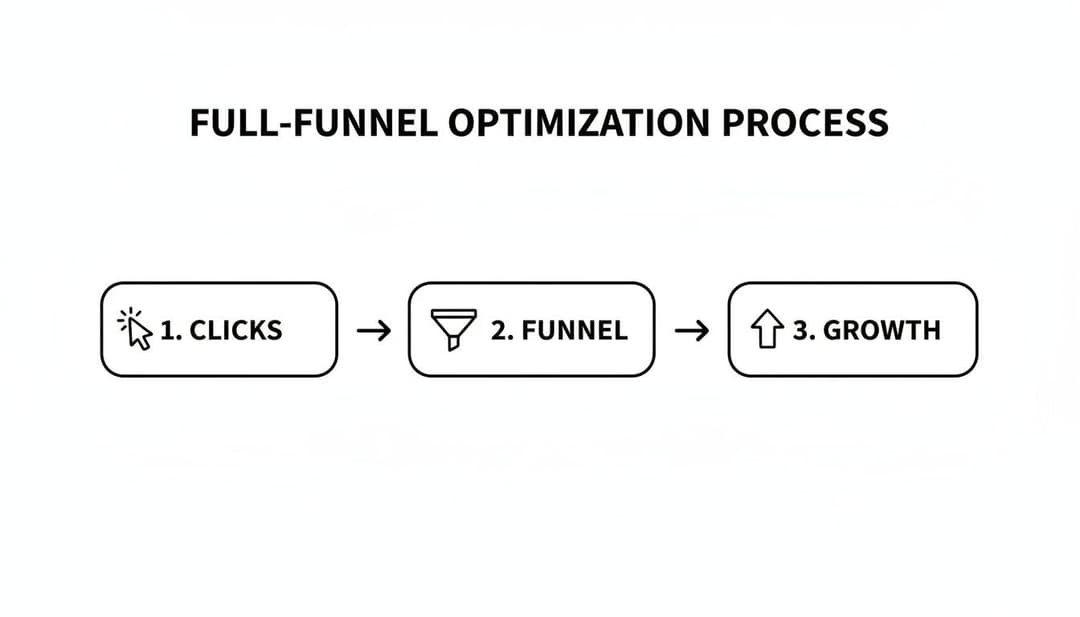
This just reinforces a fundamental truth: top-of-funnel actions are meaningless unless they’re directly tied to the conversions that actually grow your business.
The most powerful shift you can make is moving from a "spend more" mentality to a "win more" mindset. Every test is an opportunity to learn something that makes your next dollar more effective than your last.
Adopting this systematic approach puts you back in the driver's seat of your acquisition costs. By embedding this continuous optimization loop into how your team operates, you build a resilient, efficient, and ultimately profitable path to growth that can weather any storm.
Got Questions About Cutting Your CAC? We've Got Answers
When you're in the weeds trying to get your customer acquisition cost down, a lot of practical questions pop up. It's one thing to talk strategy, but another thing entirely to make it happen. Let's tackle some of the most common ones we hear from teams on the ground.
"How Long Until I Actually See My CAC Go Down?"
This is always the big one, isn't it? The honest answer is: it depends.
You can get some quick wins that show up almost immediately. Tweaking a high-traffic landing page, killing off a dud ad set that's just burning cash—that stuff can move the needle in a matter of days or weeks. Think of it as stopping the bleeding.
But the real, sustainable drops in CAC come from building solid systems. When you commit to a rigorous creative testing process or really dial in your audience personalization, you're building a machine that gets smarter over time. Most teams that stick with it start seeing a clear downward trend within the first 60-90 days. It’s not about finding one magic bullet; it's about the compounding returns you get from testing, learning, and scaling what works, week after week.
"What’s the Biggest Mistake People Make When Trying to Lower CAC?"
Easy. The most common—and most destructive—mistake is panicking and just slashing the ad budget across the board. It feels like the logical move when costs are high, but it often backfires spectacularly.
When you cut spend without fixing the reason your spend is inefficient, you just end up with less reach and fewer conversions. Your CAC might actually go up.
The smart money isn't on spending less; it's on making every dollar you spend work harder. Pour that energy into improving conversion rates, shipping better creative, and getting sharper with your targeting. Lowering your CAC is an efficiency game, not a budget-cutting game.
"So, Are AI Tools Going to Replace Me as a Media Buyer?"
Not a chance. AI tools are here to augment you, not replace you. A platform like AdStellar is built to be a media buyer's best friend, not their replacement. It takes on all the soul-crushing, repetitive work that eats up your day—building hundreds of ad variations, launching campaigns across tons of audiences, pulling all the data.
This frees you up to do the high-level work that no machine can replicate. You get to focus on:
- Reading between the lines of the data to find the why behind the numbers.
- Dreaming up killer creative concepts that actually connect with people.
- Mapping out the long-term strategy and figuring out where the budget will have the most impact.
- Keeping an eye on the competition and the bigger picture of what's happening in your market.
Think of it this way: AI handles the "what" and the "how" at a massive scale, so you can own the "why." That partnership is where truly efficient growth comes from.
Ready to ditch the manual grunt work and focus on scaling what actually works? AdStellar is the AI-powered platform that helps you launch, test, and optimize Meta ad campaigns 10x faster. Automate your workflows and start reducing your CAC today.