The idea that online advertising has a fixed price is a myth.It’s much more like a real-time auction, where costs are constantly shifting based on your industry, who you’re trying to reach, the quality of your ads, and your overall strategy.
Think of it like buying real estate. A storefront in a bustling, high-end neighborhood (your ideal, high-intent audience) is going to cost a lot more than one on a quiet side street. This is why your budget could swing from just a few dollars per click for a niche keyword to over $50 for a hyper-competitive one.
Why Online Advertising Costs Are So Variable

To really get a handle on advertising costs, you have to stop thinking about a price list and start seeing it as a living ecosystem where value is constantly being negotiated. Every single ad space—whether it's on a Google search page or a Meta social feed—is sold through an automated, split-second auction. While supply and demand are at the core, it’s not just about who throws the most money at it.
Platforms like Google and Meta have a vested interest in rewarding relevance. An ad that hits the mark with user intent and provides a great landing page experience will often win the auction for less money than a clunky, irrelevant ad with a higher bid. This whole system, often measured by things like Quality Score or Relevance Score, is there to protect the user experience and make sure advertisers are actually delivering value.
Key Drivers of Ad Cost Fluctuation
There are a few core factors that will always have a major say in how much you spend. Getting these down is the first real step toward building a campaign that doesn’t just spend money, but makes it.
- Industry and Competition: It’s a simple truth—advertising for a lawyer or a mortgage broker is going to be pricier than promoting a local bakery. When more businesses are fighting over the same eyeballs, auction prices naturally go up.
- Audience Targeting: The more granular and valuable your audience, the more you'll pay to reach them. Trying to get your ad in front of C-suite executives on LinkedIn, for example, is a premium investment because of their immense decision-making power.
- Geographic Location: Bidding for ad space in major hubs like New York City or London will always cost more than in a small town. There's just more commercial intent and way more competition packed into a smaller space.
- Ad Quality and Relevance: Like we touched on, platforms reward good ads. An ad with a high click-through rate (CTR) is a clear signal to the platform that you're showing people something they want to see, which often earns you a lower cost per click (CPC).
The digital ad market isn't just growing; it's rocketing. In 2025, global advertising spend is set to blow past $1 trillion for the first time ever, with digital channels gobbling up 75.2% of that massive pie.
This flood of cash highlights just how much businesses are shifting to platforms where they can actually track their return on investment. For performance marketers, this means the battlefield is getting more crowded. But it also creates a huge opportunity for those who can use tools like AdStellar AI to automate their creative testing and snatch up budget more efficiently than the competition. You can read more about this monumental ad spending milestone and its implications.
Decoding the Core Pricing Models
To get a handle on your ad costs, you first have to speak the language of how ad spend is actually measured and charged. Think of it like choosing a payment plan—each option is built for a totally different outcome. Getting these models straight is the first real step toward building a budget that actually works for your goals.
The digital ad world pretty much runs on three core pricing models. They might sound a bit technical, but the ideas behind them are surprisingly simple once you break them down. Knowing when and why to use each one is what separates the marketers who control their ad spend from those who let it control them.
Cost Per Click (CPC) The Tollbooth Model
Imagine your website is a hot new destination, and your ad is the only bridge to get there. With the Cost Per Click (CPC) model, you're essentially running a tollbooth on that bridge. You only make money when a car actually decides to cross.
You're not paying for the thousands of cars that see the sign for your bridge; you're only paying for the ones curious enough to actually make the trip. This makes CPC a fantastic choice for campaigns where the main goal is to drive traffic directly to a landing page or product page. It's a model that’s all about paying for action.
- Best for: Driving website traffic, lead generation campaigns, and promoting specific product pages.
- Primary Goal: Get users to take that next step and visit your site.
- Key Metric: Your Click-Through Rate (CTR) is the biggest factor influencing your overall costs.
This model is all about paying for immediate engagement. If you want people to interact with your brand by visiting your site, CPC makes sure you're only spending money on users who've already raised their hand.
Cost Per Mille (CPM) The Billboard Model
Okay, let's switch gears. With Cost Per Mille (CPM), you’re no longer running a tollbooth—you're renting a massive billboard on the busiest highway in town. "Mille" is just Latin for thousand, so you pay a flat fee for every one thousand people (impressions) who drive by and see your ad, whether they act on it or not.
This model couldn't care less about immediate clicks. Its job is to build brand awareness and get your message in front of as many relevant eyeballs as possible. It’s perfect for new product launches, big announcements, or any campaign designed to build that crucial top-of-mind recognition. For a deeper look at how this works, check out our guide on cost per impression rates.
Key Takeaway: CPM is your go-to for reach and visibility. You're paying for pure exposure, which is ideal for brand awareness campaigns where just getting seen is the entire point.
Cost Per Acquisition (CPA) The Commission Model
Finally, we have Cost Per Acquisition (CPA), which is hands-down the most results-focused model of the three. Think of this as hiring a salesperson who only works on commission. You don't pay them for making calls (impressions) or for getting prospects in the door (clicks). You only pay them when they close a deal.
In the ad world, that "deal" is whatever conversion you've defined as valuable.
- A completed purchase
- A submitted lead form
- A newsletter signup
- An app download
With CPA, you tell the ad platform your target price for each of these actions, and its algorithm goes to work trying to hit that number. This model directly connects your ad spend to real business results, which is why it's a favorite for advertisers laser-focused on return on investment (ROI). It takes most of the guesswork out of the equation by aligning your costs directly with revenue or leads.
Benchmarking Ad Costs Across Major Platforms
Knowing the different pricing models is one thing, but the real question is: how much should you actually plan to spend? Online advertising costs are anything but universal. They swing wildly from one platform to another, driven almost entirely by the audience you’re trying to reach and just how valuable they are.
Think of it like this: having a casual chat at a local coffee shop (let's call that TikTok) is always going to be cheaper than booking a speaking slot at an exclusive industry conference (that's LinkedIn). Both get your message out, but the context and the audience's professional clout set the price of admission. That's the core idea behind why platform costs are so different.
This visual breaks down the three fundamental ad models—CPC, CPM, and CPA—and gives you a quick snapshot of how you pay for performance.
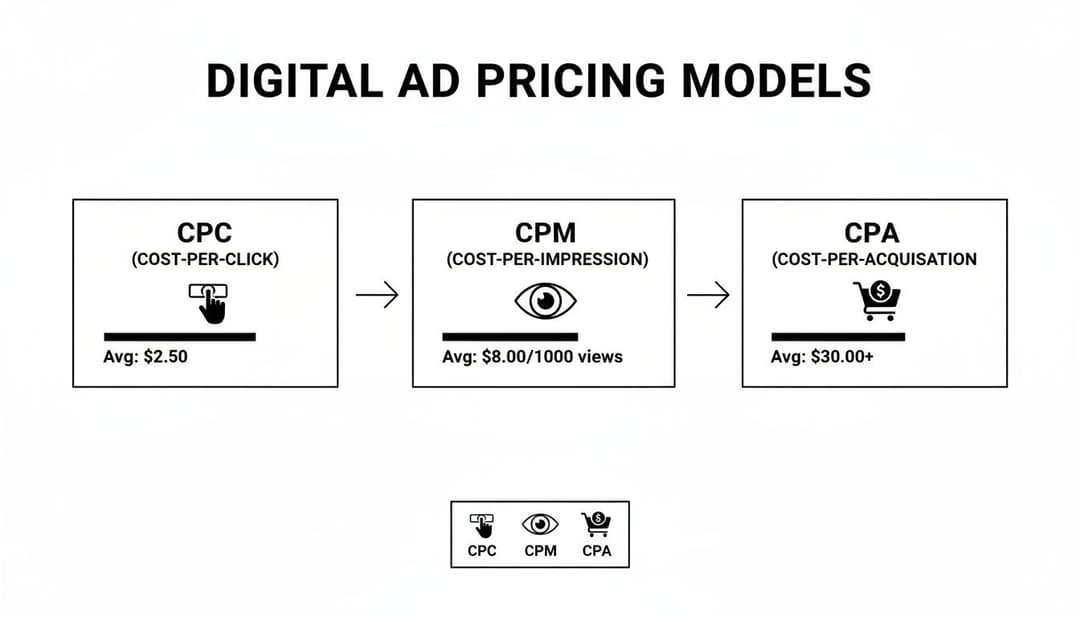
Each icon represents a different goal you might have as an advertiser, from a simple click all the way to a final sale. It’s a great illustration of the direct line between what you pay and the business outcome you're aiming for.
Meta Ads Costs (Facebook and Instagram)
Meta's platforms, Facebook and Instagram, are the Swiss Army knives of the digital ad world. With billions of users, they give you incredible scale and some seriously sophisticated targeting options that work for both B2C and B2B advertisers.
Because the audience is so massive and diverse—from teenagers to grandparents—the costs can be surprisingly affordable. The average Cost Per Click (CPC) usually lands somewhere between $0.70 and $1.80, though this depends heavily on your industry and how granular your targeting gets. If you’re just trying to get eyeballs on your brand, the Cost Per Mille (CPM) is typically in the $8 to $14 range.
Google Ads Costs
When it comes to advertising based on intent, Google Ads is the undisputed champ. You’re not just reaching people; you’re reaching people who are actively typing into a search bar, looking for a solution you just might have. That high level of intent makes the traffic extremely valuable, but it also makes it a lot more competitive.
For search campaigns, CPCs can hover between $1 to $4 for more general keywords, but they can also shoot up to over $50 in cutthroat industries like law or finance. On the other hand, the Google Display Network is more like putting up a digital billboard; it offers much lower CPMs, often around $3. Your strategy really dictates your spend here. To get a better handle on this key metric, our guide explains in detail what is a good cost per click and how to judge it for your own campaigns.
LinkedIn Ads Costs
LinkedIn is the premium, white-glove platform for B2B marketing, and its costs absolutely reflect that. You’re not targeting vague interests; you're targeting specific job titles, company sizes, and entire industries. Getting your ad in front of a CEO or a VP of Engineering is a high-stakes proposition, so the auction prices are way higher.
You should expect to pay a premium. CPCs on LinkedIn often start around $3 and can easily sail past $10, especially if you're targeting senior-level professionals. In the same vein, CPMs are frequently in the $20 to $30+ range. The investment is bigger, but for the right B2B business, the quality of a single lead can be completely unmatched.
TikTok Ads Costs
Then you have TikTok, which sits on the other end of the cost spectrum. It's a platform built on entertainment, discovery, and viral trends, making it a goldmine for brands with visually compelling content targeting younger demographics. The user base is gigantic and incredibly engaged, but the commercial intent is generally lower than on a search platform like Google.
This dynamic results in some of the most affordable ad costs you can find.
- Average CPC: Often falls between $0.20 and $1.00, making it a fantastic platform for driving huge volumes of traffic.
- Average CPM: Can be as low as $2 to $6, allowing brands to get massive reach without a massive budget.
The key takeaway is simple: ad costs are a direct reflection of audience value and intent. A click from a LinkedIn ad targeting a senior executive costs more because that one click has a much higher potential to turn into a large enterprise deal. A TikTok click, in contrast, is cheaper because it's usually part of a broader, volume-based awareness play.
To give you a clearer picture, here’s a table with some typical cost ranges you might encounter.
Estimated Online Advertising Cost Benchmarks by Platform and Industry
This table compares the average Cost Per Click (CPC) and Cost Per Mille (CPM) across major platforms for several key industries. Think of it as a guide to help set some realistic expectations for your budget.
| Platform | Industry | Average CPC Range | Average CPM Range |
|---|---|---|---|
| Meta (Facebook/IG) | E-commerce | $0.75 - $2.50 | $9.00 - $15.00 |
| Meta (Facebook/IG) | SaaS | $1.50 - $4.00 | $12.00 - $20.00 |
| Google Ads (Search) | E-commerce | $1.00 - $3.00 | $25.00 - $40.00 |
| Google Ads (Search) | Professional Services | $4.00 - $10.00+ | $30.00 - $60.00+ |
| LinkedIn Ads | SaaS | $5.00 - $12.00 | $25.00 - $45.00 |
| LinkedIn Ads | Professional Services | $6.00 - $15.00+ | $30.00 - $50.00+ |
| TikTok Ads | E-commerce | $0.25 - $1.20 | $2.00 - $7.00 |
Remember, these numbers are just benchmarks—they aren't set in stone. Your actual online advertising costs will be shaped by the hidden factors we're about to dive into next.
The Hidden Factors Driving Up Your Ad Spend

If you've ever watched your ad costs creep up for no apparent reason, you know how frustrating it can be. You check your bids, you look at the competition, but the real culprit often isn't what you see on the surface. The biggest drivers of your ad spend are frequently invisible forces working behind the scenes of every ad auction.
Think of your bid as just the entry fee. The final price you pay is influenced by several other elements that can either slap a hefty tax on your campaigns or give you a welcome discount. Ignoring them is like driving with the emergency brake on—you’ll get where you're going, but you'll burn through your budget way too fast.
The Quality and Relevance Score Tax
One of the most powerful hidden forces is the quality metric every platform uses to judge your ads. For Google, it's the Quality Score; for Meta, it's the Relevance Score. These aren't just vanity metrics—they directly and dramatically impact what you pay.
A high score is the platform's way of saying, "Great ad! Our users will like this." In return, you're rewarded with a lower Cost Per Click (CPC) and better ad placements, even if you aren't the highest bidder. But a low score tells the platform your ad is a poor fit for its audience. To compensate for that poor user experience, they penalize you, forcing you to bid much higher just to get seen.
A low Quality or Relevance Score is a direct tax on your ad spend. You're forced to pay more for the same result simply because the platform sees your ad as a poor fit for its users.
Focusing on improving these scores by sharpening your ad copy, refining your targeting, and optimizing your landing page is one of the single most effective ways to lower your costs.
The Sneaky Cost of Ad Fatigue
Have you ever seen the same TV commercial so many times you start to hate the jingle? That’s ad fatigue, and it’s a silent budget-killer in the digital world. It kicks in when your audience sees your ad so often they just start tuning it out.
When ad fatigue sets in, you'll see a few clear warning signs:
- Click-Through Rates (CTR) tank: People are bored. They've seen it before, and they just scroll past.
- Conversion Rates dwindle: The few who do click are less interested and less likely to take action.
- Costs Per Result soar: You're now paying more money for every single lead or sale because the ad has gone stale.
This problem is especially painful when you're targeting smaller, niche audiences that you can saturate quickly. You have to keep things fresh by rotating creatives, testing new messages, and trying different angles. The challenge is, with user privacy shifts, it's getting harder to rely on platform data alone to spot these trends. Knowing your data is key, which you can read more about in our guide on the decline of third-party data and what it means for advertisers.
Seasonality and Competitive Pressure
Finally, the calendar itself can blow up your ad budget. The digital ad market isn't a static environment; it's an ecosystem that ebbs and flows with major events and seasonal demand. During peak shopping seasons like Black Friday or the December holidays, all hell breaks loose.
Suddenly, thousands of businesses are all bidding on the same limited ad space, desperate to reach those same holiday shoppers. That massive surge in demand sends auction prices through the roof. A click that cost you $1 in October could easily demand $3 or $4 during the last week of November.
And it isn't just about the big holidays. Industry-specific events, back-to-school season, or even the Super Bowl can create intense spikes in competition. The smartest advertisers see these periods coming. They adjust their budgets, plan their strategies, and sometimes even find gold in the "off-seasons" when everyone else is quiet and customers are cheaper to acquire.
Actionable Strategies to Reduce Ad Costs

Knowing what drives up your costs of advertising online is one thing; actually doing something about it is another. It’s time to move from theory to action. A disciplined approach to optimization can systematically bring down your ad spend while pushing your results higher. This isn't about some magic bullet, but a continuous cycle of testing, measuring, and refining.
Think of your ad budget less like a fixed expense and more like an active investment. When you connect every tweak back to the core pricing models, you start to see exactly how your efforts move the needle. A small bump in your click-through rate (CTR), for example, directly lowers your effective CPM. A more compelling landing page brings down your Cost Per Acquisition (CPA).
Master the Art of A/B Testing
Your most powerful weapon for cutting costs is rigorous A/B testing. Stop guessing what works and let the data tell you. It’s all about methodically testing one variable at a time to see what truly resonates with your audience.
Treat it like a scientific experiment. You have your control (the current ad) and a variant with just one change. By isolating that single variable, you can say with confidence that any difference in performance is because of that specific tweak.
Optimization is not a one-time task; it's a perpetual process. The most successful advertisers are those who never stop testing, learning, and iterating on their campaigns.
Start by testing the elements with the biggest potential impact. You’d be surprised how small changes can lead to significant savings.
- Headlines: Try pitting a question against a bold statement. See which one grabs more attention.
- Ad Creatives: Does a video outperform a static image? What about different color schemes?
- Call to Action (CTA): Test "Shop Now" against "Learn More." Which one drives clicks that actually convert?
Running these tests systematically will uncover the winning combinations that lower your costs and send your conversions soaring.
Sharpen Your Audience Targeting
Wasted ad spend is almost always a symptom of lazy targeting. Showing your ads to people who couldn't care less about your product is like handing out flyers in an empty parking lot—you’re burning cash with zero chance of a return. Getting your audience right is the key to making every dollar count.
Dig into your existing customer data to build a detailed profile of your ideal buyer. Then, use the platform's targeting tools to find more people just like them.
Three ways to refine your audience include:
- Exclusion Targeting: Actively block demographics, interests, or locations that have historically tanked your campaigns. This simple move stops you from throwing good money after bad.
- Lookalike Audiences: Give the platform a list of your best customers, and its algorithm will go find new people with similar behaviors and traits. This is one of the fastest ways to scale profitably.
- Retargeting: Dedicate a slice of your budget to people who have already visited your site or engaged with your brand. These warm leads are often much, much cheaper to convert. Your cost of leads can drop significantly when focusing on this highly engaged segment.
Leverage Smart Bidding and Automation
Trying to manually adjust bids across hundreds of ad groups is a recipe for headaches and mistakes. Modern ad platforms have incredibly powerful, AI-driven bidding strategies that can optimize your spend in real-time, far better than any human ever could.
Instead of setting a manual Cost Per Click (CPC) and hoping for the best, you give the algorithm a goal and let it do the heavy lifting.
- Target CPA (Cost Per Acquisition): Tell the platform exactly what you're willing to pay for a conversion, and it will automatically adjust bids to hit that number.
- Maximize Conversions: This strategy works to squeeze the most conversions possible out of your daily budget.
- Target ROAS (Return On Ad Spend): Set a specific return you want for your ad spend (e.g., 400%), and the platform will hunt for users most likely to make high-value purchases.
Once you have this foundation, you can dive deeper into proven strategies to reduce Customer Acquisition Cost, which directly improves your profitability. By pairing these smart bidding strategies with a relentless optimization cycle, you create a powerful system for getting the absolute most out of every dollar you spend.
How AI Automation Can Lower Your Ad Spend
Let's be honest: manually trying to manage thousands of campaign variables is a losing battle. Juggling creatives, audiences, bids, and placements is quickly becoming an impossible task for any human. As this complexity spirals, so does the risk of just burning through your budget with nothing to show for it. The only real way forward is to stop guessing and start leaning on data-driven automation powered by artificial intelligence.
Think of AI platforms as a force multiplier for your marketing team. They can systematically launch and test hundreds of ad variations at a scale and speed that no person could ever hope to match. This rapid-fire testing quickly surfaces the winning combinations—the perfect creative, copy, and audience that actually deliver results.
Instead of waiting for a weekly report to tell you what went wrong, AI uses real-time performance data to automatically shift your budget around. It pulls spend from underperforming ads and doubles down on the winners, making sure every dollar is working as hard as it possibly can to generate a return.
Overcoming Ad Fatigue and Scaling Winners
This automated approach is a direct counter to costly problems like ad fatigue and audience saturation. AI algorithms keep a close watch on engagement metrics, flagging or pausing ads the second their performance starts to dip. This alone prevents you from throwing good money after bad on creative that's gone stale.
For instance, an AI tool like AdStellar might spot that a specific video ad is pulling in a 20% higher Return On Ad Spend (ROAS) with a particular lookalike audience. It will then automatically pump more budget into that exact combination while simultaneously testing new headlines to see if it can squeeze even more performance out of it. Our guide on using AI for Facebook Ads dives much deeper into these kinds of practical applications.
What you end up with is a data-driven engine that’s constantly learning and optimizing to lower your acquisition costs and scale your most profitable campaigns.
Capitalizing on a Shifting Ad Market
Getting this kind of efficiency is more critical than ever. Retail media and commerce advertising are set to explode to $178.2 billion globally in 2025, which would surpass total TV ad revenue for the first time. With digital advertising already capturing over 75% of a nearly $777 billion market, the competition is absolutely fierce.
This is where Meta-focused tools like AdStellar become essential. They centralize your creative management and performance data, making it effortless to scale high-ROAS campaigns. For growth teams, this means automating the bulk testing needed to find winners, using historical data to fuel AI insights that consistently cut acquisition costs.
AI doesn’t just make your job easier; it makes your budget smarter. By automating the high-volume testing and optimization that’s impossible to do manually, it turns your ad account into a self-learning system that gets more efficient over time.
For anyone thinking about building or integrating AI automation, it's really important to get a handle on the costs involved. You can learn more by understanding OpenAI API pricing and cost management, which breaks down how tokens work and compares costs for different models. Knowing the financial mechanics behind these powerful tools is key to appreciating what they can really do.
Common Questions About Online Ad Costs
When you're trying to figure out the world of online advertising, a few questions always seem to pop up. Let's tackle some of the most common ones that marketers wrestle with every day.
How Much Should a Small Business Spend on Online Advertising?
There's no single magic number here, but a good starting point is the 7-12% of total revenue rule for your overall marketing budget. A healthy chunk of that should go toward your digital ads. If you're a new business hungry for growth, you'll probably need to push that number even higher.
The smartest way to start is small. Pick one channel where you know your customers hang out and set a test budget you're comfortable losing. The goal is to figure out your Cost Per Acquisition (CPA) and stack it up against your Customer Lifetime Value (LTV).
You've found a winning formula when your LTV is at least 3x your CPA. Once you hit that ratio, you can pour more money into your ads with confidence, knowing it's coming back to you threefold.
Why Are My Ad Costs Increasing Over Time?
Seeing your ad costs creep up is frustrating, but it's usually due to a few predictable reasons. The most common culprits are:
- Ad Fatigue: Your audience has seen the same ad so many times they’ve gone blind to it. Engagement plummets, and costs rise as the platform struggles to show it.
- Audience Saturation: You've basically shown your ad to everyone in your target audience who is going to convert. You're hitting a point of diminishing returns.
- Increased Competition: More advertisers are trying to reach the same people you are, turning the ad auction into a bidding war and driving up prices for everyone.
Don't forget about seasonality, either. Costs always spike during huge shopping periods like Black Friday. To fight back, you need to be constantly refreshing your ad creatives, exploring new audience segments, and keeping a close eye on your frequency metrics to make sure you're not annoying people.
Which Is Better for My Business: CPC or CPM?
The right answer comes down to one thing: what's your goal? Each bidding model is a tool for a different job.
You'll want to use CPM (Cost Per Mille) when your main goal is just getting eyeballs on your brand. Think brand awareness or a big announcement. You're paying for impressions, trying to get your message in front of as many relevant people as possible.
On the other hand, CPC (Cost Per Click) is your go-to when you need to drive traffic to your website or a landing page right now. You only pay when someone actually takes action and clicks your ad, making it perfect for direct-response campaigns.
But for campaigns focused purely on sales or leads, it's almost always better to optimize for CPA (Cost Per Acquisition) or ROAS (Return On Ad Spend). These metrics tie your ad spend directly to real business results, which is what matters most.
Ready to stop guessing and start scaling your Meta ads? AdStellar AI automates bulk ad creation, testing, and optimization, helping you find winning campaigns 10x faster. Launch, test, and scale your ads with AdStellar AI today.