If you feel like your marketing budget is a leaky bucket, you're not alone. The cost of leads—what you spend to get one potential customer in the door—is a critical number for any business. For many, that number is climbing, making growth feel like an uphill battle.
Why Your Cost of Leads Keeps Climbing
For performance marketers, watching your Cost Per Lead (CPL) creep up is a familiar, frustrating sight. An expense that once felt predictable can quickly turn into a drain on your budget. But CPL isn't just another metric on a dashboard; it's a vital sign for the health and scalability of your entire business.
Think of it like the cost of raw ingredients for a chef. If the price of flour and eggs suddenly doubles, the chef has to get creative. They can raise prices, shrink portions, or find a smarter, more efficient way to run the kitchen. It's the same for you. When your CPL rises, you have to find better ways to acquire customers, or your profit margins will start to erode.
To get a handle on CPL, it helps to understand the whole landscape of lead generation metrics. Each one tells a different part of the story.
A Quick Guide to Key Lead Generation Metrics
Here's a quick rundown of the essential acronyms you'll encounter. Understanding how they relate to each other is the first step toward building a more efficient marketing engine.
| Metric (Acronym) | What It Measures | Why It Matters for Your Business |
|---|---|---|
| Cost Per Lead (CPL) | The total cost to acquire a single lead. | This is your core efficiency metric. A lower CPL means you can generate more potential customers for the same budget, fueling growth. |
| Cost Per Acquisition (CPA) | The cost to acquire a paying customer. | CPA tells you the real cost of a sale. It connects marketing spend directly to revenue, helping you gauge profitability. |
| Customer Lifetime Value (CLV) | The total revenue a single customer is expected to generate over time. | CLV provides long-term context. A high CLV can justify a higher initial CPL or CPA, as you know the investment will pay off. |
| Return on Ad Spend (ROAS) | The revenue generated for every dollar spent on advertising. | ROAS is your ultimate report card. It answers the simple question: "Is my ad budget actually making me money?" |
These metrics don't live in isolation. A high CPL might be perfectly fine if it leads to a fantastic CPA and a sky-high CLV. The goal is to see the complete picture, not just focus on one number.
The Forces Driving Up Your CPL
So, what's behind this universal challenge? A few key forces are at play. First, the digital advertising space is more crowded than ever, creating fierce competition for the same eyeballs. This platform saturation directly drives up bid prices on channels like Meta and Google, forcing you to spend more for the exact same placement.
At the same time, audiences are getting savvier and, frankly, a bit tired. The same old ad formats and messages just don't cut through the noise anymore, which means you have to constantly innovate and test to capture anyone's attention. This pressure is amplified by the decline of old-school targeting methods. As you can learn in our guide on the end of third-party data, reaching the right person now requires a much more sophisticated approach.
A rising CPL is often the first symptom of a larger issue in your marketing system. It signals a misalignment between your message, your audience, and the value you offer, forcing a strategic re-evaluation.
The Sobering Reality of Modern Lead Generation
This isn't just a feeling; the data tells a stark story. The average cost per lead across all industries has roughly doubled in recent years, a trend fueled by that intense digital competition. While the mean B2B CPL hovers around $198.44, costs can absolutely skyrocket depending on the industry.
For example, higher education leads can cost a staggering $982 each, with financial and legal services not far behind. Even in the tech sector, paid campaign CPLs often land in the $200-$310 range. You can explore more lead generation statistics and quickly find that getting ahead requires a new strategy.
This guide will provide that strategy. We'll give you a systematic approach to not just manage but actively reduce your cost of leads.
How To Calculate And Benchmark Your True CPL
If you want to lower your lead costs, you first have to measure them properly. Too many marketers get this wrong, using a simple formula that only tells part of the story. Your true Cost Per Lead (CPL) isn't just about what you pay for ads—it's the total investment you make to get a potential customer to raise their hand.
Sure, the basic formula is a decent place to start: Total Marketing Spend / Total New Leads = CPL. The trick, though, is getting "Total Marketing Spend" right. It's so much more than just the money you hand over to Meta or Google.
Defining Your True Marketing Spend
To get a real, honest CPL, you have to account for all the costs involved. Think of it like figuring out the true cost of a meal you cook at home. It’s not just the price of the groceries; you also have to consider the cost of the oven, the pans, and the electricity you used to cook it. Your marketing spend is no different.
A real calculation needs to include:
- Direct Ad Spend: This one’s the obvious part—the cash you pay directly to ad platforms for clicks, impressions, and conversions.
- Software and Tools: Don't forget the monthly fees for your marketing automation, analytics platforms, CRM, and any other tech in your lead gen stack. It all adds up.
- Creative Production: This is a big one. It covers everything from graphic design and video editing to copywriting fees and agency retainers.
- Team Overhead: You also need to factor in a portion of the salaries for the people running the show, from your media buyers to your content team.
Once you add up these often-overlooked costs, you get a much clearer picture of what it actually costs to generate a single lead. This stops you from making decisions based on fuzzy math.
Benchmarking Your CPL The Right Way
Okay, so you’ve calculated your true CPL. Now what? The next logical question is, "Is this number any good?" This is where benchmarking comes in, but context is everything.
Simply comparing your CPL to a generic industry average is a recipe for disaster. A "good" CPL is completely relative to your business, your industry, and your goals.
The lead generation economy is exploding and is on track to hit $9.6 billion by 2028. In the middle of all this growth, marketers are looking at broad averages like $198.44 per lead, with quality B2B sales leads often landing in the $31-$60 range. These numbers give you a rough idea, but they don't tell the whole story.
Just look at how much lead costs have climbed over the last few years.
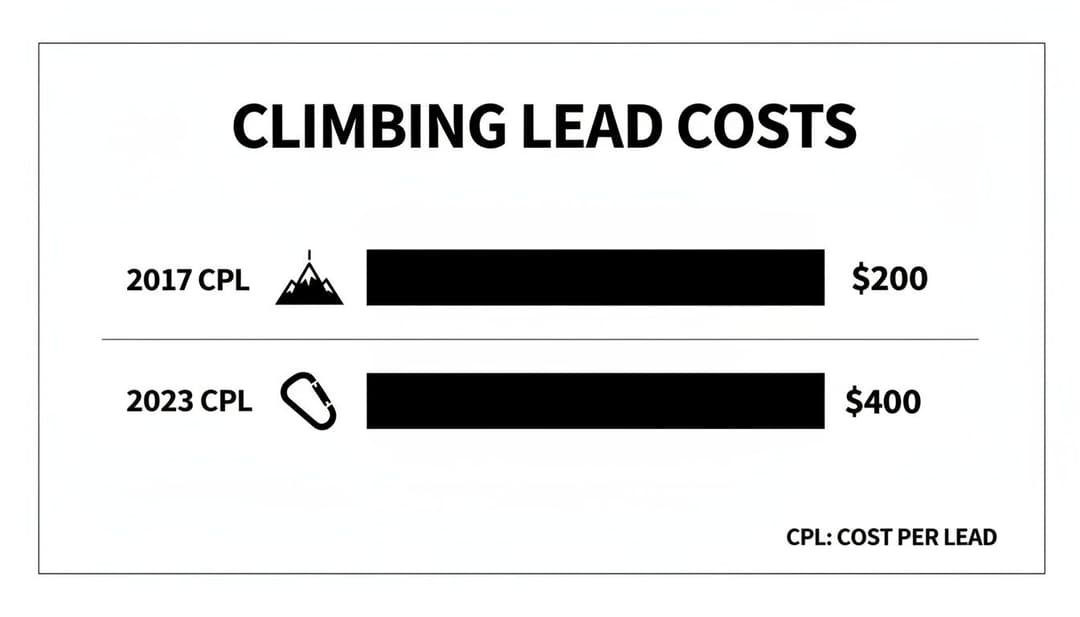
This steady climb shows why just aiming for the "average" might mean you’re already falling behind.
Here’s a look at how CPL varies wildly by industry, which is a great starting point for finding a more relevant benchmark.
Average Cost Per Lead (CPL) by Industry
| Industry | Average CPL (Paid Channels) | Notes and Considerations |
|---|---|---|
| Technology | $208 | Long sales cycles; often requires extensive nurturing. |
| Healthcare | $162 | Highly regulated; trust is a major factor in conversion. |
| Finance & Insurance | $160 | High LTV justifies a higher CPL, but competition is fierce. |
| B2B Services | $132 | Lead quality varies greatly; SQLs cost much more than MQLs. |
| Education | $103 | Seasonality plays a huge role (e.g., enrollment periods). |
| Real Estate | $101 | Hyper-local targeting is critical for success. |
| E-commerce (DTC) | $45 | Lower CPLs, but requires high volume to be profitable. |
Source: Multiple industry reports including HubSpot and Marketing Charts.
As you can see, a "good" CPL for an e-commerce brand would be a disaster for a B2B tech company. Before you benchmark, you have to consider the specifics of your market. To really get a handle on this, it's worth Decoding Your Cost Per Lead with a framework that fits your business.
Setting A Target CPL Based On Value
At the end of the day, the only benchmark that truly matters is your own profitability. Instead of chasing what everyone else is doing, work backward from your Customer Lifetime Value (LTV).
Your CPL isn't just an expense; it's a strategic investment in future revenue. The real question isn't "How low can my CPL go?" but "What CPL can I afford to pay to acquire a fantastic customer?"
Here’s a straightforward way to set your target:
- Calculate Your LTV: Figure out the total revenue an average customer brings in over their lifetime.
- Define Your Target CAC: Decide what you’re willing to spend on acquiring one paying customer (your Customer Acquisition Cost).
- Factor in Your Conversion Rate: Look at the percentage of leads that actually become paying customers.
Let's say your target CAC is $500 and your lead-to-customer conversion rate is 10%. That means for every 10 leads, you get one customer. Your maximum affordable CPL is $50 ($500 / 10). It’s that simple. This method ties your marketing efforts directly to real business results.
For a deeper dive into this crucial metric, check out our complete guide to understanding your cost per lead.
Five Levers for Lowering Your Lead Costs
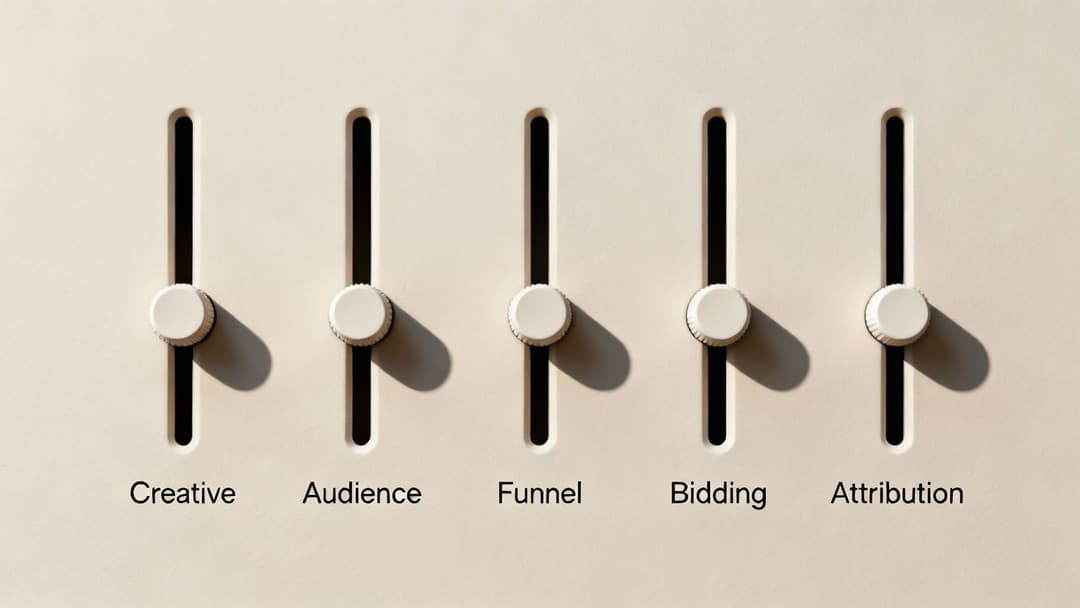
Knowing your CPL is one thing. Actually doing something about it is another game entirely. It's easy to fall into the trap of making random tweaks and just hoping for the best, but that's a recipe for wasted ad spend.
A much smarter approach is to think of your campaign like a sound mixing board with five key faders. Each one controls a critical part of your performance. When you learn to adjust them with precision, you can systematically drive down your cost of leads without torpedoing quality.
These five levers are Creative, Audience, Funnel, Bidding, and Attribution. Getting a feel for how they interact is the secret to turning a cash-burning campaign into a lean, mean, growth-generating machine. Let's break down the actionable tactics behind each one.
Lever 1: The Creative Variable
Your ad creative—the images, videos, headlines, and copy—is arguably the most powerful lever you have. In a doom-scrolling world, your creative is what either stops the thumb or gets completely ignored. Tiny changes here can cause massive swings in performance, yet most marketers barely scratch the surface, testing only a few ideas.
The goal is to graduate from simple A/B testing to high-volume creative iteration. We're talking about testing dozens, even hundreds, of combinations of headlines, images, calls to action, and formats. When you do this, you let the data—not your gut—tell you what actually resonates.
- Test Core Concepts: Go bigger than just testing button colors. Test entirely different value propositions. A SaaS company, for instance, could pit ads focused on "saving time" against ads about "slashing costs."
- Isolate Single Elements: Found a winning concept? Great. Now iterate on it. Test that killer headline with ten different images, or try the same video with five different opening hooks.
- Analyze by Component: Don't just stop at "Ad B won." Dig deeper. Did a specific headline crush it no matter which visual it was paired with? That’s a powerful insight you can build on.
By constantly feeding the ad platforms fresh creative, you fight off ad fatigue and discover pockets of high performance you would have otherwise missed. This is where a tool like AdStellar AI becomes a game-changer, letting you generate and launch hundreds of creative variations in minutes and making this level of testing a reality.
Lever 2: The Audience Focus
Running amazing creative to the wrong audience is like telling a brilliant joke in an empty room. It doesn't matter how good the material is if no one's there to hear it. Refining your audience targeting is the second critical lever for bringing down your lead costs.
Too many marketers set some basic demographic and interest targeting and call it a day. But the real wins come from getting much more specific and using your own first-party data to give the platform's algorithm better signals.
A lower CPL is often the direct result of a better match between your message and the person seeing it. Precision targeting isn't just about finding more people; it's about finding the right people who are primed to convert.
To sharpen your focus, give these tactics a shot:
- Build High-Value Lookalikes: Don't just upload your entire customer list. Create a lookalike audience from your best customers—the ones with the highest lifetime value or who buy from you again and again. You're telling the algorithm, "Go find more people exactly like these VIPs."
- Layer Your Interests: Instead of targeting a massive, broad interest like "digital marketing," start layering. For example, target people interested in "digital marketing" AND who are also admins of a Facebook Business Page. Now you're more likely reaching actual professionals.
- Utilize Exclusion Audiences: Be ruthless about who you don't want to see your ads. Exclude existing customers (for acquisition campaigns), people who just visited your site and bounced, and low-value segments. This stops you from wasting money on clicks that are going nowhere.
Lever 3: The Funnel Optimization
Your ad is just the opening act. A sky-high click-through rate is useless if everyone bails the second they hit your landing page. Optimizing the entire journey—from the ad click all the way to the thank-you page—is the third crucial lever for reducing CPL. Every single point of friction in this process is costing you leads.
Think of your funnel like a water slide. Any bumps, cracks, or sharp turns will slow people down or make them fall off completely. Your job is to make the ride to conversion as smooth and fast as possible. This whole process, known as Conversion Rate Optimization (CRO), has a direct line to your lead costs. A higher conversion rate means you're getting more leads from the same ad spend, which instantly pushes your CPL down.
A big piece of this is improving your ad's click-through rate (CTR), since platforms tend to reward engaging ads with lower costs. To dive deeper, check out our guide on how to improve your click-through rate. This efficiency mindset also applies beyond your ads. For a broader look at how operational efficiency can impact your bottom line, explore these proven strategies to reduce operational costs.
Lever 4: The Bidding Strategy
How you tell an ad platform to spend your money is a massive decision that directly impacts your cost of leads. Just setting a daily budget and hoping for the best is a surefire way to be inefficient. Modern bidding strategies let you align your spend with your actual business goals.
Your choice of bidding strategy really depends on what you're trying to achieve:
- Lowest Cost (or Max Conversions): This tells the platform, "Get me the most leads you possibly can within my budget." It's awesome for maximizing volume but can sometimes pull in lower-quality leads if your audience targeting isn't locked in.
- Cost Cap: This lets you set a target CPL you're comfortable with. The platform will then hunt for as many leads as it can without going over that average cost, giving you much more predictable results.
- Value-Based Bidding (e.g., Max Conversion Value): This is the advanced play. You pass actual revenue data back to the ad platform, and its algorithm starts optimizing for users who look like they'll become high-value customers. It shifts the focus from just lead volume to real return on ad spend (ROAS).
The key is to give the platform's algorithm enough data and breathing room to do its job. If you set your bids or budgets too tight, you'll choke the learning phase and end up with higher costs. Trusting the automation, when you've fed it great creative and a smart audience, usually pays off.
Lever 5: The Attribution Model
Finally, you can't fix what you can't measure correctly. Attribution modeling—the way you assign credit for a conversion across different marketing touchpoints—is the fifth and final lever. Using the wrong attribution model can trick you into scaling the wrong channels while pausing your best performers, accidentally sending your CPL through the roof.
For example, a standard "last-click" model gives 100% of the credit to the very last ad someone clicked. This completely ignores all the previous ads that introduced them to your brand and nurtured their interest along the way.
A multi-touch attribution model, on the other hand, gives you a much fuller picture. It helps you understand the entire customer journey, so you can make smarter decisions about where to put your budget. By properly valuing those top-of-funnel efforts, you can invest more confidently in campaigns that build awareness today to drive down your lead costs tomorrow.
The Hidden Costs of Manual Campaign Management
While the five levers we’ve discussed offer a clear path to lower lead costs, many marketers are stuck. They're caught in a manual cycle that makes pulling those levers effectively almost impossible. This old-school, hands-on approach to managing ad campaigns is often the biggest and most overlooked drain on your budget, secretly inflating your true cost of leads.
Think about the all-too-common routine. A marketer dreams up a handful of ad ideas, builds them one-by-one in Ads Manager, and hits "launch." Then the waiting game begins—days, sometimes a week, just for a trickle of data to come in. Based on those early, often flimsy indicators, they make a few reactive tweaks and start the whole slow process over again.
This method isn’t just inefficient; it's a massive money pit.
The True Price of a Slow Workflow
The most obvious cost is wasted ad spend. Every single dollar you put behind an unproven ad concept that takes a week to validate is a dollar that could have gone to a proven winner. When you can only test a few ideas at a time, you're essentially making small, slow bets and just hoping one pays off. The opportunity cost here is staggering.
But the budget drain doesn't stop with ad spend. Two other hidden costs are eating away at your success:
- Missed Growth: While you’re cautiously testing Ad A against Ad B, a competitor who can test A through Z in the same timeframe is finding breakthrough winners and pouring fuel on the fire. Slow testing means slow learning, which directly translates to missed chances for explosive growth.
- Team Burnout: Your team's strategic brainpower is your most valuable asset. Yet, manual campaign management buries talented media buyers in hours of repetitive, low-value grunt work—duplicating campaigns, swapping out headlines, and organizing assets. This time is a direct, though hidden, operational expense.
The real problem with the manual grind is that it traps you in a reactive state. You spend all your time plugging leaks in sinking campaigns instead of proactively building a system that consistently finds and scales what works.
This "Before" state of manual work turns every campaign into a multi-day ordeal riddled with guesswork. The "After" state, driven by a systematic approach, is a completely different world. By learning why you should use automated ad platforms, teams can finally shift their energy from tedious execution to high-level strategy.
Visualizing an Automated Workflow
Instead of that slow, linear slog, imagine a workflow where you can generate hundreds of creative variations in minutes.
This is what it looks like inside AdStellar AI—a centralized system where creative testing and performance analysis happen side-by-side. It transforms the manual grind into a clear, data-driven process where insights pop up automatically, ready for immediate action.
With this kind of system, you're no longer just managing ads. You're building a scalable engine for predictable growth.
Using AI to Systematically Drive Down Your CPL

If you're managing campaigns by hand, you’re always playing catch-up. You're reacting to performance data that’s already hours, if not days, old. This constant rear-view-mirror approach makes it nearly impossible to pull the five levers of cost reduction—Creative, Audience, Funnel, Bidding, and Attribution—with any real speed or precision.
The solution isn't to work harder; it's to build a system that automates the grunt work, freeing you up to focus on strategy. This is where AI moves cost reduction from a theoretical goal to a repeatable, reliable practice.
AI-powered platforms like AdStellar AI are built to overcome the limitations of the manual grind. They plug directly into those five levers by providing the speed and scale needed to actually make them work. Instead of testing a handful of ads, you can test hundreds. Instead of guessing which audiences are winners, you get data-backed answers in hours, not weeks.
This systematic approach fundamentally changes how you manage the cost of leads. You shift from a world of guesswork to a predictable engine for growth.
Amplifying Creative Testing at Scale
The single biggest impact AI has on CPL is its ability to absolutely supercharge creative testing. Manually building out dozens of ad variations is a soul-crushing task that can easily eat up an entire day. With an AI platform, you can shrink that entire process down to a few minutes.
You can instantly generate countless combinations of headlines, copy, images, and videos. This bulk creation lets you move beyond simple A/B tests and embrace a high-volume testing methodology that uncovers winning ad components with true statistical confidence. It's the difference between drilling one small test well and surveying the entire landscape for oil.
This is where you find the breakthrough insights that tank your cost of leads. For a deeper dive into how this plays out on specific channels, our guide on AI for Facebook Ads offers some great practical examples.
Uncovering Winning Audiences and Creatives Automatically
Once you have hundreds of ad variations live, the next challenge is making sense of the data flood. Manual analysis often leads to premature decisions based on flimsy evidence. AI, however, thrives on pattern recognition, effortlessly sifting through performance data to identify top performers automatically.
Imagine a dashboard that doesn't just show you numbers but tells you what they actually mean. AdStellar AI’s insights engine can pinpoint:
- Top-Performing Creatives: It identifies which images or videos consistently drive the lowest CPL.
- Most Effective Copy: The AI surfaces the specific headlines or body text that truly resonate with your audience.
- Highest-Converting Audiences: It shows you precisely which lookalike or interest-based audiences are delivering the most efficient leads.
AI acts as a tireless analyst, working 24/7 to connect the dots between your ad components and your business goals. It turns a sea of data into a clear, actionable roadmap for budget allocation.
This completely removes the guesswork and emotion from optimization. You no longer have to wonder what's working; the system shows you, letting you double down on winners and cut losers with total confidence.
Case Study: How a DTC Brand Slashed CPL by 30 Percent
Let’s make this concrete. A direct-to-consumer (DTC) lifestyle brand was getting hammered by a rising CPL on Meta. Their manual process only allowed them to test four or five new ad concepts a week, and their costs were steadily creeping up.
They switched their workflow over to AdStellar AI to adopt a more systematic approach. Here's what happened:
- Bulk Creation: In under an hour, they generated over 200 ad variations by mixing five new creative concepts with their existing top-performing headlines and audience segments.
- Rapid Testing: They launched all these variations into a single, consolidated testing campaign.
- AI-Powered Insights: Within just 48 hours, the platform’s AI had identified the three top-performing video ads and the two highest-converting audiences. The data was crystal clear—a specific user-generated content (UGC) style video was outperforming their polished studio ads by a massive margin.
- Strategic Reallocation: Armed with this data, they paused all the underperformers and shifted their entire budget to the proven winners.
The result? Their CPL dropped by over 30% in the first week. By embracing a system of high-volume testing and automated analysis, they not only lowered their cost of leads but also built a repeatable process for every campaign moving forward. They turned a volatile marketing channel into a predictable source of growth.
Your Top Questions About Cost Of Leads, Answered
Once you start digging into lead generation, the questions start popping up fast. It's one thing to understand the concepts, but it's another to apply them when your ad budget is on the line. I get it.
Here are some of the most common questions I hear from marketers trying to get a handle on their cost of leads. Think of this as the practical, no-fluff guide to navigating these challenges.
What Is a Good Cost of Leads for My Industry?
This is the million-dollar question, but the answer isn't a simple number. A "good" cost of leads is completely relative to your business. The only benchmark that truly matters is your own profitability.
Forget industry averages for a second. The real question is: can you acquire new customers profitably at your current CPL? To figure that out, you need to know your customer lifetime value (LTV) and what you're willing to pay to acquire a customer (your Customer Acquisition Cost, or CAC).
Here’s a simple way to work backward. Let's say your target CAC is $500. If you know that, on average, you convert 10% of your leads into paying customers, then your CPL needs to be $50 or less. Anything higher, and you're losing money. This ties your ad spend directly to real business results, which is exactly where it should be.
How Can I Lower My CPL Without Sacrificing Lead Quality?
This is where great marketers separate themselves from the pack. The goal isn't just to get cheap clicks; it's to get valuable leads for less. Chasing a low CPL by sacrificing quality is a classic mistake that will torpedo your ROI every time.
The secret is all about precision and relevance.
Tighten your targeting. Stop using broad demographic audiences. Instead, build lookalike audiences from your absolute best customers—the ones with the highest LTV. Layer on specific interest and behavior targeting to zero in on people who are actively looking for a solution like yours.
Align your messaging. Your ad, your landing page, and your offer need to tell one seamless, compelling story. Any disconnect in that journey creates friction, tanks conversion rates, and attracts the wrong kind of leads.
Iterate on creative relentlessly. This is non-negotiable. You have to test hundreds of ad variations to find what truly connects with your ideal customers. Modern tools can help you do this without burning out your design team.
How Long Should I Wait Before Judging a Campaign's CPL?
Patience is a superpower in advertising. You have to give the ad platforms enough data to work their magic. For platforms like Meta, this means letting the campaign get through its initial "learning phase."
As a rule of thumb, wait until an ad set gets around 50 conversions, which usually takes about a week. Pulling the plug too early is a rookie mistake. You might be killing a campaign right before the algorithm figures out how to deliver it to the right people at the right price.
That said, patience doesn't mean lighting money on fire. Set some guardrails. If a new campaign spends two or three times your target CPL without getting a single lead, it's time to hit pause. Something is clearly broken—your creative, audience, or offer—and it needs to be fixed.
It's a balancing act. Give your campaigns a fair shot, but don't let them drain your budget without results.
Does a Low CPL Always Mean a Successful Campaign?
Absolutely not. A low CPL is a great leading indicator, but it’s not the finish line. The metrics that truly define success are a low Cost Per Acquisition (CPA) and a high Return on Ad Spend (ROAS).
Think about it: a campaign could generate thousands of leads for pennies each. But if none of those people ever buy anything, what have you accomplished? You've just built a very expensive email list of unqualified prospects. The campaign is a failure.
This is exactly why you have to track what happens after the lead is generated. Always prioritize the channels and campaigns that deliver high-quality leads—the ones that turn into customers—even if their initial CPL is a bit higher. Don't fall into the trap of chasing the lowest possible CPL at all costs.
Ready to stop guessing and start systematically reducing your cost of leads? With AdStellar AI, you can launch, test, and scale your Meta campaigns 10x faster. Generate hundreds of ad variations in minutes, uncover what’s working with AI-powered insights, and turn your creative process into a predictable engine for growth. Discover how AdStellar AI can transform your ad performance.