Third-party data is information gathered by a company that doesn't have a direct line to the consumer. Picture it as a massive public library of consumer behavior that advertisers can check out to find new customers. For a long time, this kind of data has been the secret sauce for a huge slice of the digital advertising world, especially when it comes to audience targeting.
Understanding Third-Party Data and Its Role in Advertising

For years, third-party data has been the engine behind the hyper-specific ad targeting we see on platforms like Meta. It's basically information that data brokers collect from all over the web, package up, and sell to businesses like yours. These brokers are experts at compiling enormous datasets filled with user behaviors, interests, and demographic details.
Let's say you run an e-commerce brand selling high-end hiking gear. You have no way of knowing who is currently reading outdoor blogs or checking out your competitors' sites. But a third-party data provider does. They can sell you access to an audience segment they've built, like "outdoor enthusiasts" or "likely hiking gear buyers," letting you get your ads in front of a super-relevant audience you'd never be able to reach on your own.
Building Detailed Audience Profiles
The main job of third-party data is to add color and depth to what you know about potential customers. While your own first-party data tells you how people engage with your brand, third-party data paints a much broader picture of their lives and interests outside of your little corner of the internet.
This information helps marketers build out detailed customer profiles, or "personas," that go way beyond just age and location. For instance, you could target users based on:
- Purchase Intent Signals: Pinpointing users who have recently searched for or browsed products similar to yours.
- Lifestyle Attributes: Segmenting audiences by hobbies and life stages like "fitness enthusiasts," "luxury travelers," or "new parents."
- Behavioral Data: Reaching people based on their browsing habits, the apps they use, and the content they consume online.
This granular detail has been a game-changer for creating lookalike audiences on Meta—that is, finding new users who act just like your best existing customers. Getting this first step right is everything, so for a deeper dive, check out our guide on how to identify a target audience. It’s the foundation for understanding both the power and the coming challenges of using this data.
The Scale and Scope of Third-Party Data
The sheer size of this market really drives home its importance. The global third-party data platform market is on track to expand dramatically by 2030, fueled by a powerful compound annual growth rate (CAGR).
This boom reflects the relentless demand for rich datasets to fine-tune campaigns—a top priority for any marketer trying to boost ROAS and slash their CPA. You can dig into more insights on this growing market over at OpenPR.com. As we'll get into, surviving the future of advertising means knowing how to pivot as the rules and availability of this data continue to change.
So, you understand the concept of third-party data. Now, let's get to the important part: how does it actually make your campaigns better? This is where the theory hits the pavement, turning raw information into campaigns that don't just reach people, but connect with the right people.
This data is the secret ingredient that lets you move beyond educated guesses. Instead of broadly targeting "women ages 25-40," you can zero in on "women ages 25-40 who recently browsed competitor websites for running shoes and subscribe to fitness newsletters." See the difference? That's the kind of precision that separates a good campaign from a great one.
Ultimately, it all comes down to turning these detailed insights into a higher Return on Ad Spend (ROAS) and a lower cost to acquire each new customer.
Granular Audience Segmentation in Action
One of the most powerful things you can do with third-party data is build incredibly specific audience segments. Think of it like a jeweler examining a diamond with a loupe—this data lets you see the tiny, crucial details that signal a customer's real intent and potential value.
Let's say you're running marketing for an e-commerce brand that sells sustainable home goods. Simple demographics won't cut it. With a solid third-party data partner, you can build audiences based on behaviors and interests that line up perfectly with your brand's core values.
- Competitor Conquesting: You can target users who have recently visited or bought from competing sustainable brands. This is huge—you're catching them at the exact moment they're in the market.
- Complementary Interests: Go after audiences showing interest in related topics like organic gardening, minimalist living, or ethical fashion. These are your people.
- Purchase Intent: Pinpoint users actively searching for terms like "eco-friendly cleaning supplies" or "bamboo bedding." These are signals of a high likelihood to buy, and you want your ads in front of them.
This strategy lets you put your budget where it will have the most impact. You stop casting a wide, expensive net and start focusing your ad spend on consumer groups who have already raised their hands, showing a predisposition to your products.
Powering Dynamic Ad Personalization
Building a super-specific audience is only half the job. Third-party data also makes dynamic ad personalization possible, making sure the perfect message finds the right person at just the right moment. After all, if you know an audience segment loves hiking, you shouldn't be showing them ads for beach towels.
Imagine a travel company putting this to work. They can automatically serve ads for cozy mountain cabin getaways to users tagged as "outdoor enthusiasts," while showing slick all-inclusive resort packages to another segment flagged as "luxury travelers." This kind of tailored messaging makes your ads feel incredibly relevant, which naturally boosts click-through rates and conversions. It’s not just a gut feeling; research shows personalized campaigns can lift sales by 10% or more.
Enhancing Campaign Measurement and Attribution
Beyond just finding your audience, third-party data has long been essential for figuring out if your campaigns are even working. By helping you see the user's journey across different websites and touchpoints, it connects the dots between someone seeing your ad and eventually making a purchase. This multi-touch attribution helps you understand which channels and messages are actually pulling their weight.
Today's tools are pushing this even further by feeding these enriched data signals directly into their optimization models. AI-powered platforms can take the performance data from your Meta campaigns and cross-reference it with third-party insights to automatically test and scale the audience combinations that are crushing it. You can see a deeper dive into how this works by checking out our guide on AI-based customer targeting solutions.
This creates a powerful synergy, turning raw data into a predictive engine that sniffs out high-potential audiences and moves your budget to them in real-time. For any performance marketer, this means less guesswork and more data-backed decisions that drive real campaign growth.
Decoding the Data Spectrum: First, Second, and Third-Party
To build an ad strategy that lasts, you have to get a handle on the entire data ecosystem. Not all data is created equal, and knowing the difference between first, second, and third-party data is the key to navigating the big changes happening right now. Each type has a unique role, bringing its own set of pros and cons to the table.
Let’s break it down with a simple analogy. Think of first-party data as your private diary—it’s full of direct, personal interactions you've had. Second-party data is like swapping class notes with a trusted study partner. Third-party data, on the other hand, is the public library—vast, accessible to anyone, and compiled from countless sources you don’t personally know.
First-Party Data: The Gold Standard
First-party data is the information you collect directly from your audience with their full consent. It’s the most accurate and valuable data you can possibly own because it comes straight from the source: your customers and prospects.
This is the stuff you gather from your own digital properties and systems, including:
- Website Analytics: This is all about tracking how users behave on your site, often using tools like the Meta Pixel. If you need a refresher, we have a detailed article on how to set up the Facebook Pixel.
- CRM Systems: This is where you keep track of customer purchase history, contact details, and every support ticket or interaction.
- Email and SMS Lists: These are the subscribers who have actively opted in to hear from you.
Because you own this data outright, you have total control over its quality and how it’s used. It's the bedrock of any sustainable marketing strategy. The only real drawback? Scale. You're limited to collecting data only from people who interact directly with your brand.
Second-Party Data: A Strategic Alliance
Second-party data is simply another company's first-party data that you get directly from them through a partnership. It’s a smart way to tap into a new, highly relevant audience without resorting to the broad, impersonal nature of third-party data.
Here’s a classic example: a high-end hotel chain might partner up with a luxury airline to share audience data. The hotel gets access to travelers who have a proven interest in premium experiences, while the airline can market its flights to the hotel's affluent guests. It's a win-win built on trust and a shared target audience.
The real magic here is getting access to a pre-qualified audience that looks a lot like your own but isn't in your database yet. The catch? It requires finding the right partners and hammering out data-sharing agreements, which can be a complex and time-consuming process.
Third-Party Data: Scale at a Cost
Finally, we get to third-party data. This is information aggregated from tons of different external sources by data brokers, who then package it up and sell it to other companies. Its main selling point has always been its incredible scale and reach, letting advertisers find and target niche audiences they’d never be able to access otherwise.
This infographic breaks down how that aggregated data is typically collected, segmented, and then used for ad personalization.
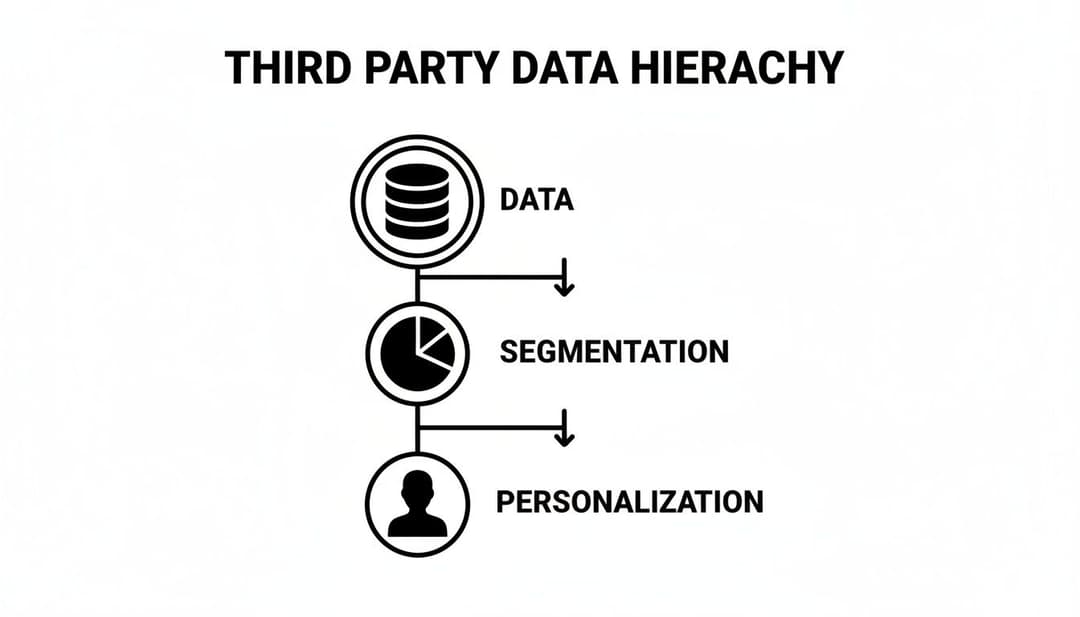
The process looks smooth, but that massive scale comes with some serious trade-offs—especially as privacy regulations get tighter and consumers become more aware of how their data is being used.
First vs Second vs Third-Party Data: A Quick Comparison
To really nail down the differences, it helps to see them side-by-side. Each data type has a distinct profile when it comes to source, accuracy, scale, and risk.
| Attribute | First-Party Data | Second-Party Data | Third-Party Data |
|---|---|---|---|
| Source | Collected directly from your own audience (website, app, CRM). | Acquired from a trusted partner's first-party data. | Purchased from data aggregators with no direct customer relationship. |
| Accuracy | Very High. You control collection and quality. | High. It's another company's reliable first-party data. | Variable. Accuracy can be questionable due to aggregation methods. |
| Scale | Limited. Restricted to your own audience reach. | Moderate. Expands reach to a new, relevant audience. | Massive. Provides access to millions of anonymous user profiles. |
| Privacy Risk | Low. Collected with direct user consent. | Moderate. Relies on the partner's compliance standards. | High. Often lacks transparency and is subject to regulations. |
As you can see, there’s a clear trade-off. First-party data offers the highest quality and safety but the lowest scale. Third-party data is the exact opposite. Understanding these distinctions is the first step toward building a more robust and future-proof advertising strategy.
Navigating the Risks of a Post-Cookie World
The ground beneath digital advertising is cracking. For years, marketers built their empires on the bedrock of third-party cookies, but that foundation is crumbling—fast. This isn't just some minor technical update; it's a massive shift driven by an unstoppable force: people demanding their privacy back.
This isn't just a trend, it's being cemented into law. Regulations like GDPR in Europe and CCPA in California were just the opening acts. These laws hand consumers real control over their data, slapping strict rules on how it’s collected, stored, and used for ads.
For marketers who have leaned heavily on third-party data to fuel their campaigns, this new world brings some serious headaches. The old playbook of buying up audience lists and chasing users across the web is quickly becoming a relic. It's time to evolve.
The Real Costs of Non-Compliance
Trying to ignore these changes is not an option. The risks of mishandling data or simply failing to adapt are steep, and they go way beyond a dip in campaign performance. The consequences are real, tangible, and can leave a lasting scar on your business.
First, there are the fines. Non-compliance with laws like GDPR can lead to staggering penalties—up to 4% of a company's annual global turnover. These aren't just empty threats. Regulators have already hit major brands with massive fines, sending a clear message that they mean business.
But the financial hit might not even be the worst part. The damage to customer trust can be far more devastating. In an age where everyone is skeptical about how their data is being used, a single privacy screw-up can permanently tarnish your brand's reputation. Once that trust is gone, winning it back is a monumental task.
Why Third-Party Risk Management is Now Essential
Even as we pivot to first-party data, the need for external data partners won't vanish completely. What must change is how you work with them. This is where a solid third-party risk management (TPRM) program becomes non-negotiable. At the end of the day, you are responsible for the data you use, no matter where it came from.
A strong TPRM framework isn't complicated, but it is critical. It boils down to a few key steps:
- Thorough Due Diligence: Before you even think about signing a contract, you have to rigorously vet potential data partners. Dig into their collection methods, their security protocols, and their documented compliance with all relevant privacy laws.
- Clear Contractual Obligations: Your agreements need to be ironclad. They must spell out exactly how data will be handled, including access controls, encryption standards, and what happens if there’s a breach.
- Continuous Monitoring: The work isn't over once the ink is dry. You need ongoing oversight to make sure your partners are consistently sticking to the rules and adapting to new regulations as they pop up.
This shift puts a huge premium on transparency. Your own internal data practices must be impeccable, as outlined in our AdStellar AI privacy policy. In a world moving beyond third-party cookies, transparent communication through a clear Privacy Policy is essential for maintaining consumer trust and ensuring compliance.
The Growing Market for Compliance
The critical need to properly vet data partners is fueling explosive market growth. The TPRM market, which is essential for safely using third party data in ad tech, was valued at USD 8.08 billion in 2025 and is projected to skyrocket to USD 33.55 billion by 2035.
This surge tells a clear story: compliance is now central to running global campaigns. Especially when you consider that an alarming 45% of data breaches originate from third-party vendors. As this space gets more complex, AI-driven tools that can scale risk assessments are becoming absolutely indispensable.
Winning Strategies for a Cookieless Future

The slow death of the third-party cookie isn't an apocalypse for advertisers. It's actually the start of a smarter, more durable era in marketing. Instead of just renting audience data from faceless aggregators, the future belongs to brands that build and own their customer relationships. This is a fundamental pivot—from borrowing insights to creating genuine value that earns you data directly.
The great news? This transition forces us toward more sustainable and powerful ways to connect with people. By prioritizing quality over sheer quantity and focusing on consent over cookies, you can build a marketing machine that isn't just compliant but is far more effective for the long haul. Here's your roadmap to not just survive the shift, but to absolutely crush it.
Double Down on First-Party Data Collection
In this new world, your most valuable asset is the data you collect yourself. Your first-party data—the information customers and prospects willingly share with you—is the gold standard. It’s accurate, relevant, and privacy-compliant right from the source. The goal is no longer to track, but to create compelling reasons for your audience to hand over their information.
You can seriously level up your first-party data game with a few key tactics:
- Offer Exclusive Content: Gate your best resources—think in-depth guides, webinars, or handy tools—behind a simple email signup. If the value is there, people will sign up.
- Build a Loyalty Program: Reward your repeat customers. Give them points, exclusive discounts, and early access to new products. This encourages them to create accounts and tell you exactly what they like.
- Use Interactive Experiences: Pull users in with quizzes, surveys, or personalized product finders. You capture incredibly valuable preference data while giving them a fun, engaging experience.
When you create a clear value exchange, data collection stops feeling transactional and starts feeling like a real relationship.
Explore Strategic Second-Party Data Partnerships
While you're building that first-party data goldmine, don't sleep on the power of collaboration. Second-party data partnerships let you tap into another company's high-quality first-party data, giving you a hyper-targeted way to reach new, relevant audiences without the baggage of broad third-party data.
Imagine a boutique fitness apparel brand partnering with a popular wellness app. The brand gets direct access to a verified audience of fitness fanatics, and the app gets to offer its users exclusive discounts. It's a win-win. This kind of strategic alliance is a potent way to expand your reach with surgical precision.
The key is finding non-competing partners who cater to the same audience you do. These relationships are built on trust and a shared understanding, ensuring the data is both relevant and ethically sourced.
Leverage Privacy-Enhancing Technologies
The end of the cookie has kicked off a wave of innovation in privacy-first advertising tech. To stay ahead of the curve, you need to start experimenting with these emerging solutions to see what sticks for your brand.
One of the most promising is the data clean room. Think of it as a secure, neutral space where multiple companies can pool their anonymized first-party data for analysis without ever sharing raw customer info. For instance, you could match your customer list against a publisher's subscriber list to measure campaign overlap, all while protecting individual user privacy.
As cookies fade, understanding new ways to get discovered online is vital. Concepts like navigating the future of digital visibility with AEO vs SEO are becoming essential for marketers planning for future growth.
Harness AI to Bridge the Data Gap
In a world with fewer tracking signals, artificial intelligence is stepping in to fill the void. AI-powered platforms like AdStellar AI can analyze performance data directly from your ad accounts, uncovering patterns and correlations that predict what works—no invasive cross-site tracking needed. This is a cornerstone of the best data-driven marketing technology available today.
These systems use machine learning to figure out which creative, messaging, and audience signals are driving results. The AI can then automatically shift your budget to the winning combinations and even generate new campaign ideas based on what's already proven to perform. This approach turns your own performance metrics into powerful, predictive insights, helping you find new pockets of customers more effectively than ever.
The role of third party data in advertising has completely reshaped performance marketing. A close proxy, alternative data, reached USD 8,889.1 million globally in 2024 and is forecasted to hit a staggering USD 181,103.5 million by 2034. North America leads this trend with over 68.9% market share, as institutions use advanced analytics to gain a competitive edge.
Your Questions on Third-Party Data Answered
Even when you've got the basics down, the slow fade of third-party data brings up a ton of practical, "what-do-I-do-now?" questions for performance marketers. Let's get straight to the most common ones and give you some direct, no-fluff answers to help you navigate what's next.
Will Third-Party Cookies Disappear Completely in 2025?
This is the billion-dollar question, isn't it? The answer has gotten a lot murkier. Google initially set a hard deadline for phasing out third-party cookies in Chrome, but they've recently pumped the brakes. For the time being, Chrome will keep giving users control through their existing privacy settings instead of flipping a universal "off" switch.
But don't get too comfortable. This feels more like a temporary delay than a change of heart. Other big players like Safari and Firefox have been blocking these cookies by default for a while now. The pressure from regulators and consumers for more privacy isn't just going to vanish. Think of this extra time not as a return to the old days, but as a critical window to double down on building a more sustainable, privacy-first strategy. Getting complacent right now is the single biggest mistake you could make.
How Does This Shift Impact My Meta Ad Campaigns Specifically?
The hit to Meta campaigns is real, especially since so much of its targeting magic was built on the back of third-party data signals. As that data gets patchier and less reliable, you're going to feel it in a few key areas:
- Audience Size and Quality: Some of those super-detailed interest and behavioral targeting options? They'll likely get less precise or shrink as the data fueling them dries up.
- Lookalike Audience Performance: Lookalikes could lose some of their punch. They need rich, high-quality seed data to work their magic and find similar users across the web.
- Retargeting Challenges: Following potential customers from your site across the internet to show them ads is getting much harder without cookies playing tag.
- Measurement and Attribution: Connecting an ad someone saw on Instagram to a purchase they made on your website a week later? That puzzle is becoming way more difficult to piece together.
The best way to fight back is to lean heavily into Meta's own first-party data tools. Things like the Conversions API (CAPI) and Lead Forms are no longer nice-to-haves; they're essential. They create a direct line of communication between your server and Meta's, bypassing the browser entirely and giving you a much more dependable stream of data.
What Is the Single Most Important Action to Take Right Now?
If you do only one thing, make it this: aggressively build and enrich your first-party data. This is your gold. It's the most valuable and future-proof asset you have in a world without cookies. Stop renting audiences from other platforms and start owning the relationship with customers who actually want to hear from you.
This all comes down to creating a clear value exchange. Give people a real reason to hand over their email or create an account. It could be exclusive content, a loyalty program, a helpful quiz—whatever it is, make it compelling. This owned data becomes the bedrock of every other strategy you build.
Are Data Clean Rooms a Realistic Option for Small Businesses?
They used to be the exclusive playground for enterprise brands with bottomless budgets and mountains of data, but data clean rooms are slowly becoming more mainstream. Think of them as a secure digital room where you and a partner—like a publisher or another brand—can pool your anonymized data to find insights without ever seeing each other's raw customer lists.
For a growing e-commerce store, that might mean partnering with a complementary brand to see how much your audiences overlap. It still takes some technical legwork and the right partner, but the technology is getting easier to use. Keep an eye on this space, because it’s a huge piece of the privacy-first advertising puzzle.
How Can AI Help Mitigate the Loss of Third-Party Data?
This is where things get interesting. Artificial intelligence is one of your strongest allies in this shift. Instead of relying on tracking what people do all over the web, AI-driven platforms can dig into your own campaign performance data to find winning patterns. They figure out which creative, copy, and audience combos are actually driving results for you.
Basically, these tools stop looking for external signals and start focusing on your internal results. They learn what works for your brand and use those insights to automatically shift budgets, test new campaign ideas, and find new high-potential audiences based on actual performance. It effectively turns your Meta Ads Manager into a predictive engine, filling the void left by disappearing third-party data.
Ready to future-proof your Meta campaigns? AdStellar AI uses machine learning to test, launch, and scale ads 10x faster, turning your performance data into a powerful competitive advantage. Stop guessing and start scaling with a data-backed approach.