Pay-per-click advertising on Facebook (now Meta) is a straightforward deal: you pay for each click your ad gets. The goal is to drive highly targeted traffic to your website or landing page, and success is measured by how well those clicks turn into real business, like sales or leads.
Building Your Foundation for Facebook PPC Success
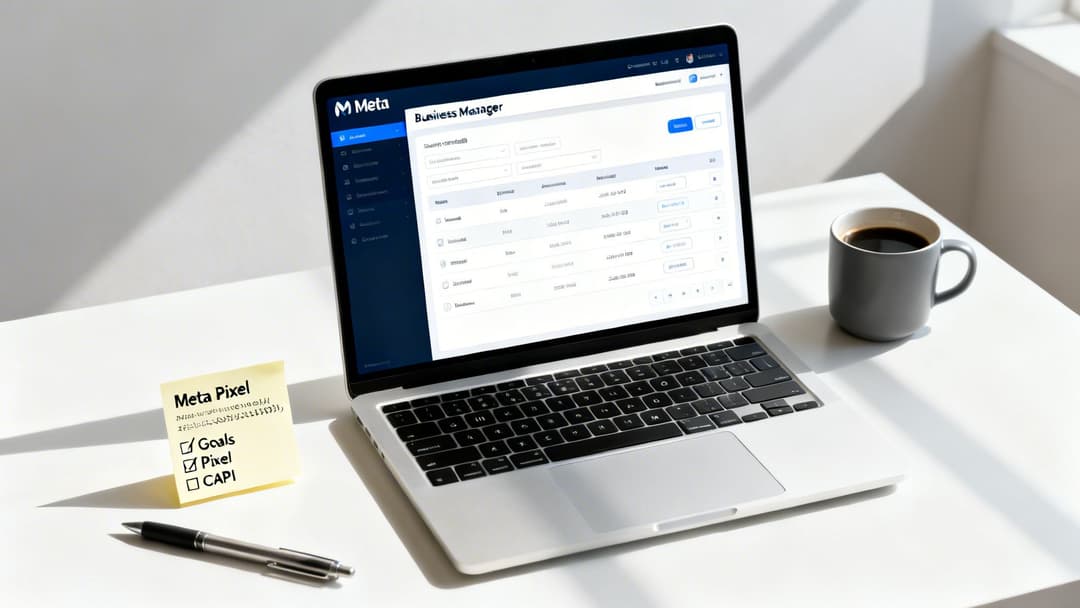
Jumping into Meta ads without a plan is like building a house on sand. Before you even think about writing ad copy or designing a single creative, the most critical step is laying a solid foundation. This groundwork ensures every dollar you spend is trackable, measurable, and working as hard as possible.
The first move is to define clear, actionable objectives. What are you actually trying to achieve? More online sales? A pipeline full of qualified leads? App installs? Your goal dictates every other decision you'll make, from the ad format you choose to the audience you target. Without a specific goal, you're just flying blind.
Choosing the right campaign objective from the start is crucial because it tells Meta's algorithm exactly what you want to accomplish. This decision directly influences who sees your ads and how your budget is spent. To help clarify, here’s a breakdown of the most common objectives and when they make the most sense.
Key Facebook PPC Campaign Objectives and When to Use Them
This table breaks down the most common Meta Ads objectives, providing clear use cases and key performance indicators (KPIs) to track for each one, helping you align your campaign goals with business outcomes.
| Campaign Objective | Primary Use Case | Key Performance Indicator (KPI) |
|---|---|---|
| Awareness | Reaching a broad audience to build brand recognition or announce a new product. Best for top-of-funnel marketing. | Reach, Impressions, Ad Recall Lift |
| Traffic | Driving users to a specific URL, like a blog post, landing page, or product page, without a direct conversion goal. | Link Clicks, Landing Page Views, Cost Per Click (CPC) |
| Engagement | Encouraging likes, comments, shares, event responses, or page follows to build a community and social proof. | Post Engagement, Cost Per Engagement (CPE) |
| Leads | Collecting information from potential customers directly on Facebook (Instant Forms) or on your website. | Leads, Cost Per Lead (CPL), Conversion Rate |
| App Promotion | Driving new installs for your mobile app or encouraging existing users to take specific actions within the app. | App Installs, App Events, Cost Per Install (CPI) |
| Sales | Driving valuable actions on your website, like purchases, add-to-carts, or subscriptions. The go-to for e-commerce. | Purchases, Conversion Value, Return on Ad Spend (ROAS) |
Aligning your business goal with the correct campaign objective is the first major step toward a successful PPC strategy. It sets the algorithm up to work for you, not against you.
Setting Up Your Tracking Infrastructure
Once you know what you want to achieve, you have to install the tools to measure it. The Meta Pixel and Conversions API (CAPI) are completely non-negotiable for any serious advertiser. These snippets of code act as the bridge between Meta's ad platform and your website, tracking user actions and feeding that crucial data back into the system.
This tracking data is the lifeblood of your campaigns for three main reasons:
- Accurate Measurement: It lets you see exactly which ads are driving conversions, giving you the hard data needed to calculate your return on ad spend (ROAS).
- Audience Building: It unlocks the ability to create powerful Custom Audiences of website visitors for retargeting—one of the highest-returning strategies available.
- Algorithm Optimization: It feeds Meta's machine learning algorithm, helping it find more people who are likely to take the action you want, which ultimately lowers your costs over time.
For a detailed walkthrough on getting this set up, check out our guide on how to set up the Facebook Pixel.
Organizing for Scalable Growth
Finally, a clean, well-structured Meta Business Manager is essential, especially if you're an agency or a brand managing multiple ad accounts. Think of it as your command center. Organizing your ad accounts, pages, and user permissions correctly from day one will save you from massive logistical headaches and security risks down the road.
A strong benchmark for Facebook PPC success is an average conversion rate of 9.21%, with top-performing campaigns pushing past 12%. This performance directly ties clicks to valuable actions like purchases or leads, which are worth an average of $19.68 CPA.
This disciplined approach allows for clean reporting and efficient management as you scale. Success in pay-per-click advertising on Facebook hinges on this foundational work, turning your ad spend from a cost into a predictable, revenue-driving engine. Get these basics right, and you're already miles ahead of the competition.
Mastering Audience Targeting That Actually Works
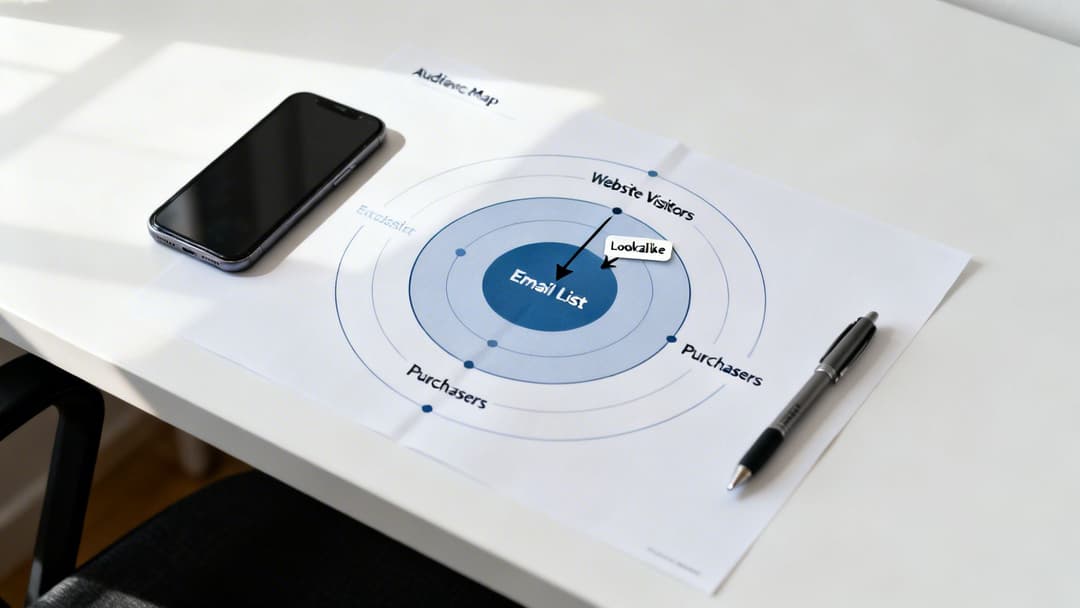
Here's where so many advertisers go wrong: they think pay per click advertising on Facebook is about reaching the most people possible. It's not. It’s about reaching the right people. While broad demographic targeting can feel like a good starting point, the real money is made when you use your own data to build audiences that have already shown interest in what you sell.
This is where you stop guessing and start knowing. The foundation for this smarter approach is Custom Audiences.
These audiences are built from your most valuable assets: the people who already know your brand. Think of them as your warm leads. They're already familiar with you, so you don't have to start from scratch.
You can create these powerful segments from a few key sources:
- Website Visitors: Using the Meta Pixel, you can group people who visited specific pages, spent a certain amount of time on your site, or even added products to their cart but never checked out.
- Customer Lists: This is gold. You can upload a list of customer emails or phone numbers, and Meta will securely match this data to user profiles. It’s the perfect way to retarget existing customers with new offers or upsells.
- App Activity: If you have a mobile app, you can create audiences based on what people do inside it, like finishing a tutorial or making an in-app purchase.
Unlocking New Customers with Lookalike Audiences
Once you have a solid Custom Audience, you can tap into one of Meta's most powerful features: Lookalike Audiences. This tool lets you take a "seed" audience—like your list of top customers—and have Meta's algorithm find new people who share similar characteristics, behaviors, and interests.
For example, you could create a Lookalike Audience based on customers with a lifetime value over $500. This tells the algorithm to find new users who act like your most profitable buyers, not just random one-time shoppers.
This is worlds more effective than just manually layering interests because it’s built on actual conversion data. You're basically creating a data-driven model of your ideal customer and asking Meta to find more people just like them.
Advanced Layering for Full-Funnel Success
The real experts combine these audience types to build a full-funnel strategy that guides users from their first interaction all the way to a sale. For a deeper dive, exploring various audience segmentation strategies can give you a more detailed playbook.
Here’s what that looks like in practice:
- Top of Funnel (Awareness): You might start with broad interest targeting, but you’ll also mix in a 10% Lookalike Audience built from your website visitors. This introduces your brand to a massive but still highly relevant group of new people.
- Middle of Funnel (Consideration): Now, you retarget people who are showing real interest. Think Custom Audiences of users who watched 75% of your video ads or visited a product page. You hit them with testimonials and case studies to build trust.
- Bottom of Funnel (Conversion): This is where you close the deal. You serve direct, action-oriented ads to a Custom Audience of people who abandoned their cart in the last 7 days, maybe with a small incentive to get them over the finish line.
To get really good at this, you need to understand the core principles at play. A solid grasp of the targeting in marketing definition is crucial for applying these concepts effectively on a platform like Facebook. By layering Custom, Lookalike, and interest-based audiences, you create a sophisticated system that nurtures potential customers and drives predictable results.
Crafting Ad Creative and Copy That Converts
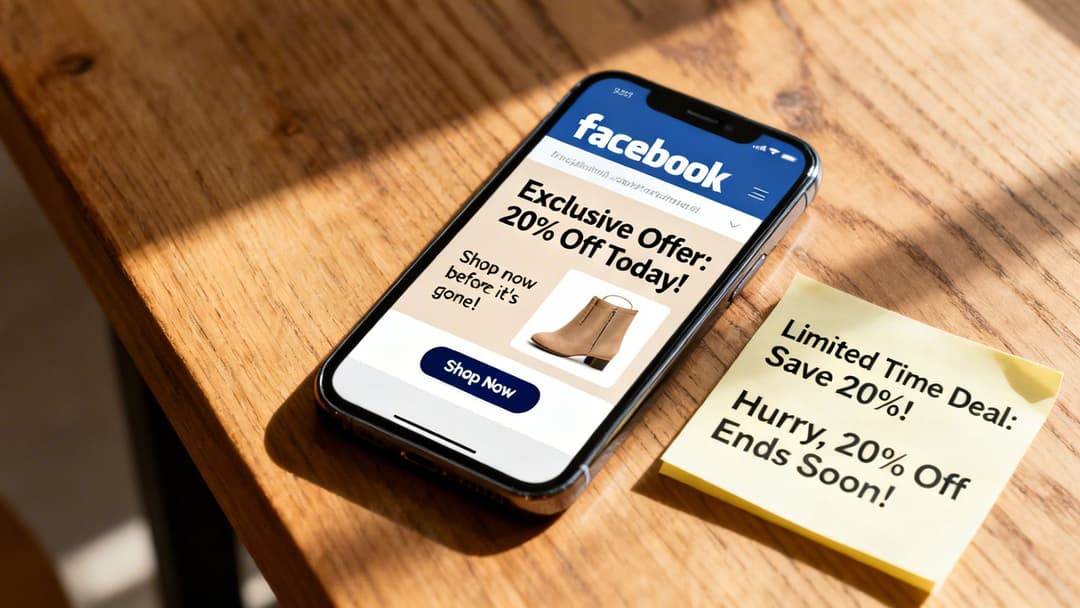
Nailing your audience targeting gets your ad in front of the right eyeballs, but it's your creative that actually makes them stop scrolling and pay attention. In the fast-paced feed of pay per click advertising on Facebook, your ad's visuals and words are your most valuable assets. A killer ad doesn't just interrupt; it engages, resonates, and ultimately convinces someone to act.
The visual—whether it's an image, a carousel, or a video—is the very first thing people see. You have less than three seconds to hook them. For static images, that means high-contrast colors, crystal-clear product shots, and minimal text overlay. I’ve found that authentic, user-generated content (UGC) often blows polished studio photography out of the water because it feels real and native to the platform.
Video is an even bigger powerhouse, especially in mobile-first placements like Reels and Stories. The trick is to design for a sound-off experience. Think bold, easy-to-read captions and a strong visual hook in the first couple of frames.
Writing Copy That Connects and Sells
Once your visual has done its job, your copy needs to close the deal. The best ad copy speaks directly to a specific pain point or desire, making your ideal customer feel seen and understood. Don't just list features; talk about the benefits and the transformation your product or service delivers.
A tried-and-true formula for writing compelling copy is the PAS framework:
- Problem: Kick things off by calling out a core problem your audience is wrestling with. (e.g., "Tired of spending hours building marketing reports?")
- Agitate: Pour a little salt in the wound. Expand on that problem and highlight the frustration it causes. (e.g., "You're buried in data, struggling to find actual insights.")
- Solution: Present your product as the obvious, simple solution to that nagging pain. (e.g., "Our tool builds beautiful, automated reports in just 60 seconds.")
If you want to go deeper on this, we've got an entire article on writing great advertising copy that’s packed with more advanced techniques and examples.
The Anatomy of a High-Converting Ad
A truly effective Facebook ad is a single, cohesive unit. Every element—the visual, headline, primary text, and call-to-action (CTA)—has to be perfectly aligned with your campaign goal and your landing page.
That CTA button is your final command, and it needs to be crystal clear. If you're after leads, "Download Now" or "Get Your Free Guide" is worlds better than a vague "Learn More." Mismatching your CTA and your landing page is one of the fastest ways to tank your conversion rates.
Compelling creative has a direct, measurable impact on performance. While the average click-through rate (CTR) on Facebook hovers around 1.44%, elite ads can hit 2.5% or even higher. It just goes to show how powerful great design and copy truly are.
Ultimately, your success comes down to how well your ad communicates value. The latest data shows that ads for lead generation campaigns boast the highest CTR at 2.53%—a whopping 60% higher than standard traffic campaigns. Why? Because they perfectly combine precise targeting with a high-intent offer. It’s the perfect synergy of audience and creative.
By focusing on creating scroll-stopping visuals and benefit-driven copy, you can turn your PPC spend into a reliable conversion machine.
Winning with Smart Bidding and Budget Strategies
This is where the real money is made or lost in pay-per-click advertising on Facebook. You can have the most brilliant creative and a perfectly dialed-in audience, but if your budget and bidding strategy are off, none of it matters. Getting this right is all about giving Meta’s algorithm the right instructions so it can go out and get you the best possible return.
The first big decision you’ll make is your bid strategy. This is you telling Meta how to spend your money in the ad auction. For most of us focused on performance, the choice usually comes down to two main options: Highest Volume and Cost Per Result Goal (or ROAS Goal for e-commerce).
Selecting the Right Bid Strategy
Highest Volume is pretty much what it sounds like. You tell Meta's algorithm to get you the most conversions it possibly can within your budget. I find this is the best way to start a new campaign. You need to gather data, see what's possible, and let the algorithm learn. It's also great if your primary goal is just to maximize the number of leads or sales, without being handcuffed to a super-strict efficiency target.
On the flip side, a ROAS Goal or Cost Per Result Goal puts you in the driver's seat. You get to set a specific target, like a minimum 3x return on ad spend. Meta will then only bid in auctions where it thinks it can hit that number. This is the go-to strategy for campaigns where hitting a specific profitability target on every single conversion is non-negotiable.
My rule of thumb? I almost always start new campaigns with Highest Volume. This lets the algorithm breathe and figure out what works. Once I have a solid baseline for my cost per acquisition (CPA), I might switch over to a Cost Per Result Goal to lock in that efficiency as I start to scale up the budget.
Campaign Budget Optimization vs Ad Set Budgets
Next up, you have to decide where to set the budget itself. You can do it at the campaign level, using what’s called Campaign Budget Optimization (CBO), or you can control it at the ad set level (Ad Set Budget Optimization, or ABO).
- Ad Set Budgets (ABO): This gives you pinpoint control. You assign a specific daily or lifetime budget to each individual ad set. This approach is perfect when you're in the testing phase. You need to make sure each audience you're testing gets a fair shot with an equal amount of spend to see which one truly performs best.
- Campaign Budget Optimization (CBO): With CBO, you set one single budget for the whole campaign. Meta’s AI then takes over, shifting that money to the best-performing ad sets automatically and in real time. For scaling campaigns that are already proven, CBO is almost always the better choice. It pushes your money towards the winners without you having to do it manually, which maximizes your overall results. For a deeper dive, our guide on ad spend optimization has you covered.
It helps to have some benchmarks in mind. In 2026, the average global cost per click (CPC) is expected to hover around $0.51 to $0.54. But I've seen top-tier campaigns get clicks for as low as $0.30 when they nail the combination of smart bidding and sharp targeting. These numbers swing wildly by industry—real estate might see a CPC of $0.91, while a simple traffic campaign could get clicks for just $0.04. You can dig into more Facebook ad statistics on electroiq.com. It just goes to show how critical it is to match the right budget strategy to your specific industry and what you're trying to achieve.
How to Optimize and Scale Your Ad Campaigns
Getting your first campaign live is a great first step, but it’s just the beginning. The real magic in pay per click advertising on Facebook happens in the optimization and scaling phases. This is where you take raw data and turn it into a predictable growth machine, shifting from just "running ads" to systematically making them better.
The Meta Ads Manager is your command center for all of this. It's easy to get lost in the endless columns of data, so let’s cut through the noise and focus on the handful of metrics that actually tell you if your campaigns are healthy.
Core Metrics to Monitor
Watching the right numbers gives you a clear diagnosis of what's working and what's not. Don't get obsessed with vanity metrics like clicks; you need to analyze the data that ties directly back to your business goals.
- Cost Per Acquisition (CPA): This is your north star metric. It tells you exactly how much you’re paying to acquire a new customer or lead. If your CPA is below your target, you're in the green. It’s that simple.
- Return On Ad Spend (ROAS): For any e-commerce business, this is the bottom line. It measures the revenue you generate for every single dollar you spend on ads. A ROAS below 1x means you're literally losing money on every sale.
- Frequency: This one tells you how many times, on average, a person has seen your ad. When this number starts creeping up—usually above 3-4 in a short window—you're heading into ad fatigue territory. Costs will rise and performance will drop.
These three metrics tell a story. A high CPA might mean your audience and creative aren't a good match. A tanking ROAS could signal your offer has lost its punch.
The A/B Testing Framework
Optimization is really just a fancy word for disciplined testing. The entire goal is to isolate a single variable at a time to see what actually moves the needle. If you test multiple things at once, you’ll have no idea what caused the change.
I always recommend starting with the big, impactful elements first before you start fiddling with button colors. My go-to testing hierarchy looks like this:
- Audience: Pit a powerful Lookalike Audience against a well-researched interest-based group.
- Creative: Test a dynamic video ad against a killer static image.
- Ad Copy: Try a short, punchy headline versus a longer, more story-driven approach.
A word of caution: always give your A/B tests enough time and budget to collect meaningful data. Calling a winner after a handful of clicks is a recipe for disaster. I usually wait for at least a few days and a decent number of conversions before I make a call.
Once you find a clear winner, that becomes your new "control" ad. Then, you rinse and repeat, testing a new variable against it. This simple, iterative process is the secret sauce to consistent improvement. For a deeper dive, check out our complete guide on Facebook ad optimization.
This flowchart breaks down the simple but incredibly effective workflow I use for managing PPC budget allocation.
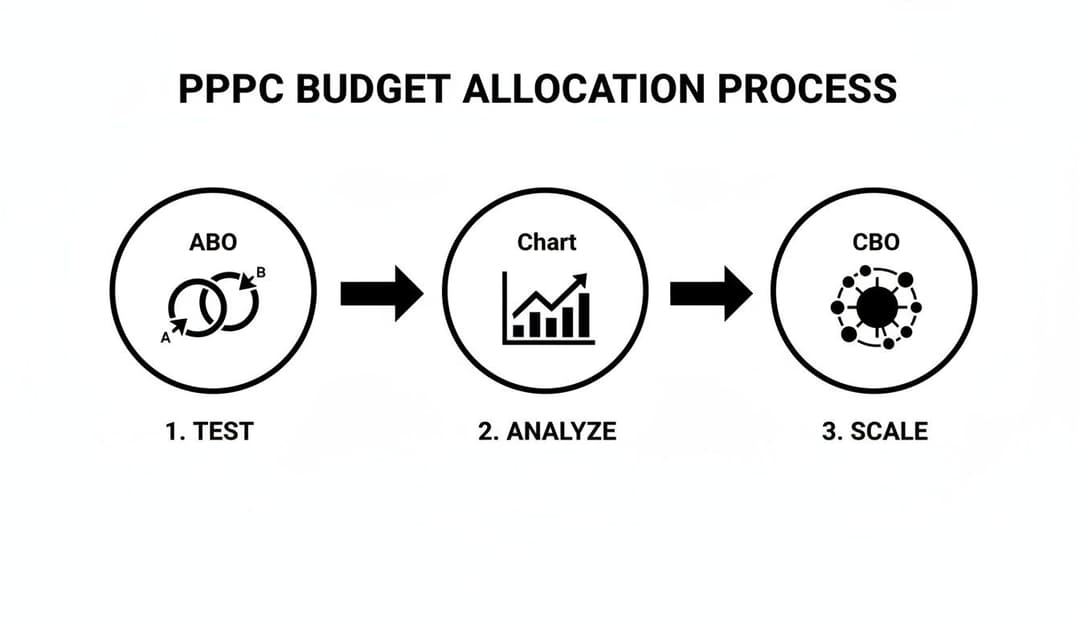
It all starts with controlled testing using Ad Set Budgets (ABO). From there, you analyze what's working and scale the winners confidently using Campaign Budget Optimization (CBO).
Knowing When and How to Scale
Scaling isn't about just dumping more money into an ad set. If you do it too fast, you can wreck your campaign's performance. The green light for scaling is consistent profitability. If you have an ad set that's been hitting its target CPA or ROAS for 3-5 consecutive days, it's ready for more fuel.
But you have to scale smart. My rule of thumb is to increase the budget gradually—no more than 20-30% every 48-72 hours. This slow-and-steady approach lets you feed the Meta algorithm without sending it into shock and resetting the learning phase. It’s the key to growing your ad spend without killing your performance.
Your Top Facebook PPC Questions, Answered
If you’ve spent any time in the trenches with Facebook ads, you know a few questions pop up over and over again. It doesn’t matter if you’re managing a tiny test budget or scaling a seven-figure account—the same hurdles trip up marketers at every level.
Let’s cut through the noise and get straight to the practical answers you need to make smarter, more profitable decisions.
How Much Should I Spend on Facebook Ads When I'm Just Starting Out?
There’s no magic number here, but a solid rule of thumb is to start with $10 to $20 per day for each ad set you plan on testing. This is usually just enough runway for Meta's algorithm to get out of its initial "learning phase" and start feeding you some usable performance data.
But honestly, the budget itself is less important than your target Cost Per Acquisition (CPA). If you sell a product for $100 and have a 50% profit margin, you know you can spend up to $50 to get a new customer and still break even. That number is your north star.
A key benchmark is to aim for a budget that lets you hit at least 50 conversions per ad set, per week. Why? Because that’s the volume of data the algorithm really needs to learn who your best customers are and optimize effectively. Think of your first few weeks of ad spend as buying data, not just sales.
What's the Real Difference Between CBO and ABO Budgets?
This is one of the most fundamental choices you'll make, and it directly impacts how you test and scale your campaigns. They each have a very specific job.
Ad Set Budget Optimization (ABO): With ABO, you set a specific daily or lifetime budget for each individual ad set. This gives you granular control, letting you dictate exactly how much is spent on a particular audience. This makes it perfect for the testing phase, where you need to give every new audience a fair, equal shot to prove itself.
Campaign Budget Optimization (CBO): Here, you set one single budget at the campaign level. Meta's AI then takes the wheel, automatically shifting that budget in real-time to the ad sets that are crushing it. CBO is hands-down the best way to scale campaigns that are already working because it's built to maximize efficiency by constantly backing your winners.
Why Are My Facebook Ad Costs So High All of a Sudden?
Sky-high ad costs—specifically your CPM (Cost Per 1,000 Impressions)—almost always come down to a few usual suspects. First, take a hard look at your audience. If it’s too narrow or you’re targeting a hyper-competitive group (like everyone else marketing to e-commerce shoppers), you’re going to pay a premium in the ad auction.
Second, your creative might be falling flat. Meta's algorithm rewards ads that get high engagement and penalizes ads that users scroll past. If your relevance score is poor, your delivery costs will go up.
And finally, never underestimate seasonality. Costs always spike during big shopping holidays like Black Friday and Cyber Monday. To bring those costs down, try broadening your audience, refreshing your ads with more engaging formats like video or Reels, and making sure your landing page offers a great user experience.
Ready to stop the guesswork and accelerate your results? AdStellar AI is an AI-powered platform that launches, tests, and scales your Meta ad campaigns 10x faster. Generate hundreds of ad variations in minutes, let AI identify your top performers, and turn creative chaos into predictable revenue. Learn more and see how it works at AdStellar AI.