Yes, Facebook advertising still delivers powerful results, but the rules of the game have completely changed. Success isn't about just boosting posts anymore; it’s about strategically partnering with Meta's algorithm, using sharp data, and running rapid-fire creative tests to find what really connects with your audience.
Yes, Facebook Ads Still Work If You Know the Rules
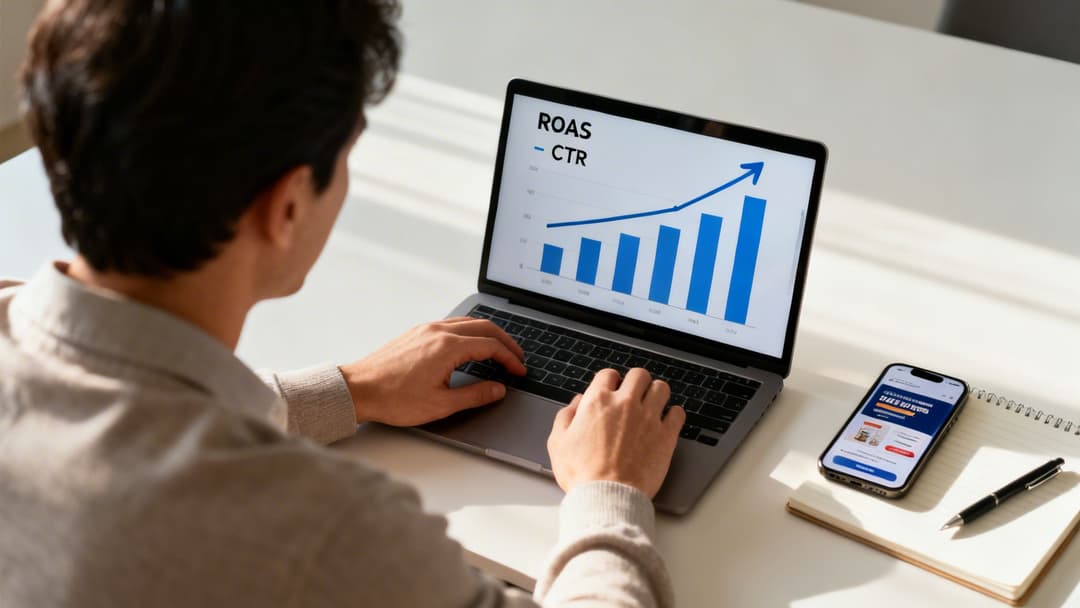
The myth that Facebook ads are "dead" usually comes from a misunderstanding of how the platform has evolved. The truth is, Meta’s advertising ecosystem is more powerful than ever—but only for businesses willing to adapt. The key is to stop chasing vanity metrics and start focusing on tangible business outcomes measured by the right key performance indicators (KPIs).
Instead of getting excited about likes or comments, smart advertisers are tracking the numbers that directly impact their bottom line. Two of the most crucial are Return on Ad Spend (ROAS), which tells you how much revenue you’re making for every dollar spent, and Click-Through Rate (CTR), which shows how compelling your ads are to the people you’re trying to reach.
Aligning Your Goals With Ad Objectives
To get real results, your campaign's objective must perfectly match your business goal. Setting the wrong one is like using a map for the wrong city—you’ll be moving, but you'll never reach your destination. Meta’s platform is a finely tuned machine, and it’s designed to optimize for the specific action you tell it to.
Success on Facebook isn't about outspending competitors; it's about out-thinking them. By aligning your business goals with the correct ad objective, you tell the algorithm exactly what success looks like, allowing it to find the right people for the right price.
The proof is in the data. The best way to see that Facebook ads still work is by looking at how effectively they can generate business leads and grow sales when you use the right objective. Data from 2026 shows that lead generation campaigns now pull in an average CTR of 2.53%. That’s a whole 61% higher than standard traffic campaigns.
This kind of performance shows just how good the platform is at driving meaningful actions when you know how to use it. You can learn more about putting these strategies into practice in our full guide to Facebook advertising best practices.
Matching Objectives To Business Goals
Picking the right campaign objective can feel tricky, but it’s actually pretty straightforward when you match it directly to what you want to achieve.
Here’s a simple table to help you choose the right objective every time.
Facebook Ad Objectives Matched to Business Goals
| Business Goal | Best Meta Ad Objective | Primary KPI |
|---|---|---|
| Increase Brand Recognition | Awareness or Reach | Ad Recall Lift, Impressions |
| Drive Website Visitors | Traffic | Cost Per Click (CPC), CTR |
| Capture New Prospects | Lead Generation | Cost Per Lead (CPL) |
| Boost Product Sales | Sales (Conversions) | ROAS, Cost Per Acquisition |
Think of this table as your cheat sheet. By starting with your end goal and working backward to select the right objective, you're setting your campaigns up for success from day one.
It’s no accident that businesses keep pouring money into Meta’s ad platform. This isn’t just a habit—it’s a strategic bet based on three things that work together in a powerful way: massive scale, incredibly rich behavioral data, and a machine-learning algorithm that’s always getting smarter.
Once you see how these three pieces connect, it becomes crystal clear why Facebook advertising can deliver such incredible results when you know what you're doing.
Imagine you’re opening a new shop. You could put it on some quiet, forgotten side street, or you could set up right in the middle of the busiest town square on the planet. With 2.28 billion daily active users, Meta is that global town square. That’s not just a vanity metric; it’s an unparalleled opportunity to reach almost any niche audience you can dream up, from local pottery fans to enterprise software buyers on the other side of the world.
This massive scale, combined with deep user engagement, is what makes the ads so potent. In fact, a jaw-dropping 74.3% of monthly active users are exposed to advertisements on the platform. These ads aren't just disruptive pop-ups; they are woven right into the daily scroll, creating a natural-feeling journey from discovery to purchase.
More Than Just Demographics
While the sheer number of people is impressive, the depth of the data is what really gives Meta its edge. Traditional advertising often works with broad strokes—things like age, gender, and location. Meta goes so much deeper by tracking behavioral signals that paint a much more vivid picture of a user's true interests and intentions.
Think of it as the difference between a generic flyer and a personal shopper. The flyer handed to everyone at the mall (demographics) is mostly noise. But a personal shopper who knows your style, what you’ve bought before, and what you’ve been browsing online (behavioral data) can show you the perfect item you didn’t even know you were looking for.
Meta’s platform doesn’t just know who its users are; it understands what they do. It sees the articles they read, the videos they watch, and the products they browse, building a rich profile of genuine interest that advertisers can tap into.
The best Facebook campaigns are built on precise targeting. To really harness the power of Meta ads, you first need a solid grasp of the core ideas behind Targeting in Marketing Definition. This is the foundation for turning a massive audience into your best customers.
The Algorithm: The Secret Engine of Success
The final piece of the puzzle is Meta's ridiculously advanced algorithm. This isn't just a simple program that serves up ads. It’s a sophisticated machine-learning system built for one single purpose: to show the most relevant ad to the person most likely to act, all at the lowest possible cost. It’s the intelligent engine connecting that massive user base with all that rich behavioral data.
Here’s a quick rundown of how it works:
- It Learns from Data: The algorithm chews through trillions of data points in real-time, constantly looking for patterns.
- It Predicts Behavior: It uses those patterns to predict which users are most likely to click, sign up, or buy something.
- It Self-Optimizes: With every ad impression, the algorithm tests and learns, automatically pushing your budget toward the creative and audience segments that are actually working.
This creates an incredibly powerful feedback loop. The more data and clear conversion signals you feed it, the smarter and more efficient it gets. It's why a well-built campaign can sometimes feel like magic—the system just seems to find your perfect customers for you. This whole process taps into the core principles of psychology and advertising that get people to take action. The algorithm basically automates this at a scale no human team could ever hope to match.
How to Work With the Meta Ad Algorithm
Think of the Meta ad algorithm as a new, incredibly smart employee you just hired. On its first day, it knows nothing about your customers, your best products, or what kind of messaging actually gets a click. To turn it into a star performer, you have to train it. In the world of Facebook ads, that training is called the learning phase.
This is easily the most critical—and most misunderstood—part of running a successful campaign. During this initial period, the algorithm is actively spending your budget to figure out who is most likely to take the action you want, whether that's a purchase, a form submission, or a simple landing page visit. It needs data, and lots of it, to start making intelligent decisions.
Interrupting this process with constant tweaks is like pulling your new hire into a meeting every five minutes to change their job description. It’s a recipe for confusion and mediocre results. The system needs stability and a big enough budget to collect data points, typically aiming for around 50 conversion events per ad set, per week, to exit the learning phase. If you want to go deeper, you can explore the mechanics of how the Facebook ads learning phase works and see why patience pays off.
Feeding the Algorithm High-Quality Signals
To train your new "employee" effectively, you need to give it the best information possible. The algorithm's performance is a direct reflection of the quality of the data signals you feed it. As privacy becomes a bigger focus, this means shifting away from broad, third-party targeting and leaning into high-intent data you already own.
This is where your first-party customer data becomes your most valuable asset.
- Custom Audiences: Uploading a list of your existing customers lets Meta find those exact people on its platform. This is perfect for re-engagement or upselling campaigns.
- Lookalike Audiences: This is where the real magic happens. By giving the algorithm a high-quality source audience (like a list of your best customers), you're handing it a perfect blueprint. It then analyzes the shared characteristics of those users to find millions of new people who "look" and act just like them.
This simple step transforms the question from "do Facebook ads work?" to "how can I make them work even better?" by giving the system a massive head start.
The visualization below breaks down this simple but powerful process of turning user actions into algorithmic intelligence.
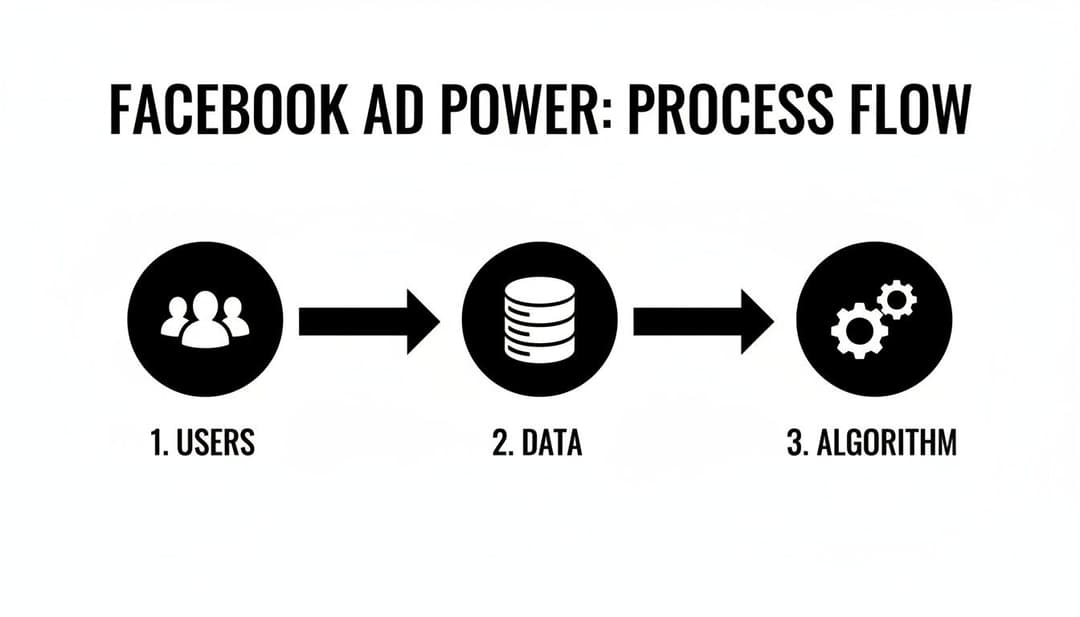
This flow shows how every user interaction—a click, a like, a purchase—generates data that trains the algorithm to make smarter delivery decisions for all your future campaigns.
So, Why Aren't My Facebook Ads Working?
You've heard the success stories. You know about the massive audience and the smart algorithm. But when you look at your own dashboard, the results just aren't there. It's a frustratingly common scenario, but let's be clear: when campaigns sputter and die, it’s rarely because Facebook Ads "don't work." It’s almost always because a critical piece of the puzzle is in the wrong place.
Think of a winning campaign as a three-legged stool: Creative, Audience, and Offer. If any one of those legs is wobbly, the whole thing comes crashing down. Finding the problem means checking each leg for the weak spot.
The Classic Mismatch: Your Audience and Your Offer
More often than not, the culprit is a fundamental disconnect between who you're talking to and what you're offering them. You could have the most brilliant, visually stunning ad in history, but if you show it to the wrong people, you’re just wasting money. It’s like trying to sell premium steak at a vegan convention.
The reverse is also true. Nailing your audience targeting won't save a weak or irrelevant offer. Your product or service has to be a compelling solution to a real problem your audience feels. If they don't see the value, they won't take action.
A perfect audience won't buy a bad offer, and a perfect offer can't save a campaign targeting the wrong crowd. The magic happens at the intersection of the right message, the right person, and the right time.
Start your diagnosis by getting brutally honest with these questions:
- Is my audience too broad? Targeting "everyone interested in fitness" is a surefire way to burn through your budget with nothing to show for it.
- Is it too narrow? If your audience is too small, Meta's algorithm might not have enough data to find its footing and optimize properly.
- Does my offer actually solve a pain point for this group? Your ad has to scream value and instantly answer the user's unspoken question: "What's in it for me?"
Your Creative is Weak or Your Audience is Bored
In the blink-and-you'll-miss-it world of a social media feed, your ad has maybe three seconds to grab someone's attention. If your creative—the image, video, and copy—is bland, generic, or just screams "I'M AN AD!", people will scroll right past. A low Click-Through Rate (CTR) is often the first sign that your creative isn't cutting it.
But even a fantastic ad has a shelf life. Ad fatigue is a very real phenomenon that happens when the same audience sees your ad over and over again. Performance drops, costs rise, and the ad simply stops working. It's not just that people are bored; the algorithm sees the declining engagement and follows suit.
If you find your once-great campaigns are suddenly underperforming, it's a huge red flag. We break down all the reasons this happens in our guide on why Facebook ads stop delivering.
You're Starving the Algorithm of Budget and Data
This one is tough to hear, but many advertisers kill their own campaigns by being too timid with their spending. The Meta algorithm needs fuel—in the form of data and budget—to power through its crucial learning phase. This is where it experiments to figure out who your ideal customers are.
Setting a tiny daily budget of just a few dollars is like trying to drive a car on fumes. The algorithm never gets the 50 conversions per week it often needs to truly optimize and find momentum.
When you choke the system with a small budget, it never learns who to target effectively. You then look at the poor results and mistakenly conclude that Facebook Ads don't work for you. You have to be willing to invest enough to give the platform a fair shot at delivering the goods.
When your campaigns hit a wall, it’s time to go back to basics. Running through a systematic checklist helps you pinpoint the exact issue instead of just guessing.
Below is a troubleshooting table to help you diagnose the most common symptoms of a struggling ad campaign and figure out exactly how to fix them.
Facebook Ads Troubleshooting Checklist
| Symptom (e.g., High CPC, Low CTR) | Potential Cause | How to Fix It |
|---|---|---|
| High CPC / CPM | Audience Saturation or Overlap: Your ads are competing against each other for the same small pool of people. Low Ad Relevance: The ad isn't resonating with the audience, so Meta charges more to show it. |
Use audience exclusion lists to prevent overlap. Refresh your creative assets to combat ad fatigue. Broaden your targeting slightly or test new lookalike audiences. |
| Low Click-Through Rate (CTR) | Weak Creative: Your image/video isn't stopping the scroll. Uninspired Copy: The headline or primary text doesn't create curiosity or highlight a benefit. Wrong Ad Format: Using a single image when a carousel or video would be more effective. |
A/B test different visuals, headlines, and calls-to-action (CTAs). Focus the first line of your copy on the user's pain point or desired outcome. Test different ad formats that better showcase your offer. |
| Low Conversion Rate | Offer-Audience Mismatch: You're selling to the wrong people. Landing Page Friction: The post-click experience is slow, confusing, or doesn't match the ad's promise. Unclear Offer: The value proposition isn't strong enough to drive action. |
Re-evaluate your targeting and make sure it aligns with your ideal customer profile. Optimize your landing page for speed and mobile experience. Ensure your ad's headline and the landing page's headline match. Strengthen your offer with a guarantee, discount, or bonus. |
| Ads Not Delivering | Insufficient Budget: The budget is too low for the algorithm to exit the learning phase. Audience Size Too Small: The target audience is too niche to generate consistent delivery. Ad Disapproval: Your ad violates Meta's policies. |
Ensure your campaign budget is high enough to generate at least 50 conversions per week. Broaden your audience or combine smaller custom audiences. Check your ad account for any policy violations and resolve them. |
This checklist is your starting point. By methodically working through these common issues, you can move from frustration to a clear, data-driven plan for turning your campaign performance around.
How AI Is Reshaping Advertising on Facebook

Let's be honest: manually building, testing, and tweaking Facebook ad campaigns has become a war against the clock. The very algorithm we’re trying to impress thrives on endless creative variety and mountains of data—two things that are incredibly difficult for human teams to deliver at scale. This is precisely where AI stops being a buzzword and starts being your biggest competitive edge.
Looking ahead to 2026, the answer to "do Facebook ads work?" will depend almost entirely on how well you're using automation. AI-powered platforms aren't just a "nice-to-have"; they’re built to smash through the exact bottlenecks that cause most campaigns to fizzle out.
Eliminating the Creative Bottleneck
The Meta algorithm is hungry, and it feasts on a diverse diet of creative options. But for a single media buyer or a small marketing team, pumping out dozens—let alone hundreds—of unique ad variations is a soul-crushing grind. It’s slow, expensive, and kills all momentum before you even get started.
This is the first wall that AI tools simply demolish.
Imagine uploading a handful of product shots and headlines, and in minutes, an AI system spits out hundreds of ready-to-launch ad combinations. It can test different backgrounds, rephrase copy to strike different emotional chords, and perfectly resize everything for every placement, from Reels to the classic news feed.
This isn't just about moving faster; it’s about feeding the algorithm exactly what it needs to find you customers. By giving it an enormous volume of creative variations, you’re basically letting it conduct thousands of tiny experiments to rapidly pinpoint the ad that truly connects with your audience.
This turbocharged process gets you out of the dreaded "learning phase" faster and drives down costs by finding winning ads in days, not weeks. Creative production is no longer a chore; it’s an on-demand strategic weapon.
Removing Guesswork From Performance Analysis
Okay, your ads are live. Now comes the second major headache: figuring out what's actually working. A single campaign can generate thousands of data points scattered across different creatives, audiences, and placements. Trying to make sense of it all in a spreadsheet is not only mind-numbing but also dangerously prone to human bias.
This is where AI analytics bring some much-needed clarity. Instead of you having to hunt for insights, the system brings them right to you.
AI-driven platforms can:
- Identify Winning Elements: Automatically analyze all the data to tell you which specific images, headlines, or calls to action are driving the lowest cost-per-lead or highest ROAS.
- Detect Ad Fatigue: Flag the creatives that are starting to burn out before they waste your budget, so you can swap in fresh content proactively.
- Surface Hidden Opportunities: Uncover high-performing audience pockets or placements you might have completely missed, giving you clear instructions on where to scale next.
Suddenly, performance analysis shifts from a reactive, backward-looking chore to a proactive, forward-looking strategy. You get automated, data-backed advice on what to kill, what to scale, and what to test next.
Accelerating Data-Backed Campaign Scaling
The final piece of the puzzle is scaling. When you strike gold with a winning ad or audience, you need to capitalize on it—fast. But manually building out new campaigns to replicate that success is slow, and every delay is a missed opportunity.
AI platforms close the loop between analysis and action. For example, a system like AdStellar AI can spot your top-performing creative and audience combo and then, with a single click, use that proven formula as the foundation for new campaigns. It’s the ultimate way to automate "doubling down on what works."
This creates a powerful feedback cycle where every dollar spent makes the system smarter. It learns from your account’s history and continuously sharpens its recommendations, helping you launch more intelligent campaigns every time.
Learning how to use AI for Facebook Ads gives you a much deeper look into these workflows. By embracing these tools, advertisers can finally outpace the competition and turn the chaos of campaign management into predictable, scalable growth.
Your Roadmap to Facebook Advertising Success in 2026
So, let's circle back to the big question: do Facebook ads actually work? The answer is a resounding yes, but getting results in 2026 has nothing to do with luck. It's all about strategy. Winning on Meta is a repeatable process built on a few core pillars that, when you get them right, create a powerful engine for predictable growth.
It’s time to pull everything together into a clear, actionable roadmap.
Think of it like building a high-performance race car. The Meta algorithm is your engine, your business goals are the finish line, and your ad creative is the high-octane fuel. If you neglect any one of these parts, you’ll stall out before you even leave the pit lane.
Success isn't about stumbling upon a single "magic bullet" ad. It’s about building a system.
The Four Pillars of Modern Facebook Advertising
This entire guide really just boils down to mastering four key areas. These aren't just "best practices"—they're the non-negotiable rules of the game if you're serious about getting a real return on your ad spend.
- Work With the Algorithm, Not Against It: You have to feed the machine what it craves. That means giving it a sufficient budget to get out of the learning phase, setting clear conversion goals, and providing high-quality first-party data to build truly powerful lookalike audiences.
- Align Objectives with Business Outcomes: Every single campaign needs to start with a clear "why." Are you trying to drive sales, capture leads, or just get your name out there? You must choose the ad objective that maps directly to that goal and then measure success with the right KPIs, like ROAS or CPL.
- Develop Scroll-Stopping Creative: Your ad has about three seconds to grab someone's attention in a crowded feed. The key is to create ads that feel native to the platform, speak directly to a customer's pain point, and are tested relentlessly to find out what actually resonates.
The question is no longer just "do Facebook ads work?" but "how can I work smarter?" The answer lies in moving beyond manual limitations and embracing intelligent automation.
And that brings us to the final pillar, which ties everything else together.
Embrace Intelligent Automation and Scaling
Honestly, the biggest barrier to success is often human limitation. It's just not possible for one person or even a small team to manually create, test, and analyze the hundreds of ad variations the algorithm needs to find winners. This is where AI-powered tools like AdStellar AI become absolutely essential.
By automating the grunt work of creative production and serving up data-backed insights, you can finally feed the algorithm the volume and variety it needs to perform at its peak. This is how you turn campaign complexity into clarity, allowing you to scale what works and achieve predictable, profitable growth.
Frequently Asked Questions
When you're in the trenches with Meta ads, the same questions always seem to pop up about budget, strategy, and what really moves the needle. Let's get straight to the practical answers for the most common queries I hear.
How Much Should I Spend on Facebook Ads to See if They Work?
There’s no one-size-fits-all answer here, but there is a core principle: you have to spend enough to get your campaigns out of the "learning phase." This is the critical period where Meta’s algorithm is figuring out who to show your ads to.
For most businesses, that means planning to spend at least $300-$600 per ad set to get a clear, statistically significant result. The goal is to hit around 50 conversion events per week—that’s the magic number the algorithm needs to really start optimizing effectively.
It's perfectly fine to start small with $20-$50 a day for initial tests. Just be ready to put more fuel on the fire for your winning ad sets to truly see what they're capable of and get a positive ROAS.
Do Facebook Ads Work for B2B Businesses?
Yes, absolutely. But you have to play a different game than B2C marketers. For B2B, Facebook ads are a powerhouse for top-of-funnel and mid-funnel marketing. You’re not trying to get an immediate sale; you’re trying to generate high-quality leads.
For B2B success, think value first, sale second. Your ads should offer something genuinely useful—like a webinar, whitepaper, or case study—in exchange for an email. That's how you build a pipeline you can nurture over the long haul.
Winning B2B campaigns on Meta almost always lean on these tactics:
- Lead Generation Objectives: Use Meta's built-in forms to capture contact info right on the platform. It's seamless.
- Detailed Targeting: Get specific. You can target users by their job title, the industry they work in, or even their company size.
- Lookalike Audiences: Upload your list of existing customers and let Meta build a powerful prospecting audience of people just like them.
Is ROAS the Only Metric That Matters for Facebook Ads?
While Return On Ad Spend (ROAS) is king for e-commerce, it's definitely not the only metric that matters. The most important KPI depends entirely on your campaign objective. Focusing on the wrong one is a classic mistake that leads advertisers to think their campaigns are failing when they aren't.
If you’re running a Lead Generation campaign, your north star is Cost Per Lead (CPL). If it’s an Awareness campaign, you’re watching metrics like Reach or Ad Recall Lift. Judging a lead-focused campaign by its ROAS is like judging a fish by its ability to climb a tree—you’ll make terrible decisions.
Always, always align your key metric with your campaign's stated goal.
How Can I Improve My Ad Creative Without a Big Design Team?
You don't need a Hollywood budget to make ads that work. Seriously. Start by looking at your best-performing organic posts. What’s already getting a reaction from your audience? That’s your creative goldmine.
User-generated content (UGC) is another fantastic resource. It feels authentic in the feed and builds instant trust. Even simple, eye-catching graphics made with accessible tools like Canva can perform incredibly well.
The single most important factor is testing variations. This is where an AI-powered platform becomes your unfair advantage. Instead of spending hours in a design tool, you can generate hundreds of creative and copy combinations in minutes. Let the data—not a big design team—tell you what actually converts.
Ready to stop guessing and start scaling? AdStellar AI automates the tedious work of ad creation, testing, and optimization, so you can focus on strategy and growth. See how our platform can launch your Meta campaigns 10x faster by visiting https://www.adstellar.ai.