In a world absolutely drowning in digital ads, just getting noticed feels like an uphill battle. But what if you had a secret weapon? The simple truth is, the magic happens at the intersection of psychology and advertising. That's where you create Meta ads that don't just get seen—they get felt.
Your Unfair Advantage in a Crowded Digital World
 Most advertisers are stuck playing the logic game. They lean heavily on features, benefits, and rational arguments, assuming that's enough to win someone over. This completely misses how people actually work. Our brains are hardwired to make decisions using emotion and mental shortcuts, not just cold, hard facts.
This is exactly where understanding a little psychology gives you a massive edge. When you get a handle on the subconscious drivers behind why people buy, you can build campaigns that connect on a much deeper level. This isn't about manipulation; it's about genuine connection.
The Challenge of Modern Advertising
We're all bombarded. The constant stream of ads is overwhelming, but the core principles of human psychology can turn that noise into a real opportunity. People see over 10,000 ads every single day—a crazy jump from just 500 back in the 1970s—and our attention spans have paid the price.
But this is where knowing how people think becomes your superpower. For instance, 93% of consumers admit that online reviews influence their decisions. That’s social proof in action. You can find more details on how consumers process ads by exploring these insights on the psychology of advertising.
This guide is designed to unpack these core psychological triggers and show you exactly how to weave them into your Meta campaigns. We’re moving past the textbook definitions to give you concrete examples that will help you:
- Bypass Ad Fatigue: Craft messages that feel fresh and relevant, even to an audience that's seen it all.
- Build Authentic Connection: Speak directly to your audience's hopes, fears, and motivations.
- Drive Measurable Performance: Turn psychological insights into better click-through rates, more conversions, and a higher return on ad spend (ROAS).
By mastering these concepts, you can develop creative ad campaigns that sidestep the logical filters of your audience and appeal directly to the decision-making parts of the brain.
Using psychology in your advertising is no longer just a clever trick—it's a fundamental strategy for winning in today's market. And when you power this approach with an AI platform like AdStellar, it becomes incredibly scalable. You can test and roll out psychologically-driven ads faster than you ever thought possible. You’re not just making ads anymore; you're building a communication engine that truly understands what makes people click.
Understanding the Shift from Logic to Emotion in Ads
If you want to understand what makes modern advertising tick, you have to rewind the clock. Early ads were incredibly straightforward, almost like a product manual. They were all about logic, listing features and explaining what something did. An ad for a car, for instance, would hammer on its engine size, horsepower, and the durability of its tires.
These ads all worked on one big assumption: that people make purely rational decisions. If you laid out the best facts, you’d get the sale. Simple enough. But a massive shift was on the horizon, one that would completely rewrite the playbook of persuasion. Psychology was starting to show that we aren't the logical creatures we thought we were.
The Rise of Behavioral Psychology
Pioneers like John B. Watson started digging into how human actions could be conditioned. What they found was that our decisions are deeply swayed by subconscious triggers, emotions, and old associations. Watson famously took these ideas to the ad world, arguing that to sell a product, you don't appeal to someone's intellect—you tap into their core emotions like love, fear, and desire.
This was a complete 180. Instead of selling soap by listing its chemical ingredients, advertisers started selling the feeling of being clean, refreshed, and wanted. They weren’t just selling cars anymore; they were selling freedom, status, and the thrill of the open road.
The big idea was simple but profound: Connect your product to a deep-seated human emotion, and people will form a powerful, lasting bond with your brand.
This pivot from rational data to emotional pull, kicked off by behaviorism in the early 20th century, changed everything. After John B. Watson went public with his theories in 1913, the ad world paid close attention. The results were explosive. Advertising billings skyrocketed by a staggering 498% between 1925 and 1928 alone, powered almost entirely by these new psychological tactics.
Why Emotion Still Dominates Today
Fast forward to today, and that emotional foundation is more critical than ever. We're bombarded with thousands of ads every single day. Our brains just don't have the bandwidth to logically process each one. So, what do we do? We use emotional shortcuts to make snap judgments. An ad that makes us laugh, feel inspired, or even a bit nostalgic is far more likely to cut through the noise than one just rattling off product specs.
Knowing this history isn't just for a trivia night. It's the key to building campaigns that actually work today. When you're crafting ad copy and creative, you’re walking in the footsteps of this fundamental shift. You aren't just selling a product or a service; you're selling an emotional outcome. Whether you're a seasoned pro or just starting out, writing good ad copy that connects on an emotional level is non-negotiable.
This whole approach—appealing to the heart before the head—is the essence of psychology in modern advertising. It's why a beautifully shot ad of a family enjoying a meal together sells more pasta than an ad detailing its ingredients. Once you grasp this evolution, you can start to more effectively pull the psychological triggers that drive real action in your own Meta campaigns.
Tapping Into the Human Brain: Core Psychological Triggers for Killer Meta Ads
The best ads don't feel like ads at all. They connect. They resonate. They tap into the deep-seated, often unconscious, drivers that make us human. When you stop just showing ads and start crafting experiences based on fundamental psychology, you move from shouting into the void to having a meaningful conversation. This is where the real magic happens.
It's about a fundamental shift in thinking—moving away from dry, logical arguments and toward creating genuine, emotional connections.
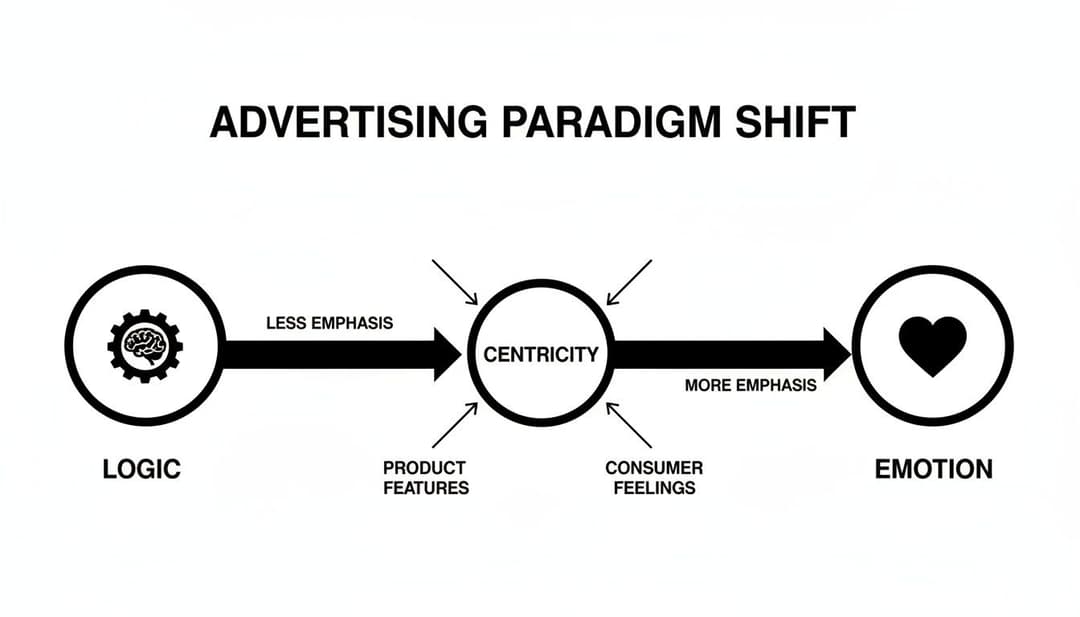
While logic has its place, the ads that truly stick with us are the ones that hit us right in the heart, creating a bond that's far more persuasive than any spec sheet. Let's break down the core principles that make this possible.
Social Proof: The Power of the Crowd
We’re social animals, hardwired to look to others for clues on how to behave. What should we buy? Where should we eat? What do we believe? This instinct is social proof, and it’s one of the most powerful forces you can wield in your advertising.
Think about it. You're walking down the street in a new city, looking for a place to eat. You see two restaurants: one is empty, the other is buzzing with people. Which one do you choose? The busy one, of course. We instinctively trust the wisdom of the crowd.
On Meta, this same principle reassures potential customers that choosing you is a safe, popular, and smart decision.
How to Use Social Proof in Your Meta Ads:
- Flash Those Five-Star Reviews: Pull direct quotes from happy customers and splash them across your ad creative. Something as simple as, “‘This completely changed my morning routine!’ - Jessica P.” builds instant credibility.
- Strength in Numbers: If you’ve got the user base, flaunt it. "Join over 50,000 happy customers who have already made the switch" creates an immediate sense of trust and popularity.
- Let Your Customers Do the Talking: Feature user-generated content (UGC) prominently. A real video of a customer unboxing your product feels infinitely more authentic than a slick studio shot.
Scarcity and Urgency: The Fear of Missing Out (FOMO)
Ever felt that jolt of anxiety when concert tickets go on sale? That immediate need to act now? That's FOMO in action, driven by the principles of scarcity and urgency. We are wired to place a higher value on things we perceive as limited or about to disappear.
It’s the same reason a "limited edition" pair of sneakers can sell out in minutes. The thought of missing out short-circuits our analytical brain and pushes us straight into action mode.
When you frame an offer as time-sensitive or in short supply, you trigger an immediate decision. The customer feels that waiting isn't just delaying—it's actively losing the opportunity.
This is a powerful lever to pull in your Meta ads to get people off the fence.
How to Use Scarcity in Your Meta Ads:
- Start the Clock: Use countdown timers in your ads for flash sales. A visible clock ticking down creates a powerful visual cue that time is running out. "Flash Sale Ends in 24 Hours!"
- Signal Low Stock: A simple line of copy can make all the difference. "Only 12 left in stock! Get yours before it’s gone" introduces just enough pressure to encourage a quick decision.
- Create Exclusivity: Frame your deal as a special opportunity. "Exclusive offer for our followers: Get 25% off this week only" makes people feel like they’re part of an in-group with special access.
Loss Aversion: The Pain of Losing Trumps the Joy of Gaining
Here's a fascinating quirk of the human brain: the pain of losing something is roughly twice as powerful as the pleasure of gaining something of equal value. This is loss aversion. It means we’re far more motivated to avoid a loss than we are to chase a gain.
Think about it: finding a $20 bill on the street is a nice little thrill. But losing a $20 bill from your wallet? That stings on a much deeper level.
You can tap into this by reframing your offers. Instead of just talking about what your customer stands to gain, highlight what they’re about to lose by not acting. It’s a subtle shift with a massive impact.
How to Use Loss Aversion in Your Meta Ads:
- Use "Don't Miss Out" Language: Frame your copy around the negative consequence of inaction. "Don't miss your chance to save 40%" hits harder than "Save 40% today."
- Flip the Script on Savings: Instead of "Save $50," try something like, "Stop losing $50 every month on high fees." This reframes the value as preventing an ongoing loss.
- Warn About Trial Expirations: For subscriptions, retargeting ads that say "Your free trial is ending. Don't lose access to your favorite features" can be incredibly effective at converting users to paid plans.
The Framing Effect: It's Not What You Say, It's How You Say It
How you present information can completely change how it’s perceived. This is the framing effect. The classic example? A yogurt labeled "80% fat-free" sounds way healthier and more appealing than the exact same yogurt labeled "20% fat."
The context you build around your offer is just as important as the offer itself. Your choice of words, images, and data points guides the user's interpretation and, ultimately, their decision.
How to Use Framing in Your Meta Ads:
- Test Positive vs. Negative Frames: Does your security system offer "peace of mind you'll gain" (positive) or protect against "the risk your home is exposed to" (negative)? Test both to see what resonates.
- Anchor Your Pricing: Always show a higher "original" price to make the sale price look like a steal. "Was $199, Now Only $79" makes the current price feel like an incredible deal.
- Break Down the Cost: A big price tag can be intimidating. Framing it in smaller chunks makes it feel more manageable. "$100" can seem steep, but "four easy payments of $25" sounds much more doable. Getting the frame right can make your CTA irresistible. If you want to dive deeper, check out our detailed guide on how to write a call-to-action that converts.
Reciprocity: The Deep-Seated Urge to Give Back
The principle of reciprocity is baked into our social DNA: when someone does something nice for us, we feel a powerful, often subconscious, urge to return the favor. It’s why your server giving you a small chocolate with the bill often leads to a bigger tip.
In marketing, you can trigger this by providing real, upfront value with no strings attached. This builds goodwill and makes people far more likely to engage with your brand or buy from you later.
The key is that the offer has to be genuinely helpful.
How to Use Reciprocity in Your Meta Ads:
- Offer Free, Valuable Resources: Run lead gen ads for a free ebook, checklist, or webinar that solves a real problem for your audience.
- Promote Purely Helpful Content: Boost a blog post or a video that's designed to educate or entertain, not just to sell. The goal is to establish yourself as a helpful expert.
- Give a Taste of Your Product: Offer a free trial, a product sample, or a useful online tool. That first positive experience creates a relationship and makes a future purchase feel less like a transaction and more like a natural next step.
To help you put these concepts into practice, here’s a quick cheat sheet connecting these psychological principles to concrete ad ideas you can start testing today.
Psychological Triggers and Meta Ad Applications
| Principle | What It Means | Ad Copy Example | Creative Idea |
|---|---|---|---|
| Social Proof | We trust what others are doing. | "Join 100,000+ creators who trust our platform to grow their brand." | A fast-paced video montage of happy customer testimonials or UGC. |
| Scarcity | We want what we can't have (or what's running out). | "Only 15 spots left in our workshop! Claim yours before they're gone." | An image with a bold text overlay: "LIMITED EDITION" or "ALMOST SOLD OUT." |
| Loss Aversion | The pain of losing is stronger than the joy of gaining. | "Don't lose out on 50% off. Your special offer expires tonight." | A split-screen visual showing a "before" (the problem) and "after" (the solution). |
| Framing | The context of the message matters more than the message itself. | "Just $1/day for complete peace of mind." (instead of "$365/year") | A graphic that visually compares the small daily cost to a common purchase, like a cup of coffee. |
| Reciprocity | We feel obligated to give back when we receive something first. | "Get your free guide to XYZ. No strings attached." | An ad that looks like a helpful infographic or checklist, offering value directly in the feed. |
By weaving these triggers into your campaigns, you move beyond just targeting demographics and start speaking directly to the underlying motivations that drive human behavior. This is how you create ads that don't just get seen—they get felt.
How AI Unlocks Psychology-Driven Advertising at Scale

Knowing the theory behind social proof, loss aversion, and scarcity is one thing. Actually putting it to work across hundreds—or even thousands—of ad variations is a completely different beast. The manual labor it takes to create, test, and analyze campaigns built on these psychological triggers is staggering. It’s so much work that even the sharpest teams are often limited to just a handful of experiments at a time.
This is exactly where the worlds of psychology and advertising get a massive upgrade from artificial intelligence. AI platforms like AdStellar are built to take these powerful psychological concepts and make them not just actionable, but infinitely scalable. The whole idea is to get you out of the weeds of manual guesswork and into a system of rapid, data-driven execution.
Instead of a marketer spending hours trying to dream up a few ways to frame an offer, an AI can spit out hundreds of variations in minutes. This opens up a level of creative exploration that just wasn't possible before.
From Manual Application to Automated Intelligence
Let's get practical. Imagine you want to test five different psychological angles—scarcity, social proof, loss aversion, framing, and reciprocity. Now, imagine you want to test those across ten different audiences, each with five unique images. Do the math, and you’re looking at 250 unique ads to build by hand. That's a non-starter for most teams, forcing them to just guess which angle will hit home.
AI completely flips this script. It turns these psychological principles into variables within a massive testing matrix that it can manage automatically.
Here’s how an AI platform tackles this:
- Generate Angle Variations: It can instantly write copy that frames the same offer through different psychological lenses. One ad might scream, "Only 50 left!" (scarcity), while another reassures with, "Join 10,000 happy customers" (social proof).
- Automate Ad Assembly: It then pairs all these copy variations with different headlines, images, and audience segments, building out a comprehensive test campaign in a single click.
- Analyze Performance by Trigger: It goes way beyond surface-level metrics like CTR and CPA. Instead, it tells you which specific psychological triggers are actually working for which audiences.
This automated process turns a painfully slow creative task into a highly efficient system for discovering what really motivates your customers to click.
Identifying Winning Triggers with Data
But the real magic of AI here is its ability to learn from your own historical performance data. A platform like AdStellar can plug into your Meta Ads account and start digging through past campaigns to find patterns you'd never spot on your own. It might find that for a specific audience, ads using loss aversion language have consistently delivered a 15% higher ROAS than those leaning on scarcity.
This is the kind of insight performance marketers dream of. It replaces subjective "best guesses" with a data-backed directive telling you exactly which psychological levers to pull for the biggest impact.
The system doesn’t just show you a report and walk away; it actively uses these findings to shape future campaigns. When you tell the AI to launch a new campaign, it automatically prioritizes the psychological angles, creative styles, and audience pairings that have the highest probability of success based on your history. This creates a powerful feedback loop where every campaign makes the next one smarter. To see more on how this works, check out our guide on using AI for Facebook ads.
Scaling Your Psychological Advertising Strategy
Once the AI locks onto a winning combination—say, a specific social proof headline paired with a user-generated video for your best-performing audience—it can automatically scale the investment. It shifts budget toward the ads that are crushing it, ensuring you’re putting your money behind your most persuasive messages without you having to constantly watch over it.
This is how you start moving at the speed of the market. You can test more ideas, find winners faster, and scale your successes with an agility that's simply impossible to achieve by hand. Ultimately, AI acts as a force multiplier, taking the timeless principles of human psychology and applying them with the speed, scale, and precision that modern advertising demands.
A Practical Framework for Testing Psychological Angles
Knowing about psychological principles is one thing, but actually using them to get results? That’s where the real magic happens, and it all comes down to testing. Without a solid framework, you’re basically just throwing spaghetti at the wall to see what sticks—a strategy that gets expensive fast.
To get beyond pure guesswork, you need a structured process. It’s not about finding one perfect, silver-bullet headline. It's about building a repeatable system that uses hard data to figure out which emotional triggers genuinely connect with your audience and, most importantly, drive them to act. A disciplined approach ensures every ad dollar spent teaches you something, making your next campaign smarter than the last.
Structuring Your Psychological A/B Tests
The heart of any good testing framework is a clean, controlled experiment. The whole point is to isolate a single variable so you can say with confidence that any change in performance was because of that one thing.
When you're testing psychological angles, this usually means keeping your visual creative the same while you swap out the persuasive framing in the copy.
Imagine you want to see what works better for your audience: the fear of missing out or the comfort of joining a crowd. You could set up a simple test pitting a Loss Aversion headline against a Social Proof headline, using the exact same image or video for both.
- Hypothesis: We believe a headline framed around what customers stand to lose will drive more urgency and conversions than one highlighting popularity.
- Variable A (Loss Aversion): "Don't miss out on clearer skin. Your special offer expires tonight."
- Variable B (Social Proof): "Join over 50,000 people who transformed their skin with our serum."
Since the audience and the creative are identical, you can directly compare the raw persuasive power of these two psychological triggers. This is how you get clean data and real insights into what actually motivates your customers.
Defining Your Success Metrics
Before you even think about launching a test, you need to know what a "win" looks like. Are you chasing a higher click-through rate (CTR), a lower cost per acquisition (CPA), or a better return on ad spend (ROAS)? Your primary metric should line up perfectly with your campaign’s overall goal.
For example, a top-of-funnel campaign trying to generate awareness might prioritize CTR and engagement. But a bottom-of-funnel campaign focused on sales should be judged almost entirely on CPA or ROAS.
Picking the right key performance indicator (KPI) is everything. A headline that gets a ton of clicks but zero conversions isn't a winner—it's just an expensive distraction. Your success metric is the North Star that guides how you interpret the results.
This isn’t just theory; the data backs it up. A massive study involving over 3.5 million people found that ads tailored to specific personality traits (like extraversion) generated up to 40% more clicks and an incredible 50% more purchases compared to generic ads. That’s the kind of impact you unlock when you find the right psychological angle for the right person.
Iteration and the Power of AI
A single A/B test is just one data point. The real momentum comes from iterative testing—a continuous cycle where the winner of one test becomes the new baseline to beat in the next one. This creates a powerful feedback loop where you're always sharpening your messaging based on what the market is telling you.
But let's be honest, managing this process manually across dozens of campaigns and ad sets is a nightmare. It quickly becomes overwhelming.
This is exactly where an AI-powered platform like AdStellar comes in. It automates the entire workflow, from generating hundreds of ad variations based on different psychological principles to analyzing the results and flagging the clear winners. The right AI tool can tell you not just what worked, but start to uncover why. It might find that scarcity-based ads crush it with your younger audience, while your older demographic responds way better to social proof.
Getting that level of insight manually is next to impossible. For a much deeper look into how to build this kind of system, check out our complete Facebook ad testing framework.
Ultimately, by combining a structured testing methodology with the scale of AI, you can turn interesting psychological theories into a data-driven engine for growth. You stop guessing what your audience wants and start knowing—with the numbers to prove it.
Common Questions, Answered
Jumping into psychology-driven advertising always brings up a few key questions. Let's tackle the most common ones head-on so you can move forward with confidence.
Isn't Using Psychology in Ads Unethical?
This is the big one, and it’s a fair question. There's a fine line between persuasion and manipulation, but the ethical path is pretty clear once you see it.
Persuasion is about showing how your product genuinely solves a problem or fulfills a desire someone already has. You're helping them make a good choice. Manipulation, on the other hand, means using deception to exploit someone's insecurities or invent a false need.
The goal should always be to empower your customer, not trick them. Ethical advertising builds trust and solves real problems; manipulative tactics just chase a quick sale, often damaging your brand in the long run.
How Do I Know Which Principle to Use for My Audience?
There’s no magic bullet here. What works for one audience might fall completely flat with another. The only way to find out what resonates is through systematic testing.
A younger crowd might be all about scarcity and FOMO, while an older demographic often responds better to trust-building social proof like testimonials.
Start with a simple hypothesis. For example: "For this audience, framing the offer around what they'll lose will be more powerful than showing them what they'll gain." Then, run a clean A/B test and let the data tell you the real story. This is how you stop guessing and start knowing what truly motivates your customers.
The best advertisers don't assume they know what people want. They build a system that lets their audience tell them directly through clicks and conversions.
Can Small Businesses Really Do This Without a Huge Budget?
Absolutely. Not too long ago, this stuff was reserved for massive corporations with dedicated research teams. But today, AI has completely leveled the playing field.
Tools like AdStellar AI give businesses of any size the power to run sophisticated, psychology-driven campaigns. Instead of needing a big team to manually create and track hundreds of ad variations, AI can generate and test them automatically based on these proven triggers.
This makes what was once complex and expensive totally accessible. Small businesses can now compete using the same powerful strategies that the big players have been using for years.
Ready to turn these insights into an advertising strategy that actually scales? With AdStellar AI, you can launch, test, and grow campaigns built on proven psychological principles 10x faster. Stop guessing and start growing with AdStellar AI today.