Let's get straight to it: what is a good cost per click?
The short answer? A good CPC is one that actually makes you money. There's no magic number here. A click that's a bargain for a high-end law firm would look absolutely insane to an e-commerce store selling t-shirts.
Defining a Good Cost Per Click for Your Business
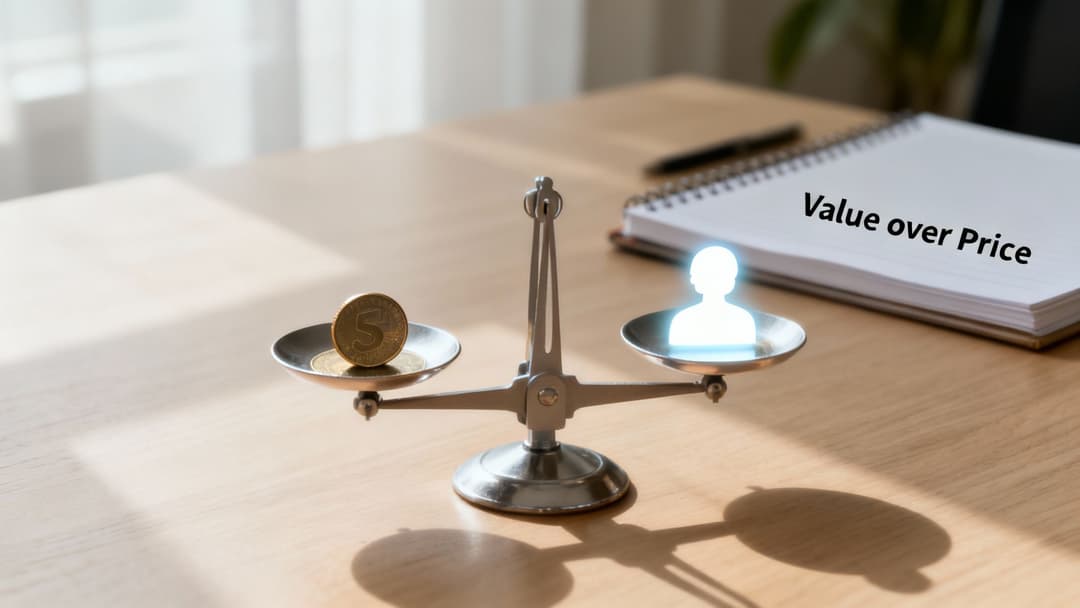
One of the most common and costly mistakes advertisers make is chasing the lowest possible CPC. It’s like putting the cheapest, lowest-octane fuel into a high-performance sports car. You might save a few bucks at the pump, but you'll kill your engine's performance and get nowhere fast.
The real goal isn't just to cut costs; it's to maximize the value you get from those costs.
A slightly more expensive click that consistently turns into a sale is infinitely more valuable than a dozen cheap clicks from people who bounce off your site in seconds. So, a "good" CPC isn't just an expense to minimize—it's a strategic lever you can pull to drive real growth.
Focus on Value, Not Just Price
To figure out what a good CPC looks like for your campaigns, you have to connect it to actual business results. A click's price is only half the story. The other, more important half is its potential to generate revenue. Getting this right is the foundation of a profitable ad strategy.
A profitable ad campaign is built on acquiring customers at a cost that makes sense for your business model. The click is just the first step in that journey.
And things are always changing. Global ad costs are on the rise. Data shows the average worldwide CPC for search ads jumped from roughly $0.52 in Q1 2023 to $0.62 in Q1 2024. That’s a 19% increase in just one year.
This trend shows exactly why obsessing over old benchmarks is a waste of time. Your ideal CPC is tied to a whole host of factors unique to your ads, many of which are completely within your control. For instance, the overall cost of social media marketing campaigns is directly shaped by your audience targeting, creative quality, and platform choice.
How Industry Competition Shapes Your CPC
Ever wonder why a click for a legal keyword costs a small fortune, while one for a t-shirt store feels like a bargain? It all comes down to your industry. The ad auction is a bit like a real estate market—a storefront in a high-traffic, high-value district will always command a higher price than one in a quiet suburb.
Your industry is probably the single biggest external factor that defines what a "good" cost per click even means. Forget universal standards; it's all about the competitive arena you're playing in.
Industries with a high customer lifetime value (LTV)—think finance, insurance, or healthcare—naturally attract fierce competition. When a single new client can bring in thousands of dollars over the years, businesses are more than willing to bid aggressively for that first click.
High Stakes, High Bids
This is simple economics in action. A law firm might happily pay $50 or more for a click because one successful case could be worth tens of thousands. On the flip side, an online t-shirt shop selling $25 items probably needs its CPC to stay under $1.00 to have any chance at turning a profit.
This is exactly why comparing your CPC to some global average is a fool's errand. You should always be judging your performance against your direct competitors and the economic realities of your sector.
A "good" cost per click isn't an absolute number; it's a relative metric that reflects your industry's value chain. What's expensive for one business is a bargain for another.
Industry CPC Benchmarks
To set realistic goals, smart performance marketers look at sector-specific ranges. It's the only way to get a true sense of the landscape. For example, recent cross-platform PPC benchmarks show that e-commerce and retail ads average around $2.61 per click. Meanwhile, finance and insurance ads often climb to $3.00 CPC because the potential return on a new customer justifies the higher bids. You can see more stats like these in the latest PPC benchmarks from Coupler.io.
To give you a clearer picture, here’s a quick breakdown of what you can expect to see across different industries.
Average Cost Per Click by Industry
This table gives you a ballpark idea of CPCs across major advertising platforms. Use it as a starting point to see how your own costs stack up.
| Industry | Average CPC (Search Ads) | Average CPC (Social Ads) |
|---|---|---|
| Finance & Insurance | $3.44 | $3.77 |
| Healthcare | $2.62 | $1.32 |
| Real Estate | $2.37 | $1.81 |
| Legal | $6.75 | $1.32 |
| E-Commerce/Retail | $2.61 | $0.70 |
Knowing these benchmarks helps you understand if your costs are reasonable or if there’s a red flag. For instance, if you're in retail and paying $5.00 per click, something is likely off. It could be poor ad relevance, ineffective targeting, or another issue driving up your costs unnecessarily. A solid Facebook ad optimization strategy is your best bet for diagnosing and fixing these kinds of problems.
The 5 Key Factors That Control Your Ad Costs
Beyond your industry, a handful of powerful variables act like levers on your Cost Per Click. Think of your ad costs not as a fixed price, but as a dynamic number you can influence by getting these five factors right. Mastering them is the difference between letting the ad auction control your budget and taking charge of your own efficiency.
A good cost per click is rarely an accident; it’s the result of actively optimizing these components.
This chart shows just how much average CPC can differ. Industries like healthcare often see higher costs, which makes sense given the high lifetime value of a new patient.
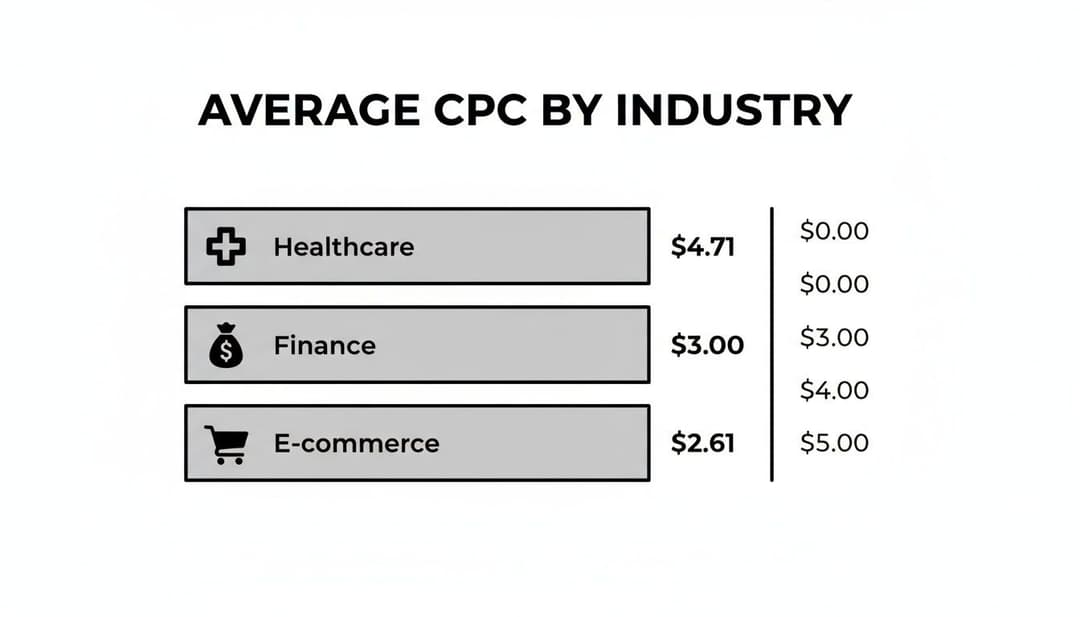
As you can see, costs in healthcare ($4.71) are quite a bit higher than in e-commerce ($2.61), driving home the importance of industry context.
1. Ad Quality and Relevance
Think of ad relevance as a reward system. Platforms like Google and Meta want to show users content they actually find useful. When your ad, keywords, and landing page are all tightly aligned with what someone is looking for, the platform gives you a higher Quality Score.
This high score acts like a discount on your CPC. An advertiser with a Quality Score of 8/10 might pay significantly less per click than a competitor with a score of 4/10, even if the competitor bids more. It’s the platform’s way of saying, "Thanks for making our user experience better."
2. Audience Targeting
Who you target has a massive impact on your costs. It's a classic case of supply and demand. A broad, cold audience is vast and relatively cheap to reach, but the clicks you get might be low-quality.
In contrast, a hyper-specific retargeting audience—people who have already visited your site or added a product to their cart—is much smaller and more competitive. Clicks from this high-intent group will almost always cost more, but they are also far more likely to convert.
3. Your Bidding Strategy
Your bidding strategy is how you tell the ad platform what you value most. Are you just trying to get the most traffic possible, or are you focused on conversions and a specific return on ad spend (ROAS)?
Different strategies lead to different CPCs:
- Maximize Clicks: This approach often brings in a lower CPC because the algorithm is hunting for the cheapest clicks available to fit your budget, regardless of their quality.
- Target CPA (Cost Per Action): Here, you set a goal for how much you're willing to pay for a conversion. The platform then adjusts your bids—and your CPC—to try and hit that number.
- Manual Bidding: This gives you full control, but it also means you are responsible for setting bids that are competitive enough to win auctions without overpaying.
Choosing the right bidding strategy is about aligning your auction behavior with your ultimate business goals. A low CPC is irrelevant if it doesn't lead to profitable actions.
4. Ad Placement
Not all ad placements are created equal. An ad appearing at the very top of a Google search results page or in the main Instagram feed is prime real estate. It's going to cost more than one shown in the Audience Network or on a partner site.
The platform's algorithm automatically bids higher for placements it predicts will drive better results, which directly impacts your average CPC.
5. Seasonality and Timing
Finally, timing plays a huge role. Competition heats up during peak shopping seasons like Black Friday or Christmas, driving CPCs up across the board. The same thing happens at specific times of day or days of the week when your target audience is most active online.
Smart advertisers adjust their budgets to compete during these high-intent moments while scaling back during quieter periods. This is how you maintain a healthy average CPC without missing out on key opportunities.
How to Calculate Your Ideal Target CPC
Industry benchmarks are a decent starting point, but they're just that—averages. The real power comes from ignoring the noise and calculating a cost-per-click that makes sense for your business. This flips the script from "what's everyone else paying?" to "what can I afford to pay and still make a profit?"
Instead of just guessing, you can work backward from what you want to achieve. The whole thing kicks off with one simple question: how much are you willing to spend to get a new customer? That number is your target Cost Per Acquisition (CPA).
Once you have your target CPA, you only need one other piece of the puzzle: your website or landing page's conversion rate. This is just the percentage of people who click your ad and then actually do the thing you want them to, like buy a product or sign up for a newsletter.
The Maximum CPC Formula
The formula itself is refreshingly simple. It creates a direct link between your business goals and how much you should pay for a click, giving you a clear ceiling for your bids. This makes every click a calculated investment, not a blind gamble.
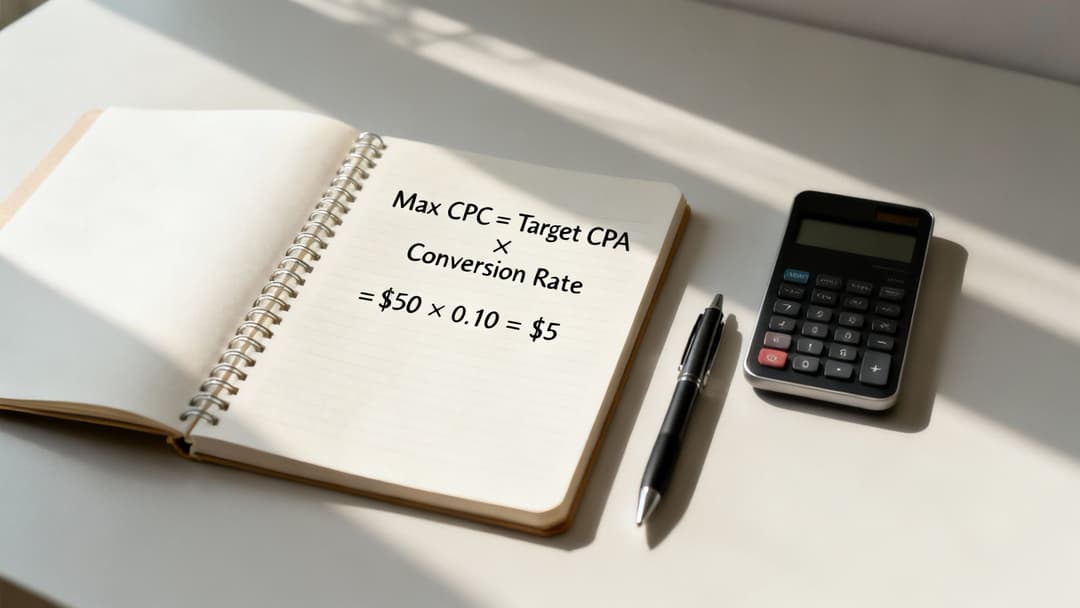
Maximum CPC = Target CPA x Conversion Rate
This little equation anchors your entire ad spend to your bottom line. It takes an abstract metric like CPC and turns it into a hard number you can use to manage your campaigns, protect your margins, and finally answer, "What's a good CPC for me?" with total confidence.
Putting the Formula into Action
Let's make this real. Imagine you run an e-commerce shop and you know your numbers:
- Your Goal: You’ve done the math and know you can spend up to $50 to acquire a new customer while staying profitable. Your Target CPA is $50.
- Your Performance: You know that for every 100 people who click your ad, 10 of them end up buying something. Your conversion rate is 10% (or 0.10).
Now, just plug those numbers into the formula:
Maximum CPC = $50 (Target CPA) x 0.10 (Conversion Rate)
The result? $5.00.
This means you can bid up to $5.00 per click and still hit your acquisition target. Every click you get for less than $5.00 is pure gravy, padding your profit margin. This is why understanding how to calculate Cost Per Acquisition is the non-negotiable first step; it’s the foundation of a smart, sustainable ad strategy.
To show how this plays out in different situations, here are a few scenarios. Notice how a higher conversion rate lets you afford a higher CPC, even with the same acquisition goal.
Example CPC Calculation Scenarios
| Scenario | Target CPA | Conversion Rate | Maximum Affordable CPC |
|---|---|---|---|
| E-commerce Store (Low CVR) | $50 | 2% | $1.00 |
| SaaS Free Trial (Medium CVR) | $100 | 8% | $8.00 |
| High-Ticket Service (High CVR) | $300 | 15% | $45.00 |
As you can see, your "good" CPC is completely relative to your business model and website performance. What might be an insanely high CPC for one company is a bargain for another. This formula gives you the power to know the difference.
Actionable Strategies to Lower Your CPC
Knowing your target CPC is one thing, but actually hitting it is a whole different ballgame. Let's be clear: there's no magic button for a lower cost-per-click. It's all about methodically making your ads more relevant and efficient.
Think of it this way: when you improve your ad's quality, you're signaling to platforms like Meta or Google that your content is valuable to their users. They reward that value with a discount on every click you get.
The single most powerful lever you have is audience targeting. Stop competing in the broad, expensive main auction and start looking for smaller, less saturated pockets of users. Don't just stick to basic demographics. Layer in specific interests, online behaviors, or create lookalike audiences based on your absolute best customers.
This approach helps you find high-intent users who are simply cheaper to reach because fewer advertisers are bidding on that exact, niche combination.
Boost Relevance with A/B Testing
Your ad copy and creative are your front line in the war for attention. Even tiny tweaks here can cause massive swings in engagement, and ad platforms love engagement—they reward it with lower CPCs.
The key is to A/B test everything, systematically. Let the data tell you what works, not your gut.
- Headlines: Pit a benefit-driven headline ("Save 20% on Winter Coats") against a question that hits a pain point ("Tired of Being Cold?").
- Ad Copy: Test different tones. Try one that's super direct and another that tells more of a story.
- Calls to Action (CTAs): Does "Shop Now" work better than a softer invitation like "Explore the Collection"? Test it and find out.
- Creative: Run a slick static image against a short video or a carousel ad. See which one stops the scroll.
This constant process of testing and learning is the secret to improving your ad's performance. It’s also a core part of learning how to improve your click-through rate, a metric that is directly tied to your CPC.
A lower CPC is often just a happy side effect of a higher click-through rate. When more of the people who see your ad actually click it, the platform sees it as highly relevant and charges you less for the placement.
Leverage Dynamic Creative on Meta
If you're running ads on Meta (Facebook and Instagram), Dynamic Creative is an absolute game-changer. Instead of painstakingly building dozens of different ad variations by hand, you just feed the machine the building blocks.
Give it a few images, a couple of videos, a handful of headlines, and some different descriptions. Meta's algorithm takes over from there. It automatically mixes and matches every component to find the winning combinations for different people in your audience. It's like having a supercomputer run your A/B tests for you at a massive scale, quickly zeroing in on the most efficient ad variations and driving your CPC down in the process.
When you're trying to figure out what a good CPC is, remember that geography and platform play a huge role. Highly competitive markets like the United States and the UK will almost always have higher average costs.
On Meta's platforms, costs also shift with the seasons. In 2024, monthly median CPCs swung from $0.62 in March all the way up to $1.21 in August, reflecting the ebb and flow of auction pressure. To truly get a handle on managing your CPC, you need flawless tracking. A great place to start is by reading up on 8 Essential UTM Parameter Best Practices for Flawless Tracking. With these tactics, you have a solid checklist to start making your campaigns more efficient today.
Looking Beyond CPC to Metrics That Drive Growth
Chasing a low Cost Per Click can feel like a win, but it's a classic case of winning the battle and losing the war. Obsessing over click costs is like a chef focusing only on the price of salt instead of the flavor of the final dish. A good CPC is just a starting point; the real prize is profitability, and that means looking at the metrics that actually measure business impact.
Let's imagine two ad campaigns. Campaign A has a jaw-droppingly low CPC of $0.50. Campaign B, on the other hand, comes in at a much steeper $4.00 per click. On the surface, Campaign A looks like the obvious champion.
But when you pull back the curtain, the story completely flips.
The Real Winner Is Always Profitability
Those cheap clicks from Campaign A aren't going anywhere. You need 200 clicks (costing $100) just to land a single $80 sale. That’s a $20 loss.
Meanwhile, the "expensive" $4.00 clicks from Campaign B are coming from highly motivated buyers. It only takes five clicks (costing $20) to secure that same $80 sale, leaving you with a $60 profit.
This simple scenario proves a critical point: the ultimate measure of your success isn't your CPC, but your Cost Per Acquisition (CPA) and Return on Ad Spend (ROAS).
A high CPC that leads to a profitable customer is always better than a low CPC that goes nowhere. Profitability, not click cost, is the North Star of any successful ad strategy.
Think of CPC as a diagnostic tool—like the temperature gauge on a car's dashboard. If it's running too high, something might be off with your targeting or creative. But the gauge itself doesn't get you to your destination. Real growth is measured by metrics like ROAS and Customer Lifetime Value (LTV), which tell you if your entire advertising engine is actually working. Before you can track this, you need to learn how to calculate Return on Ad Spend properly.
While CPC is a key cost metric for your paid ads, remember that true business growth often comes from a much broader view of your marketing efforts. It's just as important to learn how to track influencer campaign performance and ROI to get the full picture of your impact.
CPC Questions We Hear All The Time
Once you get the basics down, a few specific questions always seem to pop up. Let's walk through the most common ones I hear from clients to clear up any confusion about what a "good" cost-per-click actually looks like in the real world.
Is a CPC Under One Dollar Always Good?
Not even close. This is one of the biggest misconceptions in paid ads. A low CPC is only "good" if the clicks are high-quality and lead to profitable sales.
Think of it this way: a $0.80 click seems like a bargain, right? But if it takes 100 of those cheap clicks to sell one $50 product, you've spent $80 to make $50. That's a losing game.
Now, flip that. What if you paid $3.00 per click, but those clicks were from a much more qualified audience? If 15% of those clicks convert, your cost to acquire a customer (CPA) is just $20. That’s a fantastic outcome. The number itself is meaningless without the context of your business goals.
How Long Should a Campaign Run Before I Judge Its CPC?
You have to give the ad platform’s algorithm time to work its magic. Most platforms have a "learning phase," and you need to let it run its course before you can trust the numbers you're seeing. This usually means waiting for at least 50-100 clicks or letting it run for several days.
Jumping to conclusions in the first 24-48 hours is a classic rookie mistake. Costs can be all over the place as the algorithm figures out who to show your ads to. Be patient and wait for the data to stabilize before you start pulling levers.
Better, more engaging ad creative directly translates to higher relevance scores. Ad platforms reward this relevance by giving you priority in the ad auction, which results in a lower cost per click.
Does Better Ad Creative Really Lower CPC?
Absolutely. It’s one of the most direct ways to influence your costs. When your creative is relevant and high-quality, people engage with it—they click, share, and comment more.
Ad platforms see this positive engagement as a sign that you're providing a good user experience. They reward you with a higher Quality Score, which is basically a discount in the ad auction. The platform will literally prioritize your ad over less engaging competitors, which directly brings down your CPC.
Ready to stop guessing and start scaling? AdStellar AI helps you launch, test, and optimize hundreds of ad variations in minutes, so you can find your most profitable campaigns faster. Cut manual work and discover what truly drives results. Learn more about AdStellar AI.