So, let's get straight to it: what does social media marketing actually cost?
There’s no single price tag. The real cost breaks down into two key areas: what you pay the platforms (ad spend) and what you pay for the people and tools to make it all happen (operational expenses). For many businesses, this can be anything from a few hundred dollars for initial tests to tens of thousands for major campaigns.
Your Guide To Social Media Marketing Costs
This guide will unpack every single factor that shapes your social media marketing budget, showing you how to build a smart plan that drives real results. We'll explore how modern strategies and AI-powered tools can completely change your approach, turning what feels like a cost into a predictable, growth-driving investment.
To kick things off, the table below gives a clear snapshot of typical monthly costs for businesses at different stages. Think of it as a baseline before we dive deeper into the nuts and bolts.
Here's a high-level look at what you might expect to invest each month, combining both your ad budget and the fees for management, whether it's an agency, a freelancer, or in-house talent plus tools.
Typical Social Media Marketing Cost Ranges By Business Size (Monthly)
| Business Stage | Typical Ad Spend | Management/Tool Fees | Total Estimated Monthly Cost |
|---|---|---|---|
| Start-Up / Small Business | $500 – $2,000 | $500 – $1,500 | $1,000 – $3,500 |
| Growing Business (SMB) | $2,000 – $10,000 | $1,500 – $5,000 | $3,500 – $15,000 |
| Established Enterprise | $10,000 – $50,000+ | $5,000 – $15,000+ | $15,000 – $65,000+ |
These numbers are just a starting point, of course. The real cost depends entirely on your industry, goals, and how aggressively you want to grow.
Unpacking the Two Layers of Spend
When people ask what social media marketing “costs,” they’re really juggling two different budgets: the money for media and the money for operations. You have to get both right to build a realistic plan.
First, you have media spend. This is the cash you pay directly to platforms like Meta or LinkedIn to get your ads in front of people. Second is your operational spend, which covers the talent and technology needed to actually run those campaigns well.
Recent benchmarks show professional social media advertising services typically run from $850–$2,000 per month. For the ads themselves, a good starting point for smaller advertisers is around $200–$1,000+ per month. All in, companies that are serious about this channel can expect to invest anywhere from $10,000–$25,000 annually.
For performance marketers, these numbers highlight why efficiency is everything. If 10–20% of your media spend is wasted on slow testing and clumsy workflows, you’re losing thousands of dollars a month that could have gone toward growth. If you want to dig deeper into the management side, this guide from LYFE Marketing offers some great insights.
Here's a mistake I see all the time: businesses underinvest in the operational side. A massive ad budget with a weak strategy or terrible creative is like buying a race car but hiring a student driver—it’s an expensive way to go nowhere fast.
Why a Clear Budget Is Your Competitive Edge
Without a well-defined budget, you’re flying blind. A strategic budget transforms your social media marketing from a guessing game into a measurable growth engine, allowing you to set clear goals and prove your return on investment.
A solid budget helps you:
- Allocate Resources Effectively: You can confidently decide which platforms deserve the most investment based on where your ideal customers actually hang out.
- Set Realistic Expectations: It helps you understand what results are actually achievable with your level of spend, preventing disappointment and stopping you from pulling the plug on campaigns too early.
- Enable Smart Scaling: You can start small with a testing budget, find out what resonates, and then double down on the winning campaigns with confidence.
Building an effective budget isn't just a bookkeeping task; it’s the first step in any campaign that's built to win. If you're looking to master this process, our guide on creating a paid social media strategy provides the perfect framework. It’s all about making every single dollar count.
Getting to Grips with What Drives Your Ad Spend
To really get a handle on your social media marketing costs, you have to understand the engine running under the hood: the ad auction. It’s not a simple case of the highest bidder winning. It’s more like a talent show where the platform is the judge—your bid matters, but so does the quality of your act.
Platforms like Meta and TikTok are obsessed with user experience. Their goal is to keep people scrolling, so they’d rather show a user an ad they’ll actually enjoy than a boring one with a massive budget.
This is great news for you, because it means you have direct control over your costs. An ad that’s highly relevant and gets great engagement is rewarded with a higher ad quality score. Think of this score as a discount—it lowers what you pay to reach your ideal customers.
The Bidding Models That Define Your Costs
When you set up a campaign, you have to decide how you want to pay. This is a critical decision that should align perfectly with what you’re trying to achieve. The big three models you’ll encounter are CPM, CPC, and CPA.
CPM (Cost Per Mille): This is the cost for one thousand impressions. You pay every time your ad is shown 1,000 times. CPM is your best friend for brand awareness campaigns where the main goal is just getting as many eyeballs on your message as possible.
CPC (Cost Per Click): Pretty straightforward—you only pay when someone actually clicks on your ad. This is the go-to for driving traffic to a website or landing page. It’s a direct measure of someone’s interest in learning more about what you offer.
CPA (Cost Per Acquisition): This one is a bit more advanced. You only pay when a user completes a specific action you care about, like filling out a lead form, installing your app, or making a purchase. It ties your ad spend directly to tangible business results, making it perfect for conversion-focused campaigns.
Choosing the right bidding model is like picking the right tool for a job. Using CPM to drive sales is like trying to hammer a nail with a screwdriver—it’s just inefficient and you'll end up paying way more than you should. Always align your bid with your goal.
How Targeting Precision Shapes Your Spend
The more specific you get with your audience, the more your costs can fluctuate. If you go broad—say, targeting all men aged 25-54 in the United States—your cost per impression might be low simply because the audience pool is enormous. But you’ll probably waste a ton of money showing ads to people who couldn't care less about your product.
On the flip side, getting super specific—like targeting software developers in San Francisco who follow certain tech influencers—will almost always cost more per click or impression. That audience is smaller, more valuable, and the competition to reach them is much fiercer.
Here’s where you can get smart with it:
- Retargeting Audiences: Showing ads to people who've already visited your website is one of the most cost-effective things you can do. They already know who you are, which makes them far more likely to convert.
- Lookalike Audiences: This is a powerful way to scale. You can tell a platform, "Find me more people who look just like my best customers," and its algorithm will go to work finding new users with similar characteristics.
The Impact of Ad Formats and Placements
Finally, where your ad shows up and what it looks like have a huge impact on your social media marketing cost. An ad in Instagram Stories will have a completely different cost profile than one in the Facebook Feed or a TikTok video.
For example, video ads often get much higher engagement, but they can also have a higher upfront production cost. Interactive ads, like polls or quizzes, can actually drive down your costs by signaling to the platform that users are actively engaging with your content.
You have to test different formats and placements to see what works. You might discover that your audience goes wild for Reels ads, leading to a much lower CPA than your static image ads ever delivered. Understanding these nuances is key to putting your budget where it will deliver the best return.
Platform Cost Benchmarks And What To Expect
Ever wonder why social media ad costs are all over the map? Think of it like real estate. A billboard in Times Square costs a whole lot more than one on a quiet country road, all because of the audience it reaches. Social media platforms work the same way—the digital neighborhood you're advertising in sets the price.
Each platform is its own unique world, attracting different people with different mindsets. This is what really shapes your ad spend. Getting a handle on these nuances is the first step to putting your budget where it will do the most good, instead of just spreading it thin and hoping for the best.
Meta Ads Costs: Facebook And Instagram
Meta, the giant behind Facebook and Instagram, is like a sprawling, diverse metropolis. It offers a massive audience at a pretty accessible price point, making it a versatile all-rounder for everything from local shops to global e-commerce brands.
Because the user base is so huge and varied, you can often find a lower Cost Per Mille (CPM), which is what you pay to get your ad in front of 1,000 people. This makes it a fantastic starting point for most businesses just dipping their toes into social ads.
But don't be fooled—costs aren't the same for everyone. Your industry and what you're trying to achieve with your campaign can cause wild swings in price. For instance, an apparel brand will likely see a much lower Cost Per Click (CPC) than a company selling financial services, where a single lead is worth a fortune. This is where great creative and sharp targeting come in. A high conversion rate on your ads can make a seemingly high CPC incredibly profitable. For a deeper dive, check out our guide on how to boost your Facebook Ads conversion rate.
Think of Meta as a massive city. You can find almost any audience here, but the competition in the "downtown" commercial districts (like finance or B2B tech) is fierce and expensive. Meanwhile, you can reach niche communities in the "suburbs" for a fraction of the cost.
LinkedIn Ads Costs: The B2B Premium
If Meta is a city, then LinkedIn is the high-stakes financial district. People aren't here to scroll through vacation photos; they're networking, hiring, and making serious business decisions. This professional context makes the audience here pure gold for B2B marketers.
As you might guess, this comes at a price. Advertising on LinkedIn is significantly more expensive because you're paying a premium to target people by their exact job title, company size, and industry with laser-like precision.
The CPC and CPM on LinkedIn are often the highest you'll find anywhere, but the potential payoff is equally massive. A $5 CPC might make you wince, but what if that one click leads to a $50,000 enterprise software deal? Suddenly, it looks like a bargain. LinkedIn is a classic "you get what you pay for" platform—you pay more for each interaction, but every single one carries more weight.
TikTok Ads Costs: The Engagement Advantage
TikTok is a completely different beast, an advertising world built on entertainment, trends, and lightning-fast engagement. Its algorithm is scary good at feeding users content they'll love, and that opens up a huge opportunity for advertisers who get it.
Since the platform is so good at grabbing and holding attention, the cost to get seen—your CPM—is often lower than on older platforms like Meta. Users are already primed for video and discovery, which makes it a powerhouse for brands with products that pop on screen.
The secret to winning on TikTok isn't a huge budget; it's creative agility. A polished, corporate-style video will likely fall flat on its face. But a fun, trend-aware clip shot on a phone? That could go viral. The social media marketing cost here is less about raw dollars and more about your ability to create ads that don't feel like ads.
To help you get a clearer picture of how these platforms stack up, let's look at some industry benchmarks.
Social Media Advertising Cost Benchmarks By Platform
A comparative look at average CPC and CPM rates across major social media platforms, helping marketers budget effectively.
| Platform | Average CPC Range | Average CPM Range | Best For |
|---|---|---|---|
| Meta (Facebook & Instagram) | $0.26–$0.50 | $1.01–$3.00 | B2C, E-commerce, Local Businesses, Brand Awareness |
| $2.00–$3.00 | $5.01–$8.00 | B2B Lead Generation, High-Ticket Services, Professional Networking | |
| TikTok | $0.50–$1.50 | $4.00–$7.00 | B2C, Viral Marketing, Brand Awareness, Influencer Marketing |
Source: Data compiled from WebFX and other industry reports.
These numbers really tell the story. According to data from WebFX, the average CPC can be as low as $0.45 for an apparel brand on Facebook but jump to over $3.77 for a finance advertiser on the same platform. These benchmarks are a great starting point, but always remember that your specific industry, audience, and creative will be the ultimate factors that determine your costs.
Calculating And Proving Your Social Media ROI
Throwing money at social media ads is easy. But actually proving that spend is growing your business? That's what separates the pros from the amateurs. It’s not enough to point to a spike in clicks or impressions; you have to connect your ad dollars directly to revenue.
This is where we shift our thinking from social media marketing cost to return on investment (ROI). By getting comfortable with a few key metrics, you can build an undeniable business case for your budget and start making decisions that fuel real, measurable growth.
Mastering The Essential ROI Formulas
To prove your campaigns are working, you need to speak the language of business results. Three core formulas are about to become your best friends: Cost Per Lead (CPL), Customer Acquisition Cost (CAC), and Return on Ad Spend (ROAS).
1. Cost Per Lead (CPL)
This metric tells you exactly what you're paying to get one person to raise their hand and show interest. A "lead" could be anything from an email signup to a demo request.
- Formula: Total Ad Spend / Total New Leads = CPL
- Example: If you spent $1,000 on a Facebook campaign and it brought in 50 new leads, your CPL is a crisp $20. ($1,000 / 50 = $20).
2. Customer Acquisition Cost (CAC)
CAC takes this a step further. It measures the total cost to bring a brand-new, paying customer into the fold through your social media efforts.
- Formula: Total Ad Spend / Total New Customers = CAC
- Example: Let's use that same $1,000 campaign. If 10 of those 50 leads converted into paying customers, your CAC would be $100. ($1,000 / 10 = $100).
Think of these numbers as your campaign’s vital signs. They tell you just how efficiently your ad dollars are turning eyeballs into actual customers.
The ad costs on different platforms will directly influence these numbers, as you can see below.
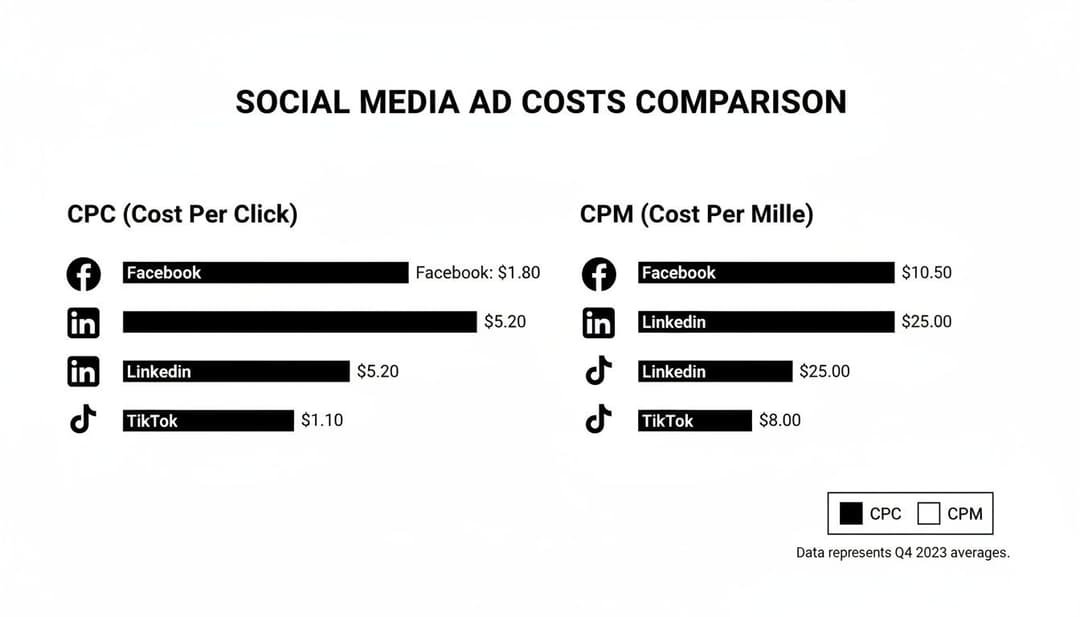
It’s no surprise that LinkedIn’s professional audience comes with a higher price tag, while platforms like TikTok and Facebook offer much cheaper reach.
The Ultimate Metric: Return On Ad Spend (ROAS)
While CPL and CAC are about efficiency, Return on Ad Spend (ROAS) is all about profitability. It answers the single most important question you'll ever get from your boss or client: for every dollar we put in, how many are we getting back?
- Formula: Total Revenue from Ads / Total Ad Spend = ROAS
- Example: If your $1,000 campaign generated $4,000 in sales, your ROAS is 4x, or 400%. ($4,000 / $1,000 = 4).
A positive ROAS is the ultimate proof that your social media strategy is firing on all cylinders. It reframes your marketing budget from a simple expense into a high-yield investment, making it so much easier to ask for more budget.
For a deeper dive into this all-important metric, our guide on how to calculate ROAS gives you a complete walkthrough.
Looking Beyond The First Purchase With CLV
At first glance, a high CAC can feel like a punch to the gut. A $100 cost to acquire a customer who only makes a $50 purchase seems like a losing game.
But hold on. What if that same customer comes back and spends $50 every month for the next two years?
This is where Customer Lifetime Value (CLV) completely changes the conversation. CLV is the total profit you expect to earn from a customer over the entire course of their relationship with your brand.
Understanding CLV allows you to justify a higher upfront ad spend. A steep initial CAC becomes perfectly fine if you know that customer’s long-term value is ten times greater. It’s a powerful mindset shift—from chasing short-term sales to building long-term, profitable relationships. Pair CLV with your ROAS calculations, and you'll have the full story of your campaign's true financial impact.
Strategies To Reduce Costs And Maximize Efficiency
In a world of rising ad costs, efficiency isn't just a nice-to-have—it's your biggest competitive advantage. The real secret to controlling your social media marketing cost isn’t just about slashing your budget. It’s about squeezing more value out of every single dollar you invest.
This means you have to shift your thinking from just buying ads to actively engineering more effective campaigns from the ground up.
With global social media ad spend rocketing past $300 billion in 2026, the digital town square is only getting louder and more crowded. At the same time, the average global CPM has crept up to around $8.74, a jump of over 10% from last year. In this kind of environment, the only way to survive, let alone thrive, is to get smarter with your creative, tighter with your audiences, and faster with your testing.
Optimize Your Foundation With Strong Relevance Scores
Think of your ad's relevance score as a quality discount from the ad platforms. When platforms like Meta see that users are actually engaging with your ad, they reward you by showing it to more people for less money. A high score is the algorithm’s way of saying your ad makes the user experience better, not worse.
To give your relevance score a boost, zero in on these areas:
- Hyper-Specific Targeting: Your creative and copy need to feel like they were written specifically for the person seeing them. Speak directly to their problems and aspirations.
- High-Value Creative: Stop the scroll. Use images, videos, and headlines that grab attention and offer something valuable right away.
- Clear Call-to-Action (CTA): Don’t make people guess. Tell them exactly what you want them to do next, whether that’s "Shop Now," "Learn More," or "Sign Up."
Master Retargeting And Lookalike Audiences
Let's be honest: not all traffic is created equal. One of the most potent ways to bring down costs is to focus your ad dollars on people who are already familiar with your brand.
Retargeting lets you show ads to people who have already visited your website, watched your videos, or even left an item in their cart. These folks are way closer to making a purchase, which almost always leads to a much lower Cost Per Acquisition (CPA).
A classic rookie mistake is lumping all your website visitors into one big retargeting bucket. You have to segment them. Someone who abandoned their cart is a red-hot lead compared to someone who just skimmed a blog post. Your ad and your offer should reflect that difference.
Once you have a healthy list of customers, you can build Lookalike Audiences to find new people with similar traits. This is how you scale your campaigns intelligently, putting your budget to work on audiences that have a higher probability of converting. For a deeper dive, our guide to https://www.adstellar.ai/blog/optimize-ad-spend-efficiency lays out some great frameworks.
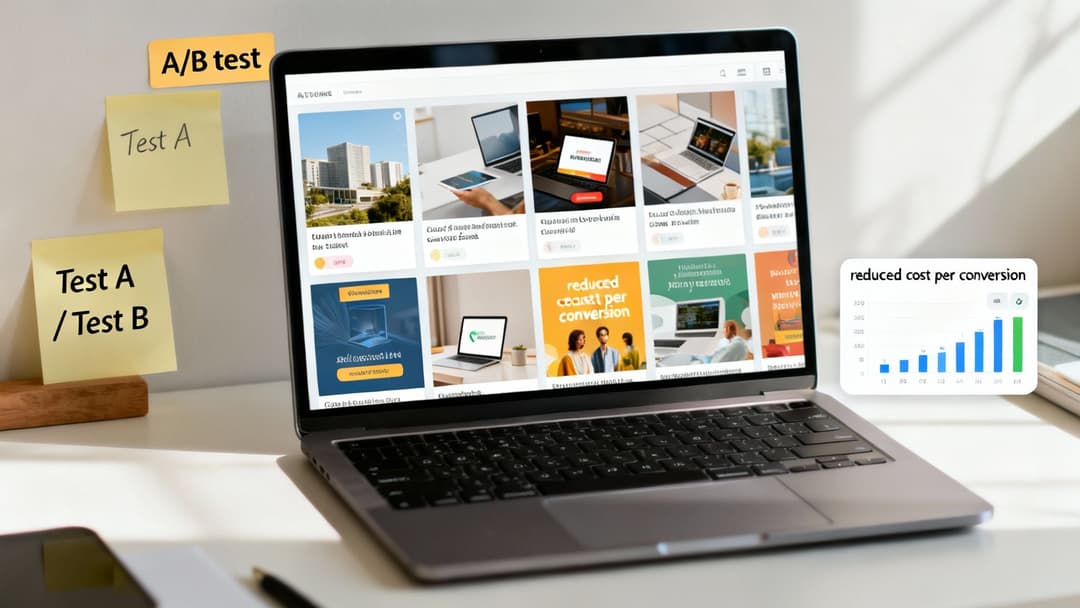
Embrace Rapid A/B Testing
Guesswork is the most expensive thing in marketing. The only way to truly know which headline, image, or audience works best is to pit them against each other and let the data decide. A systematic A/B testing process is the engine that drives optimization, helping you make small tweaks that add up to massive savings.
Don't just launch one ad and hope for the best. Create several variations and see what sticks. The key is to test just one thing at a time for clean, reliable results:
- Creative: Start with two different images or videos, but keep the copy and audience the same.
- Copy: Take your winning creative and now test two different headlines against it.
- Audience: Once you have a winning ad, test it on two completely different audience segments.
This methodical process cuts the fat from your budget. You quickly find and scale the winners while shutting down the losers before they can burn a hole in your wallet. To get a better handle on what your audience is thinking, you can explore affordable social listening tools to help shape your testing ideas.
Leverage AI For Creative Iteration At Scale
Trying to manually create and test dozens of ad variations is a massive bottleneck. It’s slow, tedious, and seriously limits how fast you can learn. This is where AI-powered platforms like AdStellar come in and completely change the game. They can automate the creation of hundreds of creative, copy, and audience combinations in minutes.
This lets your team run tests at a scale that's simply not possible for a human to manage. The AI then crunches the performance data in real-time, spots the winning elements, and can even suggest new campaigns based on what's working best. It dramatically shortens your learning cycle, helping you find those profitable ad combinations faster and more efficiently. The end result? Your overall social media marketing cost goes down because your budget is only being spent on what's already proven to work.
Building Your First Social Media Ad Budget
Alright, let's turn all this theory into action. It's time to build a social media ad budget from the ground up, using everything we've covered to create a practical spending plan. Think of your budget as more than just a number; it's a strategic document that connects your money to your business goals.
The right budget really depends on where your company is at and how ambitious you are. Are you just dipping your toes in the water, or are you ready to go all-in and start grabbing market share? Each goal demands a different level of investment and a unique way of splitting funds across platforms, creative, and management.
Sample Monthly Budget Tiers
To make this real, let's walk through three common budget scenarios. You can treat these as starting templates and tweak them to fit your own situation. They're designed to help you see how funds get allocated at different stages of growth.
1. The Testing & Learning Budget ($500 – $1,500 per month)
This lean budget is perfect for startups or any small business just getting into paid social. The main goal here isn't a massive, immediate ROAS. It's data acquisition. You're spending money to learn what messages, audiences, and creatives actually work, all without breaking the bank.
- Ad Spend Allocation: 70% of the budget. Put most of this into a single platform where you're pretty sure your core audience hangs out, like Meta.
- Management/Tools: 30% of the budget. This can cover some basic analytics tools or a bit of freelance help to make sure your campaigns are set up right from the start.
2. The Growth & Scaling Budget ($3,000 – $10,000 per month)
This is for businesses that have already proven their offer and are seeing some initial traction. You’ve found a formula that works on a small scale, and now it’s time to pour some fuel on the fire to drive consistent leads and sales.
- Ad Spend Allocation: 80% of the budget. At this point, you can confidently expand to two platforms, scaling up the winning campaigns you identified in the testing phase.
- Management/Tools: 20% of the budget. This tier gives you enough room for more advanced analytics and creative production tools, or even bringing on a small agency.
Your budget allocation tells a story about your strategy. A higher percentage on ad spend signals confidence in your model. A higher management fee suggests you're investing in expertise to find and unlock more efficiency.
3. The Market Leadership Budget ($20,000+ per month)
This is the aggressive approach, built for established brands that want to completely dominate their niche. The objective is to maximize your reach, stay top-of-mind, and simply outspend the competition on the platforms that matter most. For a deeper dive into financial planning at this level, check out a solid guide on digital marketing budget allocation.
- Ad Spend Allocation: 85% of the budget. This kind of spend supports complex, multi-platform campaigns, extensive A/B testing, and a mix of brand awareness and direct-response goals.
- Management/Tools: 15% of the budget. This covers the cost of a full-time in-house team or a top-tier agency, plus a sophisticated marketing technology stack to power it all.
To help you get started right away, we’ve put together a downloadable budget template. It's a practical tool designed to turn this guide into something you can use today to plan, execute, and win with your paid social advertising.
Got Questions About Social Media Costs? We've Got Answers.
Stepping into the world of paid social media can feel like navigating a maze. A lot of questions pop up, especially around the budget. We've heard them all. Below are some straight answers to the most common questions marketers ask, so you can build your budget with a bit more confidence.
How Much Should A Small Business Spend On Social Media Ads?
If you're just getting started, a realistic budget to aim for is somewhere between $500 and $2,000 per month. Don't think of this as the money that's going to make you rich overnight.
Think of it as your "learning budget." This amount is perfect for gathering meaningful data and testing different audiences. It lets you figure out what your customers actually care about and gives you the performance insights you need to grow later, all without betting the farm.
Should I Focus On CPC Or CPM?
The classic CPC vs. CPM debate. The right answer? It completely depends on what you're trying to achieve with your campaign. There’s no single winner here; it's all about matching the cost model to your goal.
Here’s a simple way to think about it:
- Go with CPM when your main goal is brand awareness. If you just want to get your message in front of as many relevant eyeballs as possible, you're paying for visibility.
- Go with CPC when you want to drive a specific action, like getting people to your website or filling out a lead form. In this case, you're paying for someone to actually engage.
How Long Until I See Results From Paid Social Ads?
You'll see data like clicks and impressions almost right away, which is great. But seeing consistent, profitable results? That takes a bit more patience. Realistically, you should give it three to six months for the optimization process to really work its magic.
This initial period is a critical learning phase. You're not just running ads; you're teaching the platform's algorithm what works for your business. It's a partnership where you both work to fine-tune the targeting, creative, and messaging based on what the data says. A little patience now pays off big time down the road.
Ready to stop guessing and start scaling? AdStellar AI helps you launch, test, and optimize Meta campaigns 10x faster. Automate ad creation, uncover AI-driven insights, and turn your ad spend into predictable revenue. Learn how AdStellar AI can lower your costs and accelerate your results.