On social media, an impression is counted every single time your content is displayed on a user's screen. Think of it as your post simply making an appearance in someone's feed—it doesn’t mean they stopped to look or interacted with it, just that it was delivered and shown. This metric is all about exposure, not the number of unique people who saw it.
A Simple Analogy for Social Media Impressions
To really get what impressions are, picture your ad as a billboard on a busy digital highway. Every time a car drives past that billboard, it counts as one impression. Simple as that.
It makes no difference if it's the same car driving by five times throughout the day. Each pass is a distinct event, and every single one adds to your total impression count. In the same way, if someone scrolls past your Instagram post in the morning and sees it pop up in their feed again that evening, your content has just earned two impressions from that one person.
This is the key to understanding the difference between total exposure and the size of your unique audience. A high impression count tells you your content is being served up frequently, which is exactly what you want for campaigns focused on brand awareness and hammering a message home.
An impression is a measure of visibility. It's the basic currency of digital advertising buys, confirming your content was delivered to a screen.
Once you get this, it's easy to see why impressions are often the first metric marketers check to see if a campaign is even running. Of course, the design of your creative plays a huge role in turning that impression into something more; you can find some great tips on effective ad banners design to make every single view count. For now, just keep that highway analogy in your back pocket—it’s the perfect mental model for how platforms track the sheer volume of times your content appears online.
Why Impressions Became the Currency of Digital Attention
In the world of paid social media, impressions are the raw currency of attention. This shift happened as platforms like Meta, YouTube, and TikTok exploded in popularity, creating a virtually infinite inventory of moments where an ad could be shown.
Think of the social media feed as an ever-expanding universe of digital real estate. Every scroll, every story tap, and every video play creates a new plot of land. An impression is simply a brand renting one of those tiny plots for a split second to display its message. For performance marketers, this massive scale is both an incredible opportunity and a daunting challenge.
The sheer volume is staggering. The global social media user base shot up from just 970 million in 2010 to an expected 5.66 billion by late 2025. This user boom is exactly what turned social advertising into a $276.7 billion industry.
The Scale of Social Media Impressions
This is why understanding impressions is so critical for any advertiser. Platforms like Facebook and YouTube now serve ads to over 2 billion people every single month. This creates a fiercely competitive auction where millions of brands bid against each other for a user's attention in real-time.
But simply buying up impressions won't get you very far. The goal isn't just to appear; it's to appear in front of the right person at the right time to drive an action. That’s where the real work begins. To get a solid grasp on the basics, you can find a detailed explanation of social media impressions here.
In this high-volume environment, impressions are the starting point, not the finish line. Their value is determined entirely by what happens next—the click, the conversion, and ultimately, the return on ad spend (ROAS).
This infographic does a great job of visually separating the concept of total impressions from the unique individuals reached.
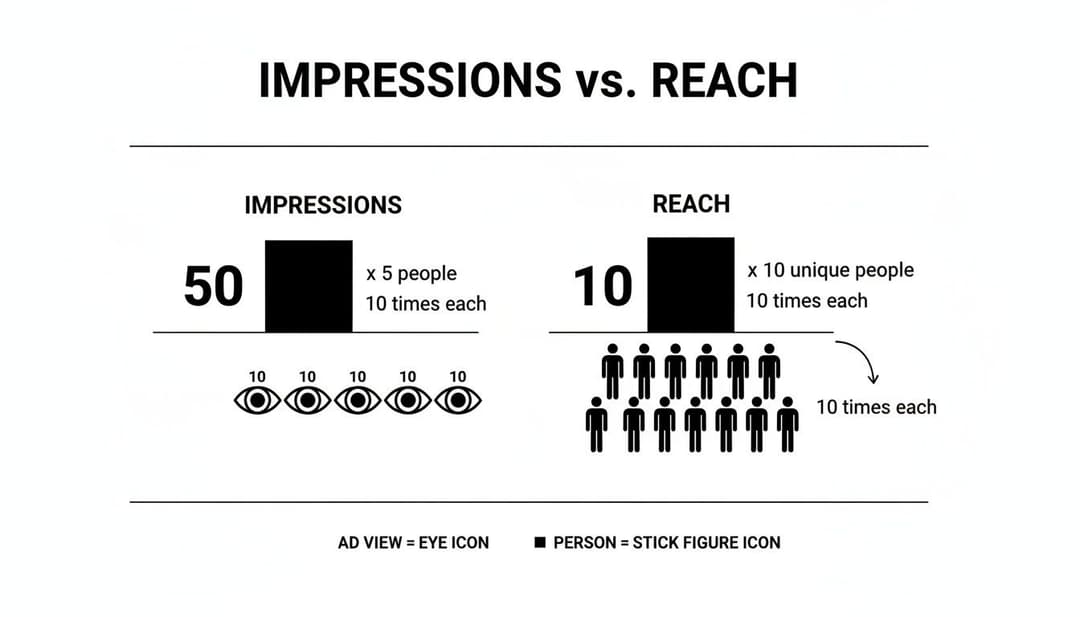
As you can see, a small group of people can generate a huge number of impressions. It’s a perfect illustration of why optimizing for quality over sheer quantity is the key to winning in paid social.
From Raw Volume to Smart Targeting
The real challenge for modern marketers is navigating this sea of impressions to find the ones that actually convert. With impression counts soaring 24% year-over-year in late 2023, the noise is louder than ever. Manually sifting through all this data to find winning combinations of creative, copy, and audiences is nearly impossible at scale.
This is exactly why automation and AI are no longer optional. Tools are built to manage this chaos, automating the creation and testing of hundreds of ad variations in minutes. By analyzing historical data and using AI to rank top performers, they help e-commerce brands and agencies cut through the clutter, launch proven winners faster, and scale high-ROAS campaigns without all the manual grunt work.
In an advertising world built on billions of impressions, this is how you turn raw attention into measurable revenue.
Decoding the Metrics: Reach, Views, and Frequency
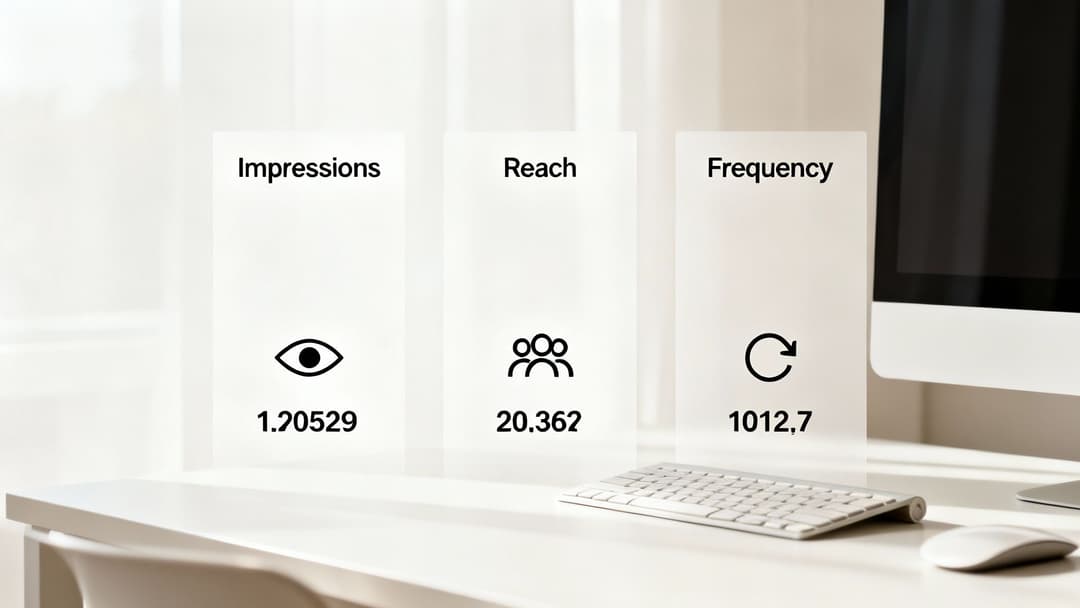
Getting a handle on impressions is a great start, but their true power becomes clear when you see how they play off other core metrics. Think of impressions, reach, and frequency as three interconnected dials on your campaign's control panel. Adjusting one inevitably affects the others, and finding the right balance is the key to hitting your goals.
Let's break this down with a dead-simple example. Say you run a social media ad that gets shown to one single person five times in one day.
Here's what your dashboard would show:
- Impressions: 5 (The ad was loaded and displayed five separate times.)
- Reach: 1 (Only one unique person ever saw the ad.)
- Frequency: 5 (That one person saw the ad an average of five times.)
This scenario perfectly illustrates the difference. Impressions are all about total exposure—the raw count of ad appearances. Reach, on the other hand, tells you how many unique people you actually got in front of. And frequency? It’s the metric that connects the two, showing how often each person was exposed to your message.
Reach: The Measure of Unique Viewers
While impressions tally up every single appearance, reach zeroes in on the unique individuals who saw your ad at least once. It answers a fundamental question: "How many different people did my content get in front of?"
If your campaign's mission is to broaden your audience and introduce your brand to new faces, reach is your north star. A high reach with a controlled frequency means your budget is efficiently finding new eyeballs, not just hammering the same small group of people over and over again. Understanding how to measure ad effectiveness is all about striking this perfect balance.
Frequency: The Repetition Factor
Frequency is just a simple calculation: total impressions divided by total reach (Impressions ÷ Reach = Frequency). It reveals the average number of times a person in your target audience saw your ad. A frequency of 1 means everyone saw it once; a frequency of 5 means they saw it, on average, five times.
This metric is your primary tool for managing ad fatigue. Let’s be real—seeing the same ad a dozen times is annoying, and it can tank your performance. At the same time, for a complex product or a brand awareness push, a higher frequency might be exactly what you need for the message to sink in.
A rookie mistake is chasing cheap impressions while completely ignoring frequency. You might end up showing your ad 20 times to the same person, blowing your budget and turning a potential customer into someone who actively dislikes your brand.
The Nuance of a "View"
Just when you think you have it all figured out, the term "view" throws a wrench in things, especially with video content. Unlike a static image impression (which is pretty straightforward), what counts as a video view is defined by time—and those definitions change drastically from one platform to the next.
- Meta (Facebook & Instagram): A video view can be registered after just 3 seconds of watch time. It's a quick glance.
- YouTube: For skippable in-stream ads, a view is typically counted only when someone watches for 30 seconds (or the entire ad if it's shorter) or clicks on it.
This distinction is massive. An advertiser looking for deep engagement will value a 30-second YouTube view way more than a 3-second Meta view. Knowing how each platform counts a view helps you align your KPIs with your actual campaign goals, whether that's grabbing quick attention or telling a deeper story.
To help clear things up, let's put these key metrics side-by-side. Each one tells a different part of your campaign's story, and knowing which one to focus on depends entirely on what you're trying to achieve.
Core Social Media Metrics Compared
| Metric | Primary Question Answered | How It's Calculated | Best Used For |
|---|---|---|---|
| Impressions | "How many times was my ad displayed?" | Total number of times an ad is shown on a screen. | Measuring brand awareness and total ad exposure. |
| Reach | "How many unique people saw my ad?" | Total number of unique users who saw an ad at least once. | Gauging audience size and brand penetration into new markets. |
| Views | "Did someone watch my video for a meaningful duration?" | Platform-specific rules (e.g., 3 seconds on Meta, 30 on YouTube). | Assessing video content engagement and message consumption. |
| Frequency | "How often did each person see my ad?" | Impressions ÷ Reach. | Monitoring ad fatigue and optimizing message repetition. |
| Clicks | "Did someone interact with my ad?" | Total number of clicks on an ad's link or call-to-action. | Driving traffic and measuring immediate user interest. |
Ultimately, no single metric can give you the full picture. A successful analyst knows how to read these numbers together to understand not just what happened, but why it happened.
How Social Media Platforms Actually Count an Impression
"Impression" seems like a simple enough word, right? Your ad appeared. But what that actually means can feel like a total black box. The technical nitty-gritty varies from platform to platform, but getting a handle on the rules is a must for anyone buying ads—especially if you're on a CPM (Cost Per Mille) model where you pay for every 1,000 impressions.
On Meta's platforms, like Facebook and Instagram, the rule is surprisingly loose. An impression is counted the very instant any single pixel of your ad touches a user's screen.
Let that sink in for a moment. Someone could be doom-scrolling at lightning speed, and if your ad blips onto their screen for half a second before it’s gone, you've just paid for an impression.
This rapid-fire counting is built for the chaos of mobile feeds. But it also exposes a critical divide that every media buyer has to wrestle with: the difference between a "served" impression and a "viewable" one.
Served Impressions vs. Viewable Impressions
Think of a served impression like a package leaving the warehouse. The ad server confirms it sent your ad out for delivery. It's on the truck, but you have no real guarantee it made it to the right doorstep or that anyone actually opened the box.
A viewable impression, on the other hand, is held to a much higher standard. Industry guidelines usually define a viewable display ad as one where at least 50% of its pixels are on-screen for at least one continuous second. For video ads, the standard is usually two seconds.
Meta counts impressions the second an ad is rendered on-screen—whether a person genuinely saw it or not. This means you're often paying for exposure that wasn't truly 'viewable' by human eyes.
That gap between served and viewable is where campaign budgets evaporate. If your ads are constantly being served but are never actually seen, you're essentially lighting money on fire. It's a classic reason for poor performance, and if you see your campaign isn't spending its budget, you can dig deeper by learning why your ad is not delivering on Facebook.
How Other Platforms Count Impressions
Not every platform is as trigger-happy as Meta. The rules often shift depending on the ad format, and this is especially true when it comes to video.
- YouTube: For its popular skippable in-stream ads, an impression (or a "view" you pay for) often isn't counted until someone watches for 30 seconds or interacts with the ad. That's a much, much higher bar.
- X (formerly Twitter): They fall closer to the industry standard. An impression is generally counted when an ad is at least 50% visible on the screen for two seconds or more.
- LinkedIn: The professional network plays by similar rules, also following the 50% visible for two seconds standard for its video ads.
For media buyers, this knowledge is power. It tells you what you’re really buying on a CPM basis. You’re not just buying ad space; you’re buying a specific platform’s definition of an appearance. Understanding these nuances helps you evaluate performance across different channels and make sure your ad dollars are going toward impressions that actually have a chance of being seen.
Why Paid Impressions Are No Longer Optional for Growth
Remember the good old days of social media? When brands could post a picture, build an audience, and actually sell things—all without spending a dime.
Yeah, those days are long gone.
Today's social media landscape is a pay-to-play arena. Platforms like Facebook and Instagram have intentionally throttled organic reach, making a strategic investment in paid impressions absolutely mandatory for any brand serious about growth.
This isn't just a hunch; the data tells a brutal story. The average organic reach on Facebook is a measly 1.65%. Even on the more visual Instagram, it’s only 3.50%, and that number dropped by 12% year-over-year. The message is clear: the algorithms are designed to bury unpaid content, forcing you to buy your way into your audience's feeds. For more on this, check out the latest social media statistics.
This forces a massive shift in how we think about marketing. We've gone from hoping for organic discovery to engineering predictable visibility with paid campaigns.
The Shift to Engineered Visibility
For any growth team or e-commerce brand, paid impressions are now the engine that powers the entire marketing funnel. They're essential for a whole host of activities that you simply can't leave up to the whims of unpredictable organic reach.
- Reaching New Customers: Paid impressions let you break out of your follower bubble and introduce your brand to highly targeted new audiences, and do it at scale.
- Validating Creative Concepts: Forget waiting months to see what works. You can test hundreds of ad variations in a matter of days, gathering real-world data on what messages and visuals actually resonate.
- Scaling Revenue Predictably: Once you find a winning formula of ad and audience, you just add more fuel. Pouring more budget into paid impressions drives consistent, measurable returns.
The question is no longer if you should invest in paid impressions. It’s how you can do it efficiently without burning through your budget. A well-defined paid social media strategy is the only path forward.
This is where AI-powered tools become a necessity, not a luxury. Manually managing the sheer volume of ads and impressions needed to scale is a recipe for disaster. Modern platforms plug directly into ad managers, automating the creation and launch of hundreds of ad variations in minutes.
By constantly analyzing performance data, these systems pinpoint which impressions are actually driving results, letting you double down on the winners and cut the losers with surgical precision.
Without that level of automation, you're just guessing while your competitors are using data to engineer growth. In this new era, mastering your paid social media strategy isn't just an advantage; it's the baseline for survival.
Turning Impressions Into Revenue
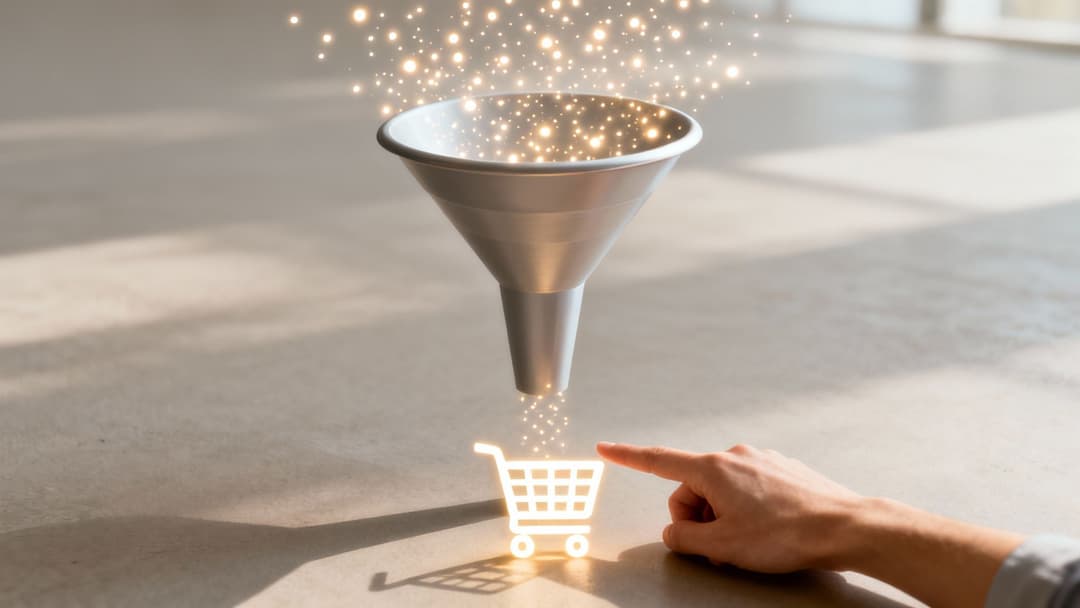
Alright, we’ve covered what social media impressions are and why they’re the bedrock of any paid ad campaign. But let's be honest, impressions alone don't pay the bills. The real magic happens when performance marketers connect those initial moments of exposure to actual business results—like revenue and profit.
This is where you graduate from simply buying attention to strategically investing in growth. It’s all about seeing impressions in the full context of your marketing funnel.
Sure, a campaign might rack up millions of cheap impressions. But if those eyeballs never click, add a product to their cart, or actually buy something, you’ve just paid to be ignored. This is easily one of the most common traps in paid social advertising.
On the flip side, a campaign with a higher CPM (Cost Per Mille) might look expensive at first glance. But what if that audience is highly qualified and converts like crazy? Suddenly, those "expensive" impressions are actually incredibly valuable. This mindset shift is what turns ad spend into a predictable revenue engine.
From Data Points to Profit Drivers
Building that bridge from an ad being seen to a customer making a purchase demands a data-first approach that sidesteps the usual pitfalls. You need a system that can tell you how different ad elements are performing at every single stage of the customer journey.
Here are the critical mistakes to watch out for:
- Chasing cheap impressions: Focusing on low CPMs without thinking about audience quality is a fast track to wasting your budget on people who will never convert.
- Ignoring ad fatigue: A high frequency might look good for brand recall, but blasting the same ad at someone 10+ times is a great way to annoy potential customers and kill your campaign's performance.
- Failing to link impressions to conversions: If you don't have proper tracking, you can't figure out which ads are actually driving sales. You're left guessing where to put your money for the best returns.
The goal isn’t just to get seen; it's to be seen by the right people who will take the right action. Think of every single impression as an investment with an expected return.
For e-commerce brands and agencies trying to do this manually, connecting all these dots at scale is next to impossible. This is where modern advertising tools come into play. They don’t just automate ad creation; they use AI to dig through performance data and pinpoint the exact combinations of creative, copy, and audience that are turning impressions into revenue.
By ranking your campaigns against crucial business goals like ROAS (Return on Ad Spend) or CPA (Cost Per Acquisition), these platforms give you a clear, automated path to scaling your winners. You can learn more about how to calculate ROAS to get a better handle on this critical metric. This data-driven process takes the guesswork out of the equation, helping you invest confidently in the campaigns that will actually grow your bottom line.
Frequently Asked Questions About Social Media Impressions
Even after you've got a handle on the basics, some practical questions always seem to come up when you’re actually in the ad manager, trying to make sense of the numbers. Let’s tackle some of the most common ones marketers run into.
Are More Impressions Always Better?
Not at all. It's tempting to chase a huge impression number because it feels like you're reaching everyone, but quality and relevance will always trump raw quantity. It’s far better to get your ad in front of a small, highly-invested audience that actually converts than to rack up millions of impressions with people who will never buy from you.
Always tie your impressions back to your main goal—whether that's clicks, leads, or sales. That's why smart marketers quickly shift their focus from impressions to metrics like ROAS (Return On Ad Spend) and CPA (Cost Per Acquisition) to measure what's really working.
What Is a Good CPM on Meta Ads?
Honestly, a "good" Cost Per 1,000 Impressions (CPM) is a moving target. It can swing wildly depending on your industry, the audience you're targeting, your location, and even the time of year. Chasing a universal benchmark is a fool's errand. The only number that matters is your own.
The most important thing is the relationship between your CPM and your Cost Per Acquisition (CPA). A high CPM can be perfectly fine if it's leading to a profitable CPA and a strong return on your ad spend.
Benchmark against your own past performance and what you know about your industry. That's your true north. For a deeper dive into measuring and growing your visibility, you can explore this guide to unlock social media impressions.
How Can I Reduce Ad Fatigue?
When the same people see your ad over and over (i.e., you have a high frequency), they start tuning it out. That's ad fatigue, and it’s a campaign killer. Here’s how you fight back:
- Expand your audience targeting. It's time to bring fresh eyes into the mix. Look into new interest groups or Lookalike audiences.
- Refresh your creative and copy. Don't let your ads get stale. A new image, a different headline, or a tweaked call-to-action can make an old ad feel new again.
- Use frequency caps. On platforms that offer it, you can literally tell the algorithm to stop showing your ad to someone after they've seen it a certain number of times.
Ready to turn your impressions into predictable revenue? AdStellar AI automates the creation, testing, and scaling of your Meta campaigns, helping you pinpoint winning ad combinations 10x faster. Stop guessing and start growing at https://www.adstellar.ai.