Your Facebook ads conversion rate is the percentage of people who click your ad and then actually complete the goal you set for them—like making a purchase or signing up for a newsletter.
Honestly, it's the ultimate report card for your campaign. Getting a handle on this one metric is the first step toward building ad strategies that are not just profitable, but scalable.
What Is a Good Facebook Ads Conversion Rate Anyway?
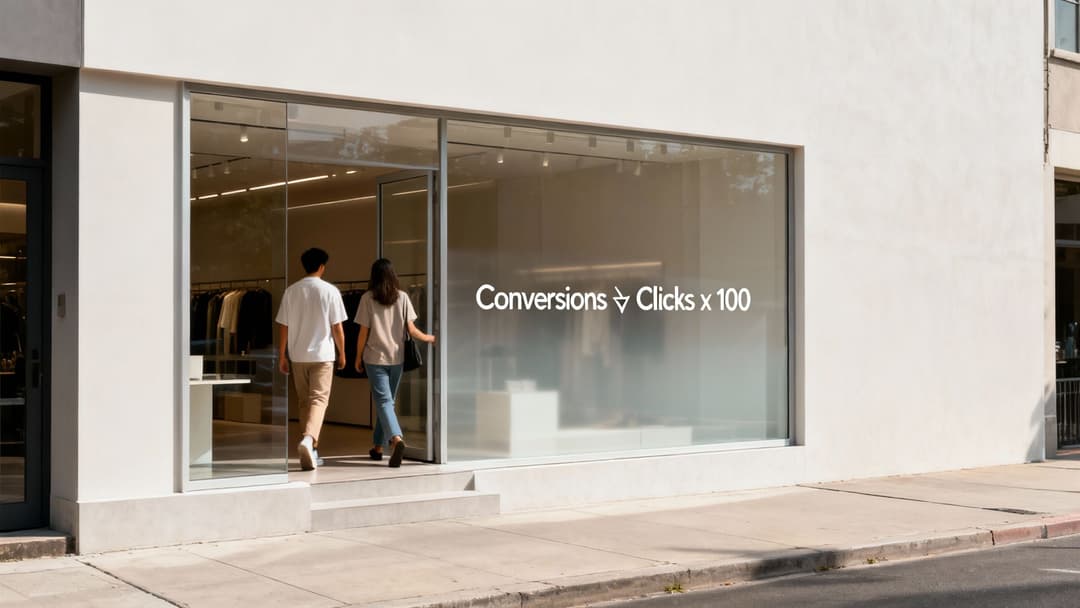
Let's cut through the jargon. Think of your Facebook ad as a flashy window display in a digital storefront. Every click is someone who saw that display and decided to walk into your store. A conversion? That's when one of those people actually buys something.
Your conversion rate tells you what percentage of those "store visitors" became paying customers. It answers the single most important question every advertiser has: "Is my ad actually driving real business results?"
Calculating Your Baseline Rate
The formula for this is dead simple, and every performance marketer should have it memorized. It gives you a quick, clean baseline to see how you're doing at a glance.
(Total Number of Conversions ÷ Total Number of Clicks) x 100 = Conversion Rate (%)
So, if your ad gets 1,000 clicks and that leads to 50 purchases, your conversion rate is 5%. This little bit of math is your starting line for diagnosing what’s working and what isn’t. You can pull all of this data directly from your Meta Ads Manager.
Why "Good" Is a Relative Term
Here's the thing, though: there's no magic number for a "good" conversion rate. A rate that’s cause for celebration in one industry could be a total disaster in another. It’s all about context.
Several factors mix things up:
- Industry: A company selling high-ticket B2B software is going to have a much lower conversion rate than an e-commerce brand selling trendy t-shirts. It's just the nature of the beast.
- Offer: A free e-book download will always convert better than a $2,000 online course. The lower the barrier to entry, the higher the conversion rate.
- Audience Temperature: People who already know and trust your brand (a warm audience) will convert way more easily than a cold audience seeing you for the very first time.
Recent data shows the average Facebook Ads conversion rate across all industries is around 8.95%. But that number is all over the map. Retail averages a modest 3.26%, while verticals like fitness and education can see rates over 500% higher than the tech industry.
It’s worth diving into these industry benchmarks to see where you stack up. Understanding these nuances is key because it directly impacts how you measure ad effectiveness for your business. This guide will give you the benchmarks and frameworks to set realistic goals and start pushing your numbers higher.
How Your Performance Stacks Up Against Industry Benchmarks
Knowing your Facebook ads conversion rate is a great start, but let's be honest, the first question we all ask is: "Is my rate any good?" The answer isn't a simple yes or no—it lives inside industry benchmarks.
Context is everything. A conversion rate that would have a high-ticket B2B service popping champagne would be a total disaster for a fast-moving e-commerce brand. Trying to compare them is like judging a marathon runner by their 100-meter dash time. They're both running, but the race is completely different. To set realistic goals and find real opportunities to grow, you have to know where you stand against your actual competitors.
Facebook Ads Conversion Rate Benchmarks by Industry
A comparative look at average conversion rates and cost per conversion across different industry verticals, helping marketers benchmark their campaign performance.
Let's dig into how different industries are actually performing on Meta's turf. The numbers vary wildly, and they tell a fascinating story about what makes people click and convert. Some industries are built to generate leads, while others are all about driving immediate, low-cost sales.
This table gives a snapshot of the average conversion rates and the cost to land a new customer across several key sectors.
| Industry Vertical | Average Conversion Rate (%) | Average Cost Per Conversion ($) | Key Performance Driver |
|---|---|---|---|
| Fitness | 14.29% | $13.29 | Low-commitment offers, emotional triggers |
| Education | 13.58% | $7.85 | Lead magnets (webinars, guides) |
| Real Estate | 10.68% | $16.92 | Lead form submissions for listings |
| B2B | 10.63% | $23.77 | High-value lead generation (demos, reports) |
| Healthcare | 11.00% | $12.31 | Appointment bookings, info requests |
| Retail | 3.26% | $21.47 | Direct-to-purchase, higher friction |
| Technology | 2.31% | $55.21 | Long sales cycles, high-ticket items |
These benchmarks reveal a pretty clear divide. Industries like fitness, education, and healthcare often see incredible conversion rates, while sectors like retail and technology sit much lower. But that doesn't mean they're failing.
Why Some Industries Convert Better Than Others
The "why" behind these numbers is far more important than the numbers themselves. It gets to the heart of what motivates a user to stop scrolling and take action.
Take the Fitness industry, which crushes it with a 14.29% conversion rate. Why? Their ads tap into powerful emotional drivers like self-improvement and transformation. The offer is often a super low-commitment lead magnet—think a free class pass or a downloadable workout guide. It’s an easy "yes" for the user.
Now look at Technology, sitting at just 2.31%. That looks bad on the surface, but it's not. Tech products often come with high price tags, long consideration periods, and complex decisions. A single conversion could be a demo request for a $50,000 piece of software. In that context, a 2.31% conversion rate is not only acceptable; it's profitable.
The biggest takeaway here is that your campaign objective is the single most influential factor in your expected conversion rate. A campaign built to generate leads will almost always have a higher CVR than one driving direct sales.
How Campaign Objectives Change the Game
The numbers in the table are blended averages, but performance can swing dramatically even within the same industry depending on the campaign objective you choose. Meta's algorithm is a powerful beast—it’s designed to get you exactly what you ask for.
Lead Generation Campaigns: These are built to collect user info right on the platform using an instant form. They average a conversion rate of 8.78% because they remove almost all friction. The user never has to leave Facebook or Instagram.
Traffic Campaigns: The goal here is just to send people to your website. While they can be great for building an audience, their conversion rates are naturally much lower because you’re adding an extra step and asking the user to leave the app.
So, you simply can't judge a sales-focused e-commerce campaign using the same yardstick as a lead-focused real estate campaign. To get a true read on your performance, you have to compare apples to apples.
A great first step is to get comfortable with where to find the right ad performance data inside Meta Ads Manager. This makes sure you're tracking the metrics that actually align with your campaign goals. Once you're benchmarking correctly, you’re on the path to building a much smarter, more profitable ad strategy.
The Four Levers That Actually Control Your Conversion Rate
Your Facebook ads conversion rate isn't some random number you just have to live with. It’s a direct result of four core elements working in sync. Think of your campaign like a high-performance engine; if one part is out of tune, the whole system sputters and stalls.
Once you get a handle on these four levers, you can stop guessing and start methodically fixing underperforming ads. When a campaign isn't delivering, you'll know exactly which lever to pull to get things humming again and drive that conversion rate up.
Ad Creative and Copy
Your ad creative is your digital handshake. It’s the very first thing a potential customer sees in their feed, and you have fractions of a second to stop their scroll and grab their attention. Interestingly, slick, overproduced ads often get ignored in favor of more authentic, relatable content.
Take user-generated content (UGC), for example. It consistently crushes studio-shot creative because it feels real and builds instant trust. It’s social proof in its purest form. The copy then has to seal the deal by hitting on the audience's pain points and clearly explaining the value you're offering.
Key Takeaway: The goal isn't just to get a click; it's to get the right click. Your creative and copy should pre-qualify your audience, making sure the people who tap through are the ones who are genuinely interested in what you have.
To push this even further, many savvy advertisers are now using AI-powered tools to rapidly test dozens of creative combinations. Digging into concepts like dynamic creative optimization can help automate the hunt for the perfect mix of visuals and messaging for each audience segment.
Audience Targeting
Who sees your ad is every bit as important as the ad itself. You could have the most persuasive creative ever made, but if you show it to the wrong crowd, your conversion rate will completely flatline. This is where smart audience segmentation becomes your secret weapon.
Warm Audiences (Retargeting): These are the people who already know you—they’ve visited your site, liked a post, or are on your email list. They represent the lowest-hanging fruit and will almost always deliver your highest conversion rate.
Lookalike Audiences: Meta can build audiences that "look like" your best customers, top website visitors, or most engaged email subscribers. This is a powerful way to find new people who share the same characteristics as your existing fans.
Broad Targeting: This is where you target based on interests, demographics, and behaviors. While you need these "cold" audiences to scale your campaigns, they will naturally have a lower conversion rate than your warmer audiences.
A well-structured campaign almost always segments these audiences by "temperature." This lets you tailor your message and budget based on how familiar someone is with your brand, which has a huge impact on your overall Facebook ads conversion rate.
Offer and Landing Page
The customer journey doesn’t end when they click your ad. The handoff from Facebook to your landing page needs to be absolutely seamless. If someone clicks an ad promising a 50% discount but lands on your confusing homepage, they're gone. That disconnect is a conversion killer.
Your landing page has to deliver on the promise you made in the ad. This idea, known as message match, is non-negotiable for building trust and guiding people toward the finish line.
So, what does a high-performing post-click experience look like?
- Clear Value Proposition: The headline should instantly tell the user they’re in the right place.
- Minimal Distractions: Get rid of extra navigation links, pop-ups, and anything else that could pull them away from the main goal.
- Compelling Call-to-Action (CTA): Your button needs to stand out and use action-focused words (e.g., "Get My Free Quote" instead of just "Submit").
The quality of your landing page is a massive lever you can pull. To see what works, check out these examples of high-converting landing pages. A solid page is often the final piece that turns a curious clicker into a happy customer.
Bidding Strategy
Finally, your bidding strategy is how you tell Meta's algorithm what you actually want it to do for you. This is probably the most misunderstood lever of the four, but it has a massive effect on who sees your ad and, ultimately, your conversion rate.
When you create a campaign, you have to pick an optimization goal. If you tell Meta you want "Traffic," its algorithm will go find people who love to click on things, whether or not they ever buy anything. This gets you cheap clicks, but your conversion rate will be in the basement.
But if you choose "Conversions," Meta's algorithm completely changes its game plan. It starts hunting for users in your target audience who have a history of taking the exact action you want, like making a purchase or filling out a lead form. Your cost per click (CPC) might be higher, but the clicks you get will be from a much higher-intent audience, leading to a far better conversion rate.
This infographic shows just how much conversion rates can vary from one industry to the next.
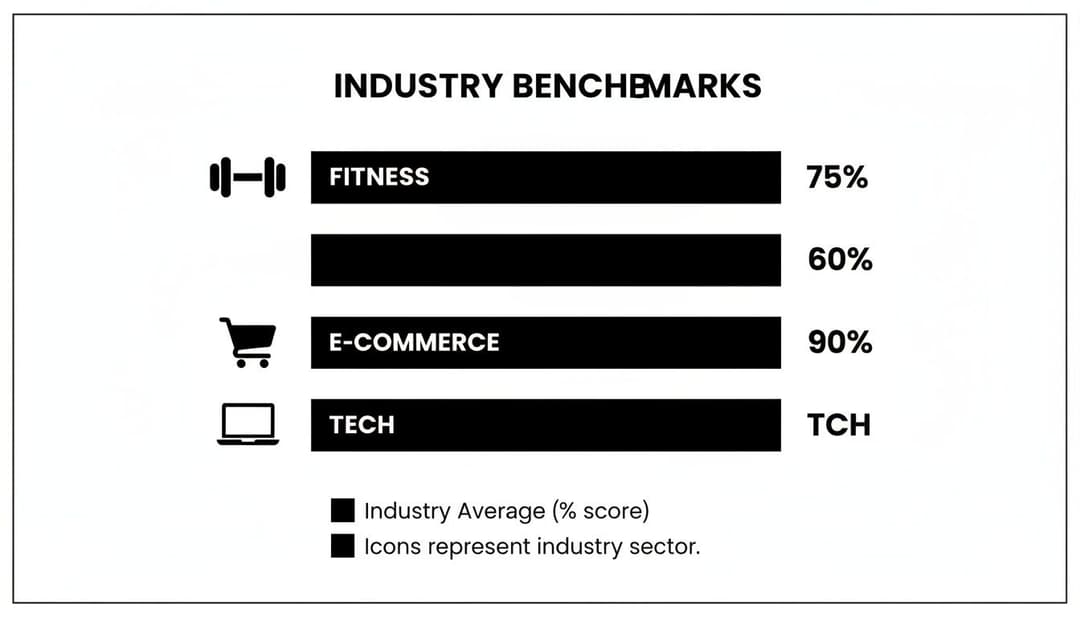
As you can see, industries like fitness often have higher conversion rates because they can tap into emotional triggers and low-commitment offers, while e-commerce and tech have their own unique hurdles to clear.
Making Sense of Attribution Windows and Modeled Conversions
Ever stare at your Ads Manager, then your Shopify or WooCommerce backend, and wonder why the sales numbers just don’t line up? Don't worry, your dashboard isn't broken. This is a classic case of attribution, and getting your head around it is the key to understanding your true Facebook ads conversion rate.
Think of attribution as a digital breadcrumb trail. Someone interacts with your ad, and Meta drops a "breadcrumb" to mark the moment. If that person eventually buys something, Meta follows that trail back and gives your ad credit for the sale. The attribution window is simply how long Meta is allowed to keep looking for that trail.
Decoding Attribution Settings
The default setting you'll see most often is the 7-day click window. It's exactly what it sounds like: Meta will only credit a conversion to your ad if the user clicked it within seven days of making their purchase. It's the industry standard for a reason—it’s simple and works well for most businesses.
But there are other flavors you can choose from:
- 1-day click: This window only gives credit if the purchase happens within 24 hours of a click. It’s perfect for products with a short, impulsive buying cycle.
- 7-day click or 1-day view: This one casts a wider net. It credits a conversion if someone either clicked the ad within seven days or just saw the ad (without clicking) and converted within one day.
Which one should you use? It all comes down to your sales cycle. A brand selling quirky phone cases might do just fine with a 1-day click window because the decision to buy is lightning-fast. On the other hand, a company selling high-end furniture needs that 7-day click window to account for the days (or even week) a customer spends mulling over the purchase. Nailing this down requires solid measurement, which is why implementing effective website conversion tracking strategies is so critical to seeing the real impact of your campaigns.
The Rise of Modeled Conversions
Things got a little trickier a few years back with privacy updates like Apple's App Tracking Transparency (ATT). Suddenly, that breadcrumb trail became harder to follow. With more users opting out of tracking, gaps started appearing in the data.
That’s where modeled conversions come into play. When Meta can't directly see a conversion because of a user's privacy settings, it uses statistical modeling to fill in the blanks. It looks at the behavior of users who have opted into tracking and uses that data to estimate the conversions from those who haven't.
Modeled conversions aren't just wild guesses. They are data-informed estimates that paint a much more complete picture of your campaign's performance in a privacy-first world. Without them, your results would look a lot worse than they actually are.
This entire system leans heavily on the data signals your website sends back to Meta. This is precisely why having a correctly installed Meta Pixel is absolutely non-negotiable for getting accurate reports.
If you need a hand with that, our guide on how to set up the Facebook Pixel is the perfect place to start—it’s the foundation for all conversion tracking. Once you understand how attribution windows and modeled data work together, you can finally look at your Ads Manager reports with confidence and make smarter, data-backed decisions to scale your campaigns.
Proven Frameworks to Systematically Optimize Conversions
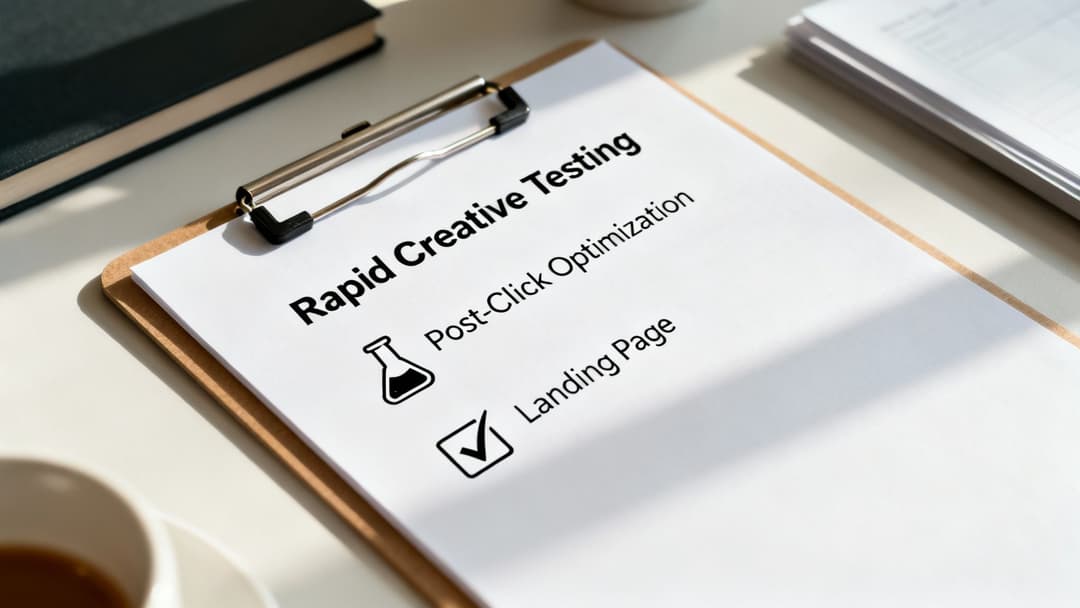
Knowing which levers control your Facebook ads conversion rate is half the battle. The other half is pulling them in a smart, systematic way. Too many advertisers fall into the trap of making random tweaks, crossing their fingers, and hoping for the best.
That’s a recipe for wasted ad spend.
Successful advertisers don’t guess; they use repeatable frameworks to diagnose problems and consistently find new winners. These systems turn chaos into a deliberate, data-driven process. Here are two powerful, battle-tested frameworks that cover both your ad creative and the critical journey that happens after the click.
Framework 1: The Rapid Creative Testing Method
Hands down, the single biggest variable in your campaign’s success is the creative. The Rapid Creative Testing framework is all about quickly identifying winning combinations of visuals, copy, and audiences at scale. It lets the data—not your gut feeling—decide what works.
Think of it like a science experiment. You isolate one variable at a time to see which one has the biggest impact. Instead of launching a single ad and hoping it’s a home run, you launch multiple variations at once to find the top performer fast.
Here’s a simple way to put it into practice:
- Isolate One Variable: Start by testing just one element. For example, keep your ad copy and audience the same, but test three to five completely different images or videos against each other.
- Identify the Winning Creative: Let the ads run for a few days, then check the data. The creative with the highest click-through rate (CTR) and lowest cost per click (CPC) is your visual winner. Pause the losers without a second thought.
- Test the Next Variable: Now, take your winning creative and test three to five different headlines or primary text variations. Again, keep the audience consistent.
- Find the Winning Copy: Let the numbers tell the story. The copy variation that drives the most conversions or has the lowest cost per action (CPA) is your new champion.
- Expand to New Audiences: With a proven creative-and-copy combination, you can now confidently roll it out to different audiences, like new lookalikes or interest groups.
This methodical approach stops you from burning cash on combinations that never had a chance. It’s a core principle behind what is multivariate testing and helps you find a winning formula much faster than old-school A/B testing.
By constantly iterating and building on what works, you create a feedback loop that steadily improves your Facebook ads conversion rate over time. Each test provides a new insight to fuel the next one.
Framework 2: The Post-Click Optimization Checklist
A killer ad can earn the click, but a leaky landing page will lose the conversion every single time. The Post-Click Optimization framework is designed to make the user's journey from your ad to the final action as smooth and frictionless as possible. It’s all about delivering on the promise your ad made.
Use this checklist to audit your landing page and plug any conversion leaks. A small fix here can often have a massive impact on your bottom line.
- Message Match: Does the headline on your landing page perfectly mirror the headline in your ad? A strong message match instantly tells the user they’re in the right place, building trust and killing bounce rates.
- Singular Call-to-Action (CTA): Does your page have one crystal-clear goal? Get rid of distracting navigation menus, social media links, or secondary offers. Focus every ounce of the user’s attention on the single action you want them to take.
- Frictionless Forms: If you’re capturing leads, keep your forms brutally short. Only ask for the information you absolutely need right now. Every extra field you add is another reason for someone to give up.
- Compelling Social Proof: Are you showing off testimonials, reviews, or case studies? Social proof is a powerful psychological trigger that reassures visitors they’re making a smart decision by trusting you.
- Mobile-First Design: The vast majority of Facebook traffic comes from mobile devices. Your landing page must load lightning-fast and look flawless on a small screen. A slow or clunky mobile experience is a guaranteed conversion killer.
Putting these frameworks into action gives you a repeatable process to not only fix underperforming campaigns but also to continuously find new pockets of growth. For e-commerce brands, where the average Facebook Ads conversion rate is a solid 9.21%, optimizing this post-click experience is often the secret to profitable scaling.
Answering Your Toughest Questions About Facebook Ads Conversion Rates
When you're deep in the trenches of Meta advertising, the same questions tend to bubble up. Getting straight answers to these common hang-ups is the key to building confidence and spending your ad budget wisely. This is where we tackle the most frequent questions performance marketers have about their Facebook ads conversion rate.
Why Is My Facebook Ads Conversion Rate So Low?
A low conversion rate is frustrating, but it’s almost never random. Think of it as a flashing warning light on your dashboard—it's pointing to a specific problem you can fix. If your numbers are in the gutter, it’s time to play detective and investigate these usual suspects.
More often than not, the culprit is a massive disconnect between your ad's promise and your landing page's reality. If your ad is shouting, "50% Off Flash Sale!" but the link just dumps people on your generic homepage, you've created a jarring experience. That broken promise kills trust instantly and sends users hitting the back button.
Other potential causes include:
- Weak Audience Targeting: You might be showing a masterpiece of an ad to the wrong crowd. An ad for high-end vegan skincare just won't land if you're targeting budget-conscious college students who live for barbecue.
- A Friction-Filled Landing Page: Does your page take forever to load on a phone? Is your checkout form asking for their mother's maiden name? Every extra second of load time and every unnecessary form field is another excuse for a potential customer to give up and leave.
- An Unclear Offer: If someone lands on your page and can't immediately figure out what you're selling and why they need it, they're gone. Your value proposition needs to be blindingly obvious from the second the page loads.
How Long Should I Wait Before Optimizing a Campaign?
Patience is a superpower in paid advertising, but it's one of the hardest to master. It's incredibly tempting to dive in and start tweaking things the moment a campaign looks like it's struggling, but jumping the gun can cause more harm than good.
Whenever you launch a new ad set, Meta's algorithm enters a critical "learning phase." During this period, it's actively experimenting with your audience to figure out who is most likely to actually convert. This process needs data to work its magic.
As a rule of thumb, you need to let an ad set get at least 50 conversions within a seven-day window before you even think about making significant changes. If you touch the creative, targeting, or budget before it exits the learning phase, you basically hit the reset button on the algorithm's progress, forcing it to start all over again.
Does a High CTR Mean a High Conversion Rate?
Not always. This is a classic trap that sends a lot of advertisers chasing the wrong metrics. A high click-through rate (CTR) is a fantastic sign that your ad creative is grabbing attention and your targeting is on point, but it absolutely does not guarantee a high conversion rate.
Think of it this way: a high CTR means you’re great at getting people to walk into your store. A high conversion rate means you’re great at getting them to actually buy something once they're inside. They’re two very different, though related, skills.
In fact, a super high CTR paired with a rock-bottom conversion rate is a huge red flag. It usually means your ad is attracting a ton of curious clicks from people who aren't a good fit for your offer. The ad might be funny or have a clickbait-y headline, but it's failing to pre-qualify anyone, leading to a flood of low-intent traffic that was never going to convert anyway.
How Can I Improve Conversions Without a Bigger Budget?
You don't always have to throw more money at a problem to fix it. The biggest wins in conversion rate optimization often come from improving efficiency and focusing your existing budget on what's already working. It’s about being smarter, not richer.
Here are a few budget-neutral strategies to get you started:
- Double Down on Retargeting: Your warmest audiences—people who’ve already visited your site or engaged with your brand—are the lowest-hanging fruit. Carve out a piece of your budget for dedicated retargeting campaigns with irresistible offers to bring these high-intent users back to close the deal.
- Refine Your Ad Copy: Tweak your copy to be more specific and do a better job of qualifying your clicks. Instead of a generic "Shop Now," try something like "Shop Our Premium Leather Wallets." This makes sure the people who click are genuinely interested in what you’re selling.
- Optimize Your Landing Page: This is the big one. Improving your page's mobile load speed, simplifying your forms, and adding compelling social proof like customer reviews are all completely free changes that can have a massive impact on your conversion rate.
Ready to stop guessing and start scaling? AdStellar AI is the AI-powered platform that helps performance marketers launch, test, and optimize Meta campaigns 10x faster. Automate ad creation, uncover what’s really working, and turn creative chaos into campaign clarity. Get started at AdStellar.ai.