Cost per impression rates, often called CPM (Cost Per Mille), is simply the price you pay for one thousand views of your ad. Think of it as the cost to rent a digital billboard—you pay a set price every time a thousand pairs of eyes drive past it, regardless of whether they stop and look.
What Cost Per Impression Really Means for Your Budget
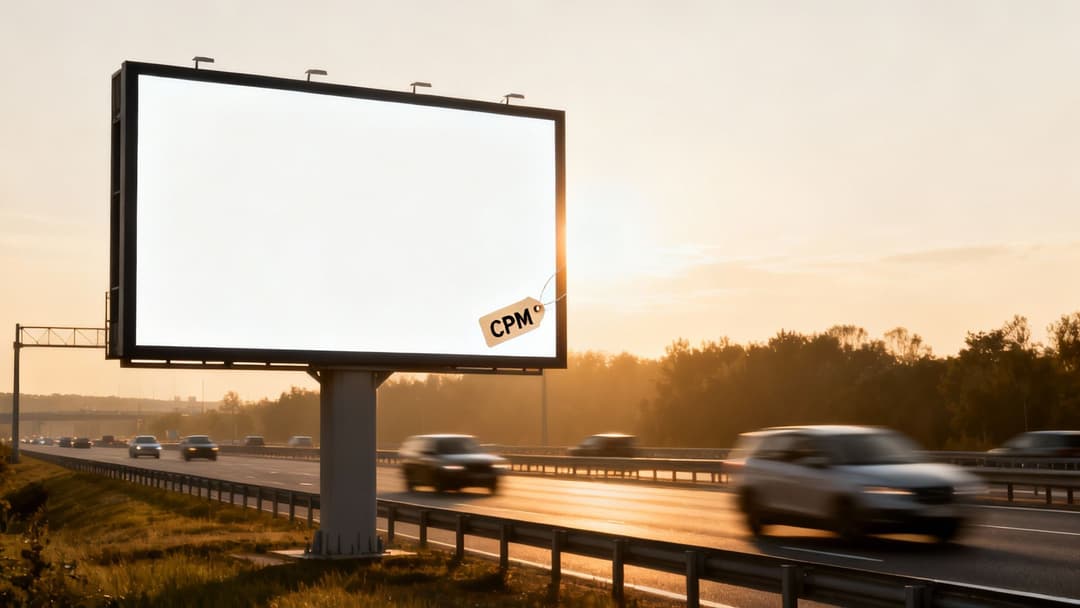
Let’s move beyond the textbook definition. Imagine your ad is a billboard on the internet's busiest highway. CPM is the rent you pay for that prime real estate.
It’s not about clicks or sales—it’s purely about visibility. You're paying for the opportunity to be seen, making it the fundamental currency of brand awareness.
This metric is essential because it answers a critical question: how cost-effective is your campaign at capturing attention? A lower CPM means you're getting more eyeballs for your money, stretching your budget further.
Why CPM Is the Starting Point for Optimization
Tracking your cost per impression is the first step toward true ad spend optimization. It gives you a baseline for campaign efficiency before a single person ever clicks. For marketers, understanding this core metric is vital for a few key reasons:
- Gauging Brand Awareness: It directly measures how much it costs to put your brand in front of potential customers. High impression counts at a low cost mean your message is reaching a wide audience efficiently.
- Priming Future Customers: Not every interaction leads to an immediate sale. Impressions build familiarity and trust, making audiences more receptive to your offers later on.
- Informing Budget Allocation: By comparing CPMs across different platforms or audiences, you can see where your budget is working hardest and shift funds to the most cost-effective channels.
A solid grasp of CPM allows you to evaluate campaign reach and efficiency at a glance. It’s the foundation upon which more complex metrics, like cost per click (CPC) and return on ad spend (ROAS), are built.
Essentially, while conversions are the ultimate goal, impressions are the necessary first touchpoint. Before someone can buy from you, they have to know you exist. If you’re interested in a deeper dive, our guide on what impressions on social media are provides additional context.
Mastering CPM is about making sure the cost of that initial introduction is as low as possible, setting the stage for profitable campaigns.
To really get a handle on today's ad costs, you have to rewind the clock a bit. The early days of social media advertising felt like a digital gold rush—a wide-open frontier with way less competition and rock-bottom prices for grabbing someone's attention.
Back then, a savvy marketer could reach a massive audience without emptying their pockets. The whole digital space was simpler, less crowded, and full of opportunities for anyone willing to jump in first.
But that wide-open space didn't stay empty for long. A couple of major shifts completely rewired the advertising world, sending competition through the roof and pushing the cost per impression on a steady march upward.
The Rise of Mobile and Algorithmic Bidding
The explosion of mobile devices was the first domino to fall. Suddenly, people were reachable anytime, anywhere, which instantly made every single impression more valuable. This mobile-first world gave ad platforms more ad space to sell, but it also gave them a firehose of new data to play with.
At the same time, the algorithms running these ad platforms got a whole lot smarter. They moved way beyond simple targeting and started predicting user behavior, actively prioritizing content that people found engaging. This created a new reality: high-quality ads got rewarded with better reach, while mediocre ones were left in the dust. The game was no longer just about who had the biggest budget, but who could create the most compelling stuff.
These two forces—the mobile boom and smarter algorithms—lit a competitive fire. As more and more brands flooded onto these platforms to capture this newly connected audience, the basic law of supply and demand kicked in. With a ton of advertisers all bidding for the same, limited user attention, the price for impressions naturally started to climb.
From Pennies to Dollars: A Story of Climbing CPMs
This isn't just a history lesson; it's the backstory for the ad costs we see today. For example, back in the early 2010s, Facebook CPMs were an absolute steal, often sitting well below $1 for many campaigns. Fast forward to 2015, and the average CPMs during peak shopping seasons like Cyber Monday were already hitting the $5-$7 range. That's competition in action.
The core takeaway is that the days of cheap, guaranteed reach are over. What worked five or ten years ago is no longer a viable strategy for sustainable growth.
This upward trend was also fueled by an increasing reliance on data to dial in campaigns. Advertisers started layering on more sophisticated targeting, using everything from demographics to interests and online behaviors. While this made ads much more relevant, it also meant everyone was competing for smaller, more valuable slices of the audience pie, which only drove costs up further. You can learn more about how different data types influence targeting by reading our guide on third-party data.
This history is exactly why marketers today can't just throw money at platforms and hope for the best. In such an expensive advertising world, using smarter optimization tools is the only way to protect your bottom line.
Benchmarking Your CPM Across Different Ad Channels
Knowing that ad costs have been on the rise is one thing, but how do your campaigns actually stack up against everyone else's? To figure that out, you need solid benchmarks. A "good" cost per impression rate isn't some magic number—it’s a moving target that changes dramatically based on the ad channel, your industry, and who you're trying to reach.
Without this context, you're flying blind. A $10 CPM might be a steal for a hyper-targeted B2B campaign on LinkedIn, but it could be a five-alarm fire for a broad awareness play on the Meta Audience Network. The only way to know if you're overpaying for eyeballs is to compare your numbers to what's typical for your specific situation.
Social Media Advertising Costs
Social media platforms are the usual suspects for building brand awareness, but their costs are all over the map. The one consistent trend? Prices are going up as more and more advertisers fight for a slice of the same user attention.
Worldwide social media CPMs hovered around $6.06 in late 2023. But on a platform like Meta, the swings are even more pronounced. Averages that were $6.11 in May 2024 are projected to climb to $9.31 by August 2025, with seasonal peaks potentially hitting $11.84. For e-commerce brands, that breaks down to Instagram Stories CPMs averaging $6.25 and feed ads hitting $7.68. These numbers, drawn from recent social media cost trends, paint a clear picture of increasing competition.
The timeline below really drives this point home, showing the steady march of CPMs from less than a dollar a decade ago to where we are today.
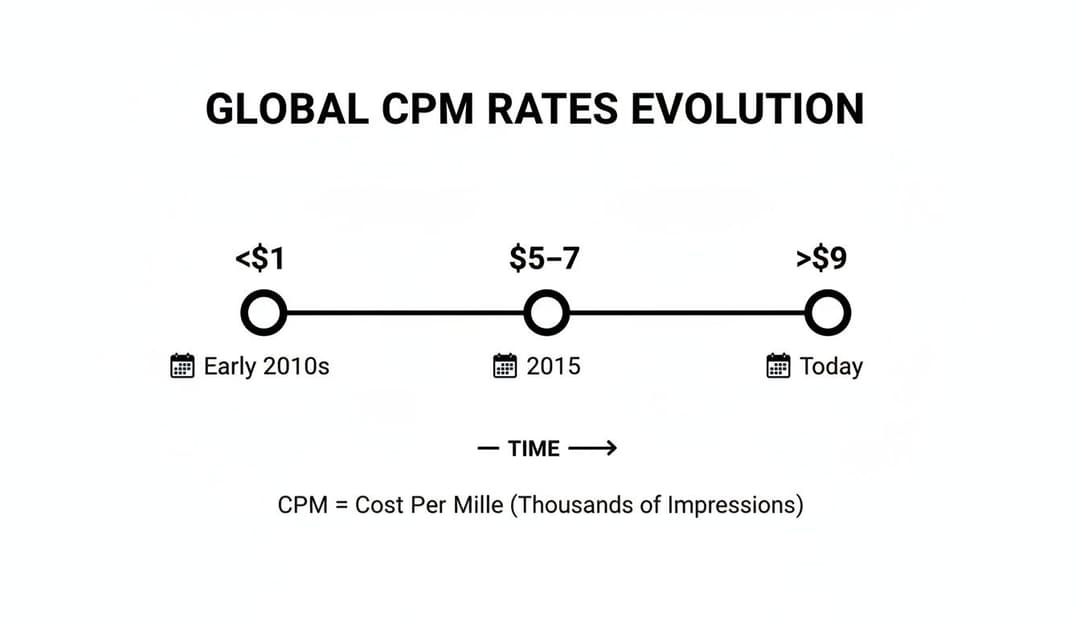
This isn't just a blip; it's a long-term trend. The cost of getting in front of people is only going one way.
Industry and Placement Matter
Beyond just the platform, your industry and ad placements are huge factors. Competitive, high-value sectors naturally attract more advertisers, which cranks up the price for every impression.
A "good" CPM is relative. It’s defined not by a universal standard but by your specific industry, the platform you use, and the audience you target. Success lies in beating the average for your unique competitive landscape.
To give you a better feel for this, here’s a quick-reference table that breaks down typical CPMs across different channels.
Average CPM Rates by Platform and Ad Placement
| Platform / Placement | Average CPM Range | Key Considerations |
|---|---|---|
| Meta (Facebook & Instagram) | $7 - $15 | Varies wildly by placement (Feed, Stories, Reels). Highly dependent on audience targeting and creative quality. |
| TikTok | $4 - $10 | Generally lower than Meta, but effective creative is non-negotiable. Skews toward a younger demographic. |
| $25 - $60+ | The highest CPMs, but you get access to a professional B2B audience. Great for high-value lead generation. | |
| YouTube Ads | $10 - $30 | In-stream ads are more expensive but capture engaged viewers. Targeting by video content is key. |
| Programmatic Display | $2 - $5 | The cheapest impressions, but placement quality can be inconsistent. Requires diligent monitoring and exclusion lists. |
| Connected TV (CTV) | $20 - $50 | Premium, non-skippable inventory. Excellent for brand awareness campaigns targeting household decision-makers. |
This table shows just how much "it depends." Your $12 CPM in the apparel industry might seem high until you see B2B marketers paying $30+ on LinkedIn for a single lead. The value of the impression is all about the potential return.
Understanding these nuances is the first step toward building a realistic budget and setting achievable goals. For a deeper dive into these costs, check out our guide on what social media marketing costs. By benchmarking correctly, you can start spotting where your ad spend is working hardest—and where it’s not.
The Key Factors That Drive Your Ad Costs
Your ad costs aren't set in stone. They're the result of a live, dynamic auction where a few powerful factors are constantly at play. Getting a handle on these drivers is the first real step toward diagnosing why your costs are high and finally taking back control of your ad spend.
Think of it like buying a house. A small home in a quiet town costs a lot less than a penthouse in a major city. In the same way, the "real estate" for your ads gets more or less expensive based on who you're trying to reach and where you're trying to reach them.
Audience and Targeting Precision
Who you target is probably the single biggest factor dictating your CPM.
Going after a broad audience of millions is like buying a billboard on a national highway—you’ll reach a ton of people, so the cost per person is low, but it's far from targeted. On the flip side, trying to reach a niche group, like C-suite executives in the tech industry, is an incredibly valuable and competitive audience.
Because so many other advertisers are bidding for their attention, the cost to get in front of them skyrockets.
- Broad Targeting: A campaign aimed at all adults aged 18-65 in the United States will have a relatively low CPM.
- Niche Targeting: A campaign targeting new homeowners who also show interest in luxury furniture will have a much higher CPM.
Nailing your targeting is everything. Our guide on how to identify a target audience can help you zero in on the right people without breaking the bank.
Ad Quality and Relevance Score
Ad platforms want to show users content they actually find interesting, not annoying junk that makes them close the app. They use algorithms to reward advertisers who create high-quality, relevant ads with lower CPMs and better placements. A high relevance score is the platform's way of telling you that your ad is a great match for your audience.
This means compelling visuals and sharp messaging aren't just "nice-to-haves"—they directly impact your ad costs. Understanding effective ad copy strategies is a must, as the quality of your ad has a real, measurable effect on your CPM.
Ad platforms are in the business of user experience. If your ad makes that experience better through relevance and quality, they'll give you cheaper impressions. If it makes it worse, you'll pay a premium.
Seasonality and Competition
The ad market has its own seasons. Costs naturally ebb and flow with the calendar, and they go wild during key shopping periods like Black Friday, Cyber Monday, and the entire Q4 holiday rush.
This flood of competition drives up the auction prices for everyone. During these peak times, it's not uncommon to see CPMs double or even triple compared to the quieter months of the year.
Ad Placements and Geography
Where your ad shows up matters—both in the real world and on the platform itself. An impression in a high-income country like the United States or Switzerland will cost you a whole lot more than one in a developing market.
Placement within a platform also plays a huge role:
- Premium Placements: Ads in the main Instagram Feed or as YouTube pre-roll videos are often the most expensive spots.
- Lower-Cost Placements: Placements like the Meta Audience Network or Facebook's right-hand column typically offer much cheaper impressions.
Once you master these factors, you can stop just paying for ads and start strategically investing in the impressions that deliver real value.
How to Lower Your CPM with AI-Powered Optimization
Knowing what drives your ad costs is half the battle. Now it's time to do something about it. Bringing down your cost per impression isn't just about pinching pennies—it’s about making every single dollar you spend work harder, ensuring your message gets in front of more of the right people.
The secret to unlocking lower CPMs is simple: improve your ad performance. Ad platforms reward engaging, relevant content with better reach at a lower price. The problem is, manually testing every possible ad variation to find a winner is a slow, expensive grind that burns through your budget and kills momentum.
This is where AI-driven optimization completely changes the game.
Automate Creative Testing at Scale
Imagine being able to test hundreds of ad variations at once—different images, headlines, and calls-to-action—all running simultaneously. AI platforms like AdStellar make this a reality by automating the creation and launch of countless ad combinations in minutes, not days.
Instead of guessing which creative will connect with your audience, you can let the data do the talking. The AI constantly tracks performance, quickly zeroing in on the top-performing elements that grab your audience's attention and won't let go.
By rapidly pinpointing the creative that generates the most engagement, you feed the ad platform’s algorithm exactly what it wants. This positive feedback loop results in the platform rewarding your campaigns with a lower cost per impression rate.
This isn't just about moving faster; it’s about making smarter, data-backed decisions before your competitors even know what's happening. For more on this, check out these AI-powered advertising solutions.
Refine Audiences with Precision
AI doesn't stop at optimizing your creative; it also sharpens your targeting to a razor's edge. By analyzing performance data in real-time, it uncovers high-value audience segments you might have overlooked completely. This means your ads are shown to people who are far more likely to engage, which naturally sends your relevance scores through the roof.
This whole process shifts you away from broad, inefficient targeting and toward precise, cost-effective audience selection. The key benefits are huge:
- Identifying Winning Combinations: AI automatically connects your best-performing creative with the audiences who will love it most.
- Reducing Wasted Spend: It quickly pulls back on audience segments that aren't responding, protecting your budget from being wasted.
- Improving Ad Relevance: Higher relevance directly leads to cheaper impressions and a healthier, more effective campaign overall.
An intelligent system learns from every dollar spent, constantly refining its approach to get you the best possible return. Our guide on using AI for Facebook Ads takes a deeper dive into how this technology gets results.
Ultimately, using AI to manage your campaigns creates a powerful cycle. Better creative leads to better engagement, which earns you lower cost per impression rates. This increased efficiency frees up your budget, letting you reach an even wider, more qualified audience for the same price. It’s the smartest way to scale your advertising and protect your bottom line.
Answering Your Top Questions About CPM
Even after you get the basics down, a few practical questions always seem to pop up when you're in the trenches, managing campaigns day-to-day. Let's tackle some of the most common strategic dilemmas that marketers run into with cost per impression rates.
Is a Low CPM Always a Good Thing?
Not at all. While a low CPM looks great on a report—hey, you're reaching people for cheap!—it can easily become a vanity metric if those are the wrong people.
An unusually low CPM is often a red flag. It might mean your targeting is way too broad, hitting a low-quality audience that will never, ever convert. The goal isn't just to be seen; it's to be seen by someone who might actually buy from you. It's almost always better to pay a slightly higher CPM to get in front of a qualified buyer than to pay pennies to reach someone who will never care about your product.
Always weigh your CPM against real business results, like a healthy Return On Ad Spend (ROAS).
How Much Does Ad Creative Affect CPM Rates?
It has a massive, almost unbelievable impact on your costs. Think of it from the platform's perspective. Facebook, TikTok, Google—they're all in the business of user experience. Their goal is to keep people on their app, not show them junk ads that make them want to leave.
High-quality, thumb-stopping creative leads to better engagement. More likes, shares, comments, and clicks. The platform's algorithm sees all that positive interaction and rewards you with better placement and, you guessed it, lower impression costs. On the flip side, if your creative is stale, boring, or irrelevant, people will just scroll past it. That’s a signal to the algorithm that you’re providing a poor experience, and it will make you pay more for impressions.
An ad platform's algorithm is your most important audience. Impress it with high-quality, engaging creative, and it will reward you with cheaper impressions and better reach.
When Should I Use CPM Bidding Instead of CPC?
You'll want to choose CPM bidding when your primary goal is brand awareness and reach. It's the perfect strategy for when you just need to get your message in front of the largest possible audience for your budget.
This approach works best for campaigns where just being seen is the main point:
- New product launches: You need to shout from the rooftops and generate some initial buzz.
- Major company announcements: Get important news out to as many people as you can, quickly.
- Top-of-funnel campaigns: The goal here is just to build brand recognition with people who aren't quite ready to buy.
But if your campaign is laser-focused on driving a specific action, like a click to your website, you should be using a Cost Per Click (CPC) model. Making sure your bidding strategy lines up with your campaign goal is absolutely crucial.
Ready to stop guessing and start optimizing? AdStellar AI automates creative testing and audience refinement to drive down your cost per impression rates while scaling what works. See how much you can save at https://www.adstellar.ai.