Let's be honest—blasting the same ad to everyone and hoping for the best is a surefire way to burn through your budget. It's like trying to sell the same generic white t-shirt to every single person who walks into a store. A few might bite, but most will just keep walking. That's a static ad: one message, one look, aimed at a massive, faceless audience.
Now, imagine a personal shopper who knows a customer's style, size, and even their favorite color the moment they walk in, immediately presenting them with a perfectly tailored suit. That’s the magic of dynamic advertising solutions.
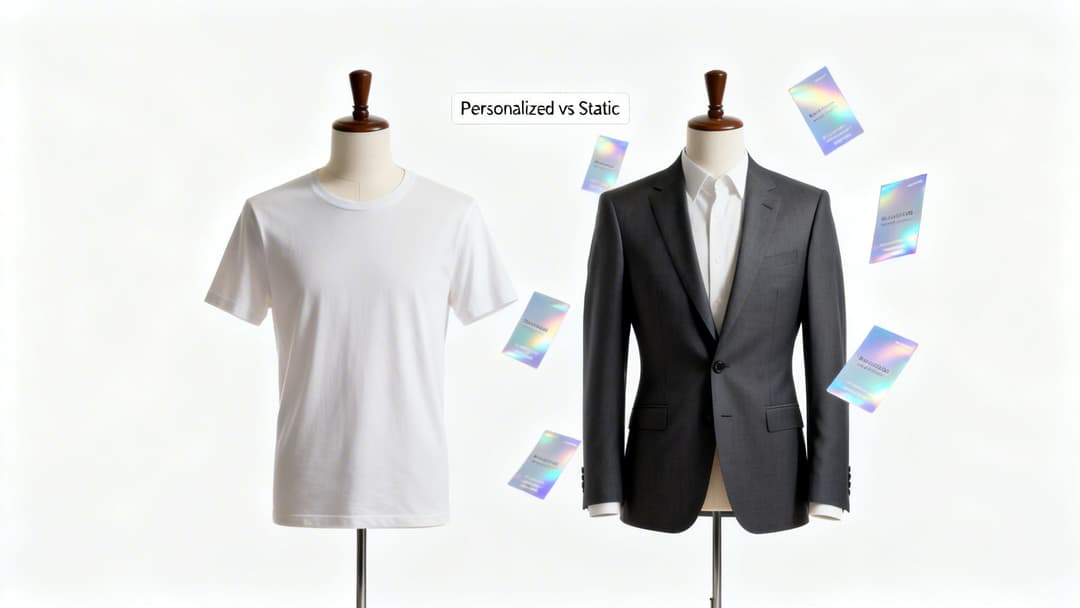
These solutions aren't just another marketing tactic; they represent a fundamental shift from manual guesswork to automated, data-driven precision. They work by assembling and showing unique ads to individual users based on their real-time behavior, context, and preferences, making your marketing feel like a helpful conversation rather than a cold sales pitch.
To give you a clearer picture, here’s a quick breakdown of how these two approaches stack up.
Static Ads vs Dynamic Ads at a Glance
| Feature | Static Advertising | Dynamic Advertising |
|---|---|---|
| Creative Approach | One-size-fits-all creative and message. | Modular creative components assembled in real-time. |
| Personalization | Minimal; based on broad audience segments. | Hyper-personalized based on individual user data. |
| Scalability | Limited; requires manual creation of each ad variant. | Highly scalable; creates thousands of variations automatically. |
| Optimization | Manual A/B testing of a few fixed versions. | Continuous, automated testing and optimization of all elements. |
| User Experience | Can lead to ad fatigue and feel generic or irrelevant. | Highly relevant, timely, and engaging. |
| Efficiency | High potential for wasted ad spend on uninterested users. | Maximizes ROAS by showing the right product to the right person. |
This table shows the core difference: static ads speak to a crowd, while dynamic ads speak to a person.
From Manual Effort to Automated Relevance
The old way involved painstakingly creating a handful of ads and crossing your fingers that one would stick. Dynamic advertising flips that script entirely. Instead, you build a flexible ad template and stock a "pantry" full of creative components—different headlines, images, product descriptions, prices, and calls to action.
The technology then acts like a master chef, instantly pulling the right ingredients to create a perfect ad for whoever is about to see it.
A dynamic ad engine takes signals—like a user's browsing history, location, or even the weather—and uses them to serve the most relevant ad combination possible. It’s the difference between shouting a generic message into a crowd and having a meaningful one-on-one conversation.
This is especially critical on crowded platforms like Meta, where attention spans are short and ad fatigue sets in fast. A message that feels personal and timely doesn't just get seen; it gets noticed. The technology that powers this is a fascinating field on its own, which you can dive into with our guide on what is Dynamic Creative Optimization.
The market's adoption of this approach tells its own story. The global dynamic ads market is on track to hit an estimated $27,020 million by 2025, riding a steady 6.2% CAGR through 2033. This isn't just hype; it's a direct response to the growing demand for advertising that actually connects.
Core Benefits for Performance-Focused Teams
If you're a marketer who lives and breathes by the numbers, dynamic advertising is a game-changer. It’s designed to directly improve the KPIs that matter by making your campaigns smarter and more efficient.
Here are the key advantages you can expect:
- Scalable Personalization: Deliver a unique ad experience to thousands or even millions of people without having to manually build every single version.
- Increased Relevance and Engagement: When an ad reflects someone's immediate interests or needs, they're far more likely to pay attention and take action.
- Improved ROAS (Return On Ad Spend): Showing people what they're already interested in cuts down on wasted ad spend and naturally pushes conversion rates higher.
- Automated A/B Testing: The system is always testing different creative combinations on its own, learning what works, and automatically shifting budget toward the winning variations.
Ultimately, dynamic advertising helps you build hyper-relevant campaigns that can grow without burning out your team. It’s about working smarter, not harder, to drive much better results.
The Core Components of Dynamic Advertising Success
To really get what makes dynamic advertising tick, you have to look under the hood. It isn't a single piece of software, but a finely tuned system where four key parts work in perfect harmony.
Think of it like a high-end restaurant kitchen. You have a creative head chef, a well-stocked pantry, direct feedback from diners, and a smart kitchen assistant tying it all together. Each part is essential. If one fails, you’re back to serving the same generic dish to every guest—the exact problem static ads have.
Let's break down this engine, piece by piece.
Dynamic Creative Optimization: The Master Chef
The heart of any dynamic campaign is Dynamic Creative Optimization (DCO). This is the "master chef" running your ad kitchen. DCO technology takes all your individual creative assets—headlines, descriptions, images, videos, and calls-to-action (CTAs)—and intelligently assembles them on the fly.
Its entire job is to build the most persuasive ad for each unique user. So, instead of you manually creating ten versions of an ad, DCO can test thousands of permutations automatically, learning which combinations actually work. This is where having a deep well of creative assets, often produced through a modern multi-channel content strategy, becomes a massive advantage.
DCO is constantly figuring things out, like:
- Does this person respond better to a lifestyle photo or a direct product shot?
- Is "Shop Now" more effective than "Learn More" for this particular audience?
- Which headline gets more clicks when paired with this specific video?
By constantly testing and learning from real user data, DCO makes sure your creative is always getting better, guided by results, not just a gut feeling.
Product and Data Feeds: The Pantry of Ingredients
If DCO is the chef, your product and data feeds are the pantry. A data feed is simply a structured file, like a spreadsheet or XML file, that holds all the information about the products or content you want to advertise. These are the raw ingredients for your dynamic ads.
For an e-commerce brand, this feed would list the vitals for every single item:
- Product ID: A unique code for each item.
- Title: The product name (e.g., "Men's Trail-Runner X2").
- Image URL: A link to the main product picture.
- Price: The current price, including any sale information.
- Availability: Is it in stock, out of stock, or running low?
But this pantry isn't just for retail. A B2B company might have a feed of case studies, while a travel site's feed would contain flight deals or hotel listings. The quality and organization of this feed are everything. A messy pantry makes for a slow, inefficient kitchen.
Audience Signals: The Digital Breadcrumbs
Audience signals are the digital breadcrumbs people leave behind as they move around the internet. These are the contextual clues that tell your dynamic ad system what a user is interested in right now. They provide the "why" for every personalized ad.
Think of audience signals as direct requests from a customer. When someone adds a pair of running shoes to their cart but doesn't check out, it’s a massive signal. A dynamic ad that later shows them those exact shoes isn't creepy; it's a helpful and timely reminder.
Common signals include things like:
- Behavioral Data: Pages they've viewed, products they've added to a cart, or videos they've watched.
- Contextual Data: The device they're using, their geographic location, or the time of day.
- Demographic Data: General, privacy-safe information like age range or broad interests.
These signals are the customer orders that tell the chef (DCO) which ingredients (from the feed) to use for each person.
AI and Automation: The Brain of the Operation
Finally, AI and automation serve as the brain that connects all these moving parts. It’s the powerful engine that processes millions of audience signals, scans your data feed, and tells the DCO which ad to build—all in the milliseconds it takes a webpage to load.
This automation is what makes personalization at scale possible. It handles a level of complexity that would be completely impossible to manage by hand, ensuring every person sees a relevant ad, whether you have a hundred customers or ten million.
And this brain doesn't just follow orders. It learns. Over time, it optimizes your entire campaign to drive the best possible return on your ad spend.
Your Step-by-Step Guide to Implementing Dynamic Ads
Diving into dynamic advertising solutions can feel like you're trying to assemble a complex machine with no instructions. But it doesn't have to be that way. With a clear roadmap, you can turn this powerful technology from a confusing concept into a repeatable process for growth.
We've broken down the entire implementation into five manageable steps. Think of it less like a single sprint and more like building a custom race car—each part needs to be installed and tuned just right for the whole thing to fly.
Step 1: Define Your Campaign Goals
Before you even think about the technical side, you have to know what winning looks like. What are you actually trying to achieve? Are you trying to win back customers who abandoned their carts, or are you looking to find brand new ones? Your answer will shape every single decision you make from here.
Most dynamic campaigns boil down to a few key goals:
- Improving Return On Ad Spend (ROAS): This is the big one. The goal here is to squeeze every drop of revenue out of your ad budget.
- Lowering Cost Per Acquisition (CPA): Perfect for campaigns where getting leads or high-value conversions is the name of the game, and you need to be as efficient as possible.
- Increasing Conversion Rate: Focus on turning more window shoppers into actual buyers by showing them exactly what they want to see.
Setting a clear, measurable goal right from the start gives you a north star to guide your campaign setup and a benchmark to measure your success against.
Step 2: Prepare and Validate Your Data Feed
Your data feed is the fuel for your dynamic ad engine. A clean, detailed, and perfectly formatted product catalog is completely non-negotiable. This file, usually a CSV or XML, holds all the details your ads will need—product IDs, titles, prices, image URLs, you name it.
A common pitfall is rushing this step. An incomplete or error-filled feed will cripple your campaign before it even starts, leading to broken images, incorrect pricing, and a frustrating user experience. Take the time to ensure every entry is accurate and all required fields are populated.
Seriously, double-check your work here. It will save you massive headaches later on.
Step 3: Segment Your Key Audiences
With your goals set and your data feed ready to go, it’s time to figure out who you’re talking to. You're not shouting into the void; you’re having specific conversations with different groups of people based on how they’ve interacted with you.
This is where good tracking comes in, usually with a tool like the Meta Pixel. If you need a refresher on getting that set up, check out this detailed guide on how to set up your Facebook Pixel.
Start by focusing on these high-value segments:
- Cart Abandoners: People who put items in their cart but bailed before checking out. This is the lowest-hanging fruit, so go after it.
- Recent Product Viewers: They showed interest by looking at specific product pages but didn't take the next step. A gentle nudge might be all they need.
- Past Purchasers: An awesome audience for upselling or cross-selling. They already trust you, so show them something else they’ll love.
- New Visitors (Prospecting): This is your chance to make a great first impression. Hit these broad audiences with your best-sellers to capture their attention.
This flow chart gives you a simple visual of how everything works together. Your data feed and audience signals are the raw ingredients the AI uses to cook up the perfect ad.
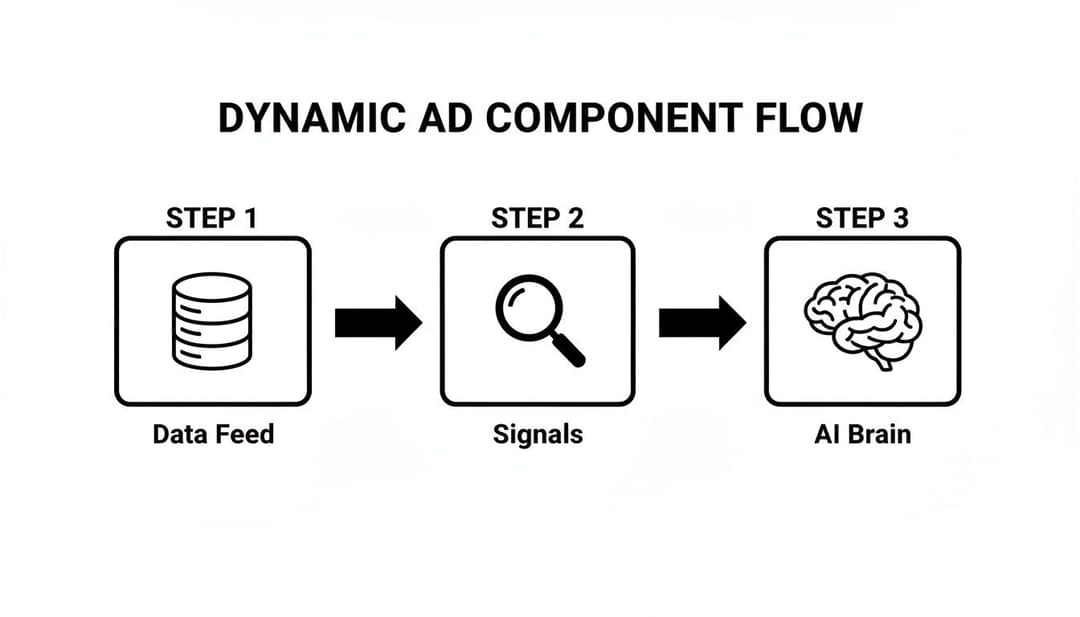
Without clean data and clear signals, the AI is just guessing. Give it what it needs to succeed.
Step 4: Build Flexible Creative Templates
Good news: you don't have to manually design thousands of ads. Instead, you'll create a few high-quality, on-brand templates. Think of them as shells with empty slots for the product image, name, price, and other details.
The system will then automatically pull that information from your data feed and plug it into the template for each individual user. This gives you the best of both worlds: brand consistency from your slick template and hyper-personalization from the dynamic content.
Step 5: Choose Your Tech Stack and Launch
Finally, you need the right tools to bring this all to life. While platforms like Meta have built-in dynamic ad features, a dedicated dynamic advertising solution can put the whole process on easy mode.
Tools like AdStellar AI are specifically designed to automate this workflow. They help you import your data feed, create audiences without the guesswork, and use AI to test countless creative combinations faster than any human ever could.
Once you’ve picked your platform, configured your settings, and set your budget, you're ready to hit the launch button.
All the theory is great, but let's be honest—the real "aha!" moment comes when you see how this stuff actually works in the wild. Seeing how real brands are using dynamic advertising solutions to move the needle is what makes the power of this approach click.
So, let's step away from the concepts and look at a few mini case studies that show just how versatile and effective dynamic ads can be across completely different industries.
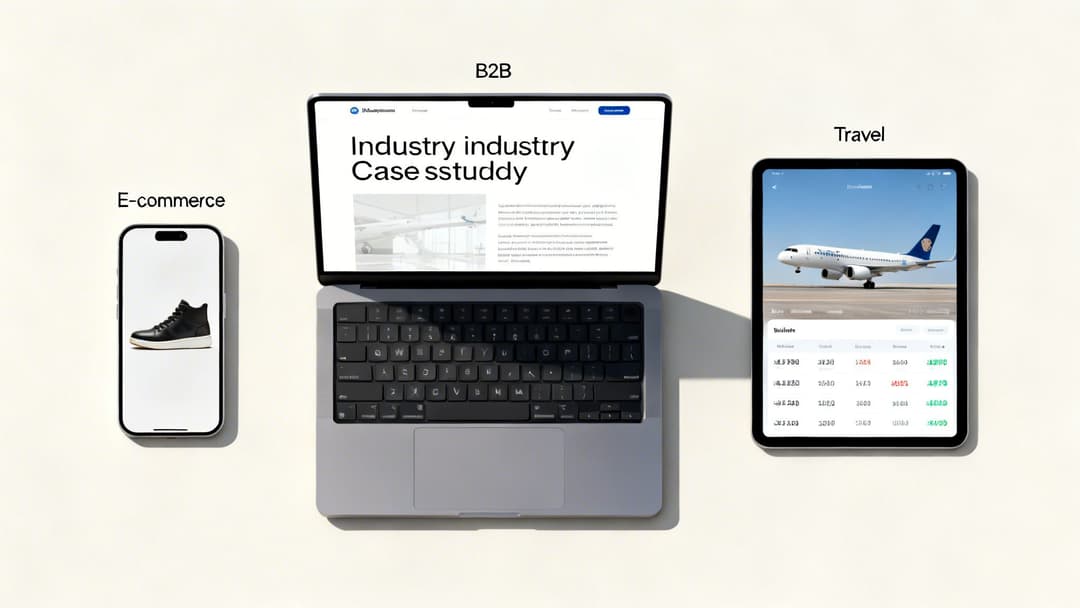
E-commerce Recapturing Lost Sales
We’ve all done it. You find the perfect pair of sneakers online, add them to your cart, and then… life happens. A leading shoe retailer was seeing this all too often, with a high cart abandonment rate hurting their bottom line. Their generic retargeting ads just weren't cutting it.
They shifted gears to a dynamic product ad campaign. By hooking their product catalog directly into their ad platform, they could automatically serve ads that featured the exact shoes someone had just left behind. To really dial up the urgency, they added dynamic overlays highlighting "low stock" warnings or "price drop" alerts.
The impact was immediate and impressive:
- A 3x increase in Return On Ad Spend (ROAS) from their retargeting campaigns.
- A 25% lift in conversion rates from shoppers who had abandoned their carts.
- A massive drop in ad spend wasted on users who were no longer in the market.
This simple change turned a generic, ignorable ad into a personal and timely reminder that brought shoppers back to finish what they started.
B2B SaaS Customizing for Verticals
A B2B software company was dealing with a notoriously long and complicated sales cycle. Their product served a wide range of industries, from healthcare to finance, and their one-size-fits-all marketing message was falling flat. A prospect in finance needs to see different proof points than one in healthcare.
Their solution was to implement a dynamic advertising strategy for their LinkedIn and display campaigns. They built a flexible ad template and connected it to a data feed of their case studies, with each one tagged by its relevant industry. Now, when a user from the healthcare sector visited their site, they were later shown a dynamic ad that featured a success story from a well-known hospital.
This wasn't just a small tweak; it was a fundamental shift from a generic pitch to a highly relevant proof point. It allowed them to build credibility and trust from the very first ad a prospect saw.
This hyper-targeted approach led to a 40% reduction in their Cost Per Lead (CPL) and a big jump in qualified leads coming from their key enterprise accounts.
Travel Industry Offering Real-Time Deals
For a major online travel agency, nothing kills a user's trust faster than showing an ad for a flight price that’s already outdated. They absolutely needed a way to display live, bookable deals to travelers who had searched for specific routes.
They set up a dynamic ad solution that plugged directly into their flight pricing API. Now, when someone searched for a flight from New York to London but didn't book, they'd later see an ad on their social feed with the current best price for that exact trip. If the price dropped, the ad updated automatically.
Want to see more creative like this in action? Our post on video ad examples has some great ideas you can borrow for your next campaign.
Dynamic advertising isn't just for social and search, either. It’s quickly moving into exciting new channels like Connected TV (CTV) and Digital Out-of-Home (DOOH), completely changing how we interact with ads on our TVs and on public screens. With CTV ad spend expected to reach $46.3 billion by 2026 and DOOH growing at 10.35%, these are formats you can't afford to ignore.
How to Measure Success and the Key KPIs to Track
Getting your dynamic campaign live is a great first step, but it’s not the finish line. The real work—and the real magic—begins now. This is where you separate the good from the great, using data to understand what’s working and what isn’t, then iterating relentlessly.
Think of it like flying a plane. Impressions might tell you how fast you're moving, but they don't tell you if you're on course. You need to look at the right gauges—the ones that measure fuel efficiency (ROAS) and altitude (CPA)—to know if you'll actually land at your destination.
The Most Important KPIs for Dynamic Ads
When you’re running dynamic ads, not all metrics are created equal. You need a mix of high-level business metrics that tell you the overall story and granular creative data that explains why the story is unfolding that way.
Here are the non-negotiable KPIs you should have front and center on your dashboard:
- Return On Ad Spend (ROAS): This is the bottom line. For every dollar you put in, how many dollars did you get back? A strong ROAS is the clearest signal that your personalized ads are hitting the mark and driving real business value.
- Cost Per Acquisition (CPA): How much does it cost you to get a new customer? The entire point of dynamic ads is to show the right product to the right person, which should naturally drive your CPA down by eliminating wasted spend on uninterested audiences.
- Conversion Rate (CVR): Of the people who clicked your ad, what percentage actually followed through and made a purchase or signed up? A climbing CVR is proof that your creative combinations aren't just getting clicks—they're genuinely persuading people to act.
These three metrics—ROAS, CPA, and CVR—are the trifecta of dynamic ad success. While other numbers are useful for context, these are the ones that directly tie your advertising efforts to tangible business results.
Digging Deeper with Creative-Level Insights
This is where dynamic advertising truly shines. The ability to see which individual components of your ads are performing best is a game-changer. You move from guessing to knowing.
By analyzing performance at the creative level, you can finally answer those nagging questions that keep marketers up at night:
- Which headline actually drives the most sales?
- Do our lifestyle photos outperform the clean, product-on-white-background shots?
- For cart abandoners, does “Shop Now” work better than “Get 10% Off”?
This level of detail takes you from making broad, campaign-wide adjustments to making precise, surgical improvements, element by element. To go even further, check out our complete guide on key performance marketing metrics that all modern growth teams should master.
To track this effectively, you'll need to focus on a set of core metrics categorized by what you're trying to achieve with your campaign.
Essential KPIs for Dynamic Advertising Campaigns
This table breaks down the most important metrics for evaluating the performance of your dynamic ads, categorizing them by campaign objective.
| Metric (KPI) | What It Measures | Why It's Critical for Dynamic Ads |
|---|---|---|
| Return On Ad Spend (ROAS) | The total revenue generated for every dollar spent on advertising. | It’s the ultimate measure of profitability. A high ROAS directly proves that your personalized ad combinations are effectively turning ad spend into revenue. |
| Cost Per Acquisition (CPA) | The average cost to acquire one new customer or lead. | Dynamic ads aim to lower CPA by showing hyper-relevant content. Tracking this confirms you're acquiring customers more efficiently and not wasting budget on uninterested users. |
| Conversion Rate (CVR) | The percentage of users who complete a desired action (e.g., purchase) after a click. | A rising CVR shows that your dynamic creative elements (images, headlines, CTAs) are compelling enough to persuade users to take the final step, not just browse. |
| Click-Through Rate (CTR) | The percentage of impressions that result in a click. | While not a final success metric, a high CTR indicates that your ad visuals and headlines are relevant and attention-grabbing, which is the first step in the conversion journey. |
| Add to Cart (ATC) Rate | The percentage of ad clicks that result in a user adding an item to their cart. | This is a key mid-funnel metric. It tells you if the specific product shown in the ad was compelling enough for the user to show strong purchase intent. |
By building a dashboard that visualizes these specific KPIs, you can quickly spot trends, identify winning ad components, and turn raw data into actionable insights. This data-first approach ensures your dynamic advertising solutions are always optimized and delivering the best possible results for your business.
Supercharge Your Campaigns with AI-Powered Platforms
 While the ideas behind dynamic advertising solutions are solid, trying to pull them off by hand is a massive headache. Just imagine trying to build and keep track of thousands of ad variations manually—it’s an impossible workload for any marketing team. This is precisely where AI-powered platforms come in and completely change the game for performance marketers.
These platforms are like a power-up for your team, automating all the grunt work of spinning up ad variations from your product or content feeds. They let you generate hundreds of creative, copy, and audience combos in minutes, not days. This gets your team out of the weeds of campaign setup and back to focusing on big-picture strategy.
From Manual Guesswork to Automated Intelligence
Today's AI tools do so much more than just basic automation. They plug right into your ad accounts, pull in your historical performance data, and use machine learning to figure out what’s worked before. That means your new campaigns are built on a foundation of past wins, giving you a serious head start right out of the gate.
The real magic of AI here is its ability to find and scale your winning ad combinations without needing someone to watch over it 24/7. The system is always testing, learning from the results, and automatically moving your budget to the top performers. It ensures every dollar you spend is working as hard as it possibly can.
This process takes the overwhelming complexity of dynamic advertising and transforms it into a smooth, revenue-generating machine. The AI handles the heavy lifting of optimization, while you get clear, simple insights on what’s actually moving the needle.
Turning Data into Actionable Insights
AI platforms solve a huge pain point for growth teams by bringing clarity to the chaos of data. Instead of drowning in spreadsheets, you get a clean dashboard that ranks your best-performing creative, audiences, and messages against the KPIs you actually care about, like ROAS or CPA. We dive deeper into how AI transforms advertising campaigns in our dedicated article.
This intelligent analysis touches every part of the creative process. For instance, figuring out how to pick the best AI photo generator highlights how AI can elevate the individual assets that make up a winning ad. It’s a perfect example of how AI can improve each component of your campaign. Platforms like AdStellar AI bring all these workflows under one roof, helping teams finally swap out tedious manual tasks for a repeatable, data-driven approach.
Frequently Asked Questions About Dynamic Advertising
Diving into dynamic advertising is exciting, but it's natural to have a few questions holding you back. Let's tackle some of the most common ones we hear from marketers so you can move forward with confidence and launch your first campaign.
How Much Data Do I Need to Start?
This is a big one, and the answer is probably less than you think. You don’t need a perfectly curated, massive dataset to get your first dynamic campaign off the ground. In fact, you can start with a simple product feed and the pixel data you already have on your website for retargeting.
The beauty of these systems is that they learn on the fly. As your ads run, they gather performance data and get smarter. Many AI platforms can also plug right into your ad account and analyze historical performance from day one, giving you an immediate head start and helping you get better results, faster.
Are Dynamic Ads Only for E-commerce?
Not at all. While they certainly made their name in e-commerce, dynamic ads are incredibly versatile and work for prospecting and countless other business models. The only real requirement is a structured "feed" of content or offers for the system to use.
Think about these examples:
- A B2B software company could show different case studies or testimonials depending on a visitor’s industry.
- A media publisher can promote articles that are highly relevant to what a user was just reading.
- A real estate firm can showcase property listings in the specific neighborhoods a user has been searching.
The principle is the same across the board: match the right message to the right person at the right time.
Will Dynamic Ads Feel Intrusive?
When done right, dynamic ads feel helpful, not creepy. The goal is genuine relevance, not just surveillance. Think about it: if you show someone a product they were just looking at, or present an offer that solves a problem they're researching, you’re actually making their life easier.
The line between helpful and intrusive is crossed when the ad provides no new value. A great dynamic ad might alert a user to a price drop, new stock availability, or a special offer—making it a welcome notification rather than just another ad following them.
As long as you stick to privacy best practices and always focus on adding value for the user, you'll be on the right side of that line.
How Do I Maintain Creative Quality with Automation?
This is a completely valid concern, and it’s solved with dynamic creative templates. You’re not handing over all creative control to a robot. Instead, you design high-quality, on-brand "shells" or master templates.
The automation simply swaps out specific elements—like a product image, price, or headline—within the framework you've already approved. It's the best of both worlds. You set the creative direction and maintain brand consistency, while the tech handles the personalization at a scale you could never manage manually.
Ready to stop the manual grind and start scaling your Meta campaigns? AdStellar AI automates bulk ad creation and uses AI to identify your winning creative, copy, and audience combinations. Launch hundreds of variations in minutes and let our platform continuously optimize for what drives real results. Discover how to unlock more revenue with AdStellar AI.