You're probably in one of two situations right now.
Either you're still building paid social campaigns by hand, duplicating ad sets, swapping headlines, checking UTM logic, and pushing variants live one at a time in Meta Ads Manager. Or you've started using AI for copy and images, but you still can't clearly tie that output to lower CPL, stronger ROAS, or cleaner scale decisions.
That's where the significant shift is happening. An AI marketing campaign generator isn't just a faster way to make ads. Used properly, it becomes an operating layer for creative production, campaign assembly, launch, testing, and performance feedback. The teams getting value from it aren't treating it like a novelty writer. They're using it to increase testing velocity, tighten feedback loops, and make better budget decisions across the full funnel.
The End of Manual Ad Creation
Launch day used to look like this. You had five creative concepts, several audience angles, and a few headline directions for each. On paper, that sounded manageable. In Meta Ads Manager, it turned into hours of repetitive setup, naming mistakes, wrong attachments, missed exclusions, and a review queue full of small errors that should never have happened.
That manual workflow breaks first at the exact point where performance marketing needs speed. Paid social works when you can test broadly, spot patterns early, and move spend fast. It doesn't work when the team spends half the day building what should've been generated in minutes.
ActiveCampaign reports that marketers save an average of 13 hours per week and $4,739 per month in operational costs when using AI, and daily users save about 14.8 hours per week and more than $5,000 per month (ActiveCampaign AI marketing statistics). That matters because campaign building is one of the easiest places to waste skilled media-buying time on low-impact work.
Where the old process fails
Manual ad creation usually creates four predictable problems:
- Testing gets narrowed too early. Teams cut concepts before launch because setup takes too long.
- Naming and structure become inconsistent. That makes analysis messy later.
- Creative fatigue hits faster. Refresh cycles slow down because production is bottlenecked.
- Media buyers become operators. They spend more time assembling ads than interpreting results.
One of the better breakdowns of that friction is this look at why manual campaign building slows execution.
Practical rule: If campaign setup time is shaping your test plan, your process is already hurting performance.
An AI marketing campaign generator changes that. Instead of building every variant one by one, you define the inputs once. Offer, audience, format, hooks, creative rules, and launch structure. The system generates combinations, assembles them, and prepares them for deployment in a format that's testable.
That's why the conversation has moved beyond “AI can write ad copy.” It now sits much closer to operational design. If you're also rethinking the upstream content engine, it's useful to discover AI content strategies that connect campaign inputs to broader creative planning.
What changes in practice
The best teams don't use generators to remove judgment. They use them to remove drag.
Instead of debating whether to launch eight variants or twenty, they launch the full set. Instead of delaying refreshes because the team is buried in production work, they feed the system stronger inputs and keep moving. That's the practical difference. The generator doesn't replace paid social fundamentals. It makes those fundamentals easier to execute at scale.
How an AI Marketing Campaign Generator Works
Many treat these tools like a black box. That's a mistake. A good AI marketing campaign generator is easier to understand if you think of it as a master chef's assistant. The chef still decides the cuisine, the ingredients, and the standard. The assistant preps, portions, labels, and helps execute the menu at speed.
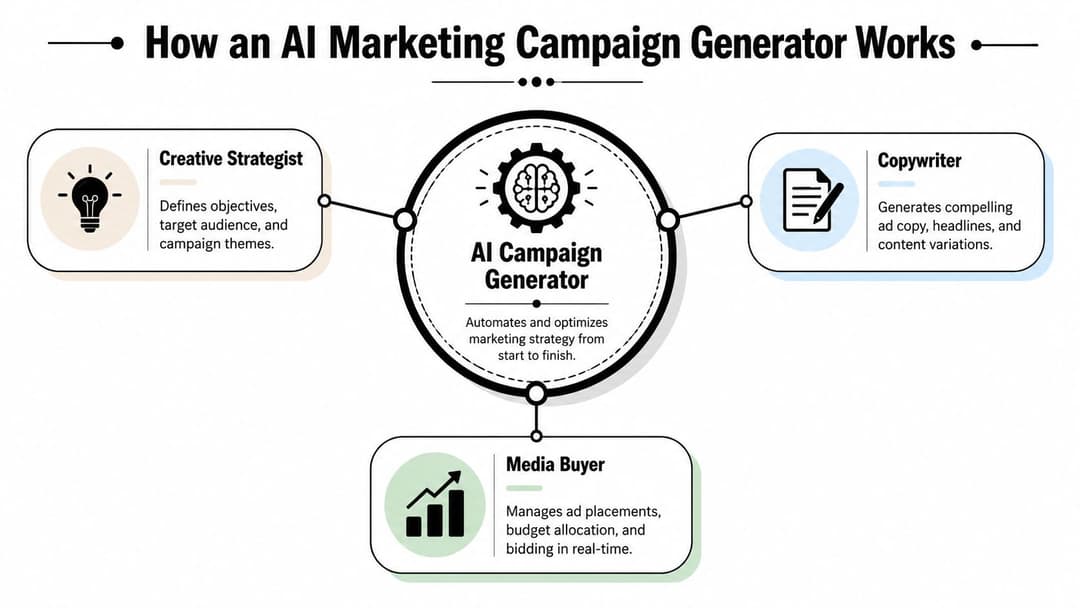
That's how the better platforms work in paid social. They combine the roles of strategist, copywriter, and media buyer into one system that turns inputs into structured campaigns.
Data goes in before anything useful comes out
The first stage is data ingestion. The platform learns from the assets and signals you already have. That usually includes past ad copy, creative library, brand guidelines, audience inputs, landing page messaging, and historical performance by angle or offer.
If this stage is weak, everything downstream gets worse. You'll still get output, but it'll be generic, repetitive, or misaligned with what your account has learned. That's why platforms built for real execution matter more than prompt-only tools. A campaign system needs structure, not just language generation. This explainer on what AI-powered campaign building actually looks like gets that distinction right.
The generator creates options, not magic
The second stage is generative production: the tool produces copy variants, creative directions, image prompts, audience angles, and sometimes landing page-message alignment.
McKinsey notes that generative AI-driven tools can compress campaign production timelines from months to weeks or even days by automating copy, images, and audience variants while enabling at-scale personalization and testing (McKinsey on generative AI in consumer marketing).
That speed is useful only if the output is organized around a test plan. Random abundance isn't strategy.
A generator should give you controlled variation, not a pile of disconnected assets.
For teams trying to extend that same logic into organic execution, this breakdown of social media content automation is a useful adjacent read.
Assembly and launch are where the real leverage shows up
The third stage is automated assembly. This is the part many marketers underestimate. The system doesn't just create copy and visuals. It maps them into campaigns, ad sets, ads, naming conventions, and launch-ready combinations.
Then comes smart launch. The platform pushes those combinations into Meta or another channel with the right campaign structure already in place. That's what removes the repetitive production burden from the media team.
A solid workflow usually follows this sequence:
- Define the campaign goal. Pick one clear performance objective.
- Set audience logic. Use your ICP, exclusions, and market context.
- Generate controlled variants. Hooks, headlines, bodies, and creatives tied to one core promise.
- Launch at scale. Push variants live in a structure built for clean readouts.
When people say an AI marketing campaign generator saves time, this is what they should mean. It turns strategy into deployable structure quickly enough that you can test before the market shifts again.
The Tangible ROI of AI in Marketing
Marketers don't need another argument for speed. They need a reason to believe faster campaign production leads to better economics.
That's the right question. Time savings are useful, but they're not the end goal. A paid social workflow is only better when it produces stronger outcomes against the metrics the team is judged on, usually ROAS, CPL, CPA, and payback quality.
Where the financial lift comes from
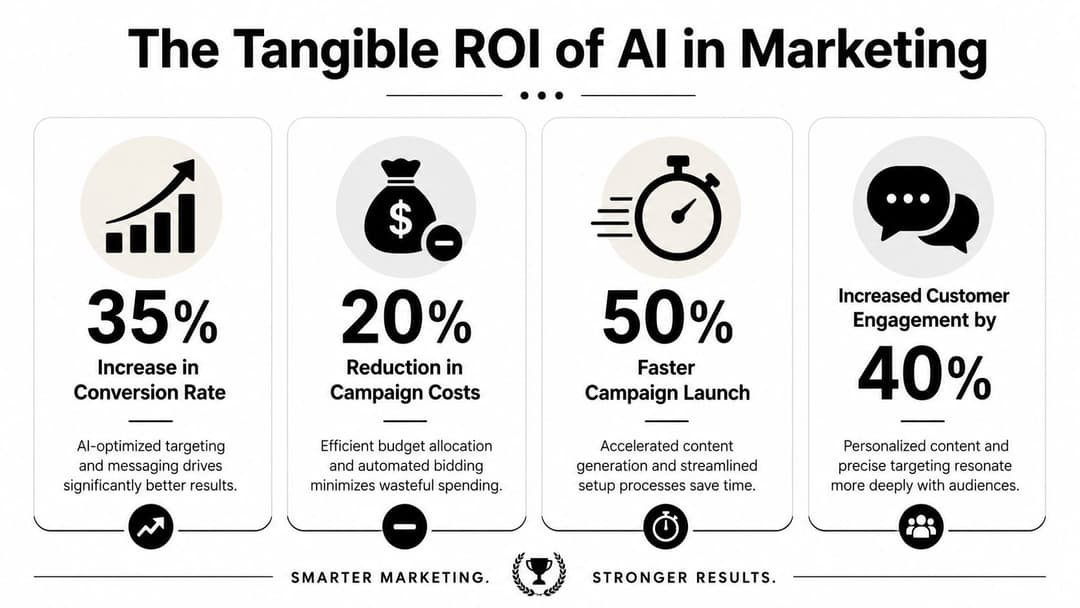
The first lever is faster discovery of winning combinations. When a generator helps you launch more thoughtful variants in less time, you identify stronger messages and creatives earlier in the cycle. That usually means fewer dollars wasted on weak combinations that manual teams keep running too long because they don't have enough alternatives ready.
The second lever is better allocation. One industry compilation reports that businesses using AI in at least three core marketing functions saw a 32% increase in ROI on average, while AI-enabled campaign optimization reduced customer acquisition costs by 23% (AI in marketing statistics). That's the economic case in plain terms. Better systems don't just create ads faster. They help direct spend toward what's working.
Why paid social benefits so quickly
Paid social is unusually sensitive to creative velocity. When you can't refresh angles or produce enough variants, performance drops for reasons that have nothing to do with audience size or bid strategy. The market sees the same message too often, and the account loses momentum.
An AI marketing campaign generator helps in three practical ways:
- It shortens the lag between insight and action. When a message wins, you can spin related variants quickly.
- It supports broader testing. More combinations mean a better chance of finding efficient pockets of performance.
- It reduces production drag around iteration. Teams can refresh without restarting the whole workflow.
If you want to estimate whether that kind of operational lift could justify the switch, a tool like this Meta ads automation ROI calculator is a useful framing device.
What matters: The ROI case gets stronger when the tool affects both production speed and budget decisions. If it only writes copy, it's a creative helper. If it changes what gets launched, tested, and scaled, it becomes a performance system.
What doesn't create ROI
A lot of teams buy “AI” and get a content spinner. That usually means lots of similar headlines, weak strategic control, no meaningful campaign assembly, and reporting that stops at surface metrics.
That setup saves some time. It rarely changes business outcomes.
True returns are seen when the generator fits into the whole paid social loop. Inputs become variants. Variants become structured tests. Structured tests produce cleaner signals. Cleaner signals lead to sharper budget moves. That's where lower CPL and stronger ROAS start to become believable, not just aspirational.
Must-Have Features for Real Performance
A flashy demo doesn't tell you much. Most AI campaign tools look impressive for the first ten minutes because they can generate copy fast. The key question is whether they help a performance team produce cleaner tests and better decisions after launch.
The biggest gap in the market is still measurement and incrementality. Improvado notes that many tools focus on creative production while marketers still struggle to prove whether AI-assisted campaigns caused lift, which is why a serious platform needs analytics that move beyond correlation (AI marketing campaigns and measurement challenges).
The feature checklist that actually matters
| Feature | Why It Matters | What to Look For |
|---|---|---|
| Direct platform integration | Manual exporting and uploading kills speed and introduces errors | Native connection to Meta campaign structure and launch workflow |
| Bulk campaign assembly | Output is useless if your team still has to build ads one by one | Ability to combine creatives, copy, and audiences into launch-ready campaigns |
| Historical performance ingestion | Generic generation misses what your account already knows | Learning from past creatives, messages, and audience results |
| Variant control | More volume only helps if it stays strategically coherent | Rules for hooks, offers, formats, naming, and exclusions |
| Testing framework | Random variation creates noise, not insight | Structured A/B or multivariate setup tied to a clear success metric |
| Creative ranking | Teams need help identifying what actually won | Breakdown by message, audience, format, and goal |
| Measurement and incrementality | Correlation alone leads to bad scaling decisions | Analytics that help separate apparent lift from causal impact |
| Asset library governance | Fast output can create brand inconsistency | Shared library, approval logic, and reusable winners |
What good looks like
You want a system that can do three things together.
First, it should generate. Second, it should assemble. Third, it should help explain why one combination deserves more spend than another. If any one of those is missing, the team ends up patching the workflow manually.
That's why analytics depth matters as much as creative generation. A platform can write strong headlines and still fail the performance test if it can't show which message family is lifting qualified leads or which creative pattern keeps producing cheap but weak conversions.
For teams comparing options, one example of this product category is AI optimization features for campaign performance, where the focus is on ranking creatives, audiences, and messages against outcome metrics rather than just generating assets.
Don't buy a generator that ends at launch. Paid social value shows up after launch.
Features that sound useful but often disappoint
Some features are over-marketed and under-deliver:
- One-click creative generation without controls. Fast, but often off-brand or strategically shallow.
- Generic “AI insights.” If the platform can't explain the recommendation, treat it carefully.
- Audience suggestions with no account context. These often restate obvious segments.
- Set-and-forget automation. Useful for demos, risky for real budgets.
A serious buyer should be skeptical of anything that makes creation look easy but measurement look vague.
Implementing Your First AI-Generated Campaign
The best first campaign is smaller than commonly believed. Don't start by trying to automate your whole account. Start with one offer, one audience definition, one conversion event, and a campaign structure you'd be comfortable evaluating by hand.
That keeps the learning curve manageable. It also makes it easier to tell whether the AI marketing campaign generator is helping or just producing more noise.
Start with a narrow test frame
The cleanest setup usually has these inputs:
- Connect the ad account and data sources. Historical ad data, existing assets, and event tracking should be available to the platform.
- Choose one business outcome. Pick a single conversion event you care about.
- Define one ICP. Stay specific enough that the message can be sharp.
- Build around one promise. Every variant should explore that promise from a different angle, not drift into new positioning.
A practical reference point comes from M1-Project, which recommends defining one ICP and one conversion event, generating 10 to 20 message variants, deploying them across two high-intent channels, and using server-side attribution so winners can be added to an evergreen library while losers are retired (AI-powered marketing workflow guidance).
That workflow works because it forces focus. It also stops teams from overcomplicating the first test.
Build variants with intent
Most first-time users typically err. They ask the tool for “more ads” instead of asking for distinct hypotheses.
A better prompt set looks more like this in practice:
- Angle variation: Problem-aware, outcome-aware, objection-handling, proof-led
- Format variation: Static image, short video, testimonial-style visual
- Audience framing: Founder, operator, marketer, buyer
- Offer framing: Demo, trial, consultation, lead magnet
If your campaign needs fresh visuals, an external workflow like this AI Photo Generator platform article can help think through on-brand image creation without turning every ad into the same synthetic look.
One practical guide to the actual launch process is this walkthrough on how to generate Facebook ads with AI.
Launch, read, then promote winners
Don't overreact to the first wave of data. Early campaign reading is about pattern recognition, not instant certainty.
Watch for these signals:
- Message family strength. Which promise is producing the right kind of response?
- Creative-format fit. Does the winning angle perform best as static, motion, or hybrid?
- Audience consistency. Are results concentrated or portable across segments?
A short walkthrough helps make that workflow more concrete:
Field note: The first campaign shouldn't prove that AI can do everything. It should prove that your team can use it to produce cleaner tests faster.
Once a winner is clear enough, move it into an evergreen library. Then use that winner as the seed for the next round of controlled expansion.
Common Pitfalls and How to Avoid Them
The fastest way to waste money with an AI marketing campaign generator is to assume automation removes the need for oversight. It doesn't. It changes where oversight belongs.

Garbage in still wins
If the brand inputs are weak, the output usually becomes generic. Bad landing page language, inconsistent creative history, unclear audience definitions, and mixed offers will all show up in the generated campaign.
Fix that by tightening inputs before launch:
- Clean the asset library. Remove outdated or off-brand creative.
- Clarify the offer. One campaign should push one main promise.
- Document the voice. Tone rules help prevent awkward copy drift.
Automation can hide strategic laziness
Some teams treat AI like a permission slip to stop thinking. They launch huge batches of ads, wait for the algorithm to “figure it out,” and call that optimization.
That usually creates messy readouts. The platform may find local winners, but the team won't understand why they won or whether they're worth scaling.
If you can't explain the test logic to another media buyer, the AI didn't simplify the workflow. It obscured it.
Generated combinations can be technically correct and still wrong
This is a common issue with bulk production. The headline may fit the image. The CTA may match the objective. But the combination still feels off for the audience, the funnel stage, or the product category.
Review generated sets for context, not just grammar. Ask:
- Does the message match the buyer's awareness level?
- Does the creative support the claim, or just decorate it?
- Would this ad make sense next to the landing page it leads to?
AI insights can be misread
Dashboards often present patterns that look authoritative. That doesn't mean they're causal. A recommendation engine may identify a winning ad theme that's really piggybacking on audience mix, placement bias, or timing.
That's why human review still matters most in two places: before launch and during interpretation after launch.
The safest approach is simple. Let the system accelerate production and surface patterns. Keep the final strategic calls with the team that owns spend, funnel quality, and business context.
Real-World Use Cases for Meta Ads
An e-commerce brand launching a new product usually faces a familiar problem. There are multiple images, several offers, and a short window to find which combination gets traction. An AI marketing campaign generator helps the team turn that asset pool into structured Meta tests quickly, then keep refreshing creatives as fatigue starts to show. The value isn't just speed. It's the ability to keep testing without bottlenecking on production.
A B2B SaaS team uses the same category of tool differently. Instead of broad consumer messaging, they generate variants around pain points, job roles, and lead magnet framing. One message speaks to RevOps leaders, another to paid acquisition managers, another to founders. The point is to preserve one core offer while changing the language around the buyer's context. That usually leads to cleaner CPL comparisons than running one generic lead ad to everyone.
A mobile app growth team benefits from pattern reuse. Once the account starts showing which hooks, visuals, and CTA structures consistently attract the right users, the generator can produce new combinations based on those winners. The media buyer still watches quality and downstream signals, but they no longer have to rebuild every refresh cycle manually.
Those are very different businesses. The underlying advantage is the same. Better campaign systems let teams test more, learn faster, and make scaling decisions with less operational drag.
If you're running paid social at a pace where manual setup is slowing tests, AdStellar AI is worth a look. It's built for generating bulk Meta campaign variations, launching them from historical performance inputs, and ranking creatives, audiences, and messages against metrics like ROAS, CPL, and CPA.