Your Meta campaigns are perfectly structured. Your targeting is razor-sharp. Your budget is approved and ready to deploy. But you're stuck in creative purgatory, waiting on design revisions for the third week in a row while your competitors flood feeds with fresh ads.
This is the ad creative production bottleneck, and it's quietly strangling your campaign performance right now.
The cruel irony? Meta's algorithm rewards accounts that consistently ship fresh creative. Every day you wait for assets is a day your competitors gain ground, your ad fatigue deepens, and your ROAS potential evaporates. This bottleneck doesn't discriminate—it hits solo marketers juggling Canva templates at midnight and enterprise teams with dedicated creative departments alike.
Here's what most marketers miss: the bottleneck isn't about working harder or hiring more designers. It's a fundamental workflow problem that's been hiding in plain sight since the shift to performance advertising. Understanding its anatomy unlocks something powerful—the ability to move from creative scarcity to creative abundance, transforming advertising from a resource-constrained struggle into a scalable optimization game.
What Actually Creates the Creative Chokepoint
The ad creative production bottleneck is the gap between how many creative assets your campaigns need and how many your workflow can actually deliver. Think of it like a highway merging from four lanes into one. Traffic doesn't just slow down—it comes to a complete standstill.
In advertising terms, this manifests as campaigns sitting in draft mode while you wait for creatives. Budgets going unspent because you lack fresh assets to test. Opportunities slipping past because you couldn't produce variations fast enough to capitalize on them.
The bottleneck lives in five distinct workflow stages, and delays compound at each one. First comes briefing, where marketers attempt to translate campaign goals into design requirements. This stage alone can stretch for days when stakeholders disagree on messaging or visual direction. Unclear briefs create downstream chaos that multiplies throughout the pipeline.
Next is the actual design phase, where limited human resources tackle an ever-growing queue of requests. A single designer might juggle fifteen different campaign needs simultaneously, each with its own deadline and revision cycle. The math simply doesn't work when one person can realistically produce three to five quality assets per day but campaigns need thirty variations to test properly.
Then comes the revision gauntlet. The first draft rarely hits the mark because what seemed clear in the brief looks different when executed. Stakeholders request changes. Designers make adjustments. New stakeholders weigh in with contradictory feedback. What should take hours stretches into weeks of ping-pong emails and Slack threads.
Approval processes add another layer of delay. Sequential sign-offs mean each stakeholder reviews in turn rather than simultaneously, creating a domino effect where one person's vacation can halt the entire pipeline. By the time legal, brand, and marketing all approve, the campaign window has often closed. Many teams struggle with a slow creative approval workflow that adds unnecessary days to every project.
Finally, there's format fragmentation. That beautiful square image needs to become a vertical story, a horizontal feed placement, and a video thumbnail. Each format requires manual resizing, repositioning, and quality checks. Multiply this across dozens of creatives and the workload becomes overwhelming.
Here's where it gets particularly painful: Meta's algorithm actively punishes this slow-moving workflow. The platform's machine learning systems favor accounts that introduce fresh creative frequently because they've learned that new ads perform better than stale ones. When your creative production crawls, your ad delivery suffers, your CPMs rise, and your conversion rates drop—not because your targeting failed, but because your workflow couldn't keep pace with algorithmic expectations.
The Five Forces Strangling Your Creative Pipeline
Designer dependency sits at the core of most creative bottlenecks. Every asset variation requires human hands and eyes, creating a hard ceiling on production capacity. When you need to test twenty different headline and image combinations, that's twenty separate design tasks competing for limited designer time. Scale that across multiple campaigns and product lines, and the queue becomes unmanageable.
The dependency goes deeper than just production capacity. Designers bring subjective creative judgment that's valuable but inconsistent. What one designer interprets as "bold and eye-catching" another might execute as "cluttered and aggressive." This variability makes it nearly impossible to systematize creative production or predict output quality.
Revision loops create a second chokepoint that's often invisible until you map the actual workflow. The typical cycle looks like this: marketer briefs designer, designer produces draft, stakeholders review, feedback gets compiled, designer makes changes, new stakeholders see the revised version and request different changes, the cycle repeats. Each iteration adds three to five business days to the timeline.
The root cause? Unclear briefs and stakeholder misalignment. When the initial creative direction lacks specificity about tone, messaging hierarchy, or visual style, designers fill in the gaps with their own interpretation. That interpretation inevitably conflicts with what stakeholders had in mind, triggering revision requests. The problem compounds when different stakeholders have conflicting visions but don't surface those conflicts until they see executed designs.
Format fragmentation has exploded as Meta expanded placement options. A single campaign might need creatives for feed (square), stories (vertical 9:16), reels (vertical video), in-stream video (horizontal), and marketplace (square with specific text requirements). Each placement has different technical specifications, aspect ratios, and best practices for text placement and visual hierarchy.
Manually adapting creatives for these formats means designers spend significant time on mechanical resizing rather than strategic creative work. That beautiful feed image needs its focal point repositioned for vertical format. Text overlays that worked in square need to move to avoid story interface elements. Video assets need different cuts for different durations. The workload multiplies with every placement you want to test.
Testing paralysis emerges when teams recognize they need creative variations but lack the production capacity to generate them. The theory is sound: test different value propositions, visual styles, and calls-to-action to identify winners. The reality is brutal: producing enough variations for statistically significant testing requires resources most teams simply don't have. This is why creative testing bottlenecks remain one of the biggest obstacles to campaign optimization.
This creates a vicious cycle. Without sufficient testing, teams don't know which creative elements actually drive performance. Without that knowledge, they can't make informed decisions about where to invest production resources. So they default to gut feelings and best practices that may or may not apply to their specific audience and offer. Performance suffers, but they lack the creative volume to diagnose why or test alternatives.
Approval bottlenecks represent the final stranglehold. Sequential sign-off processes made sense in traditional advertising where production costs were high and changes were expensive. In digital advertising where iteration is the entire game, these processes become actively harmful. When legal needs three days to review, then brand needs two days, then the marketing director needs a day, you've added a full week to every creative's timeline.
The bottleneck intensifies when approvers are unavailable. One person on vacation can halt the entire pipeline. One stakeholder who's "too busy" to review creates a backlog that cascades through subsequent stages. By the time final approval arrives, the market moment has often passed or the campaign deadline has been missed entirely.
What the Bottleneck Really Costs You
Creative fatigue doesn't wait for your workflow to catch up. Meta's users see thousands of ads weekly, and they develop banner blindness to repetitive creative faster than most marketers realize. When you can't refresh ads quickly enough, performance metrics tell a brutal story: click-through rates decline, cost per acquisition rises, and return on ad spend craters.
The decline follows a predictable pattern. Fresh creative performs well initially as it reaches new segments of your audience. After a few days or weeks, depending on audience size, those same users start seeing the same ads repeatedly. Their engagement drops. Meta's algorithm notices the declining performance and reduces your ad delivery, requiring higher bids to maintain the same reach. Your effective CPM increases while your conversion rate decreases—a double penalty for creative stagnation.
What makes this particularly painful is that the solution is simple in theory: introduce fresh creative regularly. But when your workflow takes three weeks to produce a single new asset, you're fighting creative fatigue with one hand tied behind your back. By the time your new creative finally launches, your old creative has already tanked your account metrics. The phenomenon of Instagram ad creative fatigue hits particularly hard on visual-first platforms.
Opportunity cost might be the most expensive consequence, even though it's the hardest to measure. Every seasonal moment, trending topic, and competitor gap represents a window where the right creative could capture outsized attention and conversions. These windows close quickly—sometimes in days, sometimes in hours.
Think about a trending news event relevant to your product. Competitors who can spin up creative within hours ride the wave of heightened search interest and social conversation. Meanwhile, your creative sits in the approval queue. By the time your asset is ready to launch, the trend has passed and the opportunity is gone. You'll never know what revenue you missed because you couldn't move fast enough.
Seasonal moments follow the same pattern but with higher stakes. The week before a major holiday represents peak purchase intent for many products. If your seasonal creative isn't ready until the holiday week itself, you've missed the highest-value days when customers are actively shopping. Your competitors captured those early shoppers while your team was still waiting on design revisions.
Team burnout emerges as the hidden human cost of chronic creative bottlenecks. Designers working under constant pressure to produce more, faster, with less clarity inevitably experience stress and frustration. The work becomes mechanical and joyless—endless iterations on similar assets with tight deadlines and unclear success criteria. When teams face creative burnout, both quality and velocity suffer dramatically.
This burnout has real business consequences. Talented designers leave for roles where they can do more strategic creative work rather than churning out ad variations. The remaining team members absorb the additional workload, accelerating their own path to burnout. Recruiting replacements becomes harder when the role's reputation is "high-pressure, low-creativity ad production."
Marketing teams face their own burnout cycle. The constant friction of managing creative requests, chasing approvals, and explaining why campaigns are delayed creates chronic stress. Strategic work gets crowded out by operational firefighting. The job becomes less about optimizing campaigns and more about managing a dysfunctional workflow.
How to Actually Break the Bottleneck
Systematizing creative briefs eliminates the ambiguity that triggers revision loops. A proper brief template captures every requirement upfront: specific campaign goals with measurable targets, detailed audience insights including pain points and motivations, mandatory brand elements and restrictions, desired emotional tone and messaging hierarchy, technical specifications for all needed formats, and clear approval criteria so everyone knows what success looks like.
The template forces alignment before design work begins. When stakeholders must specify their requirements in writing rather than reacting to drafts, conflicting visions surface early. You can resolve disagreements in a thirty-minute meeting rather than through weeks of revision cycles. Designers receive clear direction that reduces guesswork and wasted effort on approaches that were never going to get approved.
This upfront investment pays massive dividends downstream. Briefs that once took two days of back-and-forth emails now get completed in a single collaborative session. First drafts hit closer to the mark because designers understand exactly what's expected. Approval cycles shrink because stakeholders already agreed to the creative direction in the brief.
Modular creative frameworks transform how you think about asset production. Instead of treating each ad as a unique snowflake requiring custom design, you build a system of interchangeable components: a library of product images shot in consistent lighting and angles, a set of headline templates proven to drive engagement, background styles and color schemes that align with brand guidelines, call-to-action variations for different campaign goals, and value proposition statements that can be mixed and matched.
This modular approach unlocks exponential scaling. Five background styles, ten product images, and eight headline variations can combine into four hundred unique ad creatives. You're not creating four hundred ads from scratch—you're systematically combining proven elements in new ways. The production bottleneck shifts from "how do we create enough unique ads" to "how do we efficiently combine our creative components."
The framework also enables data-driven iteration. When you know which specific headlines, images, and backgrounds drive performance, you can systematically test new variations of high-performing elements rather than starting from scratch each time. Your creative library becomes a strategic asset that compounds in value over time. A robust creative library management system makes this approach sustainable at scale.
AI-powered creative generation represents the most fundamental shift in breaking production bottlenecks. Modern platforms can generate scroll-stopping image ads, video ads, and UGC-style content directly from a product URL without requiring designers, video editors, or actors. The technology has moved beyond simple template filling to actually understanding visual composition, messaging hierarchy, and platform-specific best practices.
The workflow transformation is dramatic. Where you once briefed a designer and waited days for drafts, you now input your product URL and campaign parameters and receive dozens of creative variations in minutes. Need to test different value propositions? The AI generates variations emphasizing different benefits. Want to try various visual styles? It produces options from minimalist to bold without separate design requests. The best AI ad creative generation tools handle everything from static images to video content.
Video production sees even more dramatic acceleration. Creating a thirty-second product video traditionally required scripting, shooting, editing, and revision cycles spanning weeks. AI-powered platforms now generate video ads complete with product showcases, text overlays, and transitions in minutes. UGC-style avatar content that previously required hiring creators and coordinating shoots can be produced on-demand with realistic AI avatars that deliver your messaging naturally.
The capability extends to competitive intelligence. You can clone successful competitor ads directly from Meta's Ad Library, understanding what's working in your space and rapidly creating your own variations. This eliminates the guesswork of "what should we try next" and replaces it with data-informed creative decisions based on what's already proven to work.
Scaling Production Without Scaling Headcount
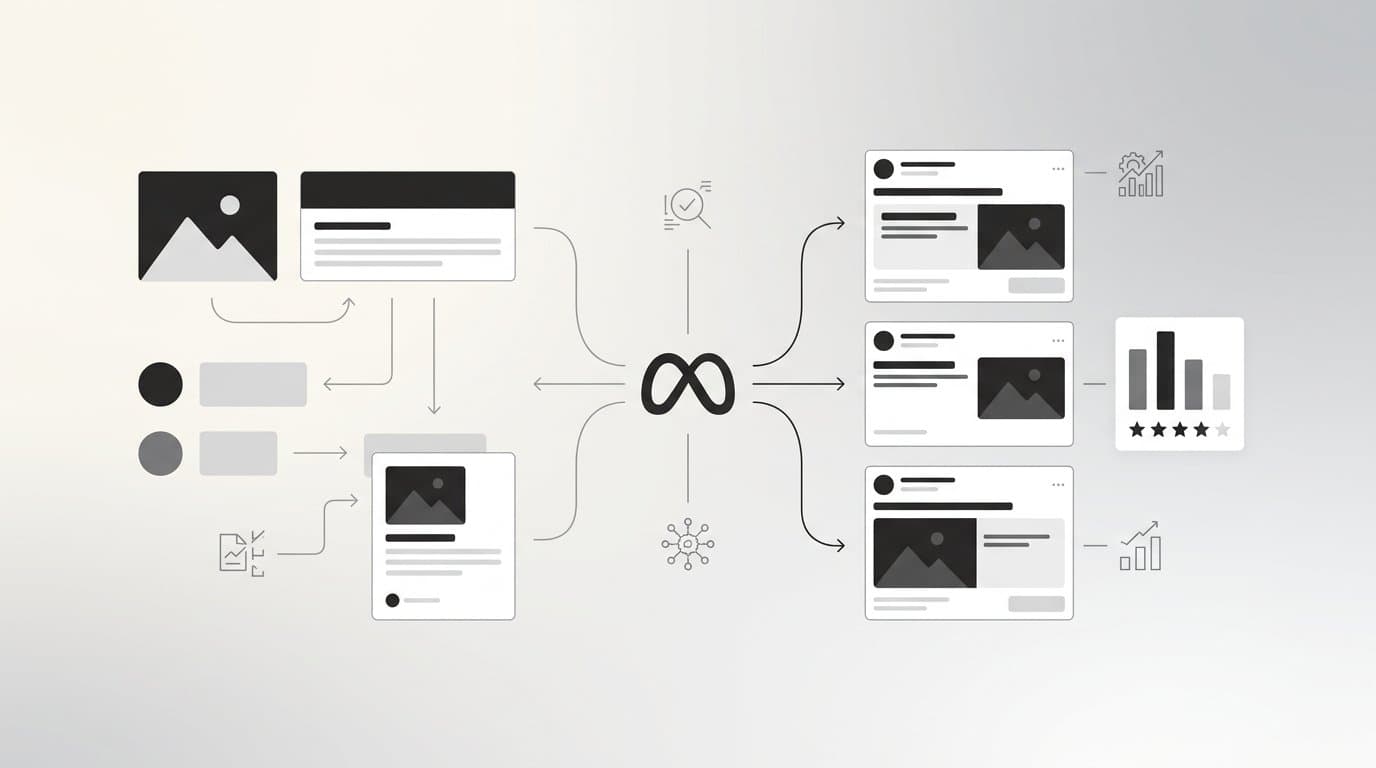
Bulk ad creation processes are where the bottleneck truly breaks. Instead of creating ads one at a time, you generate hundreds of variations by systematically combining creative elements, headlines, audiences, and copy at both the ad set and ad level. The platform handles the combinatorial math and technical execution, launching every variation to Meta in clicks rather than hours of manual campaign setup.
This bulk approach transforms testing from a luxury into standard practice. You can simultaneously test multiple value propositions across different audience segments with various creative approaches. The volume of data you collect accelerates learning and surfaces winning combinations faster than sequential testing ever could.
Performance data becomes your creative director. When you're running hundreds of variations, patterns emerge that would be invisible in small-scale testing. You discover that certain headline structures consistently outperform others. Specific visual styles resonate with particular audience segments. Some calls-to-action drive higher conversion rates regardless of the creative they're paired with.
These insights inform future creative decisions with actual evidence rather than opinions. Instead of debating whether approach A or B will work better, you test both along with approaches C through Z, let the data reveal the winners, and double down on what's proven. The creative process becomes less about subjective judgment and more about systematic optimization. Implementing creative testing automation makes this data-driven approach practical for teams of any size.
A winners library catalogs your top-performing elements with full performance context. Every creative, headline, audience combination, and landing page that exceeds your benchmarks gets saved with its actual metrics: ROAS achieved, cost per acquisition, click-through rate, and conversion rate. This living library becomes your most valuable creative asset.
When launching new campaigns, you start from proven winners rather than blank slates. Select your best-performing product image from the library. Choose headline variations that have already demonstrated engagement. Apply audience combinations that delivered strong ROAS in previous campaigns. You're building on success rather than starting from scratch each time.
The library also protects institutional knowledge. When team members leave, their creative insights don't leave with them. The winners library preserves what worked, why it worked, and the specific performance data that proves it. New team members can get up to speed quickly by studying the library rather than repeating experiments that have already been run.
From Creative Scarcity to Creative Abundance
The ad creative production bottleneck is not an inevitable cost of doing performance marketing. It's a workflow problem that emerges when traditional creative processes collide with the volume and velocity demands of modern digital advertising. The good news? Workflow problems have workflow solutions.
What's fundamentally changed is the tooling available to marketing teams. AI has moved creative generation from a scarce resource requiring specialized human skills to an abundant capability that scales with your campaign needs. The shift isn't about replacing human creativity—it's about removing the mechanical bottlenecks that prevent creative strategies from being executed at the speed and scale that Meta's platform rewards.
Teams that break free from creative bottlenecks discover something powerful: advertising transforms from a resource-constrained struggle into a data-driven optimization game. When you can generate creative variations faster than you can analyze their performance, the limiting factor shifts from production capacity to strategic decision-making. You spend less time waiting for assets and more time identifying patterns, testing hypotheses, and scaling what works.
This abundance mindset changes how you approach campaigns entirely. Instead of carefully rationing creative resources across your highest-priority initiatives, you can test aggressively across your entire portfolio. Instead of making conservative creative bets because you can't afford to waste limited design capacity on experiments, you can try bold approaches knowing you can quickly pivot if they don't work. Instead of letting opportunities pass because you can't produce assets fast enough, you can capitalize on trends and seasonal moments in real-time.
The platforms that enable this transformation handle the entire workflow from creative generation through campaign launching to winner identification in one integrated system. They analyze your historical performance data to inform creative decisions. They generate hundreds of variations combining proven elements in new ways. They launch those variations to Meta with optimized audiences and bidding strategies. They surface your top performers with clear performance rankings so you know exactly what to scale and what to pause.
This integration eliminates the handoffs and delays that create bottlenecks in the first place. You're not briefing one tool, designing in another, launching in a third, and analyzing in a fourth. The entire workflow lives in one place, with AI handling the mechanical work while you focus on strategy and optimization.
Ready to transform your advertising strategy? Start Free Trial With AdStellar and be among the first to launch and scale your ad campaigns 10× faster with our intelligent platform that automatically builds and tests winning ads based on real performance data.