The creative production invoice just landed in your inbox: $8,500 for last month's Meta ad assets. You stare at the number, doing the mental math on how many of those creatives actually drove conversions. Maybe three? Four out of the twenty-seven variations your team produced?
Meanwhile, your competitor seems to launch fresh campaigns weekly with endless creative variations. Their ads feel different every time you check the Meta Ad Library. You're wondering how they afford it.
Here's the truth most marketers eventually face: the traditional creative production model wasn't built for Meta's current reality. The platform rewards advertisers who test relentlessly, who flood the algorithm with variations, who refresh creatives before ad fatigue tanks their ROAS. But doing that through conventional means costs a fortune in agency retainers, freelancer fees, or full-time salaries.
This article breaks down the real economics of Meta ad creative production and explores what's changing in 2026 as AI-powered tools reshape how performance marketers approach the creative bottleneck.
Breaking Down What Creative Production Actually Costs
Let's start with the uncomfortable numbers most marketers know but rarely say out loud.
An in-house designer with Meta advertising experience commands $50,000 to $80,000 annually in most markets, plus benefits that add another 20-30% to that base. You're looking at $60,000 to $100,000+ for one person who can produce maybe 40-60 quality ad creatives per month if they're efficient and not pulled into other projects.
That math works out to roughly $80-150 per finished creative when you account for their full loaded cost and realistic output.
Agencies shift the structure but not necessarily the economics. Monthly retainers for Meta ad creative services typically start around $2,000 for basic packages and climb to $10,000+ for agencies handling multiple campaigns with video production. Most retainer agreements include a set number of creative assets per month, with additional creatives billed separately.
The per-creative cost through agencies often lands between $100-300 for static images and $500-2,000+ for video content, depending on production complexity.
Freelancers offer more flexibility but introduce different challenges. Hourly rates for experienced Meta ad designers range from $50-150+, with most projects requiring 2-4 hours per creative when you factor in briefing, revisions, and file delivery. A single static ad creative might cost $150-400, while video projects easily hit $1,000-3,000 depending on length and production requirements.
But here's what those headline numbers miss: the hidden costs that make creative production even more expensive than it appears.
Every creative asset requires project management time. Someone needs to write the brief, provide feedback on drafts, request revisions, approve finals, and organize files for campaign launch. For in-house teams, this eats into marketing manager hours. For agency relationships, it extends timelines and adds communication overhead.
Revision cycles multiply costs quickly. A designer might quote $200 for a static ad, but that typically includes 2-3 revision rounds. Need a fourth round because the messaging shifted? That's additional billable time. Multiply this across dozens of creatives per month and the revision tax becomes significant.
Then there's the bottleneck problem. When your designer or agency is your only source of creative assets, they become the constraint on campaign launch speed. You can't test a new audience segment until they finish the creatives. You can't capitalize on a trending topic because production takes a week. The opportunity cost of slow creative production is harder to measure but very real. Many teams find that Meta ads taking too long to create becomes their biggest competitive disadvantage.
The Volume Problem That's Breaking Traditional Creative Models
Meta's algorithm doesn't care about your creative production budget. It cares about performance data, and performance data requires volume.
The platform's recommendation engine favors advertisers who test multiple creative variations because more data points help the algorithm optimize delivery. Testing different images, headlines, video hooks, and ad copy combinations isn't optional for competitive performance anymore. It's table stakes.
Think about what this means mathematically. If you're running campaigns across three audience segments and want to test five creative variations per segment with three different headline approaches, you need 45 unique ad combinations. Add in carousel formats, video variations, and UGC-style content, and you're easily looking at 100+ creative assets to properly test a single product or offer.
Traditional creative production models collapse under this volume requirement. An in-house designer producing 50 creatives per month is already stretched thin. Asking for 100+ means hiring another designer or accepting that you simply can't test at the scale Meta's algorithm rewards.
The creative refresh cycle compounds the volume challenge. Ad fatigue sets in faster than it used to, with many advertisers reporting performance drops after 7-14 days of running the same creative to the same audience. Combat ad fatigue by launching fresh variations, which means your monthly creative needs aren't 100 assets—they're 100 assets every few weeks.
This is where the cost spiral begins. You need more creatives to find winners. Each creative costs money whether it performs or not. Most creatives won't be winners, so you're funding a lot of expensive failures to discover the few assets that drive profitable ROAS. Understanding AI Meta ads tool cost structures can help you break this cycle.
The format explosion makes everything harder. Static image ads are the baseline, but video content consistently outperforms in many verticals. UGC-style creatives that look like organic content rather than polished ads are driving strong results for direct-to-consumer brands. Carousel ads work well for showcasing multiple products or features.
Each format requires different production skills and tools. Your designer might excel at static images but lack video editing capabilities. Producing authentic-looking UGC content requires either actual user-generated assets or hiring actors and videographers to create that aesthetic. Suddenly you're not managing one creative resource—you're coordinating multiple specialists, each with their own rates and timelines.
The testing paradox becomes obvious: you need creative volume to succeed on Meta, but traditional production methods make that volume prohibitively expensive. Something has to change.
What Marketers Are Trying Instead of Expensive Teams
Faced with unsustainable creative costs, performance marketers have started exploring alternatives that shift the economics.
Template-Based Design Tools: Platforms like Canva and similar services offer pre-built templates that non-designers can customize. The appeal is obvious: lower cost, faster production, and no dependency on specialized creative talent. A marketing coordinator can produce basic ad creatives in minutes rather than waiting days for designer availability.
The limitation is differentiation. When thousands of advertisers use the same templates with minor variations, your ads start looking like everyone else's. Meta's algorithm may reward creative volume, but it also rewards thumb-stopping creative that stands out in the feed. Template-based approaches solve the cost problem but often sacrifice the performance advantage that justifies ad spend in the first place.
These tools also still require human time. Someone needs to customize templates, write copy, export files, and upload to Meta. The per-creative cost drops, but the time investment and creative bottleneck remain.
User-Generated Content Strategies: Some brands have shifted toward leveraging customer-created content rather than producing everything in-house. The logic is sound: real customers using your product creates authentic social proof that often outperforms polished studio photography.
This approach works well when you have systems to collect, organize, and repurpose UGC at scale. You need customer permission, quality control processes, and enough volume of submissions to maintain a steady flow of fresh content. Building these systems takes time and effort, and not every brand has customers actively creating shareable content.
UGC strategies also don't eliminate creative production entirely. You still need graphics, text overlays, editing, and formatting to turn raw customer photos or videos into effective ad creatives. The source material costs less, but production work remains.
AI-Powered Creative Generation: The newest alternative involves AI tools that generate ad creatives from product information, competitor analysis, or simple text prompts. These platforms create image ads, video content, and UGC-style creatives without requiring design skills or production teams.
The technology has reached a threshold where AI-generated creatives are increasingly difficult to distinguish from human-produced assets. More importantly for performance marketers, they're testing well in actual campaigns. The quality debate matters less when AI creatives are driving comparable or better ROAS than traditionally produced assets. A thorough AI Meta ads tools comparison can help you evaluate your options.
What makes AI creative generation fundamentally different from templates or UGC approaches is the volume capability. You can generate hundreds of variations in minutes, test them all, and let performance data determine winners. The per-creative cost becomes essentially zero after the platform subscription fee.
Some AI creative tools go beyond just generation. They analyze your past campaign performance, identify which creative elements drove results, and use that data to inform new creative production. They can clone competitor ads from the Meta Ad Library, create variations of winning creatives, or generate entirely new concepts based on your product URL.
The workflow integration matters too. Tools that both generate creatives and launch them directly to Meta eliminate multiple steps in the campaign creation process. You're not downloading files, uploading to Ads Manager, and manually building campaigns. The creative generation and campaign launch happen in one connected workflow.
How AI Changes the Creative Production Economics
The fundamental shift AI creative tools introduce is moving from per-asset pricing to unlimited generation models.
Traditional creative production charges per deliverable. Every image, every video, every carousel ad costs money. This creates a natural ceiling on how much you can test because each additional creative variation hits your budget.
AI platforms typically charge flat monthly subscription fees. Whether you generate 10 creatives or 1,000, the cost remains the same. This completely changes the testing economics. Suddenly, creating 50 variations to find the top 5 performers isn't wasteful—it's just smart testing methodology. Reviewing AI Meta ads tools pricing helps you understand the investment required.
The speed advantage compounds the value. Generating a creative variation with AI takes seconds or minutes versus the hours or days required for traditional production. This means you can respond to trends, test new messaging, or capitalize on current events without waiting for designer availability or agency timelines.
Think about what this enables strategically. You can test bold creative concepts without the risk of wasting expensive designer time on ideas that might not work. You can create personalized creative variations for different audience segments. You can refresh creatives weekly or even daily to combat ad fatigue.
The most sophisticated AI creative platforms do more than just generate assets. They integrate the entire workflow from creative production through campaign launch and performance analysis.
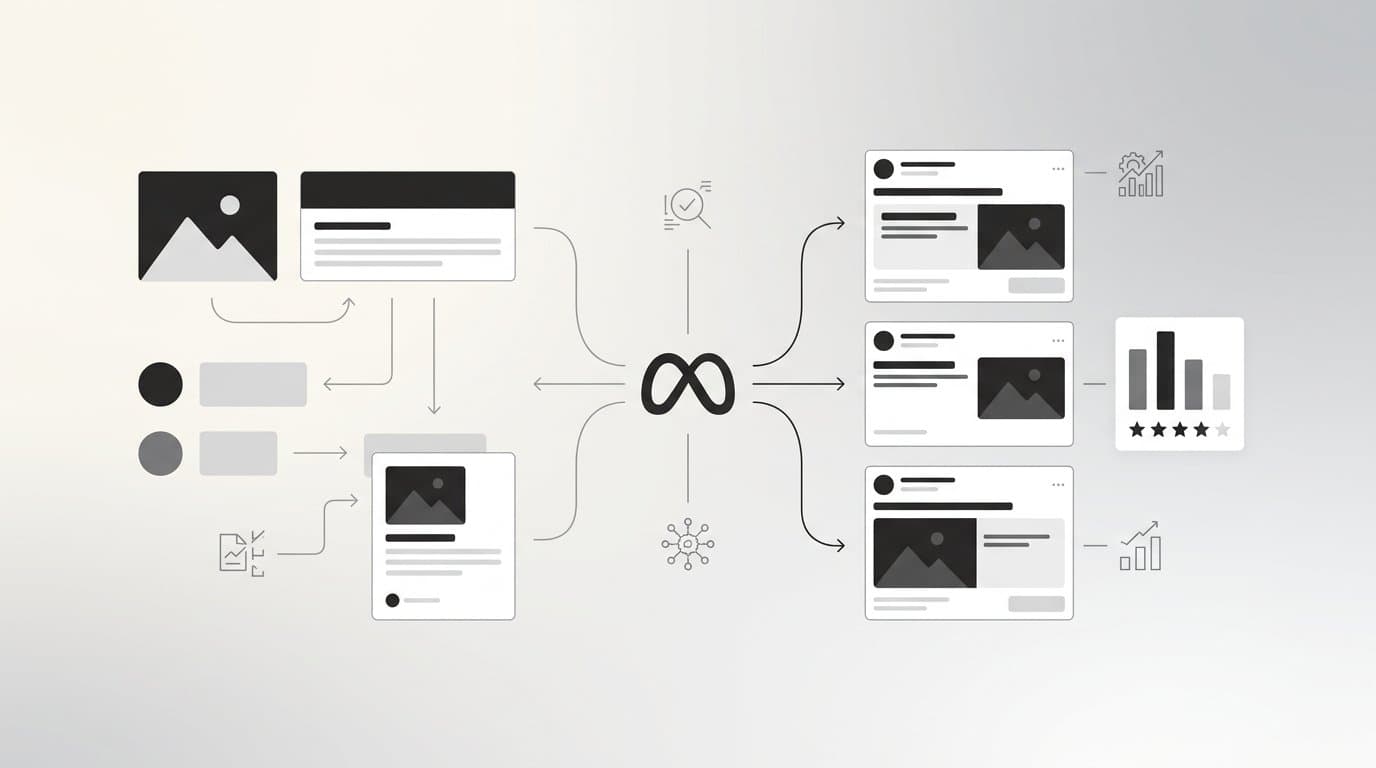
AdStellar exemplifies this integrated approach. The platform generates scroll-stopping image ads, video ads, and UGC-style creatives from a product URL or by cloning competitor ads from the Meta Ad Library. But it doesn't stop at creative generation. The AI Campaign Builder analyzes your historical performance data, ranks every creative, headline, and audience by actual results, and builds complete Meta campaigns with full transparency about every decision.
The bulk Meta ads creation tool capability creates hundreds of variations by mixing multiple creatives, headlines, audiences, and copy at both ad set and ad level. What would take hours of manual work in Meta Ads Manager happens in minutes. Every combination launches automatically, and the platform's AI Insights track performance with leaderboards that rank creatives, headlines, copy, audiences, and landing pages by real metrics like ROAS, CPA, and CTR.
This integration eliminates multiple cost centers simultaneously. You're not paying separately for creative production, campaign setup, and performance analysis. The platform handles all three, with AI that gets smarter as it learns from your campaign data.
The Winners Hub feature addresses another hidden cost: institutional knowledge. When your designer or agency produces a winning creative, that knowledge often lives in someone's head or scattered across project files. AI platforms with performance tracking can surface your best-performing creatives, headlines, and audiences automatically, making it easy to reuse proven elements in future campaigns.
Figuring Out If AI Creative Makes Sense for You
AI creative tools aren't the right solution for every advertiser, but they're increasingly the right solution for most performance marketers.
Best Fit Scenarios: High-volume advertisers running multiple campaigns simultaneously benefit most from unlimited creative generation. If you're constantly hitting creative bottlenecks or waiting on designer availability, AI tools remove that constraint entirely.
Agencies managing multiple clients face a different version of the same problem. Traditional creative production doesn't scale linearly—adding more clients means hiring more designers or limiting the creative volume per client. AI creative generation scales infinitely without adding headcount. Many agencies are exploring scaling Meta ads without team expansion as a core strategy.
Teams without dedicated design resources often struggle most with creative production. Marketing managers who wear multiple hats don't have time to become proficient in Photoshop or Premiere Pro. AI tools that generate professional-quality creatives from simple inputs eliminate the skill barrier.
Anyone struggling with creative costs relative to ad spend should evaluate the economics carefully. If creative production represents more than 10-15% of your total ad budget, you're likely overpaying. AI tools typically cost a few hundred dollars monthly while enabling creative volume that would cost thousands through traditional production.
What to Look For: Not all AI creative tools deliver the same capabilities or quality. Output quality matters most—the creatives need to perform in actual campaigns, not just look impressive in demos. Request examples or trial periods to test real performance. Consider starting with an AI Meta ads tool trial before committing.
Format variety is crucial. You need tools that can generate static images, video content, and UGC-style creatives because different formats perform differently across audiences and placements. Platforms limited to one format leave you dependent on other tools for complete creative coverage.
Integration with Meta determines workflow efficiency. Tools that generate creatives but require manual download, upload, and campaign setup in Ads Manager save money but not time. Look for platforms that launch campaigns directly to Meta, eliminating multiple workflow steps.
Performance tracking capabilities separate creative generation tools from complete advertising platforms. The ability to see which creatives, headlines, and audiences actually drive results lets you iterate intelligently rather than guessing what works.
Hybrid Approaches Work Too: You don't have to choose between AI and human creative exclusively. Many successful advertisers use AI for volume and testing while reserving human creative teams for brand campaigns, complex storytelling, or high-stakes launches.
AI excels at generating variations, testing concepts quickly, and producing performance-driven creative at scale. Human designers excel at brand consistency, emotional storytelling, and creative concepts that require cultural context or strategic thinking.
A hybrid model might look like this: use AI to generate and test 100 creative variations, identify the top performers based on actual data, then have your designer create premium versions of the winning concepts for broader campaigns. You're using each approach for what it does best.
Making the Switch Without Tanking Your Campaigns
Transitioning from traditional creative production to AI-powered tools requires some strategic planning to avoid disrupting performance.
Start With Testing: Don't shut down your existing creative production immediately. Run AI-generated creatives alongside your current assets in live campaigns to compare performance directly. This gives you real data about how AI creatives perform for your specific audience and products.
Set up A/B tests where some ad sets use traditionally produced creatives and others use AI-generated versions with similar messaging and offers. Track ROAS, CPA, CTR, and conversion rates to see if performance differs meaningfully. Most advertisers find AI creatives perform comparably or better, but testing confirms this for your situation. A solid Meta ads creative testing strategy makes this transition smoother.
Use the testing phase to learn the AI tool's capabilities and limitations. Experiment with different input approaches, creative styles, and format options. Understanding what the platform does well helps you use it more effectively once you scale up.
Reallocate Budget Strategically: The money you save on creative production doesn't have to leave your marketing budget. Many advertisers redirect those savings into increased ad spend, which often drives better overall results than spending more on creative production.
Think about it this way: if you're spending $5,000 monthly on creative production and $20,000 on ad spend, shifting to a $500 AI creative platform frees up $4,500. Adding that to ad spend gives you 22% more budget to work with, which can significantly expand your reach or allow more aggressive bidding on high-value audiences.
Alternatively, redirect savings toward higher-value strategic work. Maybe you've wanted to hire a performance analyst to dig deeper into campaign data, or invest in better attribution tracking, or expand into new advertising channels. Creative production savings can fund initiatives that were previously budget-constrained.
Measure What Actually Matters: Cost savings are nice, but they're not the primary goal. Focus on metrics that indicate whether the transition is improving your advertising performance.
Time-to-launch improvements matter significantly. Track how long it takes from deciding to test a new creative concept to having live campaigns in Meta. If AI tools cut this from days to hours, you can capitalize on opportunities faster and test more aggressively.
Creative win rates tell you if AI generation is producing viable assets. What percentage of AI-generated creatives achieve your target ROAS or CPA? If the win rate is comparable to or better than traditionally produced creatives, the transition is working.
Overall ROAS impact is the ultimate measure. Your total return on ad spend should maintain or improve as you transition to AI creative. If ROAS drops, investigate whether it's the creative quality, the volume of testing, or other campaign factors causing the decline.
Rethinking What Creative Production Should Cost
The expensive creative team problem isn't really about the cost of creative talent. It's about workflow inefficiency and technology limitations that made high costs inevitable.
Traditional creative production required specialized skills, expensive tools, and significant time investment per asset. Those requirements created natural scarcity and high costs. When each creative takes hours to produce, you can't generate the volume Meta's algorithm rewards without spending a fortune.
AI-powered creative generation removes those constraints. The technology handles the technical execution, enabling marketers to focus on strategy, messaging, and performance optimization. The goal isn't to eliminate human creativity—it's to eliminate the bottlenecks and costs that prevent testing at scale.
The marketers winning on Meta in 2026 aren't necessarily the ones with the biggest creative budgets. They're the ones who can test relentlessly, identify winners quickly, and scale what works without waiting on designer availability or agency timelines.
AI creative tools have reached a quality threshold where they're viable for performance marketing, and in many cases, they're outperforming traditionally produced assets because they enable the volume and speed that Meta's algorithm rewards. The per-creative cost becomes irrelevant when you can generate unlimited variations and let performance data determine what's worth scaling.
This shift is becoming standard practice among performance marketers who understand that creative volume and testing velocity matter more than production pedigree. The question isn't whether AI will play a role in Meta ad creative production—it's how quickly you'll adopt tools that remove the cost and speed constraints holding your campaigns back.
Ready to transform your advertising strategy? Start Free Trial With AdStellar and be among the first to launch and scale your ad campaigns 10× faster with our intelligent platform that automatically builds and tests winning ads based on real performance data.