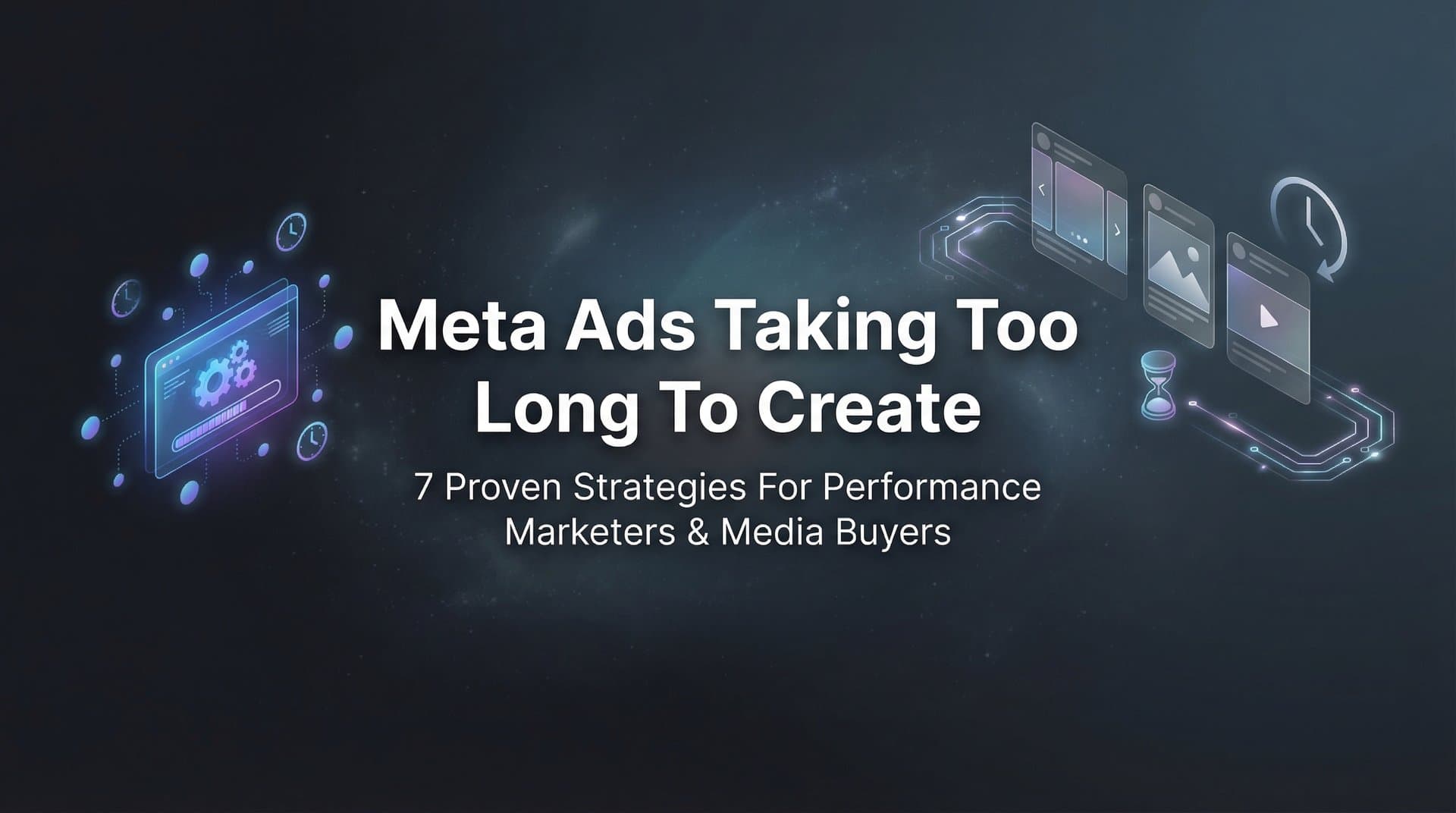
You know the drill: Monday morning, fresh coffee, ready to launch that new Meta campaign. Fast forward three hours, and you're still buried in audience settings, wrestling with ad set configurations, and manually duplicating variations for the fifth time. Sound familiar?
For digital marketers managing multiple campaigns or agencies juggling client accounts, this time drain isn't just frustrating—it's actively sabotaging your ability to test new ideas, iterate quickly, and scale what's working. Every hour spent on manual campaign setup is an hour you're not analyzing performance, optimizing budgets, or developing creative strategy.
The reality? Most of the bottlenecks slowing down your Meta ad creation are completely fixable. Marketing teams who've cracked the code on efficient campaign building aren't working harder—they're working smarter with systematic workflows, organized assets, and the right automation tools.
This guide breaks down seven proven strategies that transform campaign creation from a multi-hour marathon into a streamlined process. Whether you're launching your first campaign of the week or your fiftieth, these approaches will help you reclaim your time without sacrificing quality or performance.
1. Build a Modular Creative Asset Library
The Challenge It Solves
Starting every campaign from scratch is like reinventing the wheel daily. You're digging through old campaigns to find that high-performing image, searching Slack for the latest brand guidelines, or worse—recreating assets you know you've used before but can't locate. This creative chaos adds unnecessary friction to every launch.
The bigger issue? Without organized assets, you can't easily identify patterns in what's actually working. That winning headline from last month's campaign gets forgotten instead of repurposed. Proven creative elements sit buried in random folders instead of being systematically reused.
The Strategy Explained
Think of your creative library as a strategic arsenal, not a random junk drawer. The goal is creating a searchable, organized system where every proven creative element—images, videos, headlines, body copy, CTAs—lives in a logical structure that makes retrieval instant.
The key is taxonomy. Organize assets by performance tier (proven winners, testing, archived), campaign type (awareness, conversion, retargeting), product line, or audience segment. Tag everything with relevant metadata: performance metrics, creative concept, seasonal relevance, platform specifications.
Many marketing teams use cloud storage with clear folder hierarchies, while others leverage digital asset management platforms. The specific tool matters less than the system—you need a structure that your entire team can navigate intuitively, even at 9 PM before a campaign deadline.
Implementation Steps
1. Audit your existing creative assets and identify your top performers from the past 90 days based on your key conversion metrics.
2. Create a folder structure that mirrors how you actually build campaigns—organize by campaign objective, product category, or audience type depending on your workflow.
3. Establish a naming convention that includes key details at a glance: date, campaign type, performance tier, and creative format (e.g., "2026-03_Conversion_Winner_Video_15s").
4. Set up a regular maintenance schedule—weekly or bi-weekly—to add new winners, archive underperformers, and update performance tags.
Pro Tips
Create "swipe file" documents that pair winning creatives with their performance context—what audience saw them, what offer they promoted, what time of year they ran. This context transforms a simple image library into a strategic playbook. Consider building seasonal folders in advance so you're not scrambling when Q4 hits.
2. Create Reusable Campaign Templates
The Challenge It Solves
Every time you build a new campaign, you're making hundreds of tiny decisions: campaign objective, budget allocation method, placement preferences, conversion events, attribution windows. Most of these decisions are identical across similar campaign types, yet you're manually configuring them from scratch each time.
This repetitive setup work isn't just tedious—it introduces inconsistency. One campaign uses 7-day click attribution, another uses 1-day. Budget distribution varies randomly. Placement exclusions differ without strategic reason. These inconsistencies make performance comparison nearly impossible.
The Strategy Explained
Campaign templates are pre-configured blueprints for your most common campaign types. Instead of starting with a blank slate, you're working from a proven structure that already includes your standard settings, naming conventions, and strategic choices.
The power isn't just speed—it's standardization. When every conversion campaign follows the same template, you can actually compare performance across time periods and products. You're isolating the variables that matter (creative, audience, offer) while controlling for structural differences.
Think beyond just Meta's built-in templates. Create your own documented frameworks that include campaign structure, typical budget ranges, standard audience layering, creative specifications, and even launch checklists. For guidance on building effective frameworks, explore Meta Ads campaign structure best practices that top performers follow.
Implementation Steps
1. Identify your three most frequently launched campaign types—typically some combination of prospecting, retargeting, and catalog campaigns.
2. Document every setting and decision in your best-performing campaign of each type, from budget allocation to placement preferences to conversion optimization.
3. Create template campaigns in Meta Ads Manager that you can duplicate, or build detailed documentation with screenshots that guides manual setup.
4. Include naming convention templates that automatically incorporate date, campaign type, and product—consistency here pays dividends when analyzing performance.
Pro Tips
Build templates at the campaign level and the ad set level. Your prospecting template might include three standard ad sets: broad targeting, interest-based, and lookalike audiences. This multi-level templating means you're not just saving campaign setup time—you're accelerating the entire structure. Review and update templates quarterly as Meta's platform evolves and your strategy shifts.
3. Standardize Your Audience Segments
The Challenge It Solves
Audience building is where most marketers lose hours. You're manually layering interests, adjusting demographics, cross-referencing exclusions, and second-guessing whether to include that behavioral signal. Multiply this by every ad set in every campaign, and you've got a massive time sink.
Worse, when every campaign uses slightly different audience definitions, you can't tell what's actually working. Is this campaign performing better because of the creative, or because you happened to include a different interest layer? The lack of standardization creates analytical chaos.
The Strategy Explained
Build a master library of pre-defined, saved audiences that cover your core targeting strategies. Think of it as creating a menu of proven audience segments that you can deploy instantly, rather than rebuilding targeting from scratch each time.
The key is creating clear categories and naming conventions. Your library might include core customer segments (by product interest, purchase behavior, or lifecycle stage), lookalike tiers (1%, 3%, 5% of different seed audiences), and retargeting windows (7-day, 30-day, 90-day site visitors). Implementing solid Meta Ads campaign naming conventions ensures your audience library stays organized and searchable.
This approach doesn't eliminate audience testing—it accelerates it. You're testing new audience combinations by mixing and matching pre-built segments, not manually reconstructing targeting parameters every single time.
Implementation Steps
1. Map out your customer journey and identify the 5-7 core audience segments that represent your primary targeting strategies—typically a mix of cold prospecting, warm engagement, and hot retargeting audiences.
2. Build and save these audiences in Meta's Audience Manager with crystal-clear naming that indicates the segment type, criteria, and any key exclusions.
3. Create a simple reference document that explains when to use each audience segment, typical performance benchmarks, and recommended budget allocation.
4. Establish a testing framework for new audience variations—when you discover a winning new segment, immediately save it to your library with performance notes.
Pro Tips
Use hierarchical naming that groups related audiences together: "Retargeting_30Day_AddToCart" and "Retargeting_30Day_ViewContent" will appear together in Meta's interface, making selection faster. Build exclusion audiences proactively—having a saved "Recent Purchasers_30Day" exclusion audience means you're not rebuilding it for every campaign. Consider creating audience "stacks" that layer multiple segments for specific campaign types.
4. Batch Your Creative Production
The Challenge It Solves
Context-switching kills productivity. When you're jumping between strategic planning, creative production, campaign setup, and performance analysis throughout the day, your brain never fully engages with any single task. The result? Everything takes longer than it should.
Creative work suffers especially from fragmentation. You can't get into a creative flow state when you're designing one ad, then switching to budget allocation, then back to writing copy, then over to audience configuration. Each transition costs mental energy and time.
The Strategy Explained
Batching means dedicating focused time blocks to similar tasks, eliminating the cognitive cost of constant switching. Instead of creating ads one at a time as you build campaigns, you produce creative assets in dedicated sessions—then deploy them across multiple campaigns.
This isn't just about efficiency. When you're in creative mode for an extended period, you develop momentum. Your fifth ad variation is faster and often better than your first because you're building on ideas rather than starting cold each time.
The approach works for all creative elements: batch your image sourcing and editing, batch your copywriting sessions, batch your video production. You're leveraging the same creative headspace across multiple outputs instead of warming up repeatedly.
Implementation Steps
1. Block dedicated time on your calendar for creative production—aim for 2-3 hour sessions where creative work is the only task on your plate.
2. Before each creative session, outline all the campaigns and variations you need assets for, so you're producing with a clear roadmap rather than making it up as you go.
3. Use the first 30 minutes for setup: gather brand assets, research competitor ads, review your creative library for inspiration, and set up your design tools.
4. Produce variations systematically—create all headline options first, then all image variations, then all body copy—rather than completing one ad fully before starting another.
Pro Tips
Batch by creative concept, not just by format. If you're testing three different messaging angles, produce all variations of concept A, then all of concept B, then all of concept C. This keeps you in the same strategic mindset. Schedule your creative batching sessions during your peak creative hours—for many people, that's morning, not late afternoon when you're mentally drained. Consider creating 20-30% more variations than you plan to launch immediately; having a backlog means your next campaign can launch faster.
5. Implement Bulk Launch Workflows
The Challenge It Solves
Launching campaigns one ad at a time is like filling a swimming pool with a teaspoon. You're clicking through the same interface repeatedly, copying and pasting creative elements, manually adjusting minor variations, and praying you don't miss a setting. For campaigns that test multiple audiences, creatives, or placements, this manual multiplication is excruciating.
The time cost compounds when you're testing at scale. Want to test five creatives across three audiences? That's fifteen ad variations to set up manually. Need to launch similar campaigns for multiple products? Multiply your setup time by each product line.
The Strategy Explained
Bulk launching means creating multiple campaign variations simultaneously rather than sequentially. Instead of building ad A, then ad B, then ad C, you're setting up the variable elements once and letting tools handle the multiplication.
Meta's Ads Manager offers bulk creation features, but they're limited. More sophisticated approaches involve spreadsheet-based workflows, API integrations, or specialized platforms that let you define your variables—audiences, creatives, placements—and automatically generate all combinations. A dedicated bulk Meta Ads creation tool can dramatically accelerate this process.
The real power emerges when you combine bulk launching with your standardized audiences and creative library. You're not just launching faster—you're launching more comprehensive tests that would be impractical to set up manually.
Implementation Steps
1. Map out your typical testing matrix—how many audiences, creatives, and placements do you usually test per campaign?—to understand your bulk launching needs.
2. Start with Meta's built-in bulk creation tools: learn to use the spreadsheet upload feature or the "Duplicate" function with batch editing to create variations.
3. Create a master spreadsheet template that includes all campaign variables—audience IDs, creative asset URLs, budget allocations, placement preferences—so you can populate it quickly for each launch.
4. Test your bulk workflow with a small campaign first (3-5 ad variations) to catch any setup issues before scaling to larger launches.
Pro Tips
When using Meta's bulk tools, always preview your campaigns before publishing—bulk creation can amplify mistakes across dozens of ads. Consider using naming conventions that include variable indicators: "Campaign_AudienceA_Creative1" makes it instantly clear which combination you're looking at in reporting. For teams launching high volumes, explore Meta's API or third-party platforms that offer more sophisticated bulk creation capabilities than Ads Manager's native tools. If you need to launch multiple Meta Ads at once, investing in proper tooling pays for itself quickly.
6. Leverage AI-Powered Campaign Building
The Challenge It Solves
Even with templates, libraries, and bulk tools, campaign creation still requires countless micro-decisions. Which creative performed best with this audience last quarter? What budget split between ad sets will maximize learning? Should you use broad targeting or layer interests? These decisions take time and often rely on gut feeling rather than data analysis.
The challenge intensifies as your campaign history grows. You have mountains of performance data that could inform better decisions, but who has time to analyze six months of creative performance before launching today's campaign? Most teams end up making educated guesses instead of data-driven choices.
The Strategy Explained
AI-powered campaign building tools analyze your historical performance data to automate the decision-making process. Instead of manually selecting audiences, creatives, and settings based on memory or intuition, these platforms identify patterns in what's actually worked and build campaigns accordingly. The rise of AI for Meta Ads campaigns represents a fundamental shift in how marketers approach optimization.
The sophisticated versions don't just automate—they optimize. They recognize that your product launch campaigns perform differently than your retargeting campaigns. They understand seasonal patterns in creative performance. They know which audience segments convert best for which products.
This approach transforms campaign creation from a manual assembly process into a strategic oversight role. You're reviewing AI recommendations and approving launches rather than building every element from scratch. The time savings can be dramatic—what took hours can happen in minutes.
Implementation Steps
1. Evaluate your current campaign volume and complexity—AI tools deliver the most value when you're managing multiple campaigns with substantial historical data to learn from.
2. Look for platforms that integrate directly with Meta's API and can access your complete campaign history, not just surface-level metrics.
3. Start with a pilot approach: use AI tools for one campaign type (like retargeting or catalog campaigns) while maintaining your manual process for others, so you can compare results.
4. Review the AI's decision rationale—the best platforms explain why they selected specific audiences or creatives, turning automation into a learning opportunity.
Pro Tips
AI tools work best when fed clean, consistent data. If your historical campaigns use inconsistent naming, missing UTM parameters, or incomplete conversion tracking, clean that up first. Look for platforms that offer transparency in their decision-making—black box automation is risky, but AI that explains its reasoning helps you learn and improve your strategy. Consider tools that create feedback loops: the AI should get smarter as it learns from your campaign results, not just apply static rules. Explore the best Meta Ads automation tools to find solutions that match your workflow.
7. Establish a Campaign Launch Checklist
The Challenge It Solves
You've built the perfect campaign, invested an hour in setup, and hit publish. Two hours later, you realize you forgot to exclude recent purchasers. Or you're using yesterday's budget instead of the updated allocation. Or the conversion tracking pixel isn't firing. These forgotten steps mean pausing campaigns, making edits, and losing precious learning time.
The problem isn't incompetence—it's human nature. When you're rushing to meet a deadline or juggling multiple campaigns, details slip through. Each mistake costs time in fixes and potentially wasted ad spend on misconfigured campaigns.
The Strategy Explained
A campaign launch checklist is your safety net—a standardized pre-flight check that catches errors before they go live. Think of it like a pilot's pre-takeoff checklist: the same critical items verified every single time, regardless of experience level or time pressure.
The best checklists are specific to your workflow and common failure points. If you frequently forget to update UTM parameters, that's on the checklist. If placement exclusions often get missed, that's included. You're documenting your team's actual error patterns, not generic best practices. A well-designed Meta Ads campaign workflow incorporates these verification steps naturally.
This isn't about bureaucracy—it's about speed through consistency. A good checklist takes two minutes but prevents the hour-long cleanup from launching with wrong settings. Over time, the checklist items become automatic, but having the written backup prevents costly mistakes during high-pressure launches.
Implementation Steps
1. Review your last 10 campaign launches and identify every mistake that required post-launch fixes—these become your initial checklist items.
2. Organize your checklist in the same sequence as your campaign building workflow: campaign settings, ad set configuration, ad creative, tracking verification, budget confirmation.
3. Create separate checklists for different campaign types if they have unique requirements—your catalog campaign checklist might differ from your lead generation checklist.
4. Make the checklist accessible where you actually work: a pinned document in your project management tool, a template in your notes app, or a printed sheet at your desk.
Pro Tips
Include verification steps, not just setup reminders. Instead of "Set budget," write "Verify budget matches campaign brief and check daily vs. lifetime setting." This forces active confirmation rather than passive checkbox-ticking. Add a final "preview" step where you view your campaign in Meta's preview tool or send test ads to yourself—catching creative errors before launch saves embarrassment and budget. Update your checklist monthly based on new mistakes or platform changes; a living document stays relevant.
Putting It All Together
The path to faster Meta ad creation isn't about cutting corners—it's about building systems that eliminate repetitive work and reduce decision fatigue. Each strategy in this guide addresses a specific bottleneck in the campaign creation process, from creative production to audience selection to final launch verification.
Start with your biggest pain point. If you're constantly rebuilding audiences from scratch, implementing standardized segments will deliver immediate relief. If creative production drags on for days, batching your workflow will unlock significant time savings. If you're launching high volumes of similar campaigns, bulk workflows become essential.
The compounding effect is where the real transformation happens. When you combine a creative asset library with campaign templates, bulk launching tools, and a launch checklist, you're not just incrementally faster—you're operating at a fundamentally different speed. Tasks that consumed entire afternoons shrink to 20-minute sprints. If Facebook Ads taking hours to create has been your reality, these systematic approaches change everything.
For marketing teams ready to take the next leap, AI-powered platforms represent a step-change in efficiency. Tools like AdStellar AI analyze your historical performance data to automatically select winning creatives, build optimized audience combinations, and launch complete campaigns in under 60 seconds. The platform's seven specialized AI agents handle everything from campaign structure to budget allocation, with full transparency into every decision. Instead of manually implementing each strategy in this guide, you're leveraging AI that's already learned from your best-performing campaigns.
The time you reclaim isn't just about working fewer hours. It's about redirecting your energy toward high-value activities: analyzing performance trends, developing creative strategy, testing new channels, or simply having the bandwidth to respond quickly when opportunities emerge. In a landscape where speed-to-market often determines winners, these efficiency gains translate directly to competitive advantage.
Ready to transform your advertising workflow? Start Free Trial With AdStellar AI and experience what happens when AI handles the mechanical work of campaign creation, freeing you to focus on strategy, creativity, and results. Join marketing teams who've already discovered that the fastest way to build better campaigns is to stop building them manually.