Your startup's Meta advertising workflow looks like this: manually creating ad variations in Canva, copying and pasting audiences between ad sets, launching campaigns one at a time, and checking performance metrics across multiple dashboards. By the time you finish setting up one campaign, your competitors have already tested fifty variations and identified their winners.
This is the reality for most startup marketing teams. You are competing against companies with dedicated media buyers, creative teams, and data analysts. But you have something they do not: the ability to move faster by leveraging automation intelligently.
Meta campaign automation is not about surrendering control to algorithms. It is about reclaiming your time so you can focus on strategy instead of execution. The startups scaling profitably on Meta in 2026 share a common trait: they have automated the repetitive tasks that drain hours and amplified their strategic decision-making with AI-powered insights.
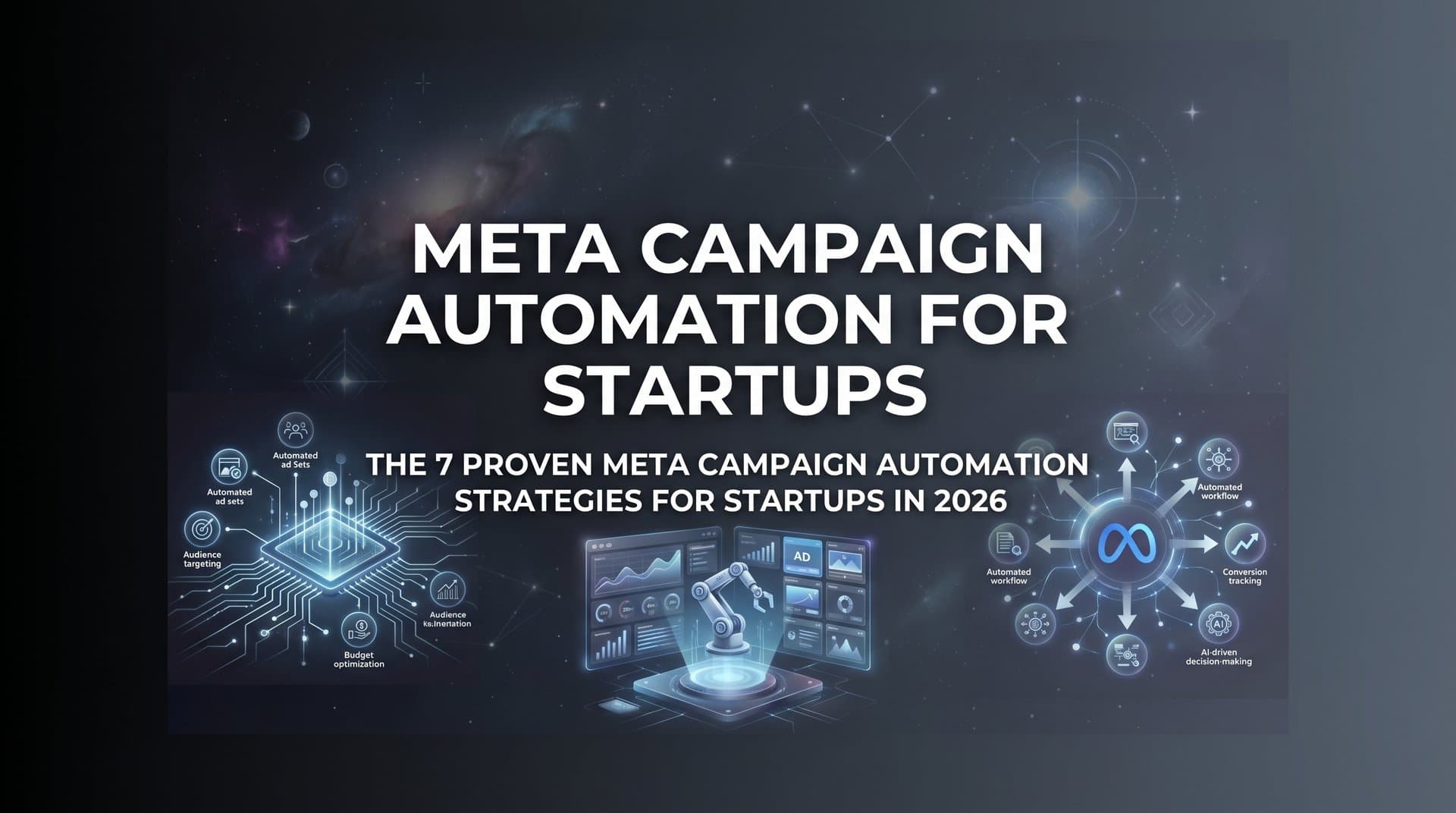
This guide breaks down seven automation strategies specifically designed for resource-constrained startups. Each approach addresses a specific bottleneck in your Meta advertising workflow, from creative production to performance analysis. The goal is simple: help you compete with larger competitors without matching their headcount.
1. Automate Creative Generation from Your Product Catalog
The Challenge It Solves
Creative production is the biggest bottleneck for startup marketing teams. Hiring designers is expensive. Using freelancers creates inconsistency and delays. DIY design tools still require hours of work for each ad variation. Meanwhile, creative fatigue sets in quickly, requiring constant refreshes to maintain performance.
The result? Most startups launch campaigns with limited creative variety, testing only a handful of variations because producing more is simply not feasible. This severely limits your ability to find winning combinations and scale profitably.
The Strategy Explained
AI-powered creative generation solves this by producing ad creatives directly from your product URLs. You provide the link, and the AI analyzes your product, generates multiple image variations, writes compelling ad copy, and creates video content without requiring design skills or video production resources.
This approach works particularly well for e-commerce startups and direct-to-consumer brands. Instead of spending hours in design tools, you can generate dozens of creative variations in minutes. The AI handles composition, color schemes, text overlays, and even UGC-style avatar content that mimics user-generated testimonials. For a deeper dive into how Meta ads automation for ecommerce specifically addresses these challenges, explore dedicated strategies for product-based businesses.
The key advantage is volume. When you can generate fifty creatives as easily as five, you dramatically increase your chances of finding scroll-stopping ads that resonate with your target audience.
Implementation Steps
1. Choose an AI creative platform that integrates directly with Meta Ads Manager and supports bulk creative generation from product URLs.
2. Create a library of your core products or service offerings with URLs that contain comprehensive product information, images, and descriptions.
3. Generate multiple creative variations for each product, testing different visual styles, messaging angles, and formats (static images, videos, UGC-style content).
4. Use chat-based editing features to refine AI-generated creatives, adjusting specific elements like headlines, colors, or calls-to-action without starting from scratch.
5. Build a workflow where you generate new creative batches weekly, maintaining fresh ad content without the traditional production bottleneck.
Pro Tips
Start with your best-selling products or highest-margin offerings to validate the approach before scaling across your entire catalog. Clone high-performing competitor ads from the Meta Ad Library to understand what visual patterns work in your niche, then use AI to generate similar variations with your branding. Always generate more creatives than you think you need because testing volume directly correlates with finding winners faster.
2. Deploy AI-Powered Audience Building Based on Historical Data
The Challenge It Solves
Audience targeting has become increasingly complex as Meta has reduced manual targeting options. Startups often default to broad targeting or copy audience setups from blog posts without understanding if those segments actually perform for their specific business.
Testing audience variations manually means creating separate ad sets, waiting for statistical significance, and analyzing results across multiple campaigns. For a lean team, this process is time-consuming and often leads to suboptimal audience selection based on incomplete data.
The Strategy Explained
AI audience automation analyzes your historical campaign performance to identify which audience segments have actually driven results for your business. Instead of guessing which interests, demographics, or behaviors to target, the AI ranks every audience you have tested by real metrics like cost per acquisition and return on ad spend.
This approach is particularly powerful for startups because it builds on your existing data. Even if you have only run a few campaigns, the AI can identify patterns in what worked and recommend audience configurations that combine your best-performing elements. Understanding how AI marketing automation for Meta ads processes this data helps you leverage these insights more effectively.
The system continuously learns as you launch new campaigns, refining its recommendations based on cumulative performance data rather than relying on generic audience templates.
Implementation Steps
1. Connect your historical Meta campaign data to an AI platform that can analyze performance across all your past audiences.
2. Review the AI-generated audience rankings to understand which segments have driven the lowest acquisition costs and highest conversion rates for your business.
3. When building new campaigns, start with AI-recommended audiences that combine proven elements from your top performers rather than creating new audiences from scratch.
4. Layer in new audience tests alongside your proven segments, allowing the AI to expand its knowledge base while maintaining performance.
5. Set up regular reviews where you examine which new audiences the AI has identified as winners, incorporating those insights into your broader marketing strategy.
Pro Tips
Do not abandon broad targeting entirely. Use AI-recommended audiences for your core campaigns while maintaining separate broad targeting tests to capture unexpected customer segments. Pay attention to the AI's reasoning for each audience recommendation because understanding the logic helps you develop better marketing intuition over time. If you are launching a completely new product, start with lookalike audiences based on your existing customers, then let the AI identify which lookalike percentages and seed audiences perform best.
3. Implement Bulk Ad Variation Testing at Launch
The Challenge It Solves
Traditional campaign setup requires creating each ad variation manually. If you want to test three creatives with four headlines across two audiences, you face the tedious task of duplicating ad sets, swapping elements, and ensuring everything is configured correctly. This process is error-prone and time-intensive.
The bigger problem is that manual setup limits your testing ambition. Most startups launch with minimal variations simply because creating more is too painful. This conservative approach means you miss potential winning combinations that only emerge when testing at scale.
The Strategy Explained
Bulk ad launching automates the combinatorial explosion of testing. You select multiple creatives, headlines, audiences, and copy variations, and the automation platform generates every possible combination, launching hundreds of ad variations in minutes instead of hours.
This strategy works at both the ad set and ad level. You can mix and match audiences with different creative sets at the ad set level, then further vary headlines and copy at the ad level within each ad set. The result is comprehensive testing coverage that would be impossible to achieve manually. An AI campaign builder for Meta ads can handle this complexity while maintaining proper campaign structure.
For startups, this means you can compete with the testing volume of much larger competitors without dedicating equivalent time resources to campaign setup.
Implementation Steps
1. Prepare your testing components: generate at least five creative variations, write three to five headline options, and identify two to three audience segments you want to test.
2. Use a bulk launching platform that allows you to select all your testing elements and automatically generates every combination as separate ads or ad sets.
3. Configure your campaign structure upfront, deciding whether to test audiences at the ad set level (recommended for budget control) or ad level (faster testing).
4. Set appropriate budgets for each ad set based on your total campaign budget divided by the number of ad sets you are launching, ensuring each variation receives sufficient traffic for meaningful data.
5. Launch your bulk campaign and resist the urge to make changes for at least three to five days, allowing Meta's algorithm time to optimize each variation.
Pro Tips
Start smaller than you think you need to. If you have never bulk launched before, test with three creatives and two audiences before scaling to dozens of variations. This helps you understand the data volume you will need to analyze. Use campaign naming conventions that clearly indicate which elements are being tested in each ad set, making performance analysis easier later. Consider staggered launches if you have a very limited budget, testing your first batch of variations before launching additional combinations based on early signals.
4. Set Up Automated Performance Scoring Against Your Goals
The Challenge It Solves
Analyzing campaign performance across dozens or hundreds of ad variations is overwhelming. Spreadsheets become unwieldy. Meta's native reporting does not make it easy to compare specific elements like headlines or creatives across campaigns. You end up making decisions based on incomplete analysis or gut feeling.
The fundamental issue is that performance is relative to your goals, but most reporting tools show absolute metrics without context. A two-dollar cost per acquisition might be excellent for one startup and disastrous for another, depending on customer lifetime value and business model.
The Strategy Explained
Automated performance scoring solves this by benchmarking every campaign element against your specific goals. You define target metrics like your maximum acceptable cost per acquisition, minimum return on ad spend, or target click-through rate, and the AI scores every creative, headline, audience, and landing page against those benchmarks.
This transforms raw metrics into actionable insights. Instead of seeing that Creative A has a 1.2% click-through rate, you see that it scores 85 out of 100 against your target, immediately understanding whether it is a winner or needs improvement. Implementing Meta ads performance tracking automation ensures these scores update in real time as new data flows in.
The system creates leaderboards that rank all your elements by performance, making it instantly obvious which components to scale and which to retire.
Implementation Steps
1. Define your goal metrics based on your business economics, calculating your maximum cost per acquisition, minimum acceptable return on ad spend, and benchmark click-through rates.
2. Configure an AI insights platform with these targets, ensuring the scoring algorithm weights metrics according to your priorities (acquisition cost might matter more than click-through rate).
3. Connect all your Meta campaigns to the scoring system so every ad element is automatically evaluated against your benchmarks as data comes in.
4. Review leaderboards regularly to identify top performers, using the scores to make quick decisions about which elements to scale, test further, or eliminate.
5. Adjust your goal metrics as your business evolves, updating targets when your customer lifetime value changes or you shift focus from acquisition to profitability.
Pro Tips
Set realistic goals based on your actual historical performance, not aspirational targets. If your average cost per acquisition is thirty dollars, do not set a ten-dollar target that makes everything look like a failure. Use separate scoring criteria for different campaign objectives because acquisition campaigns and retargeting campaigns should be evaluated differently. Pay attention to elements that consistently score well across multiple campaigns because those represent true insights about your audience, not one-time flukes.
5. Create a Winners Hub for Rapid Campaign Iteration
The Challenge It Solves
Startup marketing teams often rediscover the same winning elements repeatedly because they lack a systematic way to track what has worked. You remember that one creative performed well three months ago, but finding it requires digging through old campaigns in Ads Manager. Headlines that drove conversions get forgotten and rewritten from scratch.
This knowledge loss is expensive. Every time you launch a new campaign without leveraging proven winners, you are starting from a weaker position than necessary. The learning you gained from previous campaigns is not being compounded into future performance.
The Strategy Explained
A winners hub centralizes all your top-performing elements in one place with real performance data attached. Instead of searching through historical campaigns, you have an organized library of proven creatives, headlines, audiences, copy variations, and landing pages that have actually driven results for your business.
When launching a new campaign, you start by selecting winners from your hub rather than creating everything from scratch. This approach dramatically reduces the time to find winning combinations because you are building on proven foundations instead of testing blind. Exploring the full range of Meta campaign automation software features reveals how these hubs integrate with broader workflow automation.
The hub automatically updates as new campaigns run, adding new winners and removing elements that have stopped performing. This creates a living repository of your best-performing assets.
Implementation Steps
1. Set up a platform that automatically identifies winners based on your performance criteria and adds them to a centralized hub with performance metrics attached.
2. Organize your hub by element type (creatives, headlines, audiences, copy) so you can quickly find specific components when building new campaigns.
3. When launching new campaigns, start by browsing your winners hub and selecting proven elements as your baseline, then add new variations to test against those winners.
4. Review your hub monthly to identify patterns in what works, looking for common themes across winning creatives or consistent audience characteristics.
5. Use the hub as a training tool for new team members, showing them concrete examples of what has performed well rather than relying on abstract guidelines.
Pro Tips
Do not let your winners hub become a static archive. Continuously test new variations even when you have proven winners because creative fatigue eventually affects even the best-performing ads. Tag winners with context about when they performed well because seasonality matters, and a summer winner might not work in winter. Share your winners hub with other teams like product development because the messaging and positioning that works in ads often reveals insights about customer priorities.
6. Automate Budget Allocation Based on Real-Time Performance
The Challenge It Solves
Manual budget management means checking campaign performance daily and making adjustment decisions based on limited data. You might shift budget toward a winning ad set, but by the time you notice the trend and make the change, performance has already shifted. Or worse, you miss opportunities entirely because you cannot monitor campaigns constantly.
For startup teams juggling multiple responsibilities, this constant monitoring is unsustainable. Budget allocation decisions get delayed, leading to wasted spend on underperforming ads and missed scaling opportunities on winners.
The Strategy Explained
Automated budget allocation uses rules-based systems to shift spend toward winning ads automatically based on performance thresholds you define. When an ad set achieves your target cost per acquisition, the system increases its budget. When performance deteriorates, budgets decrease or pause entirely without requiring manual intervention.
This approach ensures your budget is always flowing toward your best-performing campaigns in real time. The automation reacts faster than manual management, capitalizing on winning trends while they are hot and cutting losses before they accumulate. Learning about Meta campaign optimization automation provides deeper insight into how these budget rules interact with Meta's own algorithms.
The key is setting intelligent rules that reflect your business logic, not just simplistic performance triggers. Your automation should understand context like time of day, day of week, and minimum data requirements before making budget decisions.
Implementation Steps
1. Define your budget allocation rules based on specific performance thresholds, such as increasing budget by 20% when cost per acquisition drops below your target for 24 hours.
2. Set minimum spend requirements before automation kicks in, ensuring decisions are based on statistically meaningful data rather than early fluctuations.
3. Configure maximum budget caps to prevent runaway spending if an ad set scales too aggressively, protecting your overall budget from single-campaign overruns.
4. Implement pause rules that automatically stop underperforming ad sets when they exceed your maximum acceptable cost per acquisition after reaching minimum spend thresholds.
5. Review automated decisions weekly to ensure the rules are working as intended, adjusting thresholds based on what you learn about your campaign performance patterns.
Pro Tips
Start with conservative automation rules and tighten them over time as you build confidence in the system. Aggressive budget shifts can destabilize campaign performance by triggering Meta's learning phase repeatedly. Use different rules for different campaign types because acquisition campaigns and retargeting campaigns have different performance characteristics and scaling dynamics. Always maintain a small percentage of budget allocated to testing new variations even when winners are performing well, ensuring you continue discovering new opportunities.
7. Build Continuous Learning Loops Into Your Workflow
The Challenge It Solves
Most startup advertising workflows are episodic. You launch a campaign, analyze results, make decisions, then start fresh with the next campaign. Each launch feels like reinventing the wheel because insights from previous campaigns are not systematically incorporated into new ones.
This lack of continuity means you are not compounding your learning. The knowledge gained from your tenth campaign should make your eleventh campaign smarter, but without systems to capture and apply those insights, you plateau in performance improvement.
The Strategy Explained
Continuous learning loops create systems that analyze cumulative campaign data and improve recommendations with each launch. Instead of treating campaigns as isolated events, the automation platform builds a knowledge base of what works for your specific business, using that intelligence to make increasingly sophisticated recommendations over time.
This approach means your advertising gets smarter automatically. The AI learns which creative styles resonate with your audience, which messaging angles drive conversions, and which audience segments deliver the best return. Each campaign feeds data back into the system, refining future recommendations. Understanding how AI for Meta ads campaigns processes this feedback loop helps you maximize the value of every dollar spent.
The transparency is crucial. You should understand why the AI is making specific recommendations, not just blindly follow suggestions. This builds your marketing expertise while saving time on execution.
Implementation Steps
1. Choose platforms that explicitly document their learning process, showing you how historical data influences current recommendations rather than presenting suggestions as black-box outputs.
2. Review the AI's reasoning for each recommendation before implementing it, using this as a learning opportunity to understand what patterns the system has identified.
3. Create a feedback loop where you note which AI recommendations performed well and which did not, helping you calibrate your trust in different types of suggestions.
4. Maintain consistency in how you structure and tag campaigns so the AI can accurately compare performance across time periods and identify true trends versus noise.
5. Schedule monthly reviews where you examine what the AI has learned about your business over the past month, documenting insights that should inform broader marketing strategy.
Pro Tips
The learning loop only works if you feed it quality data. Maintain consistent conversion tracking and ensure your attribution is accurate so the AI learns from real results, not flawed data. Do not override AI recommendations without documenting why because those decisions contain valuable context about your business that the system cannot capture automatically. Use the AI's learning as a training tool for building your own marketing intuition, paying attention to patterns it identifies that you might have missed.
Putting It All Together
Meta campaign automation is not about replacing human strategy with algorithms. It is about amplifying what lean startup teams can accomplish with limited resources. The startups winning on Meta in 2026 are not outspending their competitors. They are out-automating them.
Start with creative automation because it solves your biggest bottleneck. Generating ad variations from product URLs eliminates the design resource constraint that limits most startup testing. Once you have solved creative production, layer in AI-powered audience building to ensure you are targeting the right people with those creatives.
Bulk launching becomes powerful when you have both creative volume and audience intelligence. You can test comprehensively without the manual setup burden. Automated performance scoring then helps you make sense of all that testing data, quickly identifying winners without spreadsheet analysis.
Your winners hub captures institutional knowledge, ensuring you compound learning across campaigns instead of starting fresh each time. Budget automation ensures you capitalize on winners in real time, and continuous learning loops make each campaign smarter than the last.
The key is choosing tools that provide transparency into AI decisions. You should understand why the system recommends specific audiences or scores certain creatives highly. This builds your marketing expertise while saving time on execution. Black-box automation might save time initially, but it does not help you become a better marketer.
Your next step is simple: audit your current Meta workflow and identify the single most time-consuming manual task. That is where automation will deliver the fastest return on investment. For most startups, creative production is that bottleneck. For others, it might be campaign setup or performance analysis.
Focus on solving one problem completely before adding more automation. A fully automated creative workflow delivers more value than partially automating five different processes. Build your automation stack incrementally, validating each component before adding the next layer.
The competitive advantage is not just speed. It is the ability to test more variations, learn faster, and scale what works without proportionally scaling your team. That compounding effect is how startups compete with companies ten times their size.
Ready to transform your advertising strategy? Start Free Trial With AdStellar and be among the first to launch and scale your ad campaigns 10× faster with our intelligent platform that automatically builds and tests winning ads based on real performance data.