Most marketing teams spend more hours managing their ad creation process than actually running campaigns. The irony is brutal: while competitors are launching their fifth creative variation, you're still waiting for design feedback on version one.
This is not just a productivity problem. Every day your creative workflow stays inefficient, you are bleeding opportunities. Your best campaign ideas sit in Slack threads. Winning ad concepts never make it past the approval stage. And your creative team? They are drowning in revision requests instead of producing fresh, scroll-stopping content.
The hidden cost of inefficient ad creative workflows goes far beyond wasted time. When you can only test three ad variations instead of thirty, you are essentially gambling on creative intuition rather than letting data guide your decisions. When your turnaround time measures in weeks instead of hours, you miss trend cycles and competitive windows that could have doubled your ROAS.
This guide will help you diagnose exactly where your workflow is breaking down and show you practical solutions to fix it. We will walk through the specific bottlenecks that plague modern ad teams, identify the warning signs that your process needs an overhaul, and explore how AI-powered tools are fundamentally changing what is possible in creative production speed.
The Hidden Time Drains in Traditional Ad Creation
The traditional ad creation process looks deceptively simple on paper: brief the designer, get the creative, launch the campaign. In reality, it is a minefield of delays and miscommunication that can turn a two-hour task into a two-week ordeal.
The Handoff Problem: Every time work passes from one person to another, you lose momentum. The copywriter finishes the headline, but the designer is in meetings until tomorrow. The designer delivers the mockup, but the media buyer needs three changes before it matches campaign specs. Each handoff introduces lag time, context loss, and the risk that something gets lost in translation.
Think about your last campaign launch. How many Slack messages did it take to get a single ad from concept to approval? How many times did someone say "I thought you meant..." when reviewing the creative?
Version Control Chaos: You are testing three audiences with five creatives each, and suddenly you have fifteen ad variations to track. Which headline went with which image? Did you already test this exact combination? Is this the approved version or the one Sarah flagged for changes?
Many teams resort to elaborate naming conventions and shared spreadsheets that become outdated the moment someone makes an edit. Others dump everything into folders with names like "Final_v3_ACTUAL_Final" and hope for the best. This is not a sustainable system when you need to scale to hundreds of variations.
The Approval Bottleneck: Your creative assets are finished, but they sit in limbo waiting for stakeholder sign-off. The marketing director is traveling. The brand team needs to review for compliance. Legal wants to check the claims. Each approval layer adds days to your timeline, creating a slow creative approval workflow that kills campaign momentum.
The worst part? While your ad waits for approval, your competitors are already running similar concepts and capturing the audience attention you were counting on. By the time you finally launch, the market has moved on.
These time drains compound. A two-day delay in design plus a three-day approval wait plus another day for campaign setup means your "quick test" takes over a week. Multiply that across every campaign, and you start to see why some teams can only launch new creative monthly instead of daily.
Signs Your Creative Process Needs an Overhaul
How do you know when your workflow has crossed from "could be better" into "actively hurting performance" territory? Here are the red flags that signal it is time for a fundamental change.
Meeting Dependency: If you cannot launch a new campaign without scheduling multiple coordination calls first, your process is broken. Modern ad workflows should not require a kickoff meeting, a design review, a copy review, and a pre-launch check-in just to test a new creative angle.
When your calendar fills up with "creative sync" meetings, that is time not spent analyzing performance data or developing new strategies. The best workflows enable asynchronous collaboration where team members can contribute without constant real-time coordination.
Creative Recycling: Your team keeps reusing the same tired creatives because making new ones takes too long. You know those ads are fatiguing. You can see the engagement dropping. But spinning up fresh creative requires so much effort that you just swap the headline and call it a new variation.
This is a death spiral. Stale creative leads to poor performance, which means less budget for new creative, which leads to more recycling. Meanwhile, your competitors are testing bold new concepts while you are running the same product shot from Q3. If this sounds familiar, you may be dealing with creative fatigue that is actively hurting your results.
Data Disconnect: Your performance data lives in Meta Ads Manager, your creative assets are scattered across Google Drive, and your winning formulas exist only in someone's memory. When a campaign performs well, you cannot quickly identify which specific creative elements drove the success.
Was it the headline? The image? The audience targeting? Without tight integration between your creative library and performance analytics, you are constantly reinventing the wheel instead of building on proven winners.
Iteration Paralysis: You want to test a new creative angle, but the thought of going through the entire production process again is exhausting. So you stick with what you have, even when your gut tells you there is a better approach.
This reluctance to iterate is a workflow problem, not a creativity problem. When making changes is painful, you avoid making changes. The result? You settle for mediocre performance because excellence requires too much friction.
Scaling Anxiety: Your current workflow barely handles your existing campaign load. The idea of doubling your ad spend and creative output makes you want to hire three more people just to keep up.
If your workflow does not scale without proportionally scaling your team, you have hit a ceiling. The most efficient teams can dramatically increase creative output without adding headcount because their systems amplify individual productivity.
Breaking Down the Modern Ad Creative Workflow
To fix workflow inefficiency, you need to understand where time actually disappears. Most ad creative workflows break down into four distinct stages, and each one has specific friction points that multiply delays.
Ideation Stage: This is where you decide what to create. In traditional workflows, ideation happens in isolation from performance data. Your creative team brainstorms in a vacuum, disconnected from which angles actually drive conversions.
The inefficiency compounds when there is no systematic way to capture winning patterns. Someone remembers that "lifestyle shots worked better than product-only" from a campaign six months ago, but that insight is not documented anywhere. Every new campaign starts from scratch instead of building on proven concepts.
Production Stage: This is where most teams lose the most time. Traditional production requires coordinating multiple specialists: designers for images, video editors for motion content, copywriters for headlines and body text, and someone to assemble everything into ad-ready formats. This creative production bottleneck is often the single biggest drag on campaign velocity.
Each specialist has their own queue of work, their own tools, and their own turnaround time. A simple request like "can we try this with a different background?" triggers a whole new round of scheduling and handoffs. The production stage that should take hours stretches into days or weeks.
Testing Stage: Once you finally have creative assets, you need to set up campaigns, configure targeting, write ad copy, and launch everything into Meta Ads Manager. This manual setup process is tedious and error-prone.
Want to test five creatives against three audiences? That is fifteen ad variations to manually configure. Want to test different headlines with each creative? Now you are looking at dozens of individual ads to set up, each one a chance to make a targeting mistake or typo that skews your results. Many teams find their ad creative testing process inefficient at this exact stage.
Iteration Stage: Performance data starts coming in, and you need to act on it. But in disconnected workflows, there is a massive lag between seeing results and implementing changes. You spot a winning creative element on Tuesday, but getting a new variation with that element takes until next Monday.
This slow feedback loop means you cannot capitalize on insights while they are hot. By the time you launch your optimized version, audience behavior has shifted and your window has closed.
The Compounding Effect: Here is where it gets really painful. These four stages are not independent. Inefficiency in one stage creates problems downstream. Slow production means you test fewer variations. Limited testing means weaker insights. Weak insights mean your next ideation cycle starts with less knowledge than it should.
The teams winning at paid social are not just faster at each stage. They have eliminated the boundaries between stages entirely, creating a continuous loop where production, testing, and iteration happen simultaneously rather than sequentially.
How AI Transforms Creative Production Speed
AI is not just making creative production faster. It is fundamentally changing what is possible when you remove the traditional bottlenecks from the workflow.
From Product to Ad in Minutes: Instead of briefing a designer, waiting for mockups, and going through revision rounds, AI-powered creative generation can produce scroll-stopping ad variations directly from a product URL. The system analyzes the product, generates multiple visual approaches, and creates ad-ready assets without human intervention in the production process.
This does not mean generic, template-based ads. Modern AI can generate image ads that look professionally designed, video ads with dynamic motion and text overlays, and even UGC-style avatar content that mimics authentic user testimonials. The creative quality rivals what a skilled designer would produce, but the timeline compresses from days to minutes.
Competitive Intelligence Becomes Actionable: You can spot winning ads from competitors in the Meta Ad Library, but traditionally, recreating that concept for your brand requires starting from scratch. AI changes this equation entirely by letting you clone competitor ad approaches and adapt them to your product.
This is not about copying. It is about learning from what is already working in your market and rapidly testing whether those approaches translate to your brand. Instead of watching competitors succeed with concepts you cannot execute quickly enough, you can test similar angles within the same day.
Eliminating the Revision Bottleneck: Traditional creative revisions require going back to the designer with feedback, waiting for updates, and hoping the changes match your vision. Chat-based AI refinement flips this model by letting you iterate in real-time through conversational prompts.
Need the background darker? Just ask. Want to try a different headline placement? Describe it. The AI makes changes instantly, and you can keep refining until the creative matches your vision. This eliminates the multi-day revision cycles that plague traditional workflows.
Scaling Without Scaling Headcount: The traditional model says more creative output requires more designers. AI breaks this linear relationship by amplifying what each team member can produce. A single marketer can generate hundreds of ad variations in the time it used to take to brief a designer on one concept.
This is not about replacing creative talent. It is about removing the production bottleneck so creative strategy can happen at the speed of testing. Your team focuses on what works and why, while AI handles the execution of turning those insights into launchable assets.
The transformation goes beyond speed. When you can generate creative variations this quickly, you fundamentally change your testing strategy. Instead of carefully selecting three concepts to test because production capacity is limited, you can explore dozens of angles simultaneously and let performance data reveal what resonates.
Building a Streamlined Workflow from Creative to Launch
The most efficient ad workflows do not just speed up individual stages. They eliminate the gaps between stages entirely by consolidating the entire process into a unified system.
Unified Creative and Campaign Management: Traditional workflows force you to jump between tools: one for creative production, another for campaign setup, a third for performance tracking. Each tool switch introduces friction, context loss, and the overhead of keeping systems in sync.
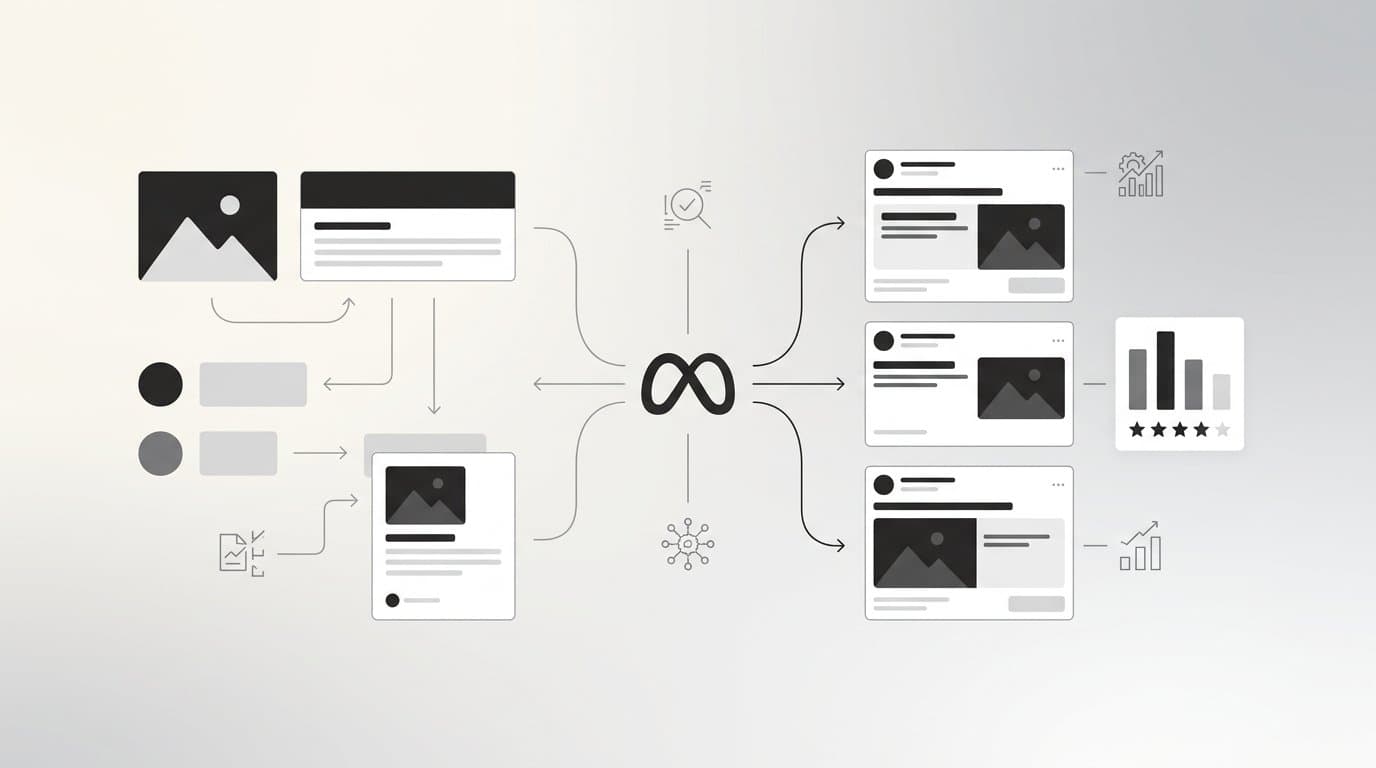
Modern platforms collapse this complexity by handling creative generation and campaign building in the same environment. You generate your ad variations, configure your targeting and budgets, and launch everything to Meta without ever leaving the platform. A robust workflow management system eliminates the export-import dance that wastes time and introduces errors.
The real power comes from tight integration. When your creative library and campaign builder share the same data, you can instantly reuse winning elements in new campaigns. That headline that drove a 4% conversion rate? It is already tagged and ready to drop into your next test. No searching through folders or trying to remember which campaign it came from.
Bulk Operations at Scale: Manual campaign setup forces you to configure each ad variation individually. Want to test five creatives against three audiences with two different headline approaches? That is thirty individual ads to set up by hand.
Bulk launching transforms this tedious process into a few clicks. You select your creatives, choose your audiences, add your headline variations, and the system generates every possible combination automatically. What used to take hours of repetitive work now happens in minutes.
This is not just about saving time. It is about making comprehensive testing practical. When you can launch hundreds of variations without manual overhead, you actually do it. You test more angles, discover more winners, and iterate faster than competitors who are still manually configuring campaigns.
Performance Data That Informs Creative: The traditional workflow creates a disconnect between creative decisions and performance data. Your creative team makes assets based on intuition or brand guidelines, then waits weeks to see if those guesses worked.
The streamlined approach flips this by feeding performance insights directly back into creative production. AI analyzes your historical campaigns, identifies which creative elements consistently drive results, and uses those patterns to inform new ad generation. Your workflow becomes a learning loop where each campaign makes the next one smarter.
Automatic Winner Identification: Instead of manually analyzing campaign data to figure out what worked, modern workflows surface winning elements automatically. The system tracks performance across every creative, headline, audience, and landing page combination, then ranks them by your actual goals.
This means you spend less time in spreadsheets and more time acting on insights. When you need to launch a new campaign, you start with a curated list of proven winners rather than guessing which elements to reuse.
Continuous Optimization: Traditional workflows treat campaign launches as discrete events: plan, build, launch, analyze, repeat. Streamlined workflows treat advertising as a continuous process where optimization happens automatically based on real-time performance.
The system constantly evaluates what is working, surfaces opportunities to scale winning combinations, and flags underperformers before they burn significant budget. This shift from batch processing to continuous optimization means you are always running your best creative, not waiting until the next campaign cycle to implement improvements.
Measuring Workflow Efficiency Improvements
You cannot improve what you do not measure. Tracking the right metrics helps you quantify workflow efficiency gains and identify remaining bottlenecks.
Time-to-Launch: This is the simplest but most revealing metric. How long does it take from deciding to test a new creative concept to having live ads running in Meta? Track this for every campaign and watch the trend over time.
Many teams are shocked when they actually measure this. What feels like a "quick turnaround" often reveals itself as a multi-week process when you account for all the waiting time between stages. Setting a goal to cut time-to-launch in half forces you to identify and eliminate the biggest delays.
Creative Output Volume: How many unique ad variations can your team produce per week? This metric directly correlates with testing capacity and learning speed. Teams that can only produce a handful of variations per month are fundamentally limited in how quickly they can optimize.
Track both total volume and volume per team member. If output does not scale linearly with team size, that signals workflow inefficiencies that adding more people will not fix. The goal is to increase per-person productivity through better tools and processes. Implementing creative testing automation can dramatically improve these numbers.
Iteration Speed: When you identify a winning creative element, how quickly can you launch new variations that incorporate that insight? This metric captures your ability to act on learnings while they are still relevant.
Fast iteration speed creates a compounding advantage. You learn what works, implement improvements immediately, learn from those results, and keep accelerating. Slow iteration means competitors can copy your winning approaches before you can fully capitalize on them yourself.
Automated Winner Detection: Instead of manually analyzing campaign data, modern platforms use leaderboard-style insights to automatically surface top performers. The system ranks every creative element by real metrics like ROAS, CPA, and CTR, making it instantly obvious what is working.
This automation saves analysis time and reduces the risk of missing important patterns. When you can see at a glance that lifestyle images consistently outperform product-only shots by 30% in conversion rate, you make better creative decisions without spending hours in spreadsheets. Effective creative library management makes this level of insight possible.
Goal-Based Scoring: Not every campaign has the same objectives. A brand awareness campaign cares about reach and engagement. A conversion campaign optimizes for cost per acquisition. Tracking generic metrics across all campaigns creates noise.
Set specific goals for each campaign, then score every creative element against those benchmarks. This goal-based approach makes it clear which assets are actually performing relative to what you are trying to achieve, not just generating vanity metrics.
Winner Reuse Rate: What percentage of your new campaigns incorporate proven elements from past winners? This metric reveals whether you are building institutional knowledge or constantly starting from scratch.
High reuse rates indicate a workflow that captures and leverages learnings. Low rates suggest insights are getting lost between campaigns, forcing you to rediscover the same lessons repeatedly.
Moving Forward: The Competitive Advantage of Speed
An inefficient ad creative workflow does not just waste time. It actively damages campaign performance by limiting your testing capacity and slowing your response to market changes. While you are waiting for design approvals, your competitors are already on their third creative iteration, learning what resonates and scaling what works.
The teams winning at paid social in 2026 are not necessarily more creative or better funded. They are faster. They can test more angles, iterate more quickly, and capitalize on insights before the window closes. This speed advantage compounds over time, creating a widening gap between teams with streamlined workflows and those still stuck in traditional processes.
Start by auditing your current workflow against the bottlenecks we have discussed. Where does work sit waiting? Which handoffs create the most delays? What insights from past campaigns are you failing to capture and reuse? These answers will point you toward the highest-impact improvements.
The shift toward AI-powered creative platforms is not a future trend. It is happening now, and it is becoming essential for teams that want to compete on creative volume and speed. The ability to generate scroll-stopping image ads, video ads, and UGC-style content from a product URL, then launch hundreds of variations with bulk operations, fundamentally changes what is possible in ad testing.
When your creative production happens at the speed of your ideas rather than the speed of your design queue, you unlock a different level of optimization. You can test bold concepts without worrying about wasted production time. You can iterate daily instead of monthly. You can build a continuous learning loop where every campaign makes the next one smarter.
Ready to transform your advertising strategy? Start Free Trial With AdStellar and be among the first to launch and scale your ad campaigns 10× faster with our intelligent platform that automatically builds and tests winning ads based on real performance data.