The campaign strategy is solid. Budget is allocated. Targeting is dialed in. Your team knows exactly which audiences to reach and what messaging should resonate. Yet week after week, you're launching the same three ad variations because your designer is backed up until next Tuesday, the video editor is waiting on footage, and the approval process has turned into a game of email ping-pong that spans departments.
This is the creative production bottleneck, and it's quietly strangling your Facebook ad performance.
While you're stuck waiting for assets, your competitors are testing dozens of variations, discovering winners, and scaling before your next creative even gets approved. Your existing ads are fatiguing, frequency is climbing, and ROAS is sliding—not because your strategy is wrong, but because you simply cannot produce fresh creatives fast enough to keep pace with how Meta's algorithm actually works. This guide will help you diagnose whether creative production is your hidden constraint, understand exactly why it happens, and discover practical solutions to eliminate this bottleneck for good.
The Anatomy of a Creative Production Bottleneck
A creative production bottleneck is the gap between how many ad variations you need to test and how many your team can realistically produce. It's that simple, and that devastating.
Here's how it manifests in practice. Meta's algorithm performs best when you feed it multiple creative variations to test across different audience segments. The machine learning systems need options to determine what resonates with specific users. Best practices suggest testing at least 5-10 creative variations per campaign, and top performers often test dozens simultaneously.
But most marketing teams can produce maybe 3-5 new creatives per week if they're moving quickly. That production rate worked fine five years ago. Today, it creates a compounding problem.
Creative fatigue accelerates faster than production cycles can replace worn-out assets. Your ad that performed beautifully in week one starts declining in week two. By week three, frequency has spiked and engagement has dropped. You know you need fresh creatives, but your designer is still working on last week's request, the video editor needs another two days, and stakeholders want to see mockups before approving anything.
Meanwhile, the algorithm keeps spending your budget on fatiguing ads because you have nothing else to show it.
The key symptoms reveal themselves clearly once you know what to look for. ROAS declines even though you have budget available and audiences left to test. You cannot launch that new campaign targeting a promising audience segment because you lack fresh creatives to test against it. Your team experiences constant burnout from endless revision cycles, trying to squeeze more performance from the same limited asset pool. This creative burnout affects both your team's morale and your campaign results.
The bottleneck creates a vicious cycle. Limited creative output forces you to run ads longer than optimal. Longer run times accelerate fatigue. Faster fatigue demands more frequent creative refreshes. More frequent refreshes overwhelm your already-constrained production capacity. The gap widens.
This is not a budget problem or a targeting problem. It's a production capacity problem, and it's the invisible ceiling preventing your campaigns from reaching their potential.
Root Causes Behind Creative Slowdowns
Traditional creative production workflows were not designed for the volume demands of modern Facebook advertising. They evolved from a world where brands launched quarterly campaigns with a few hero assets, not weekly tests with dozens of variations.
The handoff problem sits at the core of most slowdowns. A typical creative request flows like this: Marketing briefs the copywriter. Copywriter delivers headlines and body copy. Designer receives the copy and creates visual concepts. Stakeholders review and request changes. Designer revises. Video editor receives approved stills and begins motion work. More reviews happen. More revisions cycle through. Legal or compliance might weigh in. Finally, after days or weeks, the creative is ready to launch.
Each handoff adds time. Each stakeholder adds a potential delay. Each revision cycle compounds the timeline. What should take hours stretches into days or weeks. Understanding how to optimize your Facebook ad creative workflow is essential to breaking this pattern.
The volume mismatch problem makes this worse. Meta's algorithm genuinely rewards advertisers who test many variations. The platform's machine learning systems optimize better when given more creative options to match with different audience segments. Brands that test 20 variations will typically outperform brands testing 3 variations, assuming creative quality remains consistent.
But most teams can only produce a handful of new creatives per week. The math simply does not work. If you need 20 variations to test properly but can only produce 5 per week, you're either launching incomplete tests or waiting a month between campaign iterations. Both options put you at a competitive disadvantage.
Resource constraints create the underlying limitation. Designer availability is finite—your team has other projects, other clients, other priorities beyond Facebook ads. Video production costs add up quickly, especially if you're creating custom footage or hiring talent. Sourcing authentic UGC content means coordinating with creators, managing contracts, and hoping the content arrives on schedule and meets brand standards.
These constraints are not failures of planning or effort. They are structural limitations of traditional production models that were never built for high-volume testing.
How Bottlenecks Sabotage Campaign Performance
The performance impact of creative bottlenecks shows up in your metrics long before you realize what's causing the decline.
Creative fatigue sets in when the same ads run too long. Frequency climbs as the same users see your ad repeatedly. Engagement rates drop because your audience has already decided whether to click or scroll past. Click-through rates decline. Cost per result increases. ROAS slides downward even though nothing else about your campaign has changed.
You know the solution—launch fresh creatives. But you cannot, because production has not caught up.
Limited testing capacity means you cannot iterate toward winners quickly. Successful Facebook advertising is fundamentally about rapid testing and scaling what works. You should be able to launch 10 variations, identify the 2-3 winners within days, kill the losers, and double down on what's performing. Then repeat the cycle with new variations informed by what you learned. Mastering creative testing at scale is what separates top performers from the rest.
When creative production is your bottleneck, this cycle breaks down. You launch your limited variations and wait. By the time performance data is conclusive, you've already spent significant budget on underperformers because you had nothing else to test. When you finally identify a winner, you cannot quickly create similar variations to capitalize on the insight because production is still catching up from last week.
Budget gets wasted not because your strategy is wrong, but because you lack the creative velocity to execute properly.
Competitive disadvantage emerges as brands with faster creative cycles capture audience attention while slower teams recycle stale assets. Your competitor launches 15 new ad variations this week testing different hooks, visual styles, and offers. You launch 3 variations because that's all your team could produce. Their algorithm gets more data to optimize from. Their audience sees fresh, varied content. They discover winning combinations faster and scale them while they're still effective.
You're running last week's creatives and wondering why performance is declining.
The market rewards speed. Meta's algorithm rewards volume. Creative production bottlenecks prevent you from competing on either dimension.
Breaking the Bottleneck: Workflow and Process Solutions
Solving creative bottlenecks starts with rethinking how production workflows are structured. Small process changes can dramatically increase output without adding headcount.
Modular creative frameworks transform how you approach asset creation. Instead of building each ad from scratch as a unique project, you create reusable components that can be mixed and matched. Develop a library of proven hooks that work for your brand. Create visual templates with consistent layouts that only require swapping product images or headlines. Build a collection of background footage or graphic elements that can be recombined in different ways.
Think of it like Lego blocks instead of custom sculptures. Each component is high-quality and on-brand, but the real power comes from how quickly you can assemble them into new combinations. This approach lets you create 10 ad variations in the time it previously took to create 2 fully custom ads.
Streamlined approval processes reduce stakeholder loops without sacrificing quality control. Many teams discover that lengthy approval cycles exist more from habit than necessity. Map out your current approval process and identify which steps actually add value versus which exist because "that's how we've always done it."
Consider implementing tiered approval levels. Ads using proven templates and existing brand assets might only need marketing team approval. Ads with new messaging or creative directions get full stakeholder review. This lets routine variations move quickly while maintaining oversight on strategic changes.
Empower your marketing team to make more decisions without escalation. Clear brand guidelines and creative guardrails let team members move faster while staying on-brand. The goal is not to eliminate quality control but to eliminate unnecessary delays. Learning how to reduce Facebook ad production time starts with these process improvements.
Batching production cycles concentrates creative work into focused sprints rather than constant one-off requests. Instead of your designer handling ad requests as they arrive throughout the week, schedule dedicated creative production blocks. During these sprints, produce multiple variations at once for upcoming campaigns.
Batching creates efficiency through context switching reduction. Your designer stays in creative mode longer, your copywriter writes multiple headlines in one session, and your team reviews multiple concepts together rather than in drips and drabs throughout the week. The total time invested often decreases while output increases.
These workflow improvements can double or triple your creative output. But they still operate within the constraints of traditional production. For a true step-change in creative velocity, you need to eliminate production dependencies entirely.
AI-Powered Creative Generation as a Force Multiplier
AI creative generation represents a fundamental shift in how Facebook ad assets get produced. Instead of waiting for designers and video editors, you can generate ad variations directly—often in minutes rather than days or weeks.
Modern AI tools eliminate the designer dependency by generating image ads, video ads, and UGC-style content directly from simple inputs. You can provide a product URL and receive multiple ad creative variations automatically. The AI analyzes your product, generates relevant hooks, creates visual compositions, and produces ready-to-launch assets without requiring design skills or video editing software. Exploring AI creative for Facebook ads opens up possibilities that were unimaginable just a few years ago.
This changes the production equation completely. Where you previously needed to brief a designer, wait for concepts, review, revise, and repeat, you can now generate multiple variations instantly and select the ones that match your vision. The bottleneck shifts from production capacity to decision-making—a much better problem to have.
Video ad creation becomes accessible without video production expertise. AI can generate video ads with motion graphics, transitions, and UGC-style avatar content that mimics authentic creator videos. These assets perform comparably to traditional video production while being created in a fraction of the time and cost. You can test video variations that would have been prohibitively expensive or time-consuming under traditional production models.
The ability to clone successful competitor ads from the Meta Ad Library and adapt them for your brand accelerates the path to winning creatives. Instead of guessing what might work, you can see exactly what is working for competitors in your space. AI tools can analyze these ads, identify the key elements that likely drive performance, and help you create similar variations adapted for your specific products and brand voice.
This is not about copying—it's about learning from proven patterns and adapting them. If a competitor's ad style is resonating with your target audience, you can test similar approaches without starting from scratch or spending weeks in creative development.
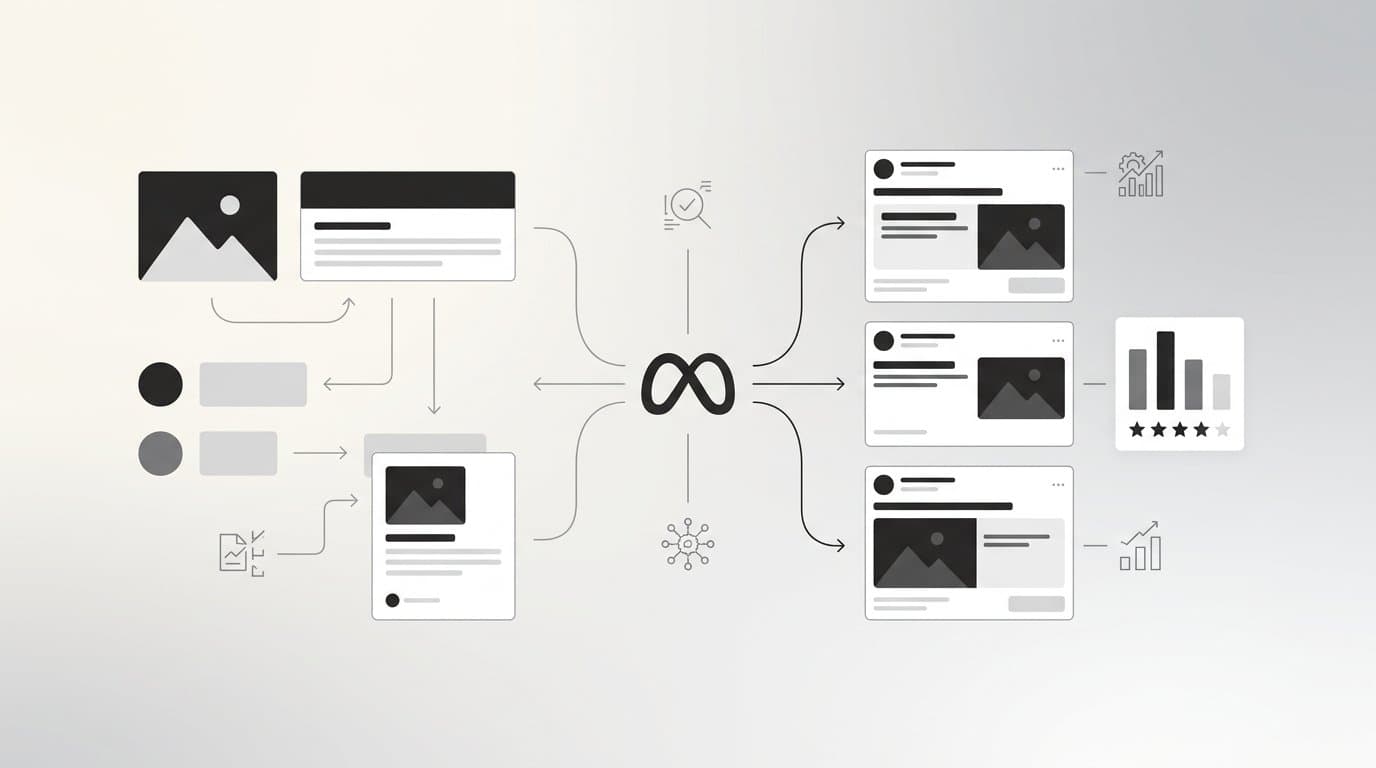
Bulk launching capabilities combine multiple creatives, headlines, and audiences into hundreds of testable variations in minutes. You can upload 10 different creatives, provide 5 headline variations, select 3 audience segments, and automatically generate every possible combination as individual ads. What would take days or weeks to manually configure gets created instantly. This creative testing automation transforms how media buyers approach campaign launches.
This volume unlocks testing strategies that were previously impossible. You can test the same creative with different headlines across different audiences simultaneously. You can identify which specific combinations perform best rather than guessing whether performance differences come from the creative, the headline, or the audience. The granular insights let you iterate faster and more precisely.
AI creative generation does not replace human creativity or strategic thinking. It replaces the mechanical production work that creates bottlenecks. Your team still makes strategic decisions about messaging, positioning, and brand voice. But instead of those decisions being constrained by production capacity, they can be tested and validated at the pace the algorithm rewards.
Building a Sustainable High-Volume Creative System
Eliminating the production bottleneck is only valuable if you can sustain high creative velocity over time. That requires building systems that learn and improve rather than just producing more volume.
Creating feedback loops where performance data directly informs which creative elements to replicate and which to retire transforms random testing into systematic improvement. Every ad you launch generates data about what works. The question is whether you're capturing and applying those insights.
Track performance not just at the ad level but at the component level. Which hooks generate the highest click-through rates? Which visual styles drive the best conversion rates? Which headline formats resonate with specific audience segments? When you understand performance at this granular level, you can systematically replicate winning elements in future creatives rather than starting fresh each time.
This approach compounds over time. Your first batch of ads teaches you which elements work. Your second batch combines those winning elements in new ways and tests new variables. Your third batch builds on everything you've learned. Each iteration gets smarter because you're applying cumulative knowledge rather than random testing.
Establishing a Winners Hub approach where proven creatives, headlines, and audiences are cataloged for instant reuse in future campaigns prevents you from reinventing the wheel. Many teams discover a winning ad, scale it until it fatigues, and then struggle to recreate that success because they did not systematically document what made it work. Implementing proper creative library management ensures your best assets remain accessible and actionable.
Build a library of your best-performing assets organized by performance metrics. When you need to launch a new campaign, start by reviewing what has already proven successful. Can you adapt a winning creative for a new product? Can you test a proven headline format with different offers? Can you apply insights from one audience segment to another similar segment?
This system ensures that your creative output quality improves alongside quantity. You are not just producing more ads—you are producing more informed ads based on actual performance data.
Balancing automation with brand oversight maintains quality while dramatically increasing output velocity. The goal is not to eliminate human judgment but to focus it where it adds the most value. AI can generate dozens of creative variations, but your team should still review them for brand alignment, message accuracy, and strategic fit before launching. The right creative management tools make this balance achievable.
Establish clear quality standards and review processes that scale with volume. This might mean spot-checking a percentage of AI-generated creatives rather than reviewing every single variation. It might mean creating approval tiers where variations of proven templates move faster than completely new creative directions.
The key insight is that quality control does not have to be a bottleneck if it's designed for volume from the start. Traditional approval processes assumed low creative volume, so reviewing every detail made sense. High-volume systems require different approaches that maintain standards while enabling speed.
Moving Beyond the Bottleneck
The creative production bottleneck is often the invisible ceiling on Facebook ad performance, not budget or targeting. You can have unlimited budget and perfectly defined audiences, but if you cannot produce enough fresh creatives to test at the pace Meta's algorithm rewards, your performance will plateau.
Solving this constraint unlocks everything else. When you can generate 20 ad variations as easily as you previously created 2, you can test more aggressively, iterate faster, and discover winning combinations that would have remained hidden under production constraints. When creative fatigue sets in, you can refresh immediately rather than waiting weeks for new assets. When you identify a winner, you can create similar variations and scale while the opportunity is fresh.
The competitive landscape increasingly favors advertisers who can test more variations faster. This is not about having bigger budgets or better targeting—it's about creative velocity as a genuine competitive advantage. The brands winning on Facebook today are often not the ones with the most resources but the ones who can move fastest from insight to execution.
AI-powered creative tools are making high-volume testing accessible to teams of any size. What previously required large design teams, video production budgets, and complex workflows can now be accomplished by small teams moving at unprecedented speed. The playing field is leveling, but only for those who recognize that creative production capacity is the constraint worth solving.
Evaluate your own production capacity against your testing ambitions. How many creative variations do you need to test properly? How many can you realistically produce with current resources? The gap between those numbers is your bottleneck, and it is costing you performance every day it persists.
Ready to transform your advertising strategy? Start Free Trial With AdStellar and be among the first to launch and scale your ad campaigns 10× faster with our intelligent platform that automatically builds and tests winning ads based on real performance data.