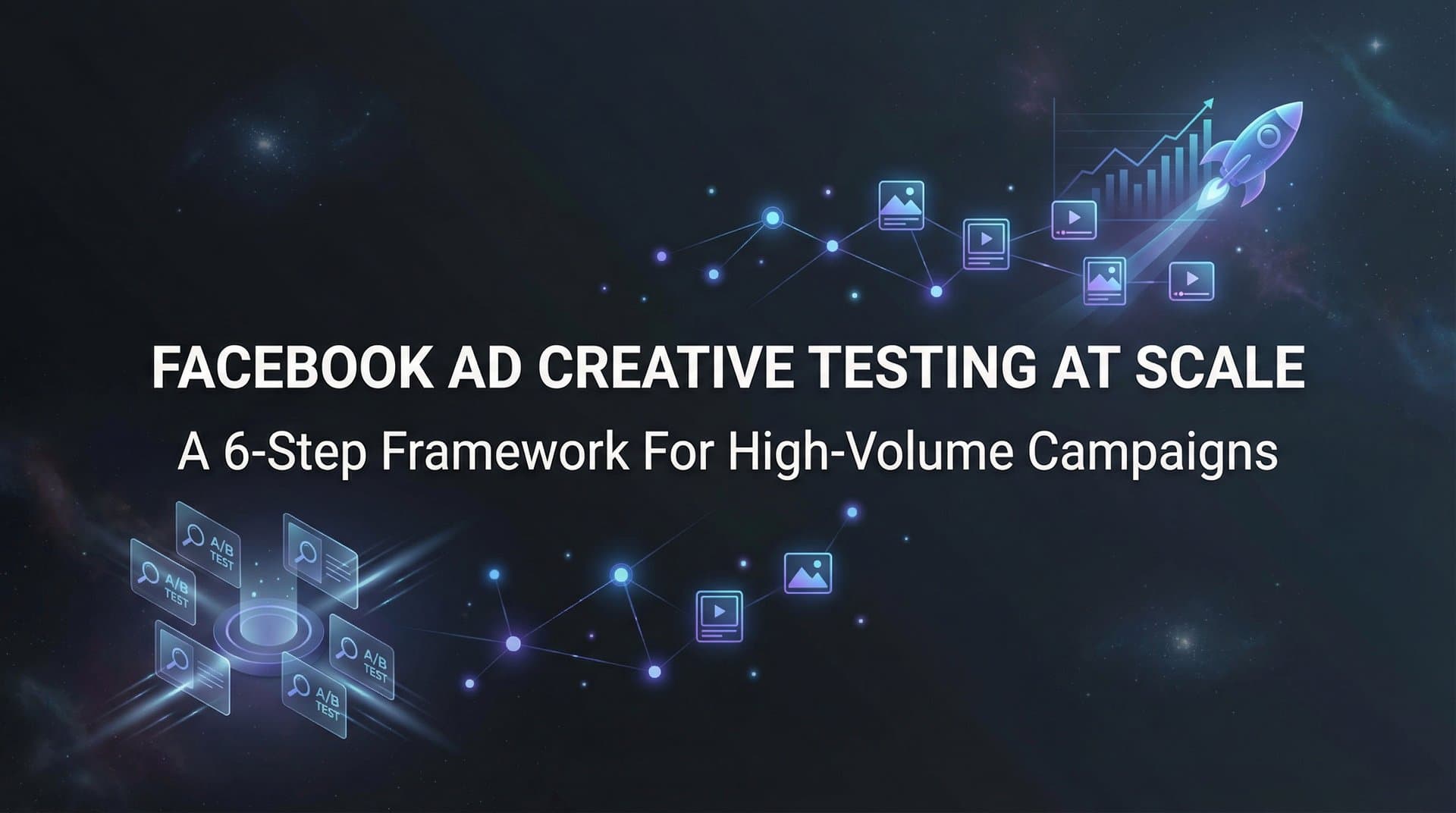
Most advertisers understand that creative testing drives Meta ad performance. But there's a massive gap between testing 3-4 ad variations and systematically testing dozens or hundreds of creatives without hemorrhaging budget or drowning in spreadsheets.
The reality? Accounts that test more creatives consistently outperform those that don't. Fresh creative combats ad fatigue, captures different audience segments, and gives Meta's algorithm more ammunition to find your best customers.
This guide gives you a repeatable framework for scaling creative testing—the kind that lets you launch 20, 50, or 100+ variations while maintaining clarity, control, and profitability. Whether you're a media buyer managing multiple accounts, an agency scaling client campaigns, or an in-house team with serious ad spend, you'll walk away with a system that makes high-volume testing manageable.
By the end, you'll know exactly how to structure campaigns for scale, streamline production and launch, set data-driven decision criteria, and build a continuous testing cycle that feeds your scaling efforts. Let's get into it.
Step 1: Build Your Creative Testing Matrix
Before you launch a single ad, you need a roadmap. Random creative testing burns budget and produces unclear results. Strategic testing starts with documenting what you're actually testing and why.
Your testing matrix is a simple framework that breaks down the variables you'll test across your creatives. Think of it as your creative DNA—the building blocks you'll mix and match to generate variations.
Visual Format: Start by defining your format options. Static images, videos, carousels, and collections each perform differently depending on your product and audience. If you're unsure which works best, that's exactly what you're testing.
Hook Styles: Your first 3 seconds determine whether someone stops scrolling. Document different hook approaches—problem-focused ("Tired of..."), benefit-driven ("Get X without Y"), curiosity-based ("The secret to..."), or social proof-oriented ("Join 10,000+ people who...").
Value Propositions: What core message are you communicating? Maybe you're testing price emphasis versus quality emphasis, or speed versus comprehensiveness. List out 3-5 distinct value angles worth testing.
Audience Angles: Different segments care about different things. A creative that resonates with first-time buyers might fall flat with repeat customers. Document which audience perspectives you're addressing in each creative.
Create a spreadsheet with these variables as columns. Each row represents a potential creative combination. You don't need to produce everything at once—this is your master list that you'll pull from strategically.
Now prioritize. If you have historical data, start with variations of what's already working. If you're starting fresh, look at competitor ads or industry trends to inform your first batch. Your goal: identify 20-50 creative concepts that warrant testing based on strategic hypotheses, not random guesses. A solid Facebook ad testing framework ensures every variation has a purpose.
The success indicator here is simple: you have a documented testing roadmap that team members can reference, and you can articulate why each creative variation exists. No more "let's just try this" without strategic reasoning behind it.
Step 2: Structure Your Campaign Architecture for Scale
Here's where most advertisers sabotage themselves: they dump all their creative tests into existing campaigns, making it impossible to isolate what's actually working. Proper campaign structure is the foundation of scalable testing.
The golden rule: separate your testing campaigns from your scaling campaigns. Your testing campaigns exist to validate creative concepts with minimal risk. Your scaling campaigns take proven winners and maximize their reach with higher budgets.
Set up dedicated testing campaigns with controlled budgets. Many advertisers allocate 20-30% of total ad spend to testing, though this varies based on account maturity. The key is protecting this budget from being consumed by underperformers while ensuring each creative gets enough exposure to generate meaningful data.
Naming Conventions Matter: When you're testing dozens of creatives, generic names like "Ad Set 1" create analysis nightmares. Build a naming system that includes critical information at a glance. For example: "TEST_Video_ProblemHook_PriceVP_Q1" tells you immediately that this is a testing ad, uses video format, leads with a problem-focused hook, emphasizes price value proposition, and launched in Q1. Learning how to organize Facebook ad accounts properly makes this process significantly easier.
Budget allocation becomes critical at scale. A common mistake is spreading $500 across 50 creatives—you'll get $10 per creative, which tells you nothing. Industry best practice suggests minimum $50-100 spend per creative variation before making kill decisions, though this depends on your cost per result. The goal is reaching statistical significance, which typically requires at least 1,000 impressions per variation.
Structure your ad sets to allow proper comparison. If you're testing creative variables, keep targeting consistent across test variations. If you're testing audience segments, keep creative consistent. Testing multiple variables simultaneously makes it impossible to know what drove results.
Consider using Campaign Budget Optimization (CBO) at the campaign level for testing, but monitor closely. CBO will naturally favor early winners, which can prevent slower-starting creatives from getting adequate exposure. Some advertisers prefer ad set budgets during testing for more control, then switch to CBO when scaling winners.
Your success indicator: you can launch 10+ creative variations simultaneously, each with sufficient budget to reach statistical significance, and you can easily identify which creative is which when analyzing results.
Step 3: Streamline Creative Production and Launch
The bottleneck in scaling creative testing is usually production and deployment. Creating each ad from scratch and manually building campaigns kills velocity. You need systems that let you move from concept to live ads in hours, not days.
Batch your creative production using modular assets. Instead of producing 20 completely unique creatives, create 5 video hooks, 4 visual backgrounds, and 3 value proposition overlays. Mix and match these elements to generate 60 potential combinations. This modular approach dramatically reduces production time while maintaining creative diversity.
Build templates for your most common creative formats. If you consistently use certain aspect ratios, text overlay styles, or brand elements, templatize them. Tools like Canva, Figma, or video editing software with preset templates can cut production time by 70% once your system is established.
The launch process is where bulk capabilities become essential. Manually building 30 ads through Meta's interface—duplicating ad sets, uploading creatives, writing copy variations—can take hours. Bulk Facebook ad launchers let you deploy multiple variations simultaneously using spreadsheet imports or API integrations.
This is where platforms like AdStellar AI transform the workflow. Instead of manually building each ad, you can deploy dozens of creative variations at once, with the system handling campaign structure, naming conventions, and tracking setup automatically. What used to take a full day becomes a 30-minute task.
Before you launch anything, establish consistent tracking parameters. Use UTM parameters that identify creative type, hook style, and test cohort. This tracking becomes critical when analyzing results across platforms or attributing conversions beyond Meta's native reporting.
Set up a launch checklist to avoid rookie mistakes: verify pixel installation, confirm conversion events are firing, check that all creatives meet Meta's specifications, ensure ad copy doesn't trigger policy violations, and confirm budget settings match your testing plan.
Your success indicator: you can move from approved creative concepts to live ads in under 4 hours, and you're launching 10+ variations at a time rather than building ads one by one. Understanding how to launch Facebook ads at scale is the key differentiator here.
Step 4: Define Your Testing Metrics and Kill Criteria
Data without decision criteria is just noise. Before you launch a single test, establish exactly what performance level graduates a creative to scaling, what kills it, and what keeps it in testing.
Your primary metrics depend on your campaign objective. For top-of-funnel awareness campaigns, CTR (click-through rate) is your north star—it indicates whether your creative stops the scroll. For conversion-focused campaigns, CPA (cost per acquisition) or ROAS (return on ad spend) matters most. Don't make the mistake of judging top-of-funnel creatives by conversion metrics before they've had time to optimize.
Set clear performance thresholds. For example: "Any creative achieving CPA below $50 after $100 spend graduates to scaling. Creatives with CPA above $75 after $100 spend get killed. Everything in between continues testing until $200 spend." These specific numbers will vary based on your business economics, but the framework remains consistent.
Minimum data thresholds prevent premature decisions. A creative that gets 10 clicks might show a $20 CPA, but that's not statistically meaningful. Establish minimum requirements before making kill decisions—typically 1,000+ impressions and $50-100 in spend, though this varies by industry and average order value. A proper Facebook ad testing methodology accounts for these statistical requirements.
Time-based criteria also matter. Creative fatigue is real, especially on Meta. Even winning creatives eventually decline. Set refresh intervals: "Any creative running for 30+ days gets evaluated for retirement, regardless of current performance." This forces continuous innovation rather than riding winners until they crash.
Document Everything: Write down your decision criteria and share it with everyone involved in campaign management. This eliminates emotional decision-making ("I really liked that creative, let's give it more budget") and ensures consistency across team members.
Build in exception rules for edge cases. Maybe a creative has a high CPA but exceptional engagement metrics that suggest brand impact. Or a creative performs poorly on cold audiences but crushes with retargeting. Your criteria should be firm enough to drive decisions but flexible enough to capture nuance.
Your success indicator: every team member can look at a creative's performance and immediately know whether to kill it, scale it, or continue testing—no debate required.
Step 5: Analyze Results and Identify Winning Patterns
Individual creative performance tells you what worked. Pattern analysis tells you why it worked and how to replicate success. This is where testing at scale becomes exponentially more valuable than small-batch testing.
Look beyond the winners list. Yes, you need to know which specific creatives hit your success criteria. But the real insight comes from analyzing commonalities across winners. Did all your top performers use problem-focused hooks? Did video consistently outperform static images? Did creatives emphasizing speed outperform those emphasizing quality?
Create a winners analysis document. For each successful creative, note the format, hook style, value proposition, and audience angle. After testing 20-30 creatives, patterns emerge. Maybe you discover that carousel ads with testimonial-style hooks consistently achieve 40% lower CPA than other formats. That's actionable intelligence for your next testing round.
Pay attention to what failed, too. If every creative using a specific angle bombed, that's valuable information. You've just saved future budget by identifying what doesn't resonate with your audience.
Build a winners library—a repository of proven creative elements you can remix and reuse. This isn't about running the same ad forever; it's about understanding which building blocks work. That winning video hook? Test it with different visuals. That killer value proposition? Try it in different formats. Reusing winning Facebook ad elements systematically compounds your testing advantages over time.
This is where AI-powered analysis becomes valuable for high-volume testing. When you're analyzing 50+ creatives, manually identifying patterns is tedious and prone to bias. Systems that can automatically flag common attributes across top performers surface insights you might miss.
Connect insights back to your creative testing matrix. Update your prioritization based on what you've learned. If certain combinations consistently outperform, produce more variations in that direction. If others consistently underperform, deprioritize or eliminate them from future tests.
The continuous learning loop is what separates sophisticated advertisers from everyone else. Each testing cycle should make your creative strategy smarter. You're not just finding winners—you're building institutional knowledge about what resonates with your audience.
Your success indicator: you can articulate clear patterns in your winning creatives, and your team uses these insights to inform creative production for the next testing cycle.
Step 6: Scale Winners and Restart the Testing Cycle
Finding winners means nothing if you don't scale them properly. And scaling without continuous testing eventually leads to performance decline as creatives fatigue. The final step is building a sustainable cycle where testing feeds scaling and scaling informs new tests.
Move proven creatives into dedicated scaling campaigns with higher budgets. These campaigns should have broader targeting (since the creative is validated) and can leverage CBO to maximize delivery. Your testing campaigns stay lean and controlled; your scaling campaigns go aggressive on what's working. If you're wondering how to scale Facebook ads profitably, this separation is essential.
Don't just scale exact winners—create variations to extend their lifespan. Take that winning video hook and test it with different visuals. Take that killer static image and test different copy angles. This "winner iteration" approach squeezes more value from proven concepts while keeping creative fresh.
The concept of creative velocity matters here. Accounts spending significant budgets should aim to test 3-5 new creative concepts weekly. This doesn't mean producing 3-5 completely original ideas—remember your modular approach. But it does mean maintaining a consistent flow of new variations entering your testing pipeline.
Set a testing rhythm based on your spend level and creative fatigue rate. Accounts spending $10k+ monthly often run weekly creative refreshes. Smaller accounts might operate on bi-weekly or monthly cycles. The key is consistency—creative testing isn't a one-time project, it's an ongoing system.
Monitor your scaling campaigns for fatigue signals. When CTR drops 20%+ or CPA increases 30%+ compared to initial performance, it's time to refresh. Don't wait for complete performance collapse. Proactive creative rotation maintains consistent results and helps you avoid Facebook ad creative burnout.
Build feedback loops between scaling and testing. What you learn at scale (audience segments that respond best, time-of-day patterns, device performance) should inform your next round of testing. Maybe you discover that mobile users respond better to shorter videos—that insight shapes your next creative production batch.
The sustainable system looks like this: 20-30% of budget in testing campaigns with continuous new creative flow. 70-80% in scaling campaigns running proven winners and their variations. Winners graduate from testing to scaling. Fatigued scaling creatives get retired. New tests constantly enter the pipeline based on learnings from both testing and scaling campaigns.
Your success indicator: you have a documented schedule for creative refreshes, a clear process for graduating winners to scale, and you're never in a position where all your creatives are fatigued simultaneously because you maintained continuous testing.
Putting It All Together
Scaling creative testing isn't about working harder—it's about building systems that let you test more while managing less. Here's your quick-reference checklist:
✓ Creative Testing Matrix: Document variables (format, hooks, value props, audience angles) and prioritize 20-50 test concepts
✓ Campaign Architecture: Separate testing and scaling campaigns with clear naming conventions and proper budget allocation
✓ Production and Launch: Use modular assets and bulk launching tools to deploy variations in hours, not days
✓ Decision Criteria: Set specific thresholds for killing, scaling, or continuing tests based on metrics and minimum data requirements
✓ Pattern Analysis: Look beyond individual winners to identify common attributes across top performers
✓ Scaling System: Graduate winners to scaling campaigns, create variations to extend lifespan, and maintain continuous testing rhythm
The advertisers who test the most—intelligently—win the most. But manual creative testing at scale hits practical limits. You can only build so many campaigns, analyze so many data points, and manage so many variations before the system breaks down. Many teams find that Facebook ad testing automation is the only way to maintain velocity without burning out.
This is where AI-powered platforms transform the workflow. Start Free Trial With AdStellar AI and experience how intelligent automation can handle bulk launching, pattern identification, and continuous optimization while you focus on strategy and creative direction. The platform's specialized AI agents analyze your performance data and automatically build, test, and scale winning ad variations—taking what used to require a full team and condensing it into a streamlined system.
The framework you've learned here works whether you're managing everything manually or using automation tools. The difference is velocity. With the right systems in place, you can test 10× more creatives in the same time, identify winners faster, and scale profitably while your competitors are still manually building their third ad variation of the week.
Start with one testing cycle using this framework. Document what you learn. Refine your process. Build momentum. Within a few months, you'll have a creative testing machine that consistently feeds your scaling efforts with fresh, proven concepts. That's how you win in Meta's auction environment—not with one brilliant creative, but with a systematic approach to finding and scaling dozens of them.