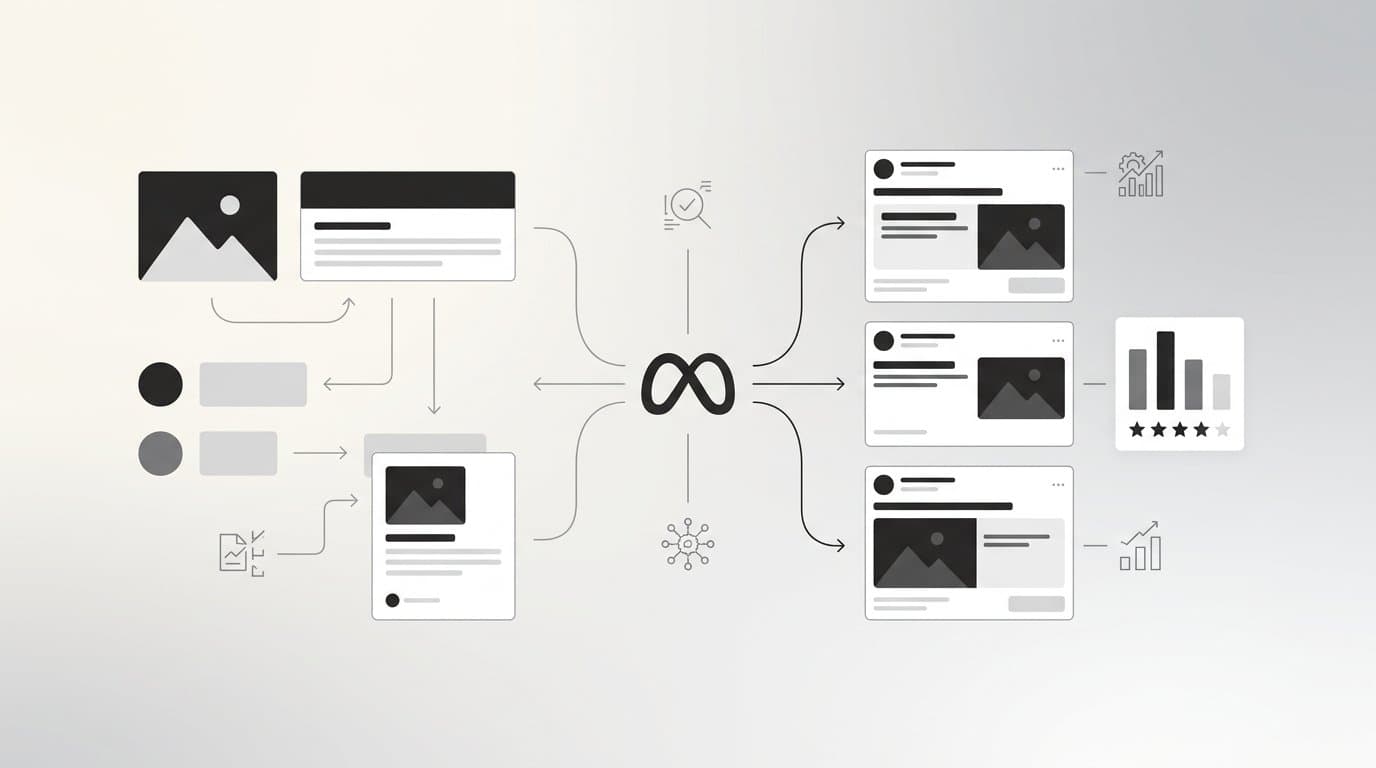
Your best-performing ad creatives are a goldmine sitting in your ad account—but most marketers leave that value untapped. Instead of constantly creating new assets from scratch, smart advertisers systematically identify, catalog, and redeploy their proven winners across new campaigns, audiences, and formats.
This approach cuts creative production time dramatically while maintaining the performance consistency that drives profitable scaling.
In this guide, you'll learn exactly how to build a repeatable system for reusing winning ad creatives in your Meta campaigns. We'll cover how to identify what's actually working (beyond surface-level metrics), organize your creative library for quick access, adapt winners for new contexts without losing their magic, and automate the entire process so you can launch proven variations at scale.
Whether you're managing a handful of campaigns or running ads for multiple clients, these steps will help you extract maximum value from every creative that earns its keep.
Step 1: Define Your 'Winner' Criteria Beyond ROAS
Before you can reuse winning creatives, you need to know what "winning" actually means for your business. Most advertisers stop at ROAS, but that single metric tells an incomplete story.
A creative might deliver a 3× ROAS while showing signs of rapid fatigue, or it might have a lower ROAS but exceptional engagement signals that indicate long-term scalability. You need a multi-dimensional view.
Build Your Multi-Metric Framework: Start with ROAS as your north star, but layer in engagement metrics that predict sustainability. Track click-through rate (CTR), hook rate (the percentage of viewers who watch the first 3 seconds), thumb-stop ratio (how often people pause scrolling), and conversion rate as complementary signals.
Set Account-Specific Thresholds: Industry benchmarks are useless for identifying your winners. A fashion brand might see 2% CTR as average while a B2B SaaS company celebrates 0.8%. Look at your own account data from the past 90 days and set thresholds at the 75th percentile of performance.
If your median CTR is 1.2%, consider anything above 1.8% as a potential winner. If your average ROAS is 2.5×, look for creatives delivering 3.5× or higher. Understanding how to calculate return on ad spend accurately is essential for setting these benchmarks.
Demand Statistical Significance: A creative that spent $50 and generated two conversions isn't a winner—it's a lucky accident. Require minimum thresholds before classification: at least $500 in spend and 20+ conversions for most businesses, adjusted based on your average order value and conversion volume.
Create a Simple Scoring System: Assign point values to each metric based on business priority. You might weight ROAS at 40%, CTR at 20%, hook rate at 20%, and conversion rate at 20%. This removes subjective judgment and creates an objective ranking system.
When you score creatives numerically, you can quickly identify your top 10% without endless debates about which metrics matter most.
Step 2: Audit and Extract Your Top Performers
Now that you know what you're looking for, it's time to dig into your account and find the gold buried in past campaigns.
Open Meta Ads Manager and set your date range to the last 60-90 days. This window captures recent performance while accounting for seasonal variations and giving creatives enough time to accumulate meaningful data.
Use Breakdown Reports Strategically: Navigate to the Ads tab and add a breakdown by "Delivery." This shows you which individual creatives performed across multiple ad sets, revealing assets that succeeded regardless of audience targeting.
A creative that works for cold audiences, warm retargeting, and lookalikes? That's a true winner worth reusing everywhere. Many advertisers struggle with this process, which is why finding winning Facebook ads remains one of the biggest challenges in paid social.
Export Your Performance Data: Click the download icon and export a detailed report including all your defined winner metrics. Open this in a spreadsheet and sort by your scoring criteria from Step 1.
Highlight the top performers that meet your statistical significance thresholds. You're looking for the top 10-15% of creatives that consistently outperformed the rest.
Download the Actual Assets: Here's where many advertisers fumble. They identify winners but never save the actual files. Go into each winning ad and download the video files, images, and carousel assets directly to a dedicated folder on your computer.
Meta's interface makes it frustratingly easy to lose track of creative assets once campaigns end or get archived.
Document the Context: Create a simple spreadsheet row for each winning creative with columns for: asset filename, campaign name, audience type it worked for, placement (feed, stories, reels), offer or promotion paired with it, date range it ran, and all key metrics.
This context is crucial because a creative that crushed it with a 20% off offer might flop when paired with a free shipping promotion. The asset itself isn't magic—it's the asset plus context.
Step 3: Build a Searchable Creative Library
A pile of downloaded files and a spreadsheet isn't a system—it's organized chaos. You need a library structure that lets you find the right creative for any new campaign in under 60 seconds.
Organize by Format and Function: Create a folder structure that mirrors how you actually think about campaigns. Top-level folders for format: Static Images, Videos, Carousels. Within each format, create subfolders by hook type: Problem-Agitate, Benefit-First, Social Proof, Educational, Curiosity Gap.
This structure helps you quickly grab a "benefit-first video" when launching a new campaign targeting warm audiences. Building a proper Meta ads winning creative library transforms how efficiently you can scale campaigns.
Tag Everything with Performance Context: Your spreadsheet becomes your search engine. For each creative, add tags that capture where it won: audience temperature (cold, warm, hot), demographic performance (if it crushed with women 35-44 but flopped elsewhere), placement winners (feed vs. stories), and the specific product or offer category.
When you're building a new campaign for cold audiences promoting Product X, you can instantly filter your library to "cold + Product X + video" and see your proven options.
Store Copy Variations Separately: Create a dedicated section in your spreadsheet for winning copy elements. Break down headlines, primary text, and CTAs that drove results.
You might discover that a specific headline like "The #1 Mistake Most [Target Audience] Make" worked across five different creatives. That headline becomes a reusable template for future campaigns. Learning how to write a call to action that converts is essential for maximizing these winning copy elements.
Make It Team-Accessible: If you're working solo, a well-organized Google Drive folder and Sheet works perfectly. For teams, consider tools like Notion, Airtable, or even a simple shared folder with a master tracking spreadsheet.
The key is that anyone launching campaigns can access the library, understand the context, and grab proven assets without asking you where things are stored.
Step 4: Adapt Winners for New Campaigns Without Breaking Them
Here's where most advertisers sabotage themselves. They take a winning creative and "improve" it by changing multiple elements simultaneously, destroying whatever made it work in the first place.
The art of adaptation is knowing what to preserve and what to test.
Identify the Winning Element: Look at your creative with fresh eyes and ask: what specific component drove this performance? Was it the opening hook that stopped the scroll? The way the offer was framed? The visual style or color palette? The specific CTA?
Often, one element carries 80% of the performance weight. A video might win because of a 3-second hook showing the problem dramatically, even if the rest of the creative is mediocre. Preserve that hook religiously when adapting. Understanding reusing winning Facebook ad elements strategically is what separates average advertisers from exceptional ones.
Test One Variable at a Time: If you want to test a winning creative with a new audience, keep the creative identical. If you want to test a creative variation, keep the audience identical.
Changing both simultaneously makes it impossible to know what drove any performance difference. Did the new audience respond better, or did your creative tweak resonate more? You'll never know.
Create Format Variations Systematically: A winning static image can become a slideshow video with the same visual hierarchy. A winning video hook can be extracted and used to open a completely new concept.
If a carousel performed exceptionally well, test turning each card into individual static ads. The format changes, but the core message and visual treatment remain consistent.
Preserve Core Message Architecture: Pay attention to the structure of winning creatives. If a video winner followed a Problem → Agitation → Solution → Proof → CTA structure, maintain that exact sequence in variations.
If a static ad winner used a bold headline at top, product image in center, and benefit bullets at bottom, preserve that visual hierarchy even when changing the specific product or offer.
The structure itself often drives performance more than the specific content filling that structure.
Step 5: Launch Winning Variations at Scale
Once you've identified winners and created smart adaptations, it's time to multiply their impact across your account. This is where systematic reuse transforms from theory into revenue.
Deploy Bulk Launching Strategically: Instead of manually creating individual ads one by one, use bulk launching capabilities to deploy multiple variations of your proven creatives across different ad sets simultaneously.
Take your top 3 winning creatives and launch them across 5 different audience segments in one coordinated push. This gives you 15 ad variations live instantly, all rooted in proven performance. Mastering how to launch multiple Facebook ads quickly is essential for executing this strategy efficiently.
Pair Winners with New Audiences: Your creative library shows which audiences each winner performed best with originally. Now test those winners with adjacent audiences they haven't seen yet.
If a creative crushed it with women 35-44 interested in yoga, test it with women 45-54 interested in wellness. If it worked for a lookalike audience based on purchasers, try it with a lookalike based on high-value customers.
You're systematically expanding the reach of proven assets into untapped territory.
Set Up Structured A/B Tests: Don't just launch and hope. Create formal tests that pit your adapted winners against each other to identify the strongest variation.
Test your original winner against two adapted versions, each changing one variable. Let them run until statistical significance, then promote the champion and retire the losers.
Establish Clear Naming Conventions: Create a naming system that tracks creative lineage. If "Video_BenefitFirst_ProductX_v1" was your original winner, name adaptations "Video_BenefitFirst_ProductX_v1.1_NewAudience" or "Video_BenefitFirst_ProductX_v1.2_NewHook."
This lets you trace performance back to the original winning creative and understand which adaptations improved on the baseline versus which ones degraded performance.
Step 6: Build a Continuous Learning Loop
Your creative library isn't a static archive—it's a living system that should evolve as you learn what works. The most successful advertisers treat creative reuse as an ongoing optimization process, not a one-time project.
Schedule Weekly Winner Reviews: Block 30 minutes every Monday to review the previous week's performance data. Which creatives crossed your winner threshold? Add them to your library immediately with full context and tags.
Which adapted creatives outperformed their originals? Those become your new baseline, and the original gets archived as "superseded."
Track Creative Evolution: Maintain a simple log showing how your library evolves. When an adapted creative outperforms its parent, document what changed and why you think it worked better.
Over time, you'll notice patterns. Maybe adding customer testimonial overlays consistently improves video performance by 15-20%. Maybe shorter hooks (under 2 seconds) outperform longer ones for cold audiences. These insights inform your entire creative production process and help you improve ad engagement systematically.
Retire Fatigued Creatives Proactively: Even winners don't last forever. Watch for fatigue signals: CTR declining steadily over 2+ weeks, frequency climbing above 3-4, or CPM increasing while other metrics stay flat.
When a creative shows these signs, pause it before it drags down campaign performance. Mark it as "fatigued" in your library with the date range it worked. Sometimes creatives can be revived after a 60-90 day rest period.
Feed Learnings Back to Production: Your creative library becomes a goldmine of insights for your design and copywriting team. Share quarterly reports showing which hooks, visual styles, offer framings, and CTAs consistently win.
When your team creates new assets, they start with proven elements rather than guessing. New creatives become winners faster because they're built on a foundation of validated concepts.
Putting It All Together
Reusing winning ad creatives isn't about being lazy with your creative strategy—it's about being strategic with your proven assets. By defining clear winner criteria, building an organized library, adapting intelligently, and launching variations at scale, you transform isolated successes into a compounding advantage.
Start with your last 90 days of data, identify your top 5-10 performers, and build your library from there. The process becomes faster and more valuable with each campaign you analyze.
Quick checklist to get started today:
1. Define your winner metrics and thresholds based on your account data, not industry averages.
2. Export and organize your top-performing assets from the last 60-90 days with full context.
3. Tag everything with context: audience type, placement, offer, and key performance metrics.
4. Adapt winners one variable at a time to maintain the core element that drove success.
5. Launch variations in bulk across new audiences to multiply impact systematically.
6. Review weekly and keep your library fresh by adding new winners and retiring fatigued creatives.
The marketers who scale Facebook ads profitably aren't always creating net-new creative from scratch—they're systematically multiplying what already works. Your winning creatives have already proven they can drive results. The question is whether you'll let them gather dust in old campaigns or put them to work across your entire account.
Ready to transform your advertising strategy? Start Free Trial With AdStellar AI and be among the first to launch and scale your ad campaigns 10× faster with our intelligent platform that automatically builds and tests winning ads based on real performance data.