Scaling Facebook ads sounds simple in theory—just increase your budget and watch the results multiply. But every experienced media buyer knows the painful reality: boost your spend too quickly and watch your cost per acquisition skyrocket, your winning ads fatigue overnight, and your profitable campaigns turn into money pits.
The difference between advertisers who scale successfully and those who burn through budgets lies in having a systematic approach.
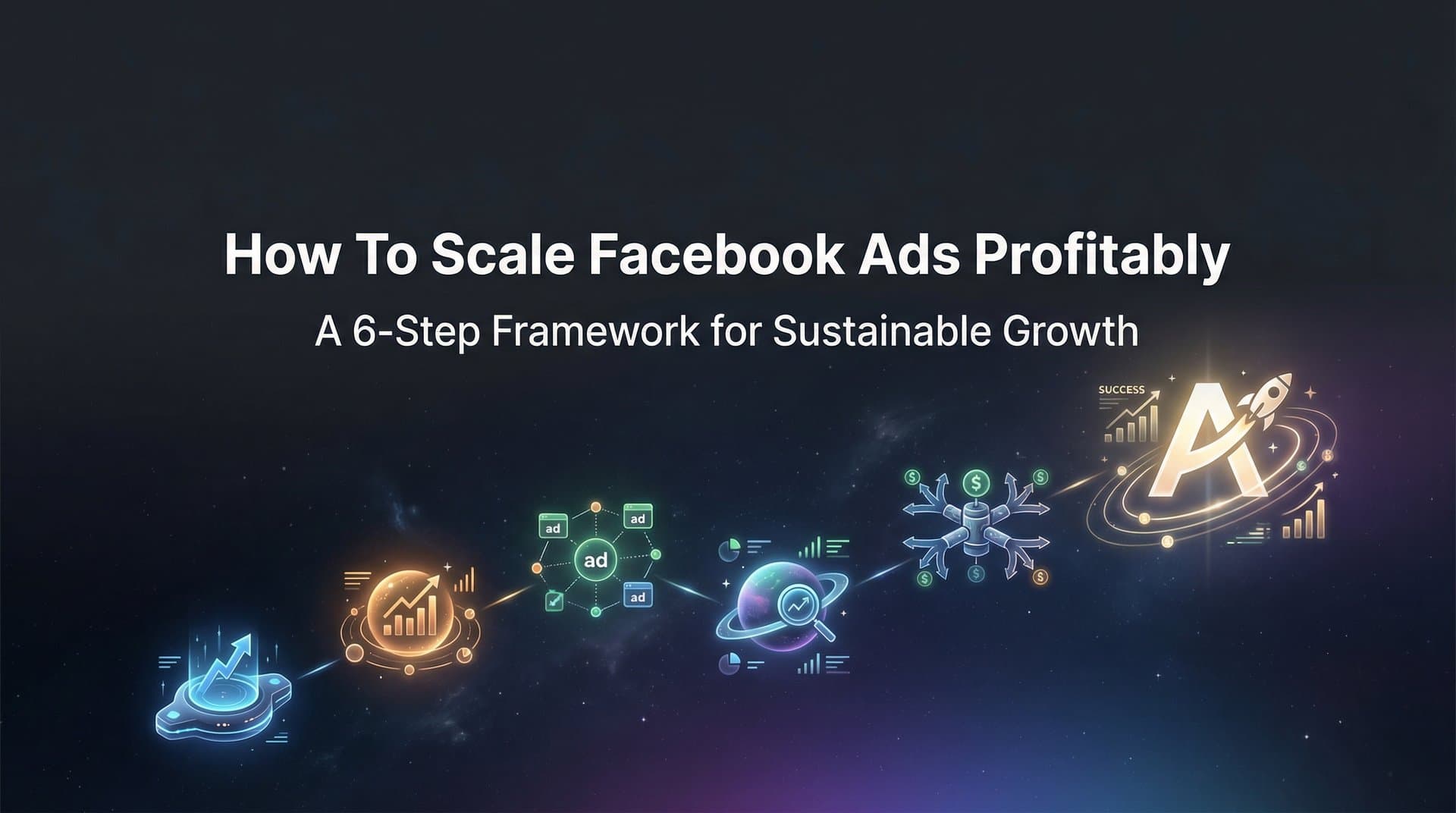
This guide walks you through a proven 6-step framework for scaling Facebook ads profitably, whether you're spending $1,000 or $100,000 per month. You'll learn how to identify which campaigns are actually ready to scale, the specific budget increase thresholds that won't trigger algorithmic chaos, and how to expand your reach without sacrificing the performance metrics that matter.
By the end, you'll have a repeatable system for growing your ad spend while maintaining—or even improving—your return on ad spend.
Step 1: Audit Your Current Performance to Identify Scale-Ready Campaigns
Before you touch that budget slider, you need to know which campaigns deserve more investment. Not every winning day means you've found a scalable campaign.
Start by defining your profitability benchmarks. What's your target cost per acquisition? What ROAS threshold keeps your business profitable? What's the acceptable ratio between customer acquisition cost and lifetime value? These numbers become your guardrails throughout the scaling process.
Next, identify campaigns with consistent performance over at least 7-14 days. One exceptional day doesn't indicate stability—it might be a fluke, a holiday spike, or temporary market conditions. You're looking for campaigns that deliver results day after day, with minimal variance in your key metrics.
Here's a critical threshold: campaigns need approximately 50 conversions before you make scaling decisions. This isn't arbitrary—Meta's algorithm requires substantial conversion data to optimize effectively, as documented in their Business Help Center. Below this threshold, you're essentially asking the algorithm to scale based on insufficient information.
Watch for red flags that signal a campaign isn't ready. High frequency numbers indicate you're already saturating your audience. Declining click-through rates suggest your creative is losing effectiveness. Inconsistent daily results mean the algorithm hasn't stabilized yet.
Create a simple scoring system to rank your campaigns. Assign points for consistent performance, conversion volume, profitability margin, and audience size potential. This transforms gut feelings into data-driven decisions.
The campaigns that score highest become your scaling candidates. Everything else stays at current budgets while you gather more data or work on improving performance first.
Step 2: Implement the 20% Rule for Budget Increases
Think of Facebook's algorithm as a finely-tuned engine. Dramatic budget changes are like slamming the gas pedal—you'll lose control before you gain speed.
The 20% rule has become industry standard practice among experienced media buyers: increase your daily budget by no more than 20% every 3-4 days. This gradual approach keeps you below the threshold that triggers a learning phase reset.
Here's what this looks like in practice. If you're spending $100 daily on a winning ad set, your first increase goes to $120. Wait three to four days, monitor performance closely, and if metrics hold steady, increase to $144. Then $173. Then $207. You're compounding growth without shocking the system.
After each increase, track your core metrics obsessively. Has your CPA jumped more than 20%? Has your ROAS dropped below your profitability threshold? These signals tell you when to pause scaling and let the algorithm stabilize.
An alternative approach involves duplicating winning ad sets at higher budgets. Instead of increasing the original ad set from $100 to $200, you create an identical copy starting at $200. This method lets you test higher spend levels without risking your proven performer, though it does split your audience reach.
Set up automated rules to protect yourself during scaling tests. Create rules that automatically pause ad sets if CPA exceeds your threshold or if ROAS drops below acceptable levels. These guardrails prevent a bad scaling decision from draining your budget overnight. Understanding how to automate Facebook ad campaigns can help you implement these protective measures efficiently.
The key insight: patience during scaling actually gets you to higher budgets faster because you avoid the costly resets that come from moving too aggressively.
Step 3: Expand Your Audience Without Diluting Quality
Once you've maximized budget on your current audiences, horizontal scaling becomes your next lever. This means finding new audiences that match the quality of your winners.
Start with lookalike audience expansion. If your 1% lookalike is performing well, test a 3% lookalike at the same budget level. The 3% trades some precision for significantly more reach—it's based on the same source audience but casts a wider net. If the 3% maintains acceptable performance, you can eventually test 5% or even broader percentages.
For interest-based targeting, use your winners to inform new tests. If "digital marketing" and "social media marketing" performed well, test adjacent interests like "content marketing" or "email marketing." The goal is finding new pockets of your target audience without straying too far from what's proven.
Consider the layering versus broad targeting decision carefully. Layered audiences (combining multiple interests or demographics) give you more control and typically higher relevance. Broad targeting hands more power to Facebook's algorithm and works best when you have substantial conversion data to guide optimization.
Monitor audience overlap religiously. Facebook's Audience Overlap tool shows when your ad sets are competing against each other for the same users. High overlap means you're bidding against yourself, driving up costs unnecessarily. Consolidate or exclude audiences to eliminate this self-competition.
The expansion strategy that works: test one new audience variable at a time. If you change targeting, creative, and placement simultaneously, you won't know which factor drove the results. Isolate variables to build genuine learning about what scales.
Step 4: Build a Creative Testing System That Feeds Your Scale
Creative fatigue is the silent killer of scaled campaigns. As you increase spend, your ads reach frequency thresholds faster, and performance degrades more quickly. Your creative production must match your scaling ambitions.
Implement a structured testing framework—the 3-2-2 approach works well. For each winning concept, test 3 different hooks, 2 body variations, and 2 calls-to-action. This systematic iteration keeps your core message while refreshing the elements that fatigue first.
Calculate your creative burn rate based on spend levels. Higher budgets mean faster frequency buildup and quicker creative exhaustion. Companies scaling to significant daily spend often need multiple new creative variations every week just to maintain performance.
Balance your creative strategy with a 70/30 split: dedicate 70% of creative resources to iterating on proven winners and 30% to testing completely new concepts. The iterations provide reliable performance to support your scale, while new concepts search for the next breakthrough that unlocks another level of growth.
Modern AI-powered Facebook ads software can dramatically accelerate creative production to match scaling demands. Rather than waiting days or weeks for design resources, platforms that analyze your top performers and generate variations based on what's working can help you maintain the creative velocity scaling requires.
Think of creative as fuel for your scaling engine. Run out of fresh creative, and your scale stalls regardless of budget or audience strategy. Build a system that produces new variations consistently, and you remove a major bottleneck to growth.
Step 5: Restructure Your Campaign Architecture for Scale
The campaign structure that worked at $50 daily often becomes inefficient at $5,000 daily. As you scale, your account architecture needs to evolve.
The Campaign Budget Optimization versus Ad Set Budget Optimization debate matters more at scale. CBO generally works better for scaled accounts because it gives Facebook's algorithm flexibility to allocate budget across ad sets based on performance. ABO offers more control during testing phases but can create inefficiencies when managing dozens of ad sets manually.
Consider consolidating ad sets to give the algorithm more conversion data per ad set. Instead of ten ad sets spending $50 each, you might perform better with three ad sets spending $166 each. More conversions per ad set means faster learning and more stable optimization.
Determine your minimum viable structure. Many advertisers over-complicate their accounts with excessive segmentation. Ask yourself: does splitting this audience into separate ad sets actually improve performance, or am I just fragmenting my data? Often, fewer, larger ad sets outperform complex structures. Learning how to structure Facebook ad campaigns properly becomes essential as your spend increases.
Set up proper exclusions to prevent audience cannibalization. If you're running both prospecting and retargeting campaigns, exclude your retargeting audiences from prospecting ad sets. If you're testing multiple lookalikes, consider excluding smaller percentages from larger ones to avoid overlap.
Advantage+ campaigns represent Meta's push toward automation and can work well for scaling, particularly if you have strong conversion data. These campaigns hand significant control to the algorithm but can find efficient audiences you might not have tested manually. The tradeoff: less granular control over targeting and creative delivery.
Your campaign structure should serve your scaling strategy, not complicate it. Simplify where possible, automate what makes sense, and maintain control over the variables that matter most to your business.
Step 6: Monitor, Adjust, and Protect Your Profits
Scaling without monitoring is like driving with your eyes closed. You need different metrics at different time horizons to catch problems before they become expensive.
Daily monitoring focuses on immediate red flags. Check for sudden CPA spikes, ROAS drops, or frequency increases that signal trouble. These daily checks take minutes but can save you from costly mistakes. Mastering your Facebook ads dashboard makes this process significantly faster.
Weekly analysis looks at trends. Is performance degrading gradually? Are certain audiences or creatives showing fatigue? Weekly reviews help you spot patterns that daily checks might miss.
Monthly evaluation examines the big picture. Are you actually more profitable than before scaling? Has your blended CAC across all channels stayed healthy? Monthly reviews ensure your scaling efforts serve your broader business goals.
Set up automated alerts for critical thresholds. Configure notifications when CPA increases by 20% or more, when ROAS drops below your profitability threshold, or when daily spend exceeds your comfort zone. These alerts catch problems even when you're not actively monitoring.
Develop a pullback protocol before you need it. When should you reduce spend? By how much? Having predetermined rules prevents emotional decisions during performance dips. Typical pullback triggers include sustained CPA increases above threshold, multiple days of negative ROAS, or external factors like inventory issues.
Understand that seasonal and market factors affect scaling success. Retail advertisers face different dynamics during holiday seasons. B2B advertisers see changes during summer months or year-end budget cycles. Your scaling strategy needs to account for these predictable fluctuations.
Build a scaling playbook specific to your account's patterns. Document what worked, what failed, and the conditions that influenced each outcome. Over time, you'll develop institutional knowledge that makes scaling decisions faster and more accurate.
The most successful advertisers treat scaling as an ongoing process, not a destination. They continuously test, monitor, and adjust based on real performance data. If you're finding that scaling Facebook ads manually has become overwhelming, you're not alone—it's a common challenge that drives many advertisers toward automation solutions.
Putting It All Together
Scaling Facebook ads profitably isn't about finding a magic budget number or secret audience—it's about building a systematic process that compounds your wins while protecting against losses.
Here's your quick reference checklist: Only scale campaigns with 50+ conversions and 7+ days of consistent performance. Increase budgets by maximum 20% every 3-4 days. Expand audiences horizontally before going broader. Maintain creative production at 3-5 new variations weekly per winning concept. Consolidate campaign structure as you scale. Set automated alerts for 20%+ CPA increases.
Start with Step 1 today—audit your current campaigns and identify which ones are truly ready for more budget. The advertisers who scale successfully are the ones who resist the urge to rush and instead build momentum methodically.
Remember that scaling reveals both strengths and weaknesses in your advertising operation. Strong offers scale smoothly. Weak targeting becomes expensive quickly. Creative systems either keep pace or become bottlenecks. Use the scaling process as diagnostic feedback about what's truly working in your marketing.
The framework outlined here works whether you're managing campaigns yourself or overseeing a team. The principles remain constant: systematic testing, gradual increases, continuous monitoring, and data-driven decisions. For a deeper dive into efficient scaling strategies, explore our guide on how to scale Facebook ads efficiently.
Ready to transform your advertising strategy? Start Free Trial With AdStellar AI and be among the first to launch and scale your ad campaigns 10× faster with our intelligent platform that automatically builds and tests winning ads based on real performance data.