Most media buyers can pinpoint the exact moment they hit the creative testing wall. You've launched a campaign that's crushing it—2.5% CTR, $18 CPA, everything's green. Then comes the inevitable question: how do you scale this without killing performance?
The answer is creative testing. But here's the problem: manually building and testing enough variations to find your next winner requires creating dozens of ad permutations, setting up proper test structures, monitoring performance across multiple campaigns, and doing it all over again when you find something that works. For a single campaign, this might take 6-8 hours. For agencies managing ten client accounts? The math becomes impossible.
Facebook ad creative testing automation is changing this equation entirely. Instead of spending your week building ad variations in Ads Manager, automation platforms analyze what's already working, systematically generate new combinations, and launch tests while you focus on strategy. The result: teams testing 10× more creative variations in the same timeframe, discovering winners faster, and scaling campaigns before market conditions shift.
The Creative Testing Bottleneck Killing Your Campaign Velocity
Let's walk through what manual creative testing actually looks like in practice. You've identified a winning ad—maybe it's a testimonial video with a specific headline and CTA that's driving conversions at $22 each. Now you want to test variations to find something even better.
You need to test different headlines (at least 5-7 variations), swap in alternative video hooks (another 4-5 options), try different CTAs (3-4 versions), and potentially test different audience segments with each combination. If you're being thorough, that's easily 60+ individual ad variations you need to create, organize, and monitor.
Each variation requires you to duplicate the campaign structure, upload creative assets, write new copy, configure targeting, set budgets, and ensure proper tracking is in place. Then you wait for statistical significance—typically 3-7 days depending on your budget and conversion volume. By the time you've analyzed results and identified your next winner, two weeks have passed. Understanding the Facebook ad creative testing bottleneck is the first step toward solving it.
The speed-to-insight gap becomes your competitive disadvantage. While you're manually building test number three, market conditions are shifting. Your audience is seeing competitor ads. Creative fatigue is setting in on your current winners. The insight you finally extract two weeks from now might already be outdated by the time you act on it.
For agencies, this bottleneck multiplies exponentially. Managing creative testing for ten clients means coordinating hundreds of ad variations across dozens of campaigns. Most teams respond by under-testing—running fewer variations than they know they should, relying on educated guesses rather than data, and leaving performance on the table because there simply aren't enough hours in the week.
The opportunity cost is staggering. Every week you're not testing is a week a competitor might be discovering the creative angle that unlocks a new audience segment or the messaging framework that drops CPA by 30%. In performance marketing, speed of learning compounds into sustainable advantage.
The Mechanics Behind Automated Creative Testing
Facebook ad creative testing automation flips the traditional testing workflow on its head. Instead of starting with manual campaign building, you start with data analysis.
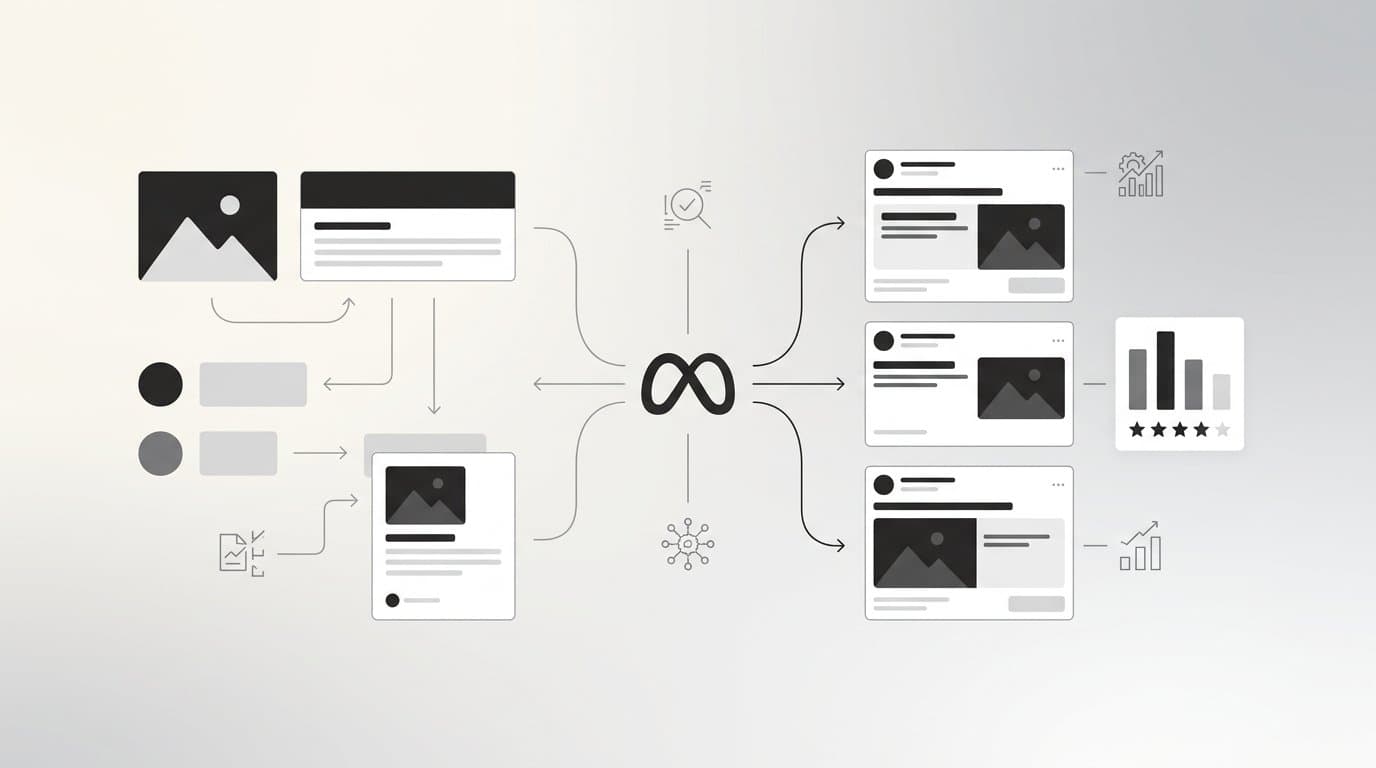
Here's how sophisticated automation platforms actually work: they connect directly to Meta's advertising API and pull your complete campaign history—every ad you've run, every metric associated with it, and every creative element that contributed to performance. The system then breaks down your winning ads into component parts: which headlines drove the highest CTR, which images generated the most conversions, which body copy resonated with specific audience segments.
This creates a performance-indexed creative library. Instead of just storing your assets in a folder somewhere, the automation platform knows that "Headline A" historically performs 23% better than "Headline B" when paired with "Image Set C" for audiences interested in productivity tools. Every creative element carries its own performance DNA. This is the foundation of effective Facebook ad creative automation.
The testing loop operates continuously. Based on your current campaign objectives and the performance patterns in your data, the system generates new creative combinations that have a high probability of success. It might combine your top-performing headline from last month with a new image variation and a CTA that worked well in a different campaign context.
These variations launch automatically—the platform builds the campaign structure, uploads assets, configures targeting based on your parameters, and sets appropriate budgets for testing. As results come in, the system monitors performance in real-time, comparing new variations against your current winners and feeding learnings back into the next iteration.
Advanced platforms use machine learning to get smarter over time. They identify patterns you might miss: perhaps video ads with text overlays consistently outperform those without, but only for cold audiences. Or maybe certain color schemes in your creative correlate with higher conversion rates for specific demographic segments. These insights become predictive—the AI starts suggesting combinations that haven't been tested yet but share characteristics with historical winners.
The human role shifts from execution to strategy. Instead of spending hours building campaigns in Ads Manager, you're reviewing performance data, approving or rejecting AI-generated variations, and feeding qualitative insights back into the system. You might notice the automation is favoring benefit-focused headlines, but your brand voice emphasizes transformation—you can adjust the parameters and let the system generate new variations within those guidelines.
Essential Building Blocks of Your Automation Stack
Effective creative testing automation isn't just about plugging in a tool and hoping for the best. The system is only as good as the foundation you build it on. Three core components determine whether automation amplifies your results or just automates mediocrity.
Performance Data Integration: Your automation platform needs direct access to Meta's advertising API—not just for launching campaigns, but for pulling comprehensive historical data. This means read and write permissions that allow the system to analyze past performance, launch new tests, and monitor results in real-time. Without this integration, you're working with incomplete information and manual data transfers that defeat the purpose of automation.
The depth of data integration matters significantly. Basic platforms might pull headline-level metrics like CTR and CPA. Sophisticated systems pull granular data: which creative elements performed best at different stages of the funnel, how performance varied across audience segments, when creative fatigue set in, and what replacement creatives successfully revived campaign performance. This granular data becomes the training set for AI-powered optimization. Understanding campaign learning Facebook ads automation helps you leverage this data effectively.
Structured Creative Asset Library: Automation can't work with a messy folder of random images and video files. You need a structured database where every creative element is tagged, categorized, and connected to its performance history. This means organizing headlines by theme (benefit-focused vs. problem-focused vs. social proof), categorizing images by style (lifestyle vs. product-focused vs. before/after), and tagging video content by hook type and length.
The organization framework should reflect how you actually think about creative strategy. If you test different value propositions, your library should be organized around those propositions so the automation can systematically test variations within each strategic direction. If you target multiple audience segments, your assets should be tagged with which segments they're designed for.
Testing Framework Configuration: The automation needs clear rules for how to conduct tests. This includes defining your success metrics (are you optimizing for CTR, CPA, ROAS, or a custom blend?), setting statistical significance thresholds (how much data do you need before declaring a winner?), and establishing budget allocation rules (how much should be spent testing new variations vs. scaling proven winners?).
Your testing framework should also include guardrails. Maybe you never want to test more than five new variations simultaneously to avoid diluting your budget. Perhaps you want the system to automatically pause any ad that spends more than $100 without generating a conversion. These parameters ensure automation operates within boundaries that make sense for your business.
Building Your Automated Testing Workflow Step by Step
Implementing facebook ad creative testing automation isn't a flip-the-switch moment. It's a methodical process that starts with understanding what's already working and builds toward systematic optimization. Here's how to approach it strategically.
Audit Your Creative Performance History: Before automation can help you, you need to understand your baseline. Pull the last 90 days of campaign data and identify your top performers across different objectives. Which ads drove the highest CTR? Which converted at the lowest cost? Which maintained performance longest before creative fatigue set in? Break these winners down into component elements—the specific headline, image, body copy, and CTA that combined to create success.
This audit reveals patterns you might not have noticed. Maybe all your top-performing ads for cold audiences use question-based headlines. Perhaps your highest-converting ads consistently feature customer testimonials rather than product features. These patterns become your testing hypotheses.
Define Clear Testing Hypotheses: Automation works best when it's testing something specific, not just randomly combining elements. Based on your audit, formulate concrete hypotheses: "Benefit-focused headlines will outperform feature-focused headlines for cold audiences." Or: "Video ads with customer testimonials will convert better than product demonstration videos for retargeting campaigns." Exploring different Facebook ad creative testing methods helps you structure these hypotheses effectively.
Each hypothesis should be testable through creative variations. If you're testing headline approaches, create 5-7 variations of each type (benefit-focused, question-based, social proof-driven) and let the automation systematically test them against your current control. This structured approach means you're learning something valuable from every test, not just discovering random winners.
Configure Your Automation Parameters: Set up the rules that govern how your automation operates. Decide how aggressive you want testing to be—are you allocating 20% of budget to testing new variations while 80% goes to proven winners, or are you in a more aggressive testing phase? Establish your success criteria: what metrics need to improve for a variation to be considered a winner?
Start conservative and adjust based on results. It's better to begin with tighter guardrails (smaller test budgets, higher significance thresholds) and loosen them as you gain confidence in the system's decision-making.
Create Feedback Loops: Schedule regular review sessions—weekly for active campaigns—where you analyze automated test results and feed qualitative insights back into the system. The automation might identify that "Variation 7" is your new top performer, but you bring the context: that variation uses a specific messaging angle that aligns with a new product benefit you just launched. That insight helps you generate better hypotheses for the next testing cycle.
Document what you learn. Create a testing log that captures not just which variations won, but why you think they won and what implications that has for future creative strategy. This institutional knowledge compounds over time, making your automation smarter and your creative strategy more sophisticated.
Tracking the Metrics That Actually Indicate Success
The most dangerous trap in automated creative testing is optimizing for the wrong metrics. Just because you can test faster doesn't mean you should declare winners based on surface-level data. The metrics that matter for automated testing go deeper than vanity numbers.
Look Beyond Click-Through Rate: Yes, CTR matters—it indicates whether your creative captures attention. But a 3% CTR means nothing if those clicks don't convert. Focus your automation on downstream metrics that connect to business outcomes. Cost per acquisition tells you what you're actually paying for customers. Return on ad spend reveals whether those customers are profitable. Conversion rate by creative variation shows which ads attract qualified traffic versus just attracting clicks.
Configure your automation to optimize for the metric that matters most to your business model. If you're running lead generation, optimize for cost per qualified lead. If you're in e-commerce, optimize for ROAS or customer acquisition cost including lifetime value projections. The automation should be working toward your business goal, not just improving engagement metrics.
Measure Testing Velocity as a Competitive Metric: One of the most valuable outputs of automation isn't any single winning ad—it's the sheer volume of learning you can generate. Track how many creative variations you're able to test per week compared to your manual baseline. Mastering Facebook ad creative testing at scale means dramatically increasing this testing velocity.
Testing velocity matters because markets move fast. Consumer preferences shift, competitors launch new campaigns, platform algorithms evolve. The team that can test more variations learns faster, adapts quicker, and maintains performance while others are still analyzing their first round of results.
Monitor Creative Lifespan and Fatigue Indicators: Every ad eventually experiences creative fatigue—the point where frequency increases, performance degrades, and you need fresh creative to maintain results. Automation platforms should track this automatically, monitoring how long winning creatives maintain performance and flagging when fatigue sets in.
Use this data strategically. If your top-performing ads typically maintain strong performance for 14 days before declining, schedule your testing cycles to ensure you have new winners ready to deploy before fatigue kills your current campaigns. If certain creative formats (like user-generated content) maintain performance longer than others (like polished product photos), adjust your creative production accordingly.
Avoiding the Traps That Undermine Automation Success
Facebook ad creative testing automation amplifies everything—including mistakes. The same system that can discover winning variations 10× faster can also waste budget 10× faster if configured incorrectly. Watch for these common pitfalls that derail even well-intentioned automation efforts.
The Over-Automation Trap: There's a seductive appeal to setting up automation and walking away. Let the AI handle everything, right? Wrong. Automation excels at optimization and iteration—taking what works and making it better through systematic testing. But breakthrough creative concepts still require human insight, cultural awareness, and strategic thinking that AI can't replicate. Understanding the balance between Facebook automation vs manual campaigns is crucial for long-term success.
The solution is to maintain creative oversight. Use automation for execution and optimization, but keep humans in the loop for strategic creative direction. Your team should still be developing new creative concepts, testing bold new approaches, and making judgment calls about brand voice and messaging. Let automation handle the systematic testing of variations within those strategic boundaries.
Rushing to Conclusions Without Statistical Significance: Automation makes it tempting to declare winners quickly because you can launch the next test immediately. But making decisions before reaching statistical significance leads to false positives—you think you've found a winner when you've actually just found random variance. This wastes budget scaling ads that don't actually perform better.
Configure your automation with appropriate significance thresholds. For most campaigns, this means waiting until you have at least 100 conversions per variation or 7 days of data, whichever comes first. Yes, this slows down your testing cycle slightly. But it ensures the winners you scale are actually winners, not statistical flukes.
Ignoring Creative Strategy and Brand Guidelines: Automation optimizes execution, but it can't replace strategic thinking about what you should be testing in the first place. If you feed the system mediocre creative concepts, it will efficiently test variations of mediocrity. If you don't establish clear brand guidelines, automation might discover that clickbait headlines perform well—but at the cost of brand integrity. Overcoming common Facebook ad creative testing challenges requires this strategic foundation.
Establish creative guardrails before you automate. Define your brand voice, specify which types of claims or messaging are off-limits, and ensure your creative library contains strong foundational concepts worth testing. The automation should be exploring variations within a strategically sound creative framework, not just randomly combining elements to see what sticks.
Your Next Move in the Automation Evolution
Facebook ad creative testing automation represents a fundamental shift in how performance marketing teams operate. The competitive advantage no longer goes to whoever can manually build the most campaigns or whoever has the biggest team. It goes to teams who can test more variations, learn faster from the results, and deploy winners at scale before market conditions shift.
This isn't about replacing creative thinking with algorithms. It's about removing the manual bottlenecks that limit how quickly you can validate creative hypotheses and scale what works. The best media buyers and agencies are using automation to amplify their creative judgment—letting AI handle the systematic testing and optimization while they focus on strategy, breakthrough concepts, and qualitative insights that machines can't generate.
The technology has reached an inflection point where sophisticated automation is no longer just for enterprise teams with massive budgets and dedicated engineering resources. Choosing the right Facebook ad creative testing platform makes this level of testing velocity accessible to teams of all sizes, democratizing capabilities that were previously available only to the biggest advertisers.
The question isn't whether to adopt creative testing automation—it's how quickly you can implement it before your competitors gain an insurmountable testing velocity advantage. Every week you're manually building ad variations is a week someone else is testing 10× more creative combinations and discovering insights you won't find for months.
Ready to transform your advertising strategy? Start Free Trial With AdStellar AI and be among the first to launch and scale your ad campaigns 10× faster with our intelligent platform that automatically builds and tests winning ads based on real performance data.