Your creative team just delivered 47 new ad variations. They're gorgeous—sharp hooks, compelling offers, perfectly on-brand. But as you open Meta Ads Manager, that familiar sinking feeling hits. Each variation needs its own ad set configuration. Targeting parameters to duplicate. Budgets to allocate. Creative files to upload and label correctly. You're looking at six hours of mind-numbing copy-paste work before a single ad goes live.
Meanwhile, your current campaign's performance is sliding. The ads that crushed it two weeks ago are now delivering half the conversions at double the cost. You know you need fresh creative in market, fast. But the gap between having great ads and actually testing them feels insurmountable.
This is the creative testing bottleneck—the operational choke point where your campaign velocity dies. It's not about lacking creative ideas or budget. It's the brutal math of how many variations you should be testing versus how many you can realistically launch, analyze, and iterate on given your current workflow.
In Meta advertising, speed determines survival. Creative fatigue accelerates faster than ever, with audience attention spans measured in days, not weeks. The advertisers winning right now aren't necessarily more creative than you. They've simply eliminated the friction between concept and live campaign. They test more, learn faster, and adapt before their competitors finish uploading assets.
This article breaks down exactly where creative testing bottlenecks form in your workflow, quantifies what they're costing you in real terms, and provides a practical roadmap for eliminating them. Because the difference between testing 10 variations per month and 100 isn't just incremental—it's the difference between stagnant performance and breakthrough scale.
The Anatomy of a Creative Testing Bottleneck
Every creative testing bottleneck has three distinct failure points. Think of them as a production line where slowdowns at any stage create cascading problems downstream.
Ideation velocity measures how quickly your team generates testable concepts. This includes brainstorming sessions, competitive research, analyzing what's working in your account, and translating insights into specific creative briefs. Many teams actually excel here—creative ideas flow freely in collaborative environments. The problem? Ideas are worthless until they're live and collecting data.
Production capacity determines how fast concepts become finished assets. Your design team needs to create images, edit videos, write copy variations, and prepare files in the correct specifications. This stage often gets blamed for bottlenecks, but in reality, most creative teams can produce assets faster than media buyers can launch them. The real constraint lies in the final stage.
Launch throughput represents how quickly finished creatives go from approved assets to active ads serving impressions. This is where most bottlenecks actually occur. It's the manual grind of campaign building: creating new campaigns or ad sets, configuring targeting parameters, setting budgets and schedules, uploading creative files, writing ad copy, double-checking everything, and finally hitting publish. Multiply this by 20, 50, or 100 variations, and you've got a full-time job just launching tests. Understanding manual Facebook ad building problems is the first step toward solving them.
Here's why this matters: bottlenecks cascade. When your launch throughput is slow, your production team starts holding back finished assets because there's no point creating more when the previous batch hasn't gone live yet. Your creative strategists stop generating new concepts because the pipeline is already backed up. The entire testing operation grinds to a halt, not because anyone is underperforming, but because the operational infrastructure can't handle the volume.
The most insidious aspect? You don't feel the bottleneck as a dramatic failure. It manifests as a persistent sense that you're "always behind," that your testing roadmap keeps slipping, that competitors seem to refresh their creative more aggressively than you can. You're not moving slower because you're less capable. You're moving slower because manual processes create a hard ceiling on velocity that no amount of hustle can overcome.
And while you're spending Tuesday afternoon duplicating ad sets and uploading variations, your current campaigns are burning budget on creatives that peaked last week. The gap between what you need to test and what you can test isn't just frustrating—it's actively costing you money every single day.
The Hidden Costs of Slow Creative Testing
The most obvious cost of a creative testing bottleneck is time—your team's hours spent on repetitive tasks. But that's just the visible expense. The real financial drain happens in three less obvious ways that compound over time.
Creative fatigue acceleration outpaces your refresh rate. Meta's algorithm shows your ads to the same users repeatedly until performance degrades. Industry observations suggest ad performance often begins declining after audiences see the same creative multiple times over a short period. When your testing bottleneck means new variations take two weeks to go live, your current winners are dying faster than you can replace them. You're forced to keep running fatigued creative because you have nothing else ready, watching your cost per conversion climb while you scramble to catch up.
The math is brutal. If your top-performing ad set is spending $500 daily and performance drops 30% due to creative fatigue, you're now paying $150 more per day for the same results. Over two weeks while you manually build the next test batch, that's $2,100 in pure waste. Multiply that across multiple campaigns, and slow creative testing becomes a five-figure monthly tax on your advertising budget. This directly contributes to poor Facebook ad performance that many advertisers struggle to diagnose.
Opportunity cost of delayed learnings compounds exponentially. Every day a test isn't running is a day you're not discovering insights. When you finally launch a test batch and find a winning angle, you can't immediately capitalize because implementing those learnings requires another round of manual campaign building. Your competitors who can test faster are already three iterations ahead, discovering second-order insights while you're still validating first-order hypotheses.
Consider this scenario: you test a new headline approach that lifts conversions by 40%. Incredible. But it takes you five days to build new campaigns incorporating that insight across other creative variations. Meanwhile, an advertiser with faster throughput tested the same insight, saw the lift, and already launched 20 new variations exploring different ways to apply that angle. They're learning what works with that headline across different images, audiences, and offers while you're still in campaign setup.
Team burnout and resource misallocation create invisible drag. Your skilled media buyers didn't get into this field to spend hours duplicating ad sets and uploading files. They wanted to analyze data, develop strategies, and optimize performance. When operational bottlenecks force them into repetitive manual work, you lose their strategic thinking. Worse, the tedium breeds frustration, mistakes increase, and your best people start eyeing opportunities at companies with better operational infrastructure.
The resource misallocation is staggering. If a media buyer earning $75,000 annually spends 15 hours per week on manual campaign building, that's roughly $27,000 in salary allocated to tasks that could be automated. That's not even counting the strategic opportunities missed while they're stuck in Ads Manager doing data entry.
Where Manual Processes Create Friction
Let's get specific about where your workflow actually breaks down. The creative testing bottleneck isn't one big problem—it's death by a thousand small frictions that accumulate into massive time sinks.
Campaign structure setup devours time through repetition. You've found a targeting combination that works—specific interests, age ranges, geographic parameters, placement preferences. Now you need to test 30 new creative variations against that audience. In a manual workflow, you're either duplicating ad sets 30 times and swapping creatives, or creating new ad sets from scratch and manually recreating all those settings. Each duplication risks configuration drift—small differences that creep in and compromise test validity.
The same friction applies to budget allocation. You want to test with even budget distribution, but Meta's interface requires setting budgets at the campaign or ad set level for each variation individually. Change your testing budget? Now you're editing 30 ad sets one by one. Want to adjust bid strategies across your test cohort? Back into Ads Manager for another round of repetitive clicks. If you're wondering what is Facebook Ads Manager capable of handling efficiently, bulk operations aren't its strong suit.
Creative asset management becomes an organizational nightmare. You've got 30 image files, 15 video files, and multiple copy variations. Each needs to be uploaded to the correct ad, labeled properly so you can track performance, and matched with the right headline-description combination. One mislabeled file or mismatched copy variation can invalidate your entire test structure.
The naming convention problem alone causes headaches. You need a system that lets you quickly identify which creative is which when analyzing performance. But implementing that system means manually naming every file, every ad, every ad set according to your convention. Miss one, and you're staring at "IMG_7234.jpg" in your performance report with no idea which variation it represents. Proper Facebook ad creative management tools can eliminate this chaos entirely.
The iteration loop problem creates exponential friction. This is where bottlenecks become truly painful. You run a test batch and discover insights—certain hooks outperform, specific audience segments respond better, particular offers drive more conversions. Excellent. Now you want to implement those learnings in your next test.
In a manual workflow, this means starting over. You're building new campaigns incorporating the winning elements, but you can't just copy-paste because you're testing new variations of the winning approach. You need the winning headline with new images. The winning image with new copy. The winning audience with new offers. Each combination requires its own manual setup, and you're back to hours of campaign building before you can validate whether your insights actually compound.
This is why many advertisers get stuck in shallow testing loops. They test once, find something that works, and just scale that winner rather than iterating deeper. Not because they lack curiosity, but because the operational cost of implementing learnings is too high. The bottleneck doesn't just slow you down—it actively limits how sophisticated your testing can become. Managing too many Facebook ad variables without proper systems makes deep testing nearly impossible.
Scaling Creative Testing Without Scaling Headcount
The traditional response to a creative testing bottleneck is hiring more people. Get another media buyer to handle campaign building. Add a project manager to coordinate workflow. Bring in a specialist for creative asset management. But this approach hits diminishing returns quickly—more people means more coordination overhead, and you're still fundamentally limited by manual processes.
The solution isn't more hands doing manual work. It's eliminating manual work entirely through smarter operational design.
Batch processing approach: launch in waves, not sequences. Instead of building campaigns one by one, structure your workflow to launch entire test cohorts simultaneously. This requires front-loading the strategic work—deciding your test matrix, preparing all assets, defining success metrics—before touching Ads Manager. When everything is ready, you execute the entire batch in one concentrated session rather than spreading it across days.
The psychological shift matters here. Sequential launching feels productive because you're constantly checking items off your list. But batch processing is dramatically faster because you minimize context switching and can optimize for repetitive efficiency. You're in "campaign building mode" once, not ten times spread across a week.
Template-based campaign building: build once, reuse infinitely. Create master campaign structures that contain all your standard targeting, placement, and budget configurations. When you need to launch a new test, you're not building from scratch—you're cloning a template and swapping in new creative elements. This approach dramatically reduces setup time and eliminates configuration drift.
The key is treating campaign structure as separate from creative content. Your template defines how you test; your creative defines what you test. When these are decoupled, you can iterate on creative rapidly without rebuilding operational infrastructure every time. Many high-volume advertisers maintain libraries of proven campaign templates for different objectives—lead generation templates, conversion templates, awareness templates—each pre-configured with optimal settings. Learning building high converting Facebook campaigns starts with this template-first mindset.
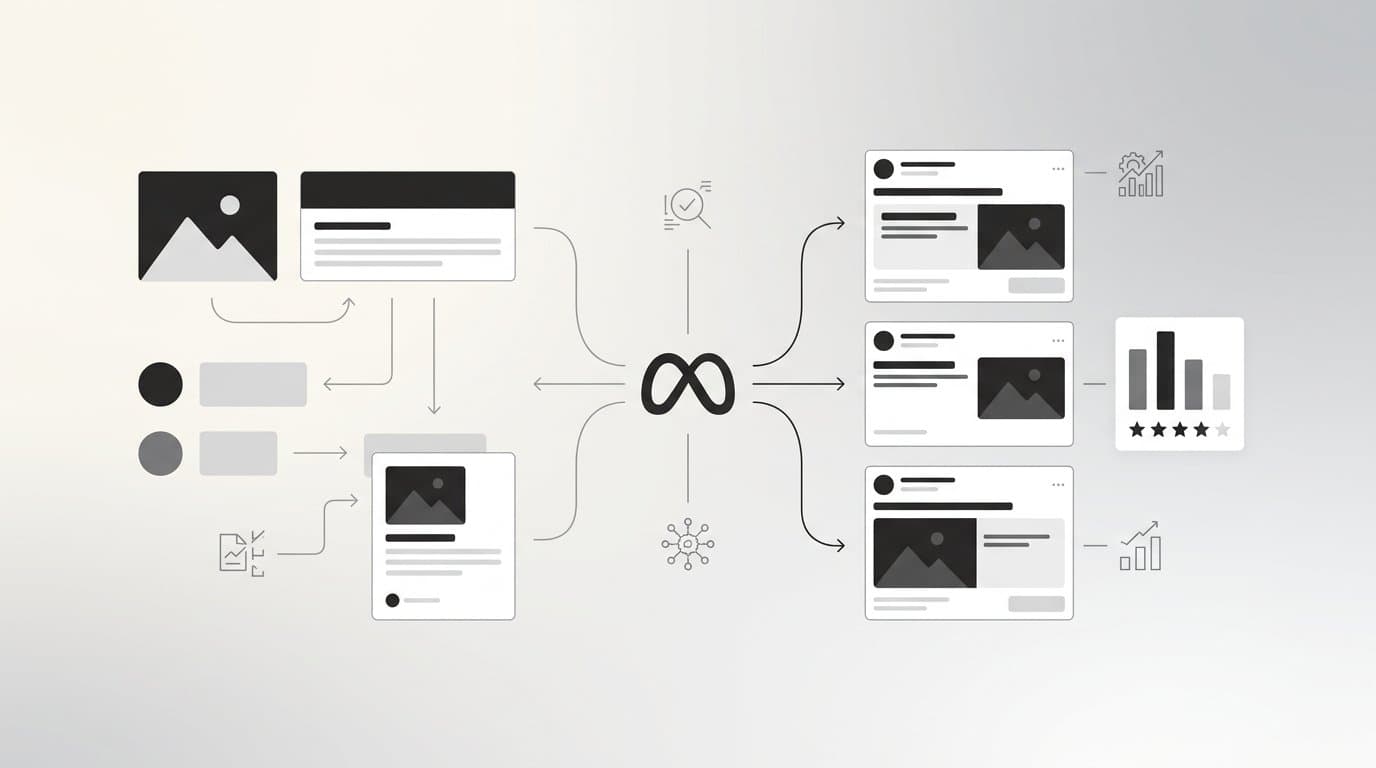
AI-powered automation: eliminate the bottleneck completely. This is where creative testing velocity transforms from incremental improvement to breakthrough capability. Platforms that analyze your historical performance data and autonomously generate campaign variations remove manual work from the equation entirely.
Instead of you deciding which combinations to test, uploading assets, and configuring campaigns, the system identifies your top-performing elements—winning headlines, effective hooks, responsive audiences—and automatically creates new variations combining those elements in untested ways. The entire process from insight to live campaign happens without human intervention. Facebook ad testing automation represents the most significant operational upgrade available to modern advertisers.
The learning loop accelerates exponentially. When a new variation performs well, the system immediately incorporates that insight into subsequent tests. You're not waiting for a media buyer to analyze results, have a strategy meeting, and manually build the next iteration. The platform is continuously testing, learning, and adapting at a pace no manual workflow can match.
This isn't about replacing human judgment—it's about augmenting it. Your team focuses on creative strategy, brand guidelines, and high-level optimization while automation handles the operational execution. You're testing 10 times more variations in the same amount of time, which means 10 times more learning velocity, which means you're discovering breakthrough insights while competitors are still launching their first test batch.
Building a Bottleneck-Free Testing Workflow
Theory is useful, but implementation determines results. Here's how to systematically eliminate creative testing bottlenecks from your operation, starting today.
Step 1: Separate creative production from campaign operations. Your design team shouldn't be waiting on media buyers, and media buyers shouldn't be blocked by creative production. Establish a clear handoff point where finished, approved assets move from creative to campaign operations in organized batches.
Create a shared asset library—this can be as simple as a structured Google Drive folder or as sophisticated as a digital asset management platform. The key is that when creatives are approved, they're immediately available to whoever is launching campaigns, properly named and organized. No Slack messages asking "where's that video file?" No email threads with attachments. Everything in one place, ready to deploy.
This separation also enables parallel work. Your creative team can be producing next week's test batch while your media buyers are launching this week's. When production and operations are intertwined, both teams spend time waiting on each other. When they're separated with clear handoffs, both teams move at maximum velocity.
Step 2: Implement a winners library system. Every test that runs generates insights, but most teams let those insights live in spreadsheets or memory. A winners library is a structured catalog of proven elements—headlines that convert, hooks that stop the scroll, audience segments that respond, offers that drive action—organized for rapid recombination.
When you're planning your next test batch, you're not starting from scratch. You're looking at your winners library and asking: "What happens if we pair this winning headline with this new image?" or "How does this proven offer perform with this emerging audience segment?" You're building on validated success rather than guessing from zero. Implementing automated creative testing strategies makes this recombination process systematic rather than ad hoc.
The library should include context: when the element won, in what campaign structure, at what scale, with what results. A headline that crushed it in a lead generation campaign might not work for e-commerce conversions. Document the conditions of success so you can intelligently apply learnings to new contexts.
Step 3: Adopt tools that handle bulk launching and continuous learning. This is the leverage point that transforms your entire operation. Manual workflows impose a hard ceiling on testing velocity. Automation removes that ceiling entirely.
Look for platforms that don't just schedule ads or provide analytics, but actually build campaigns for you based on performance data. The system should analyze what's working in your account, identify patterns in your winning creatives, and autonomously generate new test variations that combine proven elements in novel ways. When a test completes, the insights should automatically inform the next generation of campaigns without requiring manual intervention. The best Facebook ads automation tool handles this entire workflow seamlessly.
The goal is continuous testing loops that run faster than human decision cycles. You wake up Monday morning to find that weekend tests completed, learnings were extracted, and new variations incorporating those insights are already live and collecting data. Your role shifts from operational execution to strategic oversight—reviewing what the system is learning and providing high-level guidance on brand direction and business priorities.
This is how you test 100 variations per week without hiring 10 media buyers. The operational work happens automatically, and your team's time is spent on the high-value activities that actually move the needle: creative strategy, audience insights, offer development, and performance analysis.
Measuring Your Testing Velocity
You can't improve what you don't measure. If you're serious about eliminating creative testing bottlenecks, you need quantitative metrics that reveal exactly where your workflow is slow and how much progress you're making.
Time-to-live: from approval to serving. This metric measures the hours between a creative being approved and that creative serving its first impression in a live campaign. In a manual workflow, time-to-live often stretches to 24-72 hours or more. In an automated workflow, it can compress to under an hour.
Track this metric weekly and look for patterns. Does time-to-live spike on certain days? That might indicate coordination issues between teams. Does it vary by campaign type? That suggests some campaign structures are more complex to build than others, pointing to opportunities for template creation. The goal is driving this number down consistently, because every hour of delay is an hour your creative isn't generating insights.
Testing ratio: new variations versus active ads. Calculate how many new creative variations you launch each week compared to your total number of active ads. If you're running 50 ads and launching 5 new variations per week, your testing ratio is 10%. Industry leaders often maintain testing ratios of 30-50% or higher, meaning they're constantly refreshing a significant portion of their creative.
A low testing ratio indicates bottleneck problems—you're not launching enough new variations to stay ahead of creative fatigue. A high testing ratio suggests healthy velocity and aggressive learning orientation. Track this metric over time and set targets for improvement. Moving from 10% to 25% testing ratio might require operational changes, but it directly translates to faster learning and better long-term performance. Understanding the difference between automated vs manual Facebook campaigns helps contextualize what testing ratios are achievable.
Learning cycle speed: insight to implementation. When you discover a winning element in a test, how many days pass before you launch new variations incorporating that insight? This metric reveals whether your bottleneck is in initial launching or in iteration velocity.
Many teams are reasonably fast at launching their first test batch but slow at iterating on learnings. They test 20 variations, find a winner, and then take two weeks to implement those insights in the next round. Meanwhile, the insight is going stale—audiences change, competitive landscape shifts, and what worked two weeks ago might not work today.
Measure your learning cycle speed by tracking the date insights are documented (when a test concludes and you know what worked) versus the date new campaigns incorporating those insights go live. Target reducing this cycle to under 72 hours. The faster you can iterate on learnings, the more compounding advantage you build over competitors stuck in slower cycles.
These metrics create accountability and visibility. Share them in team meetings. Graph them over time. Celebrate improvements. When everyone can see the bottleneck quantitatively, it becomes a shared problem to solve rather than a vague frustration everyone complains about but nobody addresses.
Putting It All Together
The creative testing bottleneck isn't a creative problem—it's an operational one. Your team has plenty of ideas. Your designers can produce assets. Your media buyers understand Meta's platform. But all that talent and capability hits a wall when manual processes create friction between concept and execution.
The teams dominating Meta advertising right now aren't necessarily more creative than you. They haven't cracked some secret audience targeting formula. They've simply removed the operational barriers that slow everyone else down. They test more variations, learn faster, and adapt before their competitors finish uploading assets to Ads Manager.
This advantage compounds over time. Every week they're running 50 tests while you're running 10, they're accumulating insights five times faster. Those insights inform better creative strategy, which leads to more winning variations, which generates more insights. The gap widens not because they're smarter, but because their operational infrastructure enables velocity you can't match with manual workflows.
Start by auditing your current bottleneck. Track your time-to-live, testing ratio, and learning cycle speed for two weeks. The numbers will reveal exactly where your workflow breaks down. Maybe you're fast at initial launching but slow at iteration. Maybe your creative team is producing assets faster than campaigns can absorb them. Maybe you're spending 60% of your media buying time on manual campaign building that could be automated.
Then systematically address the friction points. Separate creative production from campaign operations. Build a winners library so you're always building on proven success rather than starting from scratch. Create campaign templates that eliminate repetitive setup work. And seriously evaluate whether your current tools are enabling velocity or imposing artificial limits on how fast you can test.
The breakthrough comes when you shift from manual execution to automated operations. When your platform can analyze performance data, identify winning patterns, and autonomously generate new test variations, you're no longer constrained by how many hours your team can spend in Ads Manager. You're testing at machine speed while your competitors are still testing at human speed. Exploring scaling Facebook ads without increasing team size becomes realistic only with this operational shift.
That's not a small advantage. That's the difference between discovering breakthrough creative angles in days versus months. Between staying ahead of creative fatigue versus constantly playing catch-up. Between scaling profitably versus hitting performance plateaus you can't explain.
The creative testing bottleneck is costing you money every single day it persists. Not just in team time, but in missed opportunities, fatigued creative, and competitive disadvantage. The good news? It's entirely solvable. The operational infrastructure exists to eliminate these bottlenecks completely. The question is whether you'll adopt it before your competitors do.
Ready to transform your advertising strategy? Start Free Trial With AdStellar AI and be among the first to launch and scale your ad campaigns 10× faster with our intelligent platform that automatically builds and tests winning ads based on real performance data. Break through the bottleneck that's been holding you back and discover what your campaigns can achieve when operational friction disappears.