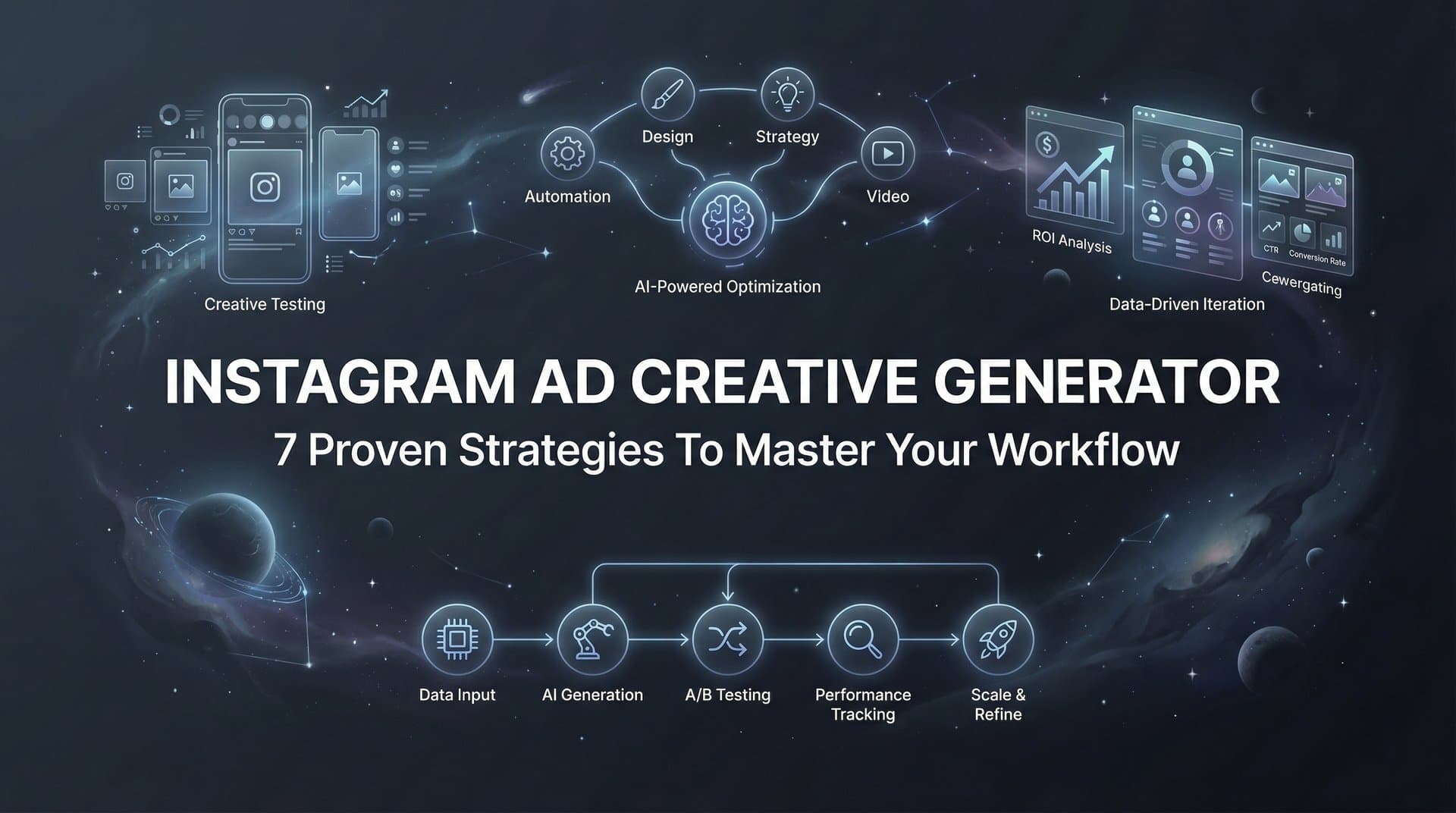
Creating scroll-stopping Instagram ads at scale is one of the biggest challenges facing digital marketers today. With over 2 billion monthly active users on Instagram and increasingly competitive ad placements, the pressure to produce fresh, high-performing creative has never been higher.
An Instagram ad creative generator can transform how you approach this challenge—but only if you know how to leverage it strategically.
This guide walks you through seven battle-tested strategies that will help you maximize the output of your creative generation tools, whether you're a solo marketer managing multiple accounts or an agency handling dozens of clients. You'll learn how to feed your generator the right inputs, scale winning concepts, and build a system that continuously improves your ad performance.
1. Build a Performance Data Foundation Before Generating
The Challenge It Solves
Most marketers jump into creative generation tools without first establishing what actually works for their audience. This approach is like asking someone to cook you dinner without telling them what you like to eat. You'll get something, but it probably won't be what you need.
Without historical performance data guiding your creative generation, you're essentially starting from scratch every time. Your generator has no context for what resonates with your specific audience, what messaging converts, or which visual styles drive engagement.
The Strategy Explained
Think of your historical ad data as the curriculum for training your creative generation process. Before you generate a single new ad, spend time systematically collecting and organizing your past winners and losers.
Pull your top 20 performing ads from the last 90 days based on your primary conversion goal. Document everything: the hook in the first three seconds, the visual composition, the call-to-action placement, the color palette, even the pacing of video content. Then do the same for your bottom 20 performers.
This creates a performance blueprint that tells your generator exactly what to amplify and what to avoid. When you feed this context into your creative generation workflow, you're not starting from zero—you're building on proven success patterns specific to your audience.
Implementation Steps
1. Export your last 90 days of Instagram ad performance data from Meta Ads Manager, sorting by your primary conversion metric (purchases, leads, app installs, etc.).
2. Create a spreadsheet documenting your top 20 and bottom 20 ads with columns for: creative format, opening hook, primary message, visual style, CTA type, target audience, and key performance metrics.
3. Identify patterns in your winners: Do certain product angles consistently outperform? Do specific visual styles generate higher engagement? Does user-generated content beat polished studio shots?
4. Build a "creative DNA document" that summarizes these patterns in clear, actionable guidelines you can reference when generating new creative.
Pro Tips
Don't just look at click-through rates—analyze the full funnel. An ad with a 5% CTR that converts at 0.5% is less valuable than one with a 3% CTR converting at 2%. Focus your analysis on what drives your actual business goal, not vanity metrics.
2. Feed Your Generator with Audience-Specific Creative Briefs
The Challenge It Solves
Generic creative briefs produce generic ads. When you tell your generator to "create an ad for our product," you're leaving massive performance on the table. Different audience segments respond to completely different messaging, pain points, and visual styles.
The 25-year-old first-time buyer and the 45-year-old repeat customer need entirely different creative approaches, even if they're buying the same product. One-size-fits-all creative generation leads to one-size-fits-nobody results.
The Strategy Explained
Persona-driven creative briefs transform your generator from a random idea machine into a precision targeting tool. Instead of generating "ads for women 25-45," you create separate briefs for "budget-conscious millennial moms" versus "established professional women seeking premium options."
Each brief should include the audience's primary pain point, their decision-making criteria, the objections they typically have, and the emotional outcome they're seeking. The more specific you get, the more targeted your generated creative becomes.
This approach lets you generate creative at scale while maintaining the personalization that drives conversions. You're essentially cloning the strategic thinking you'd apply to custom-crafting ads for each segment.
Implementation Steps
1. Segment your audience into 3-5 distinct personas based on demographics, purchase behavior, and engagement patterns from your existing customer data.
2. For each persona, document: primary pain point they're trying to solve, secondary motivations, common objections, preferred content style (educational vs. entertaining, formal vs. casual), and emotional triggers that drive action.
3. Create a creative brief template that includes: target persona, core message angle, proof points to include, visual style preferences, and CTA approach.
4. Generate separate creative batches for each persona using their specific brief, rather than mixing generic ads across all segments.
Pro Tips
Use actual customer language from reviews, support tickets, and sales calls in your briefs. When your generated creative echoes the exact words your audience uses to describe their problems, the relevance score skyrockets.
3. Leverage Winning Element Extraction for Variation Testing
The Challenge It Solves
You've found a winning ad. Great. But how do you scale that success without just running the same creative into the ground until it stops working? Most marketers either duplicate the winner exactly or start from scratch with completely new concepts.
Both approaches miss the opportunity to systematically test which specific elements of your winner are actually driving performance. Is it the opening hook? The product angle? The visual composition? The color scheme? Without isolating these variables, you're flying blind.
The Strategy Explained
Think of your winning ads as recipes with multiple ingredients. Element extraction means breaking down each winner into its component parts—headline, opening visual, product angle, social proof, CTA, background music—then systematically testing variations of each element while holding others constant.
This approach lets you understand not just what works, but why it works. When you discover that your "transformation angle" consistently outperforms your "feature angle" across multiple creative variations, you've found a scalable insight you can apply broadly.
Your creative generator becomes exponentially more powerful when you feed it these isolated winning elements and ask it to create strategic variations that test one variable at a time.
Implementation Steps
1. Take your top 5 performing ads and break each one down into discrete elements: opening hook (first 3 seconds), primary message angle, visual style, social proof type, CTA format, and pacing/editing style for video.
2. Create a matrix showing which combinations of elements you've already tested with your winning ads.
3. Generate new creative variations that swap out one element at a time—keep the winning hook but test a different product angle, or keep the product angle but test a different visual style.
4. Launch these variations in structured A/B tests where you're measuring the impact of the specific element you changed, not just overall performance.
Pro Tips
Start with hook variations first. The opening three seconds of your video or the primary image in your static ad has the biggest impact on whether someone stops scrolling. Once you've optimized the hook, move to testing message angles, then visual styles.
4. Implement a Bulk Creative Launch Strategy
The Challenge It Solves
Generating creative at scale is pointless if you're still launching ads one at a time. The traditional approach of building each ad set individually, uploading creative, writing copy, and configuring settings creates a bottleneck that prevents you from testing at the volume necessary to find winners quickly.
When you're limited to launching 5-10 ads per week because of manual setup time, you're not testing enough to overcome the inherent variability in ad performance. You need volume to find outliers.
The Strategy Explained
Bulk launching transforms creative generation from a creative exercise into a systematic testing operation. Instead of carefully crafting each ad as a unique snowflake, you're building a production line that can launch 50-100 variations in the time it used to take to launch five.
This doesn't mean sacrificing quality—it means implementing quality controls upstream in your generation process, then executing launches in batches. You're essentially separating the strategic thinking (which variations to test) from the mechanical execution (actually launching them).
The key is building templates and workflows that let you populate multiple ads simultaneously with different creative assets while maintaining consistent structure, tracking, and optimization settings.
Implementation Steps
1. Create standardized campaign structures with consistent naming conventions that make it easy to identify what you're testing (format_audience_angle_date).
2. Build creative asset libraries organized by element type (hooks, product shots, testimonials, CTAs) so you can quickly mix and match components.
3. Use bulk upload tools or API integrations that let you launch multiple ad variations simultaneously rather than one at a time through the Ads Manager interface.
4. Establish quality control checkpoints before bulk launch: verify all tracking pixels are firing, confirm audience targeting is correct, and spot-check creative rendering across placements.
Pro Tips
Launch your bulk creative in waves rather than all at once. Start with 20-30 variations, let them run for 48 hours to gather initial data, then launch your next batch. This prevents budget dilution and gives you early performance signals to inform your next generation round.
5. Create Format-Specific Generation Workflows
The Challenge It Solves
Instagram isn't one platform—it's four distinct advertising environments with completely different user behaviors and creative requirements. A Reels ad needs vertical video with fast pacing and trending audio. A Feed ad works better with polished static images and detailed captions. Stories demand interactive elements and swipe-up urgency.
When you use the same creative generation approach for all placements, you end up with mediocre results everywhere. Your Reels look like chopped-up Feed videos, and your Stories feel like afterthoughts.
The Strategy Explained
Format-specific workflows mean building separate generation processes optimized for how people actually consume content in each placement. You're not just resizing the same creative—you're rethinking the entire approach based on the context.
For Reels, your workflow emphasizes entertainment value, fast cuts, trending audio, and hooks that work without sound. For Feed, you focus on thumb-stopping visuals, clear value propositions, and longer-form storytelling. For Stories, you prioritize vertical composition, interactive elements, and urgency-driven CTAs.
This means maintaining separate asset libraries, creative briefs, and performance benchmarks for each format. Yes, it's more work upfront. But the performance difference is dramatic when your creative actually fits the placement.
Implementation Steps
1. Audit your current ad performance by placement to identify which formats are driving your best results and which need improvement.
2. Create format-specific creative templates: Reels (9:16 vertical, 15-30 seconds, trending audio, text overlay for sound-off viewing), Feed (1:1 or 4:5 ratio, clear product focus, detailed caption), Stories (9:16 vertical, interactive elements, swipe-up CTA, 15-second segments).
3. Build separate asset libraries for each format with pre-sized elements that are optimized for that placement's technical requirements and user behavior patterns.
4. Generate creative in format-specific batches rather than trying to adapt one creative across all placements—create 20 Reels variations, then 20 Feed variations, rather than creating one ad and forcing it into four formats.
Pro Tips
Don't spread your budget equally across all placements. Analyze where you're getting the best return and weight your creative generation toward those formats. If Reels converts at 3x your Feed ads, generate three times as many Reels variations.
6. Establish a Continuous Learning Feedback Loop
The Challenge It Solves
Most marketers treat creative generation as a one-way process: generate ads, launch them, check performance, then start over from scratch. This approach wastes the most valuable asset you're creating—performance data that reveals exactly what your audience responds to.
Without a systematic feedback mechanism, your creative generation doesn't improve over time. You're not learning from your tests. You might be generating more creative, but you're not generating better creative.
The Strategy Explained
A continuous learning loop means building systems that automatically feed performance data back into your creative generation process. Your winners inform what you generate next. Your losers tell you what to avoid. Each round of testing makes your next round smarter.
This creates a compounding improvement effect. In month one, you might generate creative based on general best practices. By month three, you're generating based on dozens of tests revealing exactly what works for your specific audience. By month six, your generator is producing winners at a much higher rate because it's learned from hundreds of data points.
The key is making this feedback process systematic rather than ad hoc. You're not just occasionally looking at what worked—you're building regular review cycles that update your generation parameters based on recent performance.
Implementation Steps
1. Schedule weekly performance reviews where you analyze your last 7 days of creative launches and identify the top 10% and bottom 10% performers.
2. Document patterns in your winners and losers in a living document that updates each week: What hooks are working this week? What product angles are resonating? What visual styles are declining?
3. Update your creative generation briefs and templates based on these weekly insights before generating your next batch of creative.
4. Create a "creative graveyard" document tracking what you've tested that didn't work, so you don't accidentally regenerate failed approaches with slight variations.
Pro Tips
Look for velocity changes, not just absolute performance. An ad type that worked great last month but is declining week-over-week is telling you something important about creative fatigue. Shift your generation focus before performance crashes completely.
7. Scale Personalization Without Losing Brand Consistency
The Challenge It Solves
Here's the paradox: personalized creative converts better, but maintaining brand consistency across hundreds of ad variations seems impossible. You want ads that feel tailored to each audience segment, but you also need everything to feel cohesively "on brand."
Most marketers solve this by choosing one extreme—either strict brand guidelines that prevent personalization, or wild creative freedom that produces a scattered brand presence. Both approaches leave performance on the table.
The Strategy Explained
Think of brand consistency as guardrails, not handcuffs. You're defining the boundaries within which personalization can happen, not dictating every creative decision. This means establishing clear rules for what must stay consistent (logo usage, color palette, brand voice tone) while giving flexibility for what can vary (specific messaging, visual composition, product angles).
The solution is building comprehensive asset libraries and style guides that your creative generation process draws from. Every generated ad pulls from approved brand elements, but combines them in ways tailored to specific audiences.
You're essentially creating a "brand kit" that your generator uses like Lego blocks—each piece is on-brand, but you can assemble them in countless configurations to create personalized experiences.
Implementation Steps
1. Define your non-negotiable brand elements that must appear consistently across all creative: logo treatment, primary color palette, font families, brand voice characteristics (professional vs. casual, technical vs. accessible).
2. Build approved asset libraries organized by category: product images (all shot with consistent lighting and backgrounds), lifestyle images (featuring diverse audiences but consistent visual style), graphic elements (icons, shapes, patterns in brand colors), approved headlines and copy frameworks.
3. Create personalization parameters that define what can vary by audience: messaging angles, pain points emphasized, social proof types, CTA language, secondary colors for accent.
4. Set up approval workflows for your generated creative that check for brand compliance before launch—either automated checks for technical requirements (logo size, color hex codes) or quick human review for subjective elements.
Pro Tips
Use your brand elements as creative constraints, not limitations. When you tell your generator "use only these three color palettes," you're not restricting creativity—you're focusing it. Constraints often produce more innovative solutions than unlimited freedom.
Putting It All Together
Mastering your Instagram ad creative generator isn't about finding the perfect tool—it's about building the right system around it.
Start with strategy one: audit your historical performance data and identify your top 10 performing ads. Use these as the foundation for everything that follows. This single step will immediately improve the quality of everything you generate because you're building on proven success rather than guessing.
From there, work through each strategy sequentially, implementing one per week. Week one, build your performance foundation. Week two, create your audience-specific briefs. Week three, extract winning elements from your top performers. This paced approach prevents overwhelm and lets you see the compounding impact as each strategy builds on the previous one.
Within two months, you'll have a complete creative generation system that produces better ads faster while continuously improving based on real performance data.
The marketers who win on Instagram aren't necessarily the most creative—they're the ones who've built systems that let them test more, learn faster, and scale what works. Your creative generator is the engine, but these seven strategies are the fuel that makes it run.
Ready to transform your advertising strategy? Start Free Trial With AdStellar AI and be among the first to launch and scale your ad campaigns 10× faster with our intelligent platform that automatically builds and tests winning ads based on real performance data.