Your marketing calendar says it's time to launch new Instagram campaigns. The creative brief is approved. The budget is allocated. Everything should be moving forward.
But nothing happens.
Your designer is backed up with requests from three other campaigns. The copywriter is waiting for feedback on last week's drafts. The approval chain involves four people across two time zones. And somewhere in this maze of handoffs and waiting periods, your competitive advantage is evaporating.
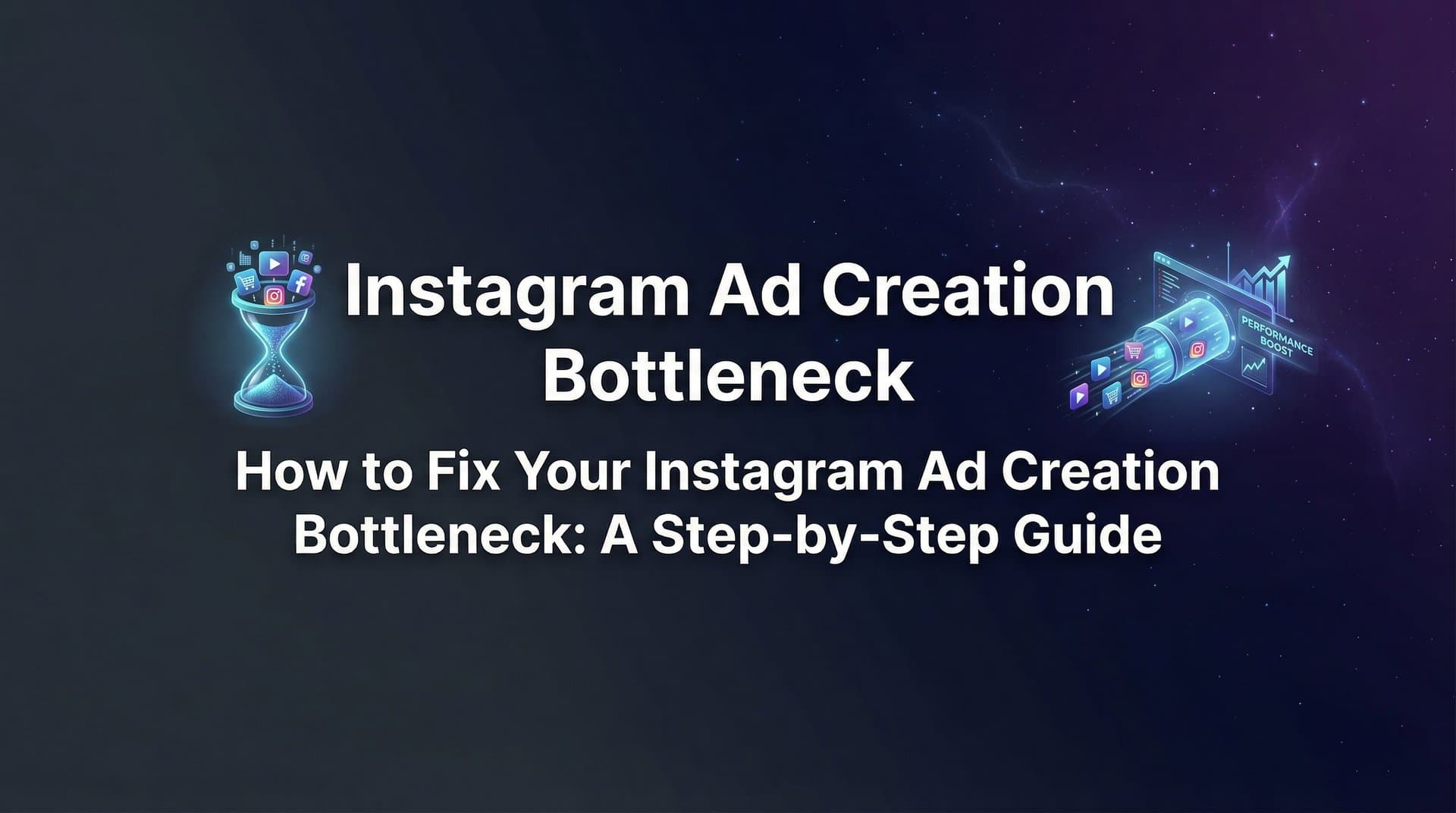
This is the Instagram ad creation bottleneck, and it's costing you more than just time. While you're stuck in production limbo, your competitors are testing new angles, capturing market share, and iterating based on real performance data. The opportunity cost compounds daily.
The frustrating part? This isn't a resource problem you can solve by simply hiring more people. Adding another designer or copywriter often just creates more coordination overhead. The real issue is systemic: your workflow has friction points that slow everything down, regardless of team size.
Here's what makes this particularly challenging for teams running Meta advertising at scale: Instagram campaigns require constant iteration. What worked last month stops working. Audience fatigue sets in. New competitors enter your space. The teams that win aren't necessarily the ones with the biggest budgets—they're the ones who can test faster, learn quicker, and adapt their creative approach in real-time.
But you can't iterate quickly if it takes five days to get a single ad variation live.
The good news? This bottleneck is fixable through systematic process improvements and strategic automation. You don't need to accept slow turnaround times as the cost of quality work. You can build a workflow that produces Instagram ads faster without sacrificing performance.
This guide walks you through the exact process: how to diagnose where your workflow breaks down, implement targeted fixes for each bottleneck type, and build systems that transform multi-day creation cycles into something that takes minutes. By the end, you'll have a clear roadmap for scaling your Instagram ad output without proportionally scaling your headcount.
Step 1: Map Your Current Ad Creation Workflow
You can't fix what you can't see. Most teams have a vague sense that "things take too long," but they've never actually documented where the time goes.
Start by tracking a single Instagram campaign from initial concept to live ads. Write down every stage: the creative brief gets written, then sent to the designer, who creates mockups, which go to the copywriter, who drafts headlines and body text, which all goes to the stakeholder for approval, who requests revisions, which loop back through design and copy, then finally get uploaded to Ads Manager, where someone manually builds the campaign structure, sets targeting, allocates budget, and launches.
Now add timestamps. How long does each stage actually take? Not the active work time—the elapsed time from when one person finishes to when the next person starts. This is where the bottleneck reveals itself.
A typical workflow might look like this: Creative brief takes 2 hours of active work but sits in someone's queue for a day before they get to it. Design takes 3 hours but waits 2 days for the designer's availability. Copywriting takes 1 hour but waits another day. First approval takes 10 minutes but the stakeholder doesn't see it for 3 days. Revisions take 2 hours but add another 2-day delay. Final approval is quick, but then campaign setup in Ads Manager takes 2 hours of tedious manual work.
Total active work time? Maybe 8-10 hours. Total elapsed time? Eight to ten days.
The gap between those numbers is your bottleneck.
Now identify all the handoff points—the moments when work transfers from one person to another. These transitions are where things typically stall. Someone finishes their part, but the next person doesn't know it's ready. Or they're busy with something else. Or they have questions that require another round of back-and-forth.
Calculate your current time-to-launch metric: how many days from "we need this campaign" to "ads are live and spending"? This becomes your baseline. Every improvement you make should measurably reduce this number.
The goal isn't to shame anyone for being slow. The goal is to see the system clearly so you can identify which constraints, if removed, would have the biggest impact on overall speed.
Step 2: Identify Your Specific Bottleneck Type
Not all bottlenecks are created equal. The solution that works for a creative production constraint won't help if your real problem is approval friction.
Here's a diagnostic framework: look at where work piles up in your workflow map from Step 1.
Creative Production Bottleneck: If your designer consistently has a backlog of requests, and campaigns stall waiting for visual assets, you have a creative production constraint. The symptom is that copywriters and media buyers are ready to move forward, but there aren't enough finished visuals to work with. This is common in agencies managing multiple client accounts or brands running numerous campaigns simultaneously.
Copy Bottleneck: If visuals are ready but ad text takes forever to write, review, or approve, your constraint is in copywriting. Maybe you have one person writing all the ad copy across multiple campaigns. Or perhaps the copy review process involves too many opinions and endless revision cycles. The symptom is finished creative sitting unused because the words aren't done.
Approval Bottleneck: If everything is ready but campaigns sit waiting for sign-off, you have an approval process problem. This often happens in organizations with multiple stakeholders who all want input, or when the final approver is a busy executive who reviews ads whenever they have time. The symptom is completed work that can't launch because someone hasn't said "yes" yet.
Technical Bottleneck: If creative and copy are done, approvals are complete, but someone still needs to spend hours manually building campaigns in Ads Manager, you have a technical setup constraint. This includes creating campaign structures, duplicating ad sets for different audiences, uploading creative assets, writing out all the ad variations, and configuring targeting and budgets. Understanding Instagram ad setup complexity helps you recognize when this is your primary constraint.
Most teams have one primary bottleneck that causes the most delay. Identify yours by asking: "If we could magically make one part of this process instant, which would reduce our time-to-launch the most?"
That's where you start.
The beauty of this approach is that you can tackle bottlenecks sequentially. Fix the biggest constraint first, and your overall speed improves. Then the next constraint becomes visible, and you address that one. It's a continuous improvement process rather than trying to fix everything at once.
Step 3: Streamline Your Creative Asset Pipeline
If creative production is your bottleneck, the solution isn't just "hire more designers." It's building a system that produces visual assets faster and more efficiently.
Start with modular creative systems. Instead of designing every ad from scratch, create a library of reusable components: background templates, product image treatments, text overlay styles, and brand elements that can be mixed and matched. Think of it like building with LEGO blocks rather than sculpting each piece from clay.
This doesn't mean your ads look cookie-cutter. It means your designer spends time on strategic creative decisions rather than recreating the same button style for the hundredth time.
Build a winners library—a organized collection of visual elements that have proven performance. When an Instagram ad performs well, don't just celebrate and move on. Extract the components: the background style, the product positioning, the color palette, the composition approach. These winning elements become building blocks for future campaigns.
The teams that scale creative production successfully don't reinvent everything constantly. They identify what works and systematically reuse it with variations.
Establish clear creative briefs that reduce revision cycles. Most design delays come from misalignment: the designer creates something based on their interpretation, but it's not what the stakeholder had in mind. A good brief includes specific references, clear objectives, and constraints that guide decisions upfront rather than through multiple revision rounds.
Your brief should answer: What's the campaign goal? Who's the target audience? What's the key message? What visual style should this match? What are the must-have elements? What should we avoid?
Set up batch production sessions instead of one-off ad creation. Instead of your designer switching contexts constantly between different campaigns, block time for focused creative sprints. "Tuesday afternoon, we're producing all the creative for next week's campaigns." This reduces the cognitive overhead of constant task-switching and allows for more efficient work.
Batching also enables better use of design tools. When you're in the same creative file producing multiple variations, the marginal cost of each additional asset drops significantly.
Step 4: Accelerate Your Copywriting Process
Even with perfect visuals, your campaigns can't launch without the words. If copywriting is your bottleneck, you need systems that produce quality ad text faster.
Start building a swipe file of high-performing headlines and CTAs. Every time an Instagram ad performs well, save the copy. Organize it by campaign objective: awareness campaigns that drove reach, conversion campaigns that generated sales, retargeting campaigns that brought people back. This becomes your reference library when writing new ads.
You're not copying old ads verbatim. You're identifying patterns in what works: the headline structures that grab attention, the body copy frameworks that build interest, the CTAs that drive action.
Create copy frameworks for different campaign types. An awareness campaign targeting cold audiences needs different messaging than a conversion campaign targeting warm leads. Instead of starting from a blank page each time, start from a proven structure you can adapt.
For example, your conversion campaign framework might be: [Attention-grabbing question] + [One-sentence benefit statement] + [Social proof or credibility element] + [Clear CTA with urgency]. Now you're just filling in the specifics rather than figuring out the overall approach from scratch.
Use AI copywriting tools to generate first drafts and variations at scale. Tools that analyze your best-performing copy and generate new variations based on those patterns can dramatically accelerate the writing process. You're not replacing human judgment—you're using AI to handle the first draft so copywriters can focus on refinement and strategic decisions.
The key is treating AI output as a starting point, not a finished product. Generate ten variations, pick the two most promising, refine them, and you've saved significant time compared to writing everything from scratch.
Implement a streamlined review process with clear approval criteria. Copy bottlenecks often come from subjective feedback loops where stakeholders request changes based on personal preference rather than performance criteria. Establish upfront what makes copy "approved": Does it include the required messaging? Does it follow brand voice guidelines? Does it have a clear CTA?
If the answer is yes, it's approved. This removes the endless revision cycles where copy gets wordsmithed to death without actually improving performance.
Step 5: Automate Campaign Building and Launch
Here's where the biggest time savings live: eliminating the manual technical work of campaign setup.
Think about what happens after creative and copy are approved. Someone opens Ads Manager. They create a new campaign. They build out ad sets for different audiences. They upload creative assets one by one. They write out ad variations by hand. They configure targeting parameters. They set budgets. They double-check everything. Then they launch.
This process can take hours for a single campaign with multiple ad sets and variations. It's tedious, error-prone, and completely unnecessary in 2026.
Bulk launching capabilities eliminate the manual repetition. Instead of creating each ad variation individually, you upload your creative assets and copy variations once, define your targeting and budget parameters, and launch everything simultaneously. Using bulk Facebook ad creation software transforms what used to take hours into minutes.
But the real transformation comes from AI-powered tools that analyze performance data to select winning combinations automatically. Instead of guessing which creative should pair with which headline and which audience, the system looks at your historical performance data and identifies the combinations most likely to succeed.
This is where platforms like AdStellar AI fundamentally change the game. Seven specialized AI agents work together to build complete campaigns: the Director agent sets overall strategy, the Page Analyzer reviews your existing performance data, the Structure Architect designs campaign architecture, the Targeting Strategist identifies optimal audiences, the Creative Curator selects winning visual elements, the Copywriter generates and refines ad text, and the Budget Allocator distributes spend efficiently.
The entire process—from strategy to live ads—happens in under 60 seconds.
What makes this powerful isn't just speed. It's that the AI explains its reasoning at every step. You see why it selected certain creative elements, why it paired specific headlines with particular audiences, why it allocated budget the way it did. This transparency means you maintain strategic control while eliminating manual execution work.
Set up systematic A/B testing without manual variation creation. Instead of spending time building test campaigns by hand, define what you want to test (different headlines, different creative styles, different audience segments) and let automation handle the setup. Implementing proper Instagram ad creative testing methods allows you to run more tests, learn faster, and optimize based on actual performance rather than assumptions.
The Winners Hub concept—where proven ad elements are automatically saved and made available for future campaigns—creates a continuous improvement loop. Your best-performing headlines, visuals, and audience combinations become building blocks that get reused and recombined in new ways.
Step 6: Establish a Continuous Improvement Loop
Fixing your bottleneck once isn't enough. As your ad volume scales, new constraints will emerge. The key is building a system that continuously identifies and addresses friction points.
Set up weekly metrics reviews focused specifically on time-to-launch improvements. Track how long campaigns take from initial brief to live ads. Break this down by stage: creative production time, copywriting time, approval time, technical setup time. Watch for trends. Is one stage consistently slow? That's your next optimization target.
The goal isn't perfection—it's progressive improvement. If you reduce average time-to-launch from ten days to seven days, that's a 30% improvement in speed-to-market. Then you work on getting it to five days, then three days, then same-day launches for urgent campaigns.
Create feedback mechanisms that route winning elements back into your creative library. When an Instagram ad performs exceptionally well, it shouldn't just be a one-time success. The visual approach, the messaging framework, the audience targeting—all of it should be documented and made available for future campaigns.
This is where many teams fail: they generate insights but don't systematize them. Someone notices "that lifestyle image with the product in context performed really well," but six months later, new campaigns use generic product shots because that insight wasn't captured in a usable format.
Build a learning system where each campaign informs the next. This means more than just looking at performance metrics. It means asking: What did we learn about our audience? What creative approaches resonated? What messaging frameworks drove action? Effective Instagram campaign management treats every campaign as a learning opportunity rather than an isolated event.
The teams that scale successfully aren't just trying to hit this month's targets—they're building institutional knowledge that compounds over time.
Scale your output progressively as bottlenecks are removed. Don't try to 10× your campaign volume overnight. As you eliminate constraints, gradually increase your ad production. This allows you to identify new bottlenecks before they become critical and ensure quality doesn't suffer as volume increases.
A good approach: when you fix a major bottleneck and reduce time-to-launch significantly, increase your campaign volume by 30-50%. Run at that level for a few weeks. Identify any new friction points. Address those. Then scale again.
Your Path Forward: From Bottleneck to Competitive Advantage
The Instagram ad creation bottleneck isn't a personal failing or a resource problem. It's a systems problem, and systems problems have systematic solutions.
Start with visibility: map your current workflow and calculate your actual time-to-launch. Most teams are shocked when they see how much time elapses between "we need this campaign" and "ads are live." That gap is your opportunity.
Then identify your primary constraint. Is it creative production? Copywriting? Approvals? Technical setup? Don't try to fix everything at once. Address the biggest bottleneck first, and your overall speed improves immediately.
Implement the targeted solutions: streamline creative production with modular systems and winners libraries, accelerate copywriting with frameworks and AI assistance, reduce approval friction with clear criteria, and eliminate manual technical work with automation. The right Instagram ad builder with automation can compress days of work into minutes.
The teams that solve this challenge gain genuine competitive advantage. They can test more variations, respond faster to market changes, and scale their advertising without proportionally scaling their headcount. While competitors are still waiting for approvals, they're already analyzing results from their next test.
Here's your implementation checklist: Workflow mapped with timestamps and handoff points identified. Primary bottleneck diagnosed using the framework from Step 2. Creative pipeline streamlined with modular systems and winners library established. Copy process accelerated with frameworks, swipe files, and AI assistance. Campaign building and launch automated to eliminate manual technical work. Weekly improvement loop established to track progress and identify new constraints.
Pick the one bottleneck causing the most pain right now. Not all of them—just one. Implement the targeted solution this week. Measure the improvement. Then move to the next constraint.
The compound effect of these improvements is remarkable. Reducing time-to-launch from ten days to three days means you can run three times as many campaign iterations in the same timeframe. More iterations mean more learning. More learning means better performance. Better performance means more budget to invest in testing. Leveraging Instagram campaign automation creates this virtuous cycle where speed compounds into competitive advantage.
Ready to transform your advertising workflow from bottleneck to competitive advantage? Start Free Trial With AdStellar AI and experience what happens when seven specialized AI agents build, test, and launch your Instagram campaigns in under 60 seconds—giving you the speed and scale to dominate your market while your competitors are still stuck in approval limbo.