Testing Facebook ad creatives shouldn't feel like throwing spaghetti at the wall. Yet most advertisers treat creative testing like a lottery—launch a few variations, cross their fingers, and hope something sticks. The problem? Without a systematic approach, you're burning budget on guesses instead of building a predictable system for finding winners.
Think about it: you could have the perfect audience and flawless targeting, but if your creative doesn't stop the scroll, none of it matters. Your ad creative is the first impression, the pattern interrupt, the reason someone pauses mid-feed to pay attention. And the only way to know what works is to test deliberately.
The gap between advertisers who struggle and those who scale profitably often comes down to one differentiator: they've mastered systematic creative testing. They don't guess which image will perform better or debate whether video outperforms static. They test, measure, learn, and iterate faster than their competitors.
This guide breaks down six proven methods for testing Facebook ad creatives that reveal your winners without wasting budget. You'll learn exactly how to structure tests, which variables to isolate, how long to run experiments, and when you have enough data to make confident decisions. Whether you're launching your first creative test or refining an existing framework, these methods will help you make data-driven decisions that improve your return on ad spend.
Step 1: Define Your Testing Variables and Success Metrics
Before you launch a single test, you need clarity on two things: what you're testing and how you'll measure success. This sounds obvious, but it's where most creative testing falls apart. Advertisers test multiple variables simultaneously, then can't figure out what actually drove the results.
Start by identifying the specific creative element you want to test. Your options include the primary visual (image or video), headline, body copy, call-to-action button, or ad format (static image vs. video vs. carousel). Pick one. Just one. If you change both the image and the headline simultaneously, you'll never know which element caused the performance difference.
Primary Visual: This is your scroll-stopper—the image or video that appears in the feed. Test different subjects, color schemes, or visual styles.
Headline: The text directly above or below your visual. Test different value propositions, emotional triggers, or specificity levels.
Body Copy: The longer-form text that provides context. Test different lengths, tones, or information hierarchy.
CTA Button: The action you want people to take. Test "Learn More" vs. "Shop Now" vs. "Get Started" to see what resonates.
Format: Static image vs. video vs. carousel. Each format serves different purposes and performs differently by audience.
Next, choose your primary success metric based on your campaign objective. If you're running awareness campaigns, click-through rate (CTR) tells you which creative captures attention. For conversion campaigns, cost per acquisition (CPA) reveals which creative drives action efficiently. For e-commerce, return on ad spend (ROAS) shows which creative generates profitable sales.
Here's the critical part most advertisers skip: set your statistical significance threshold before launching. Industry standard is 95% confidence with at least 1,000 impressions per variation. This prevents you from declaring winners prematurely based on early fluctuations that don't represent true performance.
Document your hypothesis for each test. Write down what you expect to happen and why. "I believe video will outperform static images because our product requires demonstration" or "I think benefit-focused headlines will beat feature-focused headlines because our audience is problem-aware." This prevents post-hoc rationalization where you convince yourself you "knew it all along" regardless of results. Building a solid Facebook ad testing framework starts with this documentation discipline.
Step 2: Structure Your A/B Test for Single-Variable Isolation
Clean data requires controlled conditions. When you set up an A/B test, you're creating a scientific experiment where everything stays constant except the one variable you're testing. Mess this up, and your results become meaningless.
Create identical ad sets with only one variable changed between them. If you're testing headlines, use the exact same image, body copy, CTA, and targeting for both variations. The only difference should be the headline itself. This ensures that any performance difference can be attributed directly to that variable.
You have two options for running A/B tests: Meta's native A/B testing tool in Ads Manager or manual split testing. The native tool handles budget distribution automatically and provides built-in statistical analysis. Manual split testing gives you more control but requires you to monitor budget pacing and calculate significance yourself.
Using Meta's A/B Test Tool: Navigate to Ads Manager, select "A/B Test" when creating a campaign. Choose "Creative" as your variable, and Meta will duplicate your ad set with the ability to swap out the specific element you're testing. The platform automatically splits budget evenly and shows confidence indicators when one variation pulls ahead significantly.
Manual Split Testing: Create two separate ad sets with identical settings. Set the same daily budget for each. Use the same audience targeting, placement options, and optimization settings. The only difference should be the creative element you're testing. Monitor performance daily to ensure budget is splitting evenly—sometimes Meta's algorithm will favor one ad set over another if early performance diverges.
Budget distribution matters more than most advertisers realize. If one variation gets 70% of your budget and the other gets 30%, you're not running a fair test. Set equal budgets and check daily that spending is proportional. If Meta starts heavily favoring one variation within the first 48 hours, you may need to manually adjust budgets to ensure both variations get adequate exposure.
Run your test for a minimum of seven days. Why seven? Weekly patterns affect user behavior—weekend performance often differs from weekday performance, and certain days see higher engagement. Running for a full week ensures you capture these variations rather than making decisions based on a few strong or weak days. Understanding this Facebook ad testing methodology prevents costly mistakes.
During the test period, resist the urge to make changes. Don't adjust budgets, don't edit copy, don't tweak targeting. Any modification resets your learning window and invalidates your data. Let the test run its full course, then analyze results with fresh eyes.
Step 3: Implement Dynamic Creative Testing for Multiple Elements
Single-variable A/B testing is precise, but it's slow. When you want to discover winning combinations at scale, Dynamic Creative Optimization (DCO) accelerates the process by testing multiple elements simultaneously and letting Meta's algorithm find the best combinations.
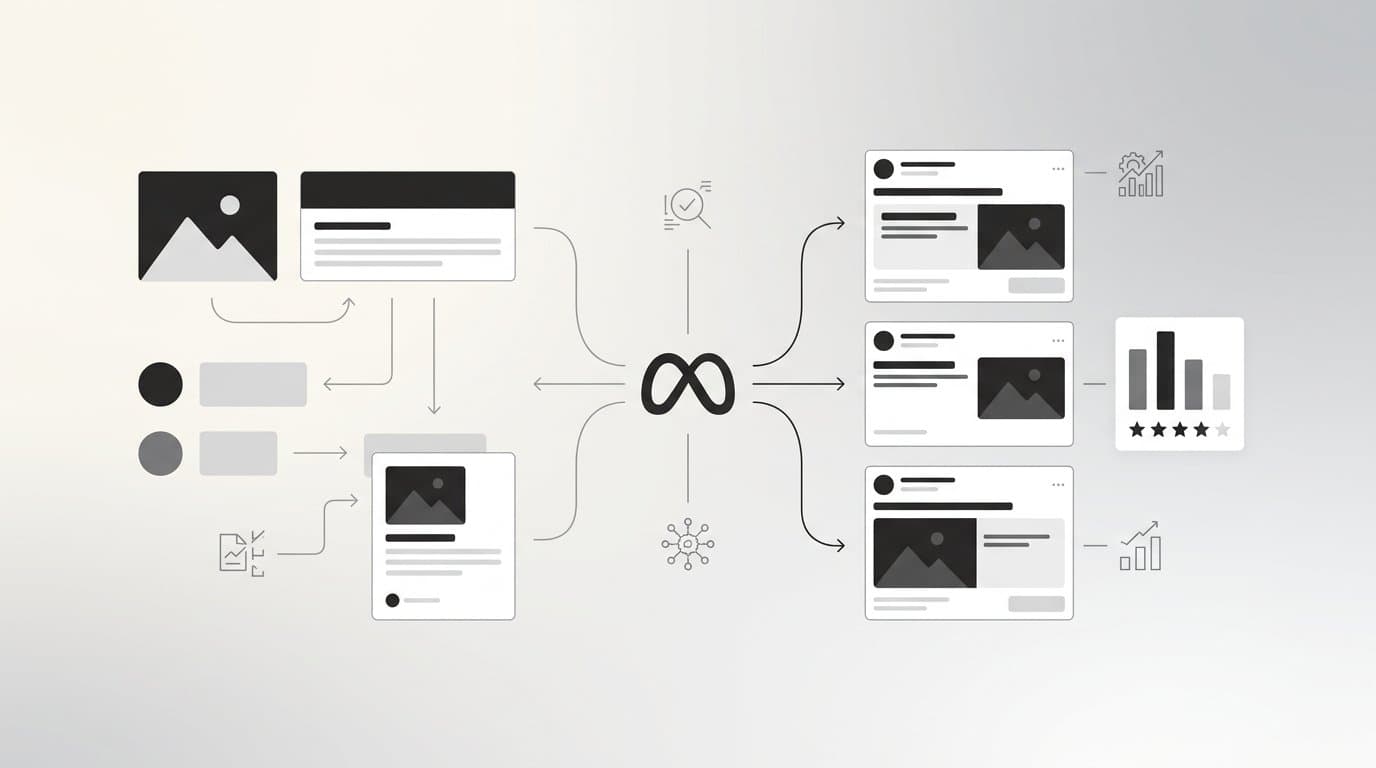
DCO works differently than manual A/B testing. Instead of creating separate ads for each variation, you upload multiple assets—several headlines, multiple images or videos, various descriptions, and different CTA buttons. Meta then automatically generates combinations and serves the best-performing versions to your audience.
When should you use DCO versus manual A/B testing? Use DCO when you're in discovery mode—when you have multiple creative elements and want to quickly identify which combinations resonate. Use manual A/B testing when you want to isolate specific learnings or validate hypotheses with controlled conditions.
Setting up DCO is straightforward. In Ads Manager, toggle on "Dynamic Creative" when creating your ad. You'll see upload fields for multiple assets: up to 10 images or videos, 5 headlines, 5 descriptions, and 5 CTAs. Meta will test different combinations and optimize delivery toward the best performers.
The real value comes from analyzing the asset-level breakdown. After your DCO campaign runs for several days, navigate to the "View Asset Performance" report in Ads Manager. This shows you which individual headlines, images, and CTAs performed best across all combinations. You might discover that one headline consistently outperforms others regardless of which image it's paired with, or that a specific image works well only with certain copy angles.
Here's the limitation you need to understand: DCO optimizes for delivery, not necessarily for learning. Meta's algorithm will quickly allocate more budget to combinations that perform well early, which means underperforming combinations may not receive enough exposure to reach statistical significance. This is fine for campaign performance but can limit your ability to extract clear learnings.
Use DCO as a discovery tool, then validate your winners with controlled tests. If DCO reveals that a particular image and headline combination crushes everything else, create a manual A/B test that isolates those elements to confirm the finding. This two-phase approach gives you both speed and precision. For teams running high-volume campaigns, exploring Facebook ad creative testing at scale becomes essential for maintaining competitive advantage.
Step 4: Test Creative Concepts Before Scaling Production
The biggest mistake advertisers make is investing heavily in polished creative production before validating the underlying concept. You don't need a $5,000 video shoot to test whether your messaging resonates. You need a $50 test to validate the idea before committing production budget.
Concept testing means validating creative directions with low-fidelity versions before producing high-fidelity assets. Run small-budget tests—$20 to $50 per day per concept—using static mockups, rough video cuts, or even stock images that represent your concept. The goal is to test the messaging angle, not the production quality.
This approach flips the traditional creative process. Instead of: brainstorm → produce → launch → hope it works, you follow: brainstorm → rough test → validate → produce winners. You're de-risking production investment by letting real audience data guide which concepts deserve polished execution.
Testing Creative Angles: Your concept tests should compare different messaging approaches, not just visual variations. Test problem-aware messaging ("Struggling with X?") against solution-aware messaging ("Here's how to solve X") against social proof messaging ("Join 10,000+ people who solved X"). Each angle appeals to different awareness stages and audience segments.
Don't worry about polish during concept testing. Ugly ads that convert beat beautiful ads that don't. A simple text-on-image mockup created in Canva can validate whether your value proposition resonates. A smartphone video shot in your office can test whether demonstration-style content works better than testimonial-style content. Save the production budget for concepts that prove themselves. The best Facebook ad creative tools can help you rapidly produce these test variations without expensive production.
Kill losing concepts fast. If a concept is clearly underperforming after three to five days—significantly higher CPA or lower CTR than your benchmarks—turn it off and reallocate budget to potential winners. Don't let ego or sunk cost fallacy keep bad concepts running. The goal is to find winners quickly, not to prove that every idea was brilliant.
When a concept shows promise, that's when you invest in production. Take the validated messaging angle and create polished versions with professional visuals, refined copy, and strong production value. You're now investing in assets with proven market fit rather than guessing which concepts might work.
Step 5: Analyze Results and Identify True Winners
Data without context is just noise. After your tests run, the analysis phase determines whether you've found genuine winners or just statistical flukes. This is where discipline separates effective testers from those who make expensive mistakes based on premature conclusions.
Wait for statistical significance before declaring winners. Use Meta's built-in confidence indicators if you're running native A/B tests, or use an external statistical significance calculator if you're running manual tests. The standard threshold is 95% confidence, meaning there's only a 5% chance that the performance difference occurred by random chance rather than true creative superiority.
Don't jump the gun. If one variation is winning after two days with 500 impressions, you don't have a winner yet—you have early noise. Let the test run until you hit your predetermined sample size and time window. Premature decisions lead to false positives where you scale "winners" that regress to the mean once they get more exposure.
Look beyond your primary metric. A high-CTR ad might seem like a winner until you check conversion rate and realize it's attracting clicks but not driving actions. For conversion campaigns, you need to evaluate the full funnel: CTR shows whether the ad captures attention, but CPA shows whether it attracts the right people who actually convert.
Check performance across audience segments. Meta's breakdown tools let you analyze results by age, gender, placement, and device. Sometimes a creative wins overall but performs terribly with a specific segment. If your ad crushes with 25-34 year-olds but flops with 45-54 year-olds, you've learned something valuable about creative resonance that can inform future tests.
Document everything in a creative testing log. Create a simple spreadsheet or document that records: test date, hypothesis, variables tested, results, confidence level, and key learnings. This builds institutional knowledge over time. Six months from now, when you're planning new tests, you can reference past learnings instead of repeating experiments you've already run. A robust Facebook ad creative library management system makes this documentation searchable and actionable.
Your testing log should capture both winners and losers. Failed tests teach you what doesn't work, which is just as valuable as discovering what does. Maybe you learned that carousel ads underperform single-image ads for your audience, or that benefit-focused copy beats feature-focused copy. These insights compound as your testing library grows.
Step 6: Scale Winners and Build Your Iteration Cycle
Finding winners is only half the battle. The other half is scaling them effectively while maintaining a continuous testing cycle that keeps your creative fresh and prevents fatigue.
When you identify a winning creative, graduate it to a higher-budget campaign while keeping your original test campaign running as a control. This lets you scale the winner without losing your baseline for comparison. If performance drops when you scale, you'll know immediately because you still have the control campaign running at the original budget level. Learning how to scale Facebook ad campaigns properly prevents the common pitfall of killing winners through aggressive budget increases.
Scaling doesn't mean simply increasing budget on the winning ad set. Meta's algorithm performs best when you create new campaigns with higher budgets rather than dramatically increasing existing campaign budgets. A common approach: if your test ran at $50/day and found a winner, create a new campaign at $200-500/day featuring that winning creative alongside your other proven performers.
Create variations of winners rather than starting from scratch. When you find a winning creative, don't just run it until it dies from fatigue. Generate new versions using the same core concept with different executions. If a video ad wins, create new videos using the same script structure but different visuals. If an image ad wins, test new images with the same headline and copy. You're iterating on proven concepts rather than gambling on entirely new ideas. Understanding reusing winning Facebook ad elements systematically accelerates this iteration process.
Establish a continuous testing cadence by allocating 20-30% of your total ad budget to testing new creatives. This ensures you're always discovering new winners while scaling existing ones. Many advertisers make the mistake of stopping all testing once they find something that works, then wonder why performance eventually declines. Facebook ad creative burnout is inevitable—ads that perform well today will decline over time as audiences see them repeatedly.
Your testing calendar should include both incremental tests (small variations of proven winners) and breakthrough tests (entirely new concepts or angles). Allocate 70% of your testing budget to incremental tests that refine what's working, and 30% to breakthrough tests that might discover entirely new winning approaches. This balance keeps you improving consistently while occasionally finding game-changing new directions.
AI-powered tools can dramatically accelerate your iteration cycles. Instead of manually creating every variation and setting up each test, platforms can analyze your historical performance data and automatically generate new ad variations based on your proven winners. Implementing Facebook ad creative automation lets you test more creatives in less time without increasing manual workload.
Your Creative Testing System Starts Now
Facebook ad creative testing transforms advertising from expensive guesswork into a predictable system for finding and scaling winners. The advertisers who consistently win aren't those with the biggest budgets or the fanciest production teams. They're the ones who test systematically, learn continuously, and iterate faster than competitors.
Start with clear hypotheses and single-variable A/B tests to build your testing foundation. Graduate to dynamic creative testing when you want to discover winning combinations at scale. Always validate with proper statistical rigor before scaling—95% confidence with adequate sample sizes prevents costly mistakes based on premature conclusions.
Your quick implementation checklist: Define one variable and one primary metric per test. Run tests for a minimum of seven days to capture weekly patterns. Require 95% confidence before declaring winners. Document every test result in a creative testing log. Always allocate 20-30% of budget to new tests even when current creatives are performing well.
The creative testing muscle you build compounds over time. Each test teaches you something about what resonates with your audience. Your testing log becomes a knowledge base that informs future decisions. Your iteration speed increases as you develop systems for generating and testing new variations efficiently.
Ready to accelerate your creative testing and launch winning campaigns faster? Start Free Trial With AdStellar AI and discover how AI agents can analyze your historical performance data and automatically generate new ad variations based on your proven winners, helping you test more creatives in less time while building campaigns that scale profitably.