Instagram advertising rewards the systematic and punishes the reactive. With Meta's algorithm constantly evolving and audience attention spans shrinking, running the same ad creative until it burns out is a reliable way to watch your ROAS slide in real time.
The marketers consistently pulling strong returns are not guessing. They are testing deliberately, scaling what works, and cutting what does not before it drains the budget. But ad testing on Instagram is not as simple as duplicating a campaign and swapping a headline.
Done poorly, testing produces inconclusive data, wasted spend, and creative fatigue that poisons future campaigns. Done well, it becomes a compounding advantage where every test makes the next campaign smarter and every launch starts from a stronger baseline.
This guide covers eight Instagram ad testing best practices that performance marketers and media buyers actually use to generate reliable, actionable insights. Whether you are running a handful of campaigns or managing hundreds of ad variations, these strategies will help you build a testing system that finds winners faster, eliminates guesswork, and scales with confidence.
Each practice is designed to stand on its own, so you can implement them in any order based on where your current process has the biggest gaps.
1. Test One Variable at a Time to Get Answers You Can Actually Use
The Challenge It Solves
When a test fails to produce a clear winner, the most common culprit is not the creative or the audience. It is the test design itself. Running ads that differ in multiple ways simultaneously makes it impossible to know which change actually drove the result. You end up with data that points somewhere but cannot tell you why, which means you cannot replicate the win or avoid the loss next time.
The Strategy Explained
Structured A/B testing isolates a single variable between two otherwise identical ad sets. Everything stays constant except the one element you are testing: the headline, the creative format, the call to action, the opening frame of a video, or the primary text. When one version outperforms the other, you know exactly what made the difference.
Before launching any test, write down your hypothesis. Something as simple as "We believe leading with a product benefit in the headline will outperform leading with a question because our audience is already problem-aware" gives you a frame for interpreting results. Without a documented hypothesis, even clean test data can be misread.
Prioritize variables by impact. Creative tends to have the largest effect on performance, followed by the offer or hook, then headlines and copy, then audience targeting. Start where the leverage is highest.
Implementation Steps
1. Choose one variable to test and document your hypothesis before building the ads.
2. Duplicate your ad set and change only that single variable in the second version.
3. Keep all other settings identical: budget, placement, audience, bidding strategy, and schedule.
4. Run the test until you have sufficient data to draw a conclusion, then document the result and your interpretation in a shared log.
Pro Tips
Resist the temptation to "improve" the control ad while the test is running. Any change to the control invalidates the comparison. If you spot something you want to fix, note it and address it in the next test cycle. Discipline in test design is what separates actionable insights from noise.
2. Give Every Test Enough Budget and Time to Reach Statistical Significance
The Challenge It Solves
Killing a test after two days because one version looks weaker is one of the most common and costly mistakes in Instagram ad testing. Early performance data is inherently unstable. Delivery is uneven, audiences are still being learned, and small sample sizes amplify random variation. Decisions made on early data often turn out to be wrong once the test matures, and pulling a potential winner prematurely wastes both the spend already committed and the learning opportunity.
The Strategy Explained
Meta's own Ads Manager documentation confirms that ad sets enter a learning phase when first launched or significantly edited. During this phase, Meta's delivery system is actively optimizing, testing different users, times, and placements to find the most efficient delivery path. Performance during the learning phase is less stable and less representative of how the ad will perform at scale.
Meta recommends allowing ad sets to exit the learning phase before drawing conclusions. The learning phase typically requires a meaningful number of optimization events, which varies depending on your objective and budget. For most campaigns, this means giving tests a minimum of several days of run time and enough budget to accumulate a statistically meaningful sample before making a call.
The principle of statistical significance from data science applies directly here: the smaller your sample, the more likely any observed difference between two versions is due to random chance rather than a real performance difference.
Implementation Steps
1. Set a minimum run time for every test before you will review results, typically at least seven days for most campaign types.
2. Allocate sufficient budget for each test ad set to exit Meta's learning phase before you evaluate performance.
3. Resist checking results daily and making reactive changes, which resets the learning phase and extends the time needed to get reliable data.
4. Define in advance the sample size or spend threshold that will trigger your final evaluation.
Pro Tips
If budget is limited, run fewer tests simultaneously rather than spreading spend so thin that no individual test reaches significance. One well-funded test that produces a clear answer is worth more than five underfunded tests that produce nothing actionable.
3. Prioritize Creative Testing Above Everything Else
The Challenge It Solves
Many advertisers spend the majority of their testing energy on audience tweaks and bidding strategies while treating creative as an afterthought. This is backwards. Creative is the element a user actually sees and responds to. It is what stops the scroll, communicates the value, and drives the click. Optimizing everything around a mediocre creative is like tuning an engine in a car with flat tires.
The Strategy Explained
Marketing industry consensus, supported by Meta's own creative best practices documentation, holds that ad creative is one of the most significant drivers of campaign performance on Instagram. Meta's guidance explicitly encourages testing multiple creative formats including image, video, and Stories formats.
There are two distinct levels of creative testing worth understanding. The first is format testing: comparing image ads versus video ads versus carousel formats to understand which format your audience responds to. The second is concept testing: comparing fundamentally different creative approaches within the same format, such as a product-focused visual versus a lifestyle visual versus a UGC-style testimonial.
Concept testing is where the biggest performance differences are typically found. Two video ads can perform completely differently if one leads with social proof and the other leads with a product demonstration. Testing at the concept level surfaces those differences.
AI creative tools like AdStellar dramatically accelerate the volume of creative variations you can test. AdStellar generates image ads, video ads, and UGC-style avatar content from a product URL, letting you build multiple distinct creative concepts quickly without needing designers, video editors, or actors. More creative variations in testing means more data and faster discovery of what resonates.
Implementation Steps
1. Audit your current testing split: what percentage of your tests are creative tests versus audience or bidding tests? Shift the balance toward creative.
2. Test at the concept level first to find which creative direction performs best, then optimize within that direction.
3. Use AI creative generation tools to increase your testing volume without proportionally increasing production time or cost.
4. Track creative performance separately from campaign performance so you can identify which specific assets are driving results.
Pro Tips
Do not just test what looks good to you internally. Test creative concepts that reflect different audience beliefs, pain points, and motivations. The creative that wins is often the one that connects with how the audience thinks, not the one that best showcases the product.
4. Separate Audience Testing from Creative Testing
The Challenge It Solves
Running a new creative to a new audience at the same time is a common shortcut that produces unreadable results. If performance improves, was it the creative or the audience? If it drops, which one caused it? Mixing variables in the same test does not save time. It wastes the entire test because you cannot act on the results with confidence.
The Strategy Explained
Audience testing and creative testing need to operate in separate phases or separate campaign structures. When testing audiences, hold the creative constant so that any performance difference between ad sets reflects the audience quality, not creative variation. When testing creatives, hold the audience constant so that performance differences reflect the creative, not who saw it.
Meta's platform supports several distinct audience types worth testing systematically: interest-based audiences, lookalike audiences built from customer lists or pixel data, and broad targeting where Meta's algorithm finds the right users without detailed targeting constraints. Each of these can perform very differently depending on your product, price point, and funnel stage, and each deserves its own structured test.
Audience test winners also inform creative direction. If a lookalike audience built from your highest-value customers outperforms a broad interest audience, that tells you something about who your best customers are, which should influence the messaging and visuals you test next.
Implementation Steps
1. Run audience tests using your current best-performing creative as the control, keeping it identical across all audience variations.
2. Document which audience types produce the best results at each funnel stage before layering in new creative tests.
3. Once you have a clear audience winner, use it as the stable foundation for your next round of creative testing.
4. Revisit audience tests periodically as your product, pricing, or market position evolves.
Pro Tips
Audience learnings have a shelf life. An audience that performed well six months ago may behave differently today as platform dynamics, competition, and user behavior shift. Build audience retesting into your quarterly roadmap rather than treating it as a one-time exercise.
5. Use Multivariate Testing to Scale Your Winning Combinations
The Challenge It Solves
A/B testing tells you which headline wins and which creative wins. But it does not tell you which combination of headline and creative performs best together. Two elements that each win their individual tests do not always combine to produce the best overall ad. Multivariate testing addresses this gap, but it only becomes practical once you have baseline winners to work with.
The Strategy Explained
Multivariate testing differs from A/B testing in that it tests combinations of variables rather than isolated single changes. Instead of testing headline A versus headline B, you test headline A with creative 1, headline A with creative 2, headline B with creative 1, and headline B with creative 2 simultaneously. The goal is to find which combination produces the best result.
This approach makes sense once you have validated individual elements through A/B testing. Jumping to multivariate testing before you have proven winners to combine means you are testing combinations of unknowns, which produces data that is difficult to interpret.
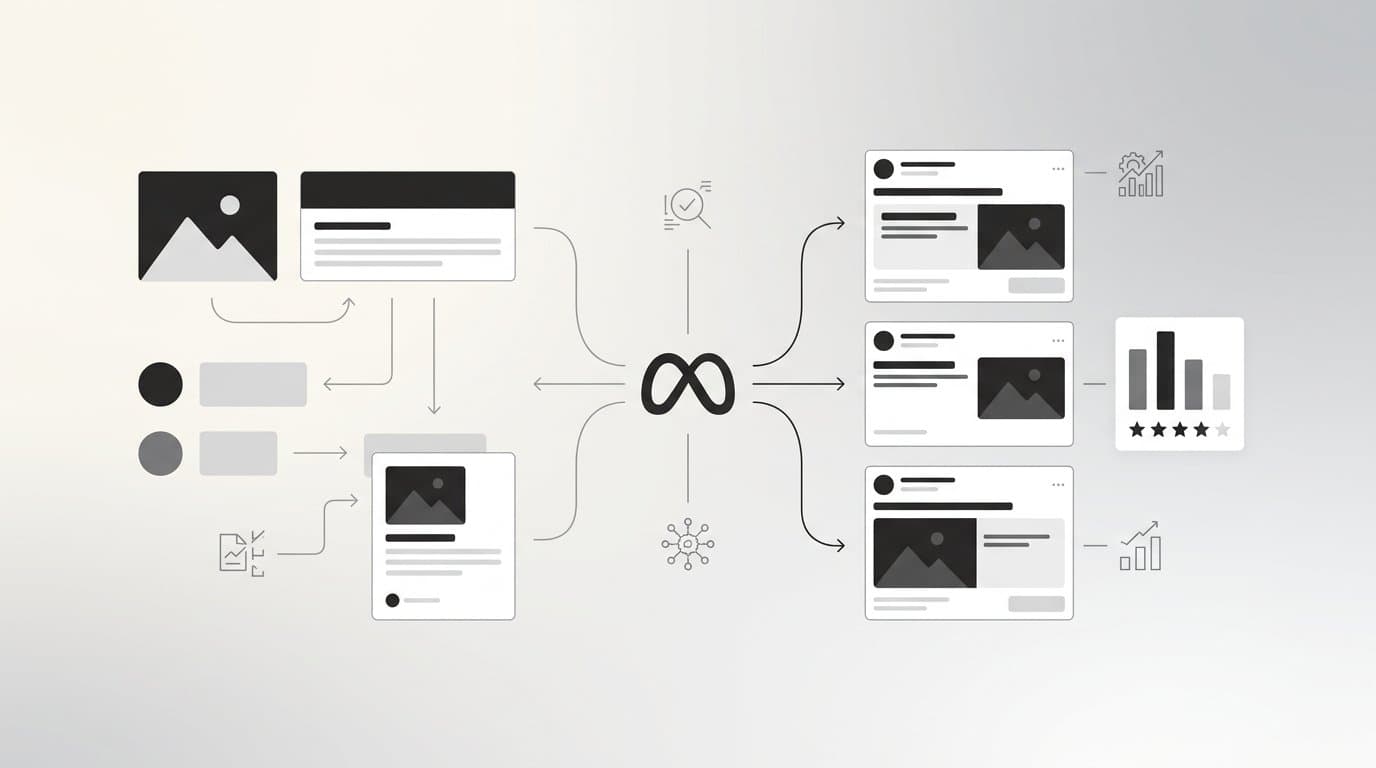
Bulk ad creation tools make multivariate testing practical for teams of any size. AdStellar's Bulk Ad Launch feature lets you mix multiple creatives, headlines, audiences, and copy at both the ad set and ad level, generating every combination and launching them to Meta in minutes rather than hours. What would previously require a large team to build manually can now be executed quickly, which means you can run meaningful multivariate tests without the operational overhead that used to make this approach impractical for smaller teams.
Implementation Steps
1. Confirm you have at least two proven creative winners and two proven headline winners from prior A/B tests before starting multivariate testing.
2. Map out all the combinations you want to test and calculate the total number of ad variations before building anything.
3. Use bulk creation tools to generate all combinations efficiently and launch them within the same campaign structure.
4. Evaluate results at the combination level, not just the individual element level, to identify which pairings consistently outperform.
Pro Tips
Keep multivariate tests manageable. Testing too many combinations simultaneously dilutes spend across too many variations and makes it harder for any single combination to accumulate enough data to be conclusive. Start with two to three variables and two options each, which gives you a manageable set of combinations to evaluate.
6. Define Your Success Metrics Before the Test Launches
The Challenge It Solves
Choosing what to optimize for after a test is already running is a subtle but serious problem. When you define success metrics after seeing early results, you are unconsciously selecting the metric that makes your preferred outcome look like the winner. This is called moving the goalposts, and it produces confident-sounding conclusions that are actually meaningless. Pre-defining your success metric removes that bias entirely.
The Strategy Explained
Before any test launches, document the single primary metric that will determine the winner. This metric should align directly with your actual business goal for that campaign, not just the metric that is easiest to measure or looks best in early data.
For top-of-funnel awareness campaigns, relevant metrics might include cost per thousand impressions, video view rate, or link click-through rate. For bottom-of-funnel conversion campaigns, the relevant metrics are typically cost per acquisition (CPA) or return on ad spend (ROAS). These are standard, widely used performance metrics in digital advertising, and aligning your test metric to your funnel stage is essential for interpreting results correctly.
A creative that generates a high click-through rate but a poor conversion rate is not a winner for a conversion campaign, even if the CTR looks impressive. Defining your success metric in advance keeps you anchored to what actually matters.
Set a benchmark before the test launches. Define what a winning result looks like in numerical terms: a CPA below a specific threshold, a ROAS above a specific target, or a CTR meaningfully above your current baseline. Without a benchmark, every result becomes subject to interpretation.
Implementation Steps
1. Before building any test, write down the single primary metric that will determine the winner.
2. Confirm that metric aligns with the actual business goal for this campaign and this funnel stage.
3. Set a specific benchmark that defines what a winning result looks like before you launch.
4. Document both the metric and the benchmark in your test log so the evaluation criteria are fixed before results come in.
Pro Tips
It is fine to track secondary metrics for context, but they should not override your primary metric when declaring a winner. If your primary metric is CPA and one version has a lower CPA but a slightly lower CTR, the lower CPA version wins. Secondary metrics inform future hypotheses, not the current test outcome.
7. Build a Structured Testing Roadmap Instead of Testing Randomly
The Challenge It Solves
Ad hoc testing, where you run whatever test seems interesting this week, produces disconnected learnings that do not build on each other. Each test exists in isolation, results get forgotten or lost, and the same questions get retested repeatedly because there is no institutional memory. Teams in this pattern spend significant budget generating data they never fully use.
The Strategy Explained
A structured testing roadmap treats your testing program as a cumulative learning system rather than a series of one-off experiments. It starts with a prioritized list of hypotheses ranked by potential impact and organized into a logical sequence where each test builds on the findings of the previous one.
A quarterly testing calendar works well for most teams. At the start of each quarter, identify the three to five most important questions your testing program needs to answer. Rank them by potential impact on performance. Schedule tests in an order that makes sense, typically starting with high-leverage variables like creative concept, then moving to refinements like copy and headline, then to combinations once individual winners are established.
Documentation is the part most teams skip, and it is the part that creates the compounding advantage. A simple shared log that captures the hypothesis, test structure, result, and interpretation for every test gives your team institutional knowledge that accelerates future decisions. Marketing teams that systematically document test results build a foundation that makes every subsequent campaign smarter.
AdStellar's AI Insights feature surfaces patterns across your campaigns automatically, ranking creatives, headlines, copy, audiences, and landing pages by real metrics like ROAS, CPA, and CTR. This kind of automated pattern recognition reduces the manual analysis burden and helps you spot trends across tests that would be easy to miss when reviewing results one campaign at a time.
Implementation Steps
1. At the start of each quarter, list every testing hypothesis your team wants to explore and rank them by estimated impact.
2. Build a testing calendar that sequences tests logically, with foundational tests scheduled before refinement tests.
3. Create a shared test log template that captures hypothesis, structure, result, and interpretation for every test.
4. Review the log at the end of each quarter to identify patterns and carry the most important learnings into the next quarter's roadmap.
Pro Tips
Keep your hypothesis list separate from your active test calendar. The hypothesis list is a living backlog. The active calendar is only what you are currently testing. Keeping them separate prevents the common mistake of trying to run too many tests simultaneously and spreading budget too thin to get conclusive results from any of them.
8. Turn Winners into a Repeatable Launch System
The Challenge It Solves
Many teams run excellent tests, surface real winners, and then start from scratch the next campaign. The winning creative sits in a folder somewhere. The top-performing audience gets rebuilt from memory. The headline that consistently outperformed everything else does not make it into the brief. All the learning from prior tests evaporates because there is no system for capturing and reusing it. This is where testing programs stall out despite strong individual results.
The Strategy Explained
A winners library changes the economics of every future campaign. Instead of starting from a blank slate, you start from a collection of proven elements: creatives that have demonstrated real performance, headlines that have won controlled tests, audiences that have delivered strong results at each funnel stage, and copy angles that have resonated with your target customer.
The library only has value if it is actively maintained and easy to access. A folder of old screenshots does not count. You need a system that captures performance data alongside the creative asset so anyone on the team can look at the library and immediately understand what each element achieved, not just what it looks like.
AdStellar's Winners Hub is built specifically for this. It centralizes your best-performing creatives, headlines, audiences, and more in one place with real performance data attached. When you are ready to launch a new campaign, you can select proven winners directly from the hub and add them to the new campaign immediately, without rebuilding from memory or hunting through old campaign data.
This is what separates teams that scale efficiently from those that plateau. Efficient scaling is not just about finding winners. It is about building a system that makes those winners accessible and reusable so each new campaign starts from a stronger position than the last.
Implementation Steps
1. Define what qualifies a creative, headline, audience, or copy element for inclusion in your winners library, based on your pre-defined success metrics.
2. After every test cycle, review results and formally add qualifying elements to the library with their performance data attached.
3. Make the winners library the default starting point for every new campaign brief, not an optional reference.
4. Retire elements from the library when their performance data becomes outdated or when newer winners have clearly superseded them.
Pro Tips
Tag winners by funnel stage, audience type, and product category so the library remains searchable as it grows. A library with fifty unorganized winners is almost as hard to use as no library at all. A well-organized library with clear tags and performance context becomes one of the most valuable assets your marketing team owns.
Putting It All Together
A strong Instagram ad testing process is not a one-time project. It is a system that gets sharper with every campaign. The eight practices in this guide work together: clean test structure produces reliable data, reliable data surfaces real winners, and a winners library turns those insights into faster launches and stronger returns over time.
Start with the area where your current process is weakest. If you are testing multiple variables at once, fix that first. If you are killing tests before they reach significance, address that next. If you have no system for capturing and reusing winners, build one. You do not need to overhaul everything simultaneously to see meaningful improvement.
The compounding effect of systematic testing is significant. Marketers who build a structured testing process consistently outperform those who rely on intuition alone, because they accumulate real performance data that informs every future decision. Each test adds to the foundation. Each winner makes the next launch faster. Each documented learning reduces the guesswork in the next campaign.
Tools like AdStellar are built to accelerate exactly this kind of system. From generating creative variations at scale with AI to launching bulk ad combinations to Meta in minutes, to surfacing your top performers through AI-powered leaderboards and centralizing them in the Winners Hub, AdStellar is designed to help you spend less time on manual busywork and more time acting on what actually works.
Start Free Trial With AdStellar and be among the first to launch and scale your ad campaigns faster with an intelligent platform that automatically builds and tests winning ads based on real performance data.