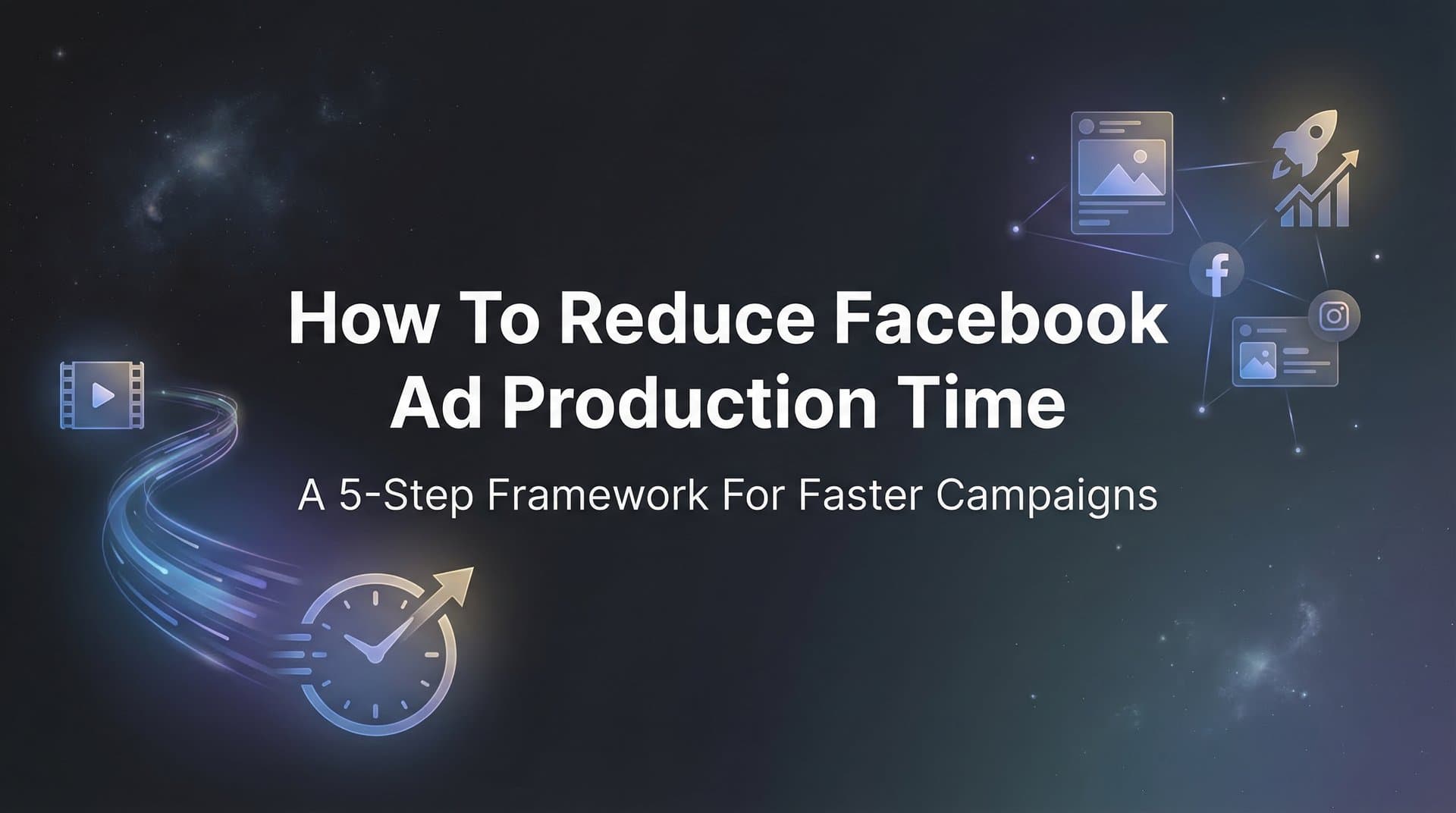
Building Facebook ad campaigns shouldn't consume your entire workday. Yet many marketers spend hours—sometimes days—on tasks that could take minutes: hunting for winning creatives, writing ad copy variations, configuring targeting options, and manually setting up each campaign. This production bottleneck doesn't just waste time; it limits how many campaigns you can test, slows your iteration cycles, and ultimately caps your growth potential.
The good news? With the right systems and tools in place, you can dramatically cut your Facebook ad production time without sacrificing quality.
This guide walks you through five practical steps to streamline your workflow, from organizing your creative assets to leveraging AI-powered automation. Whether you're a solo marketer managing multiple accounts or an agency scaling client campaigns, these strategies will help you launch more campaigns in less time—freeing you to focus on strategy and optimization rather than repetitive setup tasks.
Step 1: Audit Your Current Workflow to Find Time Drains
You can't fix what you don't measure. Before you optimize anything, you need a clear picture of where your time actually goes during ad production.
Start by tracking time spent on each production phase for your next three campaigns. Break it down into specific categories: creative sourcing and selection, copywriting and variations, campaign structure setup, targeting configuration, and final review and approval. Use a simple spreadsheet or time-tracking tool to log actual minutes spent on each task.
The results often surprise marketers. What feels like "just a few minutes" configuring audiences might actually consume 30-45 minutes per campaign when you factor in research, testing different combinations, and double-checking exclusions.
Next, identify repetitive tasks that happen with every single campaign launch. These are your prime automation candidates. Do you manually recreate the same campaign structure each time? Copy-paste targeting parameters from previous campaigns? Scroll through your media library hunting for that one creative that worked well last month? Write these down—each repetitive task represents an opportunity to save time.
Document your entire process from initial brief to live campaign. Map out every step, even the ones that seem trivial. Where do bottlenecks occur? Common culprits include waiting for creative approvals, switching between multiple tools, and decision paralysis when choosing from too many options without clear performance data. Understanding these time-consuming Facebook ad setup patterns is the first step toward eliminating them.
Here's the crucial part: calculate your true cost per campaign launched. Multiply your total hours by your effective hourly rate (or what you could bill for that time). If you're spending four hours per campaign and your time is worth $100 per hour, each campaign costs you $400 in labor before you've spent a dollar on ads. This baseline gives you a concrete number to improve against and justifies investing in better systems.
The audit isn't about judgment—it's about awareness. Most marketers discover they're spending 60-70% of their time on mechanical tasks rather than strategic thinking. That's the opportunity.
Step 2: Build a Reusable Creative and Copy Library
Every minute you spend hunting for that winning creative from three months ago is a minute you're not spending on strategy. A well-organized asset library transforms creative selection from a scavenger hunt into a quick decision.
Start by organizing your winning creatives with a clear tagging system. Go beyond basic folders—use metadata that actually helps you find what you need. Tag by format (image, video, carousel), objective (conversions, leads, awareness), performance tier (top 10%, solid performer, test), audience segment, and funnel stage. When you need a proven conversion-focused image for mid-funnel audiences, you should find it in 30 seconds, not 30 minutes.
Create modular copy templates with swappable components. Instead of writing every ad from scratch, build a library of high-performing headlines, body text blocks, and CTAs that you can mix and match. Think of it like building with LEGO blocks—you're not reinventing the wheel each time, you're recombining proven elements in new ways. This approach directly addresses the challenge of Facebook ad copywriting being time consuming.
For each template, document what makes it work. "Urgency-based headline for limited-time offers" tells you more than "Headline 7." When you understand the psychology behind each element, you can deploy it strategically rather than randomly.
Categorize assets by audience segment and campaign type. Your messaging for cold audiences differs from your retargeting copy. Your lead generation ads need different creative approaches than your product launches. When everything's organized by use case, you can grab the right assets immediately.
Establish a regular process for adding proven performers to your library. After each campaign, identify your top 20% of creatives and copy variations. Tag them, add performance notes, and file them properly. Learning how to reuse winning Facebook ads effectively means your library gets stronger over time.
The key is making retrieval effortless. If accessing your library takes more than a few clicks, you'll default to starting from scratch—which defeats the entire purpose. Many marketers find that organizing their Winners Hub properly cuts creative selection time by more than half.
Step 3: Standardize Your Campaign Structure and Naming Conventions
Decision fatigue kills productivity. When you're rebuilding campaign structure from scratch every time, you're burning mental energy on questions you've already answered dozens of times before.
Create campaign templates for your most common objectives. If you run conversion campaigns weekly, build a master template with your standard structure: campaign settings, ad set configuration, and ad format preferences. Clone it instead of rebuilding it. The same applies for lead generation, awareness campaigns, or any objective you use regularly. Understanding how to structure Facebook ad campaigns properly makes this process significantly faster.
Implement consistent naming conventions that make campaigns instantly identifiable at a glance. A good naming system includes the objective, audience, offer, and date. For example: "CONV_Retargeting_SpringSale_2026-03" tells you everything you need to know without opening the campaign. When you're managing dozens of campaigns, this clarity saves significant time during optimization and reporting.
Pre-configure saved audiences and targeting presets for your different customer segments. Instead of rebuilding your "engaged website visitors, past 30 days, excluded purchasers" audience each time, save it once and reuse it. Build a library of your standard targeting configurations: cold lookalikes, warm retargeting segments, and hot conversion audiences. When you're setting up a new campaign, you're selecting from proven options rather than configuring from scratch.
Build a campaign setup checklist to eliminate missed steps and reduce review time. Your checklist might include: verify pixel tracking, confirm budget allocation, check ad placement selections, review audience exclusions, and validate UTM parameters. Working through a standardized checklist is faster than trying to remember everything, and it prevents costly mistakes that require campaign edits after launch.
The beauty of standardization is that it frees your brain for the creative and strategic work that actually matters. You're not wondering "Should I exclude purchasers?" for the hundredth time—you're following your proven process while focusing on the unique elements of this specific campaign. For agencies, learning how to organize Facebook ad accounts across multiple clients makes this even more critical.
Think of it like a pilot's pre-flight checklist. They don't reinvent the process each time—they follow the same proven sequence so they can focus on the variables that actually differ flight to flight.
Step 4: Automate Repetitive Tasks with AI-Powered Tools
Here's where the real time savings happen. The tasks you do manually every single time—analyzing performance data, selecting winning elements, configuring campaign structures, writing copy variations—can now be handled by AI in seconds instead of hours.
Modern AI tools analyze your historical performance data to automatically select winning creative elements. Instead of manually reviewing dozens of past campaigns to identify which images, headlines, and audiences performed best, AI can scan your entire history and surface the proven winners. This data-driven approach is not only faster—it's often more accurate than human pattern recognition across large datasets.
Bulk ad creation capabilities transform the most tedious part of campaign production. Rather than manually creating each ad variation one at a time—selecting the creative, writing the copy, configuring the settings, then repeating the process for the next variation—you can launch multiple variations simultaneously. Platforms with bulk launching features let you deploy dozens of ad combinations in a single session, testing more variations in minutes than you could manually build in hours. This is essential when learning how to launch multiple Facebook ads quickly.
AI-powered targeting recommendations eliminate the guesswork from audience configuration. Instead of manually researching which interests might work or testing random lookalike percentages, AI can analyze your past campaign performance to recommend targeting strategies that have actually driven results for your specific business. This moves you past generic best practices to personalized recommendations based on your real data.
Automated workflows for common campaign types remove the repetitive setup entirely. For example, AdStellar AI uses seven specialized agents that handle different aspects of campaign building: analyzing your landing page, architecting campaign structure, developing targeting strategy, curating creatives, writing copy, and allocating budget. Understanding how AI builds Facebook campaigns helps you leverage these tools more effectively. The entire process—from brief to ready-to-launch campaign—happens in under 60 seconds with full transparency into the AI's reasoning for each decision.
The continuous learning loop is what makes AI automation increasingly valuable over time. Each campaign you run feeds more data back into the system, improving future recommendations. Your AI gets smarter about what works for your specific audience, your creative style, and your business objectives.
What used to require deep expertise and hours of manual work—analyzing performance patterns, identifying winning combinations, structuring campaigns for optimal delivery—now happens automatically while you focus on higher-level strategy and creative direction.
Step 5: Implement Batch Processing and Bulk Launching
Context switching destroys productivity. Every time you jump from creative work to campaign setup to copywriting and back again, you lose momentum and mental clarity. Batch processing eliminates this friction.
Group similar campaigns together and build them in dedicated production blocks. Instead of building campaigns one at a time as requests come in, schedule specific production sessions where you build multiple campaigns back-to-back. Your brain stays in "campaign building mode," making each subsequent campaign faster than the last. Many marketers find they can build three campaigns in a two-hour focused block faster than they could build those same three campaigns scattered across a week.
Use bulk launching capabilities to deploy multiple ad variations in a single session. When you're testing different creative and copy combinations, bulk tools let you set up all variations at once rather than creating each individually. This approach not only saves time—it ensures all your test variations launch simultaneously with consistent settings, giving you cleaner data for analysis. Mastering how to launch Facebook ads at scale becomes much easier with batch processing.
Schedule recurring production time rather than handling campaign building ad-hoc. Block out specific times in your calendar dedicated solely to campaign production. Treat these blocks as seriously as you would client meetings. When production time is scheduled and protected, you can batch similar tasks, minimize interruptions, and work more efficiently.
The psychological benefit is significant too. When campaign building has a defined time and place, it stops bleeding into your entire day. You're not constantly context-switching between strategic work and mechanical setup tasks.
Measure your new production time against your baseline from Step 1. Track the same metrics you measured during your initial audit: time per campaign, time per task category, and total cost per campaign launched. The improvements often compound—a 20% reduction in creative selection time plus a 40% reduction in campaign setup time plus a 30% reduction in copywriting time can cut your total production time in half or more. These Facebook ad creation time reduction strategies stack together for dramatic results.
Document what's working and what still needs optimization. Your workflow should continuously evolve as you identify new bottlenecks and discover better approaches. The goal isn't perfection—it's progressive improvement that frees up more time for strategic work with each iteration.
Putting It All Together
Reducing Facebook ad production time isn't about cutting corners—it's about eliminating unnecessary friction so you can focus on what actually drives results. The marketers who launch more campaigns, test more variations, and iterate faster are the ones who win. Speed creates competitive advantage.
Start by auditing your current workflow to identify where time disappears. You can't optimize what you don't measure, and the insights from tracking your actual time investment often reveal surprising opportunities. Build systems that let you reuse proven winners instead of reinventing the wheel with each campaign. Your creative library and copy templates become more valuable with every campaign you add to them.
Standardize your processes so every campaign doesn't feel like starting from scratch. Templates, naming conventions, saved audiences, and checklists transform decision fatigue into efficient execution. Then leverage AI and automation to handle the repetitive tasks that slow you down—from analyzing performance data to building campaign structures to writing copy variations.
Here's your quick checklist to get started: Document your current time-per-campaign baseline so you have a concrete improvement target. Organize your creative library with clear tagging that makes retrieval effortless. Create campaign templates for your most common objectives. Explore AI tools that automate campaign building and bulk launching. Implement dedicated production blocks for batch processing similar campaigns.
Your next step: pick one bottleneck from your workflow audit and tackle it this week. Don't try to overhaul everything at once—incremental improvements compound quickly. Maybe you start by organizing your creative library. Or you build your first campaign template. Or you test an AI-powered tool for one campaign type.
The time you save scales with every campaign you launch. An hour saved per campaign becomes 50 hours saved across 50 campaigns—more than a full work week reclaimed for strategic thinking, creative development, and optimization.
Ready to transform your advertising strategy? Start Free Trial With AdStellar AI and be among the first to launch and scale your ad campaigns 10× faster with our intelligent platform that automatically builds and tests winning ads based on real performance data.