Facebook advertising success increasingly comes down to one thing: creative that stops the scroll. With average attention spans shrinking and competition intensifying, the ads that win are the ones that capture interest instantly and communicate value clearly. The challenge? Producing enough high-quality creative variations to test what resonates with your audience without exhausting your budget or your design team.
AI-powered creative tools have fundamentally changed this equation. What once required hiring designers, coordinating photoshoots, and waiting days for revisions can now happen in minutes. More importantly, AI doesn't just speed up production. It enables the kind of systematic testing that separates campaigns generating 2x ROAS from those hitting 5x or higher.
The strategies below focus on practical implementation. These aren't theoretical approaches but proven tactics that marketers are using right now to generate more creatives, test faster, and scale what works. Whether you're managing a single product or juggling campaigns across multiple clients, these methods will help you create ads that actually convert.
1. Generate Product-Based Creatives from Your URL
The Challenge It Solves
Creating ad creatives from scratch is time-intensive. You need product photos, compelling copy, attention-grabbing headlines, and designs that work across different placements. For each new product launch or campaign refresh, the process starts over. When you're testing multiple angles or running campaigns for various products, this manual workflow becomes a significant bottleneck that limits how quickly you can launch and iterate.
The Strategy Explained
AI creative generation from product URLs automates the entire creative production process. You provide a link to your product page, and the AI analyzes everything: product images, descriptions, features, pricing, and value propositions. It then generates complete ad creatives with professionally designed visuals, compelling headlines, and ad copy tailored to different marketing angles.
This approach works because AI can instantly identify the most marketable aspects of your product and translate them into ad-ready formats. Instead of spending hours in design software or writing multiple copy variations, you get a range of creative options to test immediately. This is a core benefit of AI powered Facebook advertising that transforms how marketers approach creative production.
Creating Image Ads, Video Ads, and UGC Content with AdStellar
The strategies outlined above become exponentially more powerful when you have a platform that can execute them efficiently. AdStellar integrates AI-powered creative generation across multiple formats, enabling you to produce image ads, video ads, and UGC-style content from a single workflow. This eliminates the fragmentation of managing separate tools for different creative types and creates a streamlined process for testing across formats.
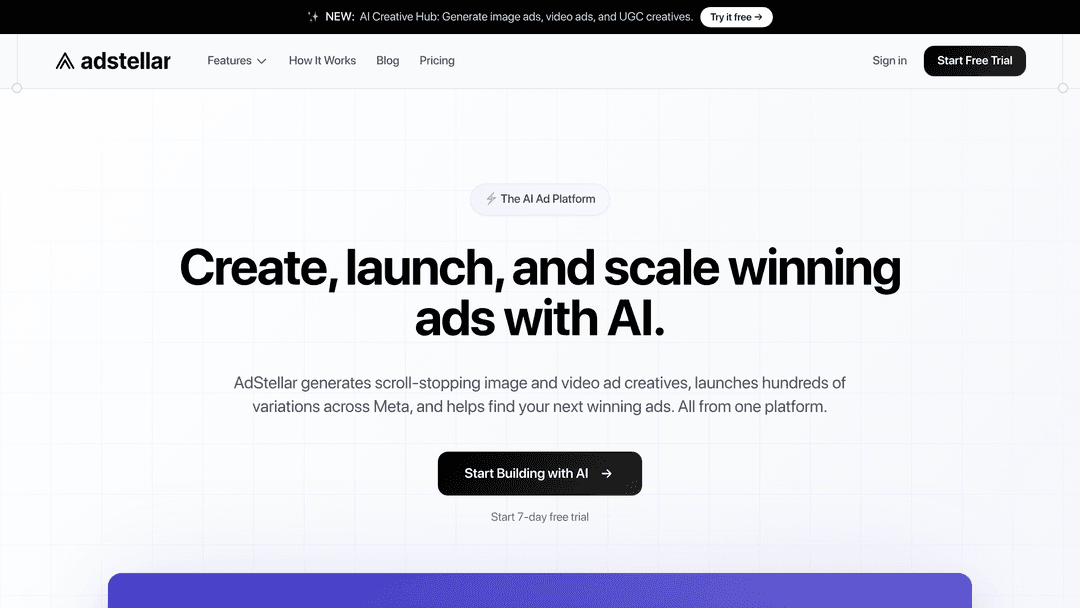
Image Ad Generation
AdStellar's image ad creation starts with your product URL or existing assets. The platform analyzes your product information and generates complete static ad creatives with professional design layouts, compelling headlines, and ad copy variations. You can specify the visual style, messaging angle, and design preferences, then receive multiple creative options within minutes.
The advantage goes beyond speed. Each generated image ad comes as a complete package with matched headlines and copy, ensuring visual and messaging consistency. You can edit any element through conversational prompts, requesting changes like "make the headline more benefit-focused" or "adjust the color scheme to match our brand guidelines" without needing design software skills.
For testing purposes, you can generate dozens of image variations that explore different value propositions, visual approaches, and messaging frameworks. This systematic variety is what enables the bulk testing strategy covered earlier. Instead of creating five image ads manually and hoping one works, you can generate 30 variations that test different combinations of benefits, emotional triggers, and visual styles, then let performance data reveal which approaches resonate with your audience.
Video Ad Creation
Video consistently outperforms static images in Facebook advertising, but video production traditionally requires significantly more resources. AdStellar's video generation capability removes this barrier by creating professional video ads from the same product information you use for image ads.
The platform offers multiple video formats to match different campaign objectives. You can generate product showcase videos that highlight features and benefits, transformation-style videos that demonstrate before-and-after results, or announcement videos for launches and promotions. Each video includes motion graphics, text overlays, music, and professional transitions that create polished output without video editing experience.
What makes this particularly valuable for testing is the ability to create video variations at scale. You might generate one video emphasizing product features, another focusing on customer outcomes, and a third highlighting competitive advantages. Testing these different narrative frameworks helps you understand which stories drive the strongest response from your target audience, insights that inform not just your video strategy but your entire marketing messaging.
The video creation process integrates with the same bulk launching capabilities used for image ads. You can include video variations in your bulk tests alongside static images, comparing format performance while testing messaging and audience combinations simultaneously. This comprehensive testing approach surfaces insights about both what you say and how you present it.
UGC-Style Avatar Ads
AdStellar's AI avatar feature addresses one of the most effective yet resource-intensive ad formats: user-generated content. The platform provides realistic digital presenters who can deliver scripted content in a conversational, authentic style that mirrors genuine customer testimonials and product reviews.
Creating UGC-style ads through AdStellar starts with script development. You can write your own scripts or use AI assistance to generate natural-sounding copy that feels like organic recommendations rather than promotional content. The platform offers diverse avatar options representing different demographics, allowing you to match presenters to your target audience for maximum relatability.
The key to effective UGC-style content is authenticity in delivery. The avatars can present product demonstrations, share testimonial-style experiences, or explain benefits in casual language that resonates with audiences seeking genuine recommendations. You maintain complete control over the messaging while achieving the authentic feel that makes UGC content perform well.
Testing different avatar presenters, scripts, and presentation styles follows the same systematic approach as other creative formats. You might generate versions with different presenters to see which personality type your audience responds to, or test various script angles to identify which benefit-focused narratives drive the strongest conversions. This testing capability transforms UGC from a single creative approach into a testable framework with multiple variations.
Cross-Format Campaign Building
The real power emerges when you combine these capabilities within integrated campaigns. AdStellar enables you to build campaigns that test image ads against video ads against UGC content, all while varying headlines, copy, and audiences across formats. This comprehensive testing reveals not just which creative performs best, but which format works best for your specific product and audience.
You might discover that image ads drive the lowest cost per click but video ads generate higher quality conversions, or that UGC-style content outperforms polished brand videos for certain audience segments. These insights inform how you allocate creative resources and budget across formats, optimizing not just individual ads but your entire creative strategy.
The platform's performance scoring then ranks all these elements, regardless of format, against your campaign goals. Your winners hub might reveal that a specific UGC script outperforms everything else, or that certain image layouts consistently drive results across different products. These proven elements become the foundation for your next campaigns, creating the continuous improvement loop that separates scaling advertisers from those stuck in constant experimentation.
By centralizing image, video, and UGC creation in a single platform, you eliminate the workflow friction that normally limits testing volume. Instead of juggling multiple tools, coordinating with different creators, and managing assets across platforms, you generate comprehensive creative variations, launch them systematically, and analyze performance holistically. This integrated approach transforms AI creative from a production tool into a complete testing and optimization system.
Implementation Steps
1. Input your product page URL into an AI creative platform that supports URL-based generation.
2. Review the AI-generated creative options, which typically include multiple visual styles, headlines, and copy variations based on different marketing angles.
3. Select the creatives that best align with your campaign goals and brand voice, making minor adjustments if needed through chat-based editing.
4. Launch these variations into your Facebook campaign to begin testing which approaches resonate most with your target audience.
Pro Tips
Ensure your product page is optimized before using it for AI generation. Clear product images, detailed descriptions, and well-defined value propositions give the AI better source material to work with. Test creatives that emphasize different product benefits rather than just visual variations, as the messaging angle often matters more than the design style.
2. Clone and Improve Competitor Ad Strategies
The Challenge It Solves
Figuring out what creative approaches work in your market requires expensive trial and error. You could spend thousands testing different styles, messages, and formats before discovering what resonates. Meanwhile, your competitors may have already invested that time and budget to find winning formulas. The traditional approach to competitive research involves manual screenshots, design recreation, and guesswork about what made their ads successful.
The Strategy Explained
AI-powered competitor ad cloning lets you identify successful ads in Meta's Ad Library and recreate similar creatives for your own products. This isn't about copying ads verbatim but understanding the strategic elements that make them work: the visual style, the messaging framework, the value proposition structure, and the overall creative approach.
Advanced AI tools can analyze competitor ads and generate new creatives that adopt the same successful patterns while featuring your products and brand. You're essentially starting your testing from a proven baseline rather than from zero, dramatically reducing the time to find winning creative approaches. An AI Facebook ad strategist can automate this competitive intelligence and apply it directly to your campaigns.
Implementation Steps
1. Research competitors in Meta's Ad Library to identify ads that have been running consistently for weeks or months, which signals strong performance.
2. Use AI creative tools that support competitor ad cloning to analyze the successful ad's structure, style, and messaging approach.
3. Generate new creatives that apply the same strategic framework to your products, maintaining the elements that likely contribute to the competitor's success.
4. Test these AI-generated variations against your standard creatives to validate whether the competitor's approach works for your audience.
Pro Tips
Look for competitor ads that have been active for at least 30 days, as this indicates sustained performance rather than short-term testing. Pay attention to the specific benefits they emphasize and the emotional triggers they use, not just the visual design. The messaging strategy often matters more than the aesthetic when recreating successful approaches for your brand.
3. Create UGC-Style Ads Without Hiring Creators
The Challenge It Solves
User-generated content consistently outperforms polished brand ads because it feels authentic and trustworthy. The problem? Sourcing real UGC requires finding creators, negotiating rates, coordinating content production, managing revisions, and dealing with usage rights. For many marketers, especially those with limited budgets or quick turnaround needs, this process is simply not feasible at the scale required for effective testing.
The Strategy Explained
AI avatar technology now enables you to create UGC-style video ads featuring realistic digital presenters who showcase your products. These AI-generated videos maintain the authentic, casual feel of real user content without the logistics of hiring creators. The avatars can speak scripted copy, demonstrate products, and deliver testimonial-style messages that resonate with audiences looking for genuine recommendations.
This approach gives you the conversion benefits of UGC content with the speed and control of AI generation. You can create multiple variations with different presenters, scripts, and product angles in the time it would take to coordinate with a single creator. Mastering AI copywriting for Facebook ads ensures your avatar scripts sound natural and drive conversions.
Implementation Steps
1. Select AI avatar options that match your target audience demographics and create authentic-feeling presentations.
2. Develop scripts that sound conversational and genuine, avoiding overly promotional language that would undermine the UGC feel.
3. Generate video variations featuring different avatars, scripts, and product demonstrations to test which combinations perform best.
4. Launch these UGC-style videos alongside your traditional creatives to compare performance and identify whether the authentic approach drives better results.
Pro Tips
Keep scripts natural and conversational. The best UGC-style content sounds like a friend recommending a product, not a brand selling one. Test different avatar personalities to see which resonates most with your audience. Some products work better with enthusiastic presenters while others benefit from more subdued, informative delivery.
4. Launch Bulk Ad Variations to Find Winners Faster
The Challenge It Solves
Finding winning ad combinations requires testing multiple variables: different creatives, various headlines, alternative copy, and diverse audiences. Creating these combinations manually is tedious and time-consuming. Building each ad set individually means you're likely testing far fewer variations than you should, which slows down the discovery of high-performing combinations and limits your ability to scale successful campaigns.
The Strategy Explained
Bulk ad launching allows you to create hundreds of ad variations by mixing and matching your creative elements at both the ad set and ad level. Instead of manually building each combination, you select your creatives, headlines, copy variations, and audiences, and the system generates every possible combination automatically. This exponentially increases your testing capacity without proportionally increasing your workload.
The power of this approach lies in systematic exploration. When you test 200 combinations instead of 20, you're far more likely to discover unexpected winners. Maybe a specific headline works brilliantly with one creative but poorly with another. Facebook ads bulk creation surfaces these insights that manual campaign building would miss.
Implementation Steps
1. Prepare your testing elements: multiple creatives, several headline variations, different copy options, and target audiences you want to test.
2. Use a bulk launching tool to select which elements you want to combine at the ad set level versus the ad level for proper testing structure.
3. Generate all combinations and review the campaign structure before launching to ensure it aligns with your testing strategy and budget allocation.
4. Launch the bulk campaign and monitor initial performance to identify which combinations are generating the best results within your first few days.
Pro Tips
Start with a focused test rather than trying to combine every possible element. Testing five creatives with three headlines and two audiences creates 30 combinations, which is manageable. Be strategic about budget allocation across your bulk tests to ensure each combination gets enough spend to generate meaningful data before you make optimization decisions.
5. Use AI Performance Scoring to Prioritize Top Creatives
The Challenge It Solves
When you're running campaigns with dozens or hundreds of ad variations, identifying your best performers becomes overwhelming. You're looking at multiple metrics across different ad sets, trying to determine which creatives, headlines, and audiences are actually driving results. Manual analysis is slow and prone to missing patterns, especially when high-performing elements are scattered across various campaigns.
The Strategy Explained
AI performance scoring automatically ranks every element of your campaigns against your specific goals. Instead of manually comparing metrics, the AI evaluates each creative, headline, copy variation, audience, and landing page based on the outcomes that matter to you, whether that's ROAS, CPA, CTR, or conversion rate. It creates leaderboards that instantly show you what's working and what's not.
This systematic scoring does more than save time. It reveals insights you might miss through manual analysis, like a specific headline that consistently outperforms others across multiple creatives, or an audience segment that drives higher quality conversions even if the initial CTR is lower. Effective Meta ads optimization relies on this kind of data-driven creative prioritization.
Implementation Steps
1. Define your primary campaign goals and target metrics so the AI knows what performance indicators to prioritize in its scoring.
2. Set your benchmark thresholds for what constitutes good performance based on your historical data or industry standards.
3. Review the AI-generated leaderboards that rank your creatives, headlines, audiences, and other elements by actual performance against your goals.
4. Use these insights to scale spending on top performers and eliminate or revise underperforming elements quickly.
Pro Tips
Don't just look at overall scores. Examine performance patterns across different audience segments, as a creative might excel with one demographic while underperforming with another. Regularly update your benchmark goals as your campaigns mature and performance improves, ensuring the AI continues to push you toward better results rather than settling for "good enough."
6. Build Campaigns with AI That Learns from Your History
The Challenge It Solves
Every campaign you've run contains valuable lessons about what works for your business, but extracting and applying those insights is difficult. You might remember that certain headlines performed well or that specific audiences converted better, but translating that knowledge into optimized new campaigns requires analyzing historical data, identifying patterns, and making strategic decisions about what to test next.
The Strategy Explained
AI campaign builders analyze your entire advertising history to identify what has driven results in the past. They examine which creatives generated the highest engagement, which headlines led to conversions, which audiences responded best, and which combinations of elements produced the strongest ROAS. Using these insights, the AI builds complete campaigns that incorporate your proven winners while suggesting strategic variations to test.
What sets advanced AI campaign builders apart is transparency. Rather than just outputting recommendations, they explain the rationale behind every decision. You understand why the AI selected specific creatives, chose particular audiences, or recommended certain budget allocations. This is the foundation of an intelligent Meta ads platform that creates a learning loop where you're not just executing AI suggestions but understanding the strategic thinking that drives them.
Implementation Steps
1. Connect your historical campaign data to an AI campaign builder that can analyze past performance across all your advertising efforts.
2. Review the AI's analysis of your top-performing elements, understanding which creatives, headlines, audiences, and strategies have driven the best results.
3. Use the AI to build new campaigns that incorporate these proven elements while introducing strategic variations to test new approaches.
4. Examine the AI's rationale for each recommendation to understand the strategy, not just execute the tactics, building your own expertise over time.
Pro Tips
The AI gets smarter with each campaign you run, so consistency matters. The more data you feed the system, the better its recommendations become. Don't ignore the AI's explanations for its choices. Understanding why certain elements are recommended helps you make better manual decisions when needed and builds your strategic thinking about what drives performance in your specific market.
7. Organize and Reuse Your Winning Creative Elements
The Challenge It Solves
Your best-performing creatives, headlines, and audiences are scattered across multiple campaigns, making them difficult to find and reuse when building new ads. You might remember that a specific image worked well three months ago, but locating it and understanding exactly why it performed requires digging through old campaigns and analyzing historical data. This friction means you're often starting from scratch rather than building on proven success.
The Strategy Explained
A centralized winners hub automatically collects and organizes all your top-performing elements in one accessible location. Instead of hunting through campaign archives, you can instantly see your best creatives, highest-converting headlines, most effective copy variations, and strongest audiences, all ranked by actual performance data. When building new campaigns, you simply select from these proven winners rather than guessing what might work.
This approach transforms your advertising workflow from constant experimentation to strategic iteration. You're building each new campaign on a foundation of validated elements while testing new variations to expand your library of winners. Implementing Facebook campaign automation ensures this process happens systematically, creating a compounding advantage where your creative options improve with every campaign you run.
Implementation Steps
1. Set up a system that automatically identifies and saves your top-performing elements based on your defined success metrics.
2. Review your winners hub regularly to understand which types of creatives, messaging approaches, and audiences consistently deliver results.
3. When building new campaigns, start by selecting proven elements from your winners hub rather than creating everything from scratch.
4. Continue testing new variations alongside your winners to expand your library of high-performing elements over time.
Pro Tips
Don't just save individual elements. Note which combinations performed exceptionally well, as the interaction between creative, headline, and audience often matters more than any single component. Regularly refresh your winners by retesting older top performers, as audience preferences and market conditions change. What worked brilliantly six months ago might need updating to maintain its effectiveness.
Putting It All Together
The strategies above share a common thread: they use AI to eliminate bottlenecks in your advertising workflow while amplifying your ability to test, learn, and scale. The marketers seeing the strongest results aren't using AI to replace their strategic thinking. They're using it to execute their strategies faster and at greater scale than manual processes allow.
Start with the approach that addresses your biggest current challenge. If creative production is your bottleneck, begin with URL-based generation or competitor cloning to accelerate asset creation. If you're struggling to identify what's working across large campaigns, prioritize AI scoring and winner organization. If you're launching new campaigns too slowly, focus on bulk testing and AI campaign building.
The key is treating these strategies as a system rather than isolated tactics. Generate more creative variations with AI, launch them efficiently through bulk testing, identify winners through AI scoring, and organize those winners for reuse in future campaigns. Each strategy reinforces the others, creating a continuous improvement loop that gets stronger with every campaign you run.
What separates successful Facebook advertisers from those burning budgets without results is not just better creatives but better systems for creating, testing, and scaling those creatives. AI gives you the tools to build those systems. The question is which strategy you'll implement first.
Ready to transform your advertising strategy? Start Free Trial With AdStellar and be among the first to launch and scale your ad campaigns 10× faster with our intelligent platform that automatically builds and tests winning ads based on real performance data.