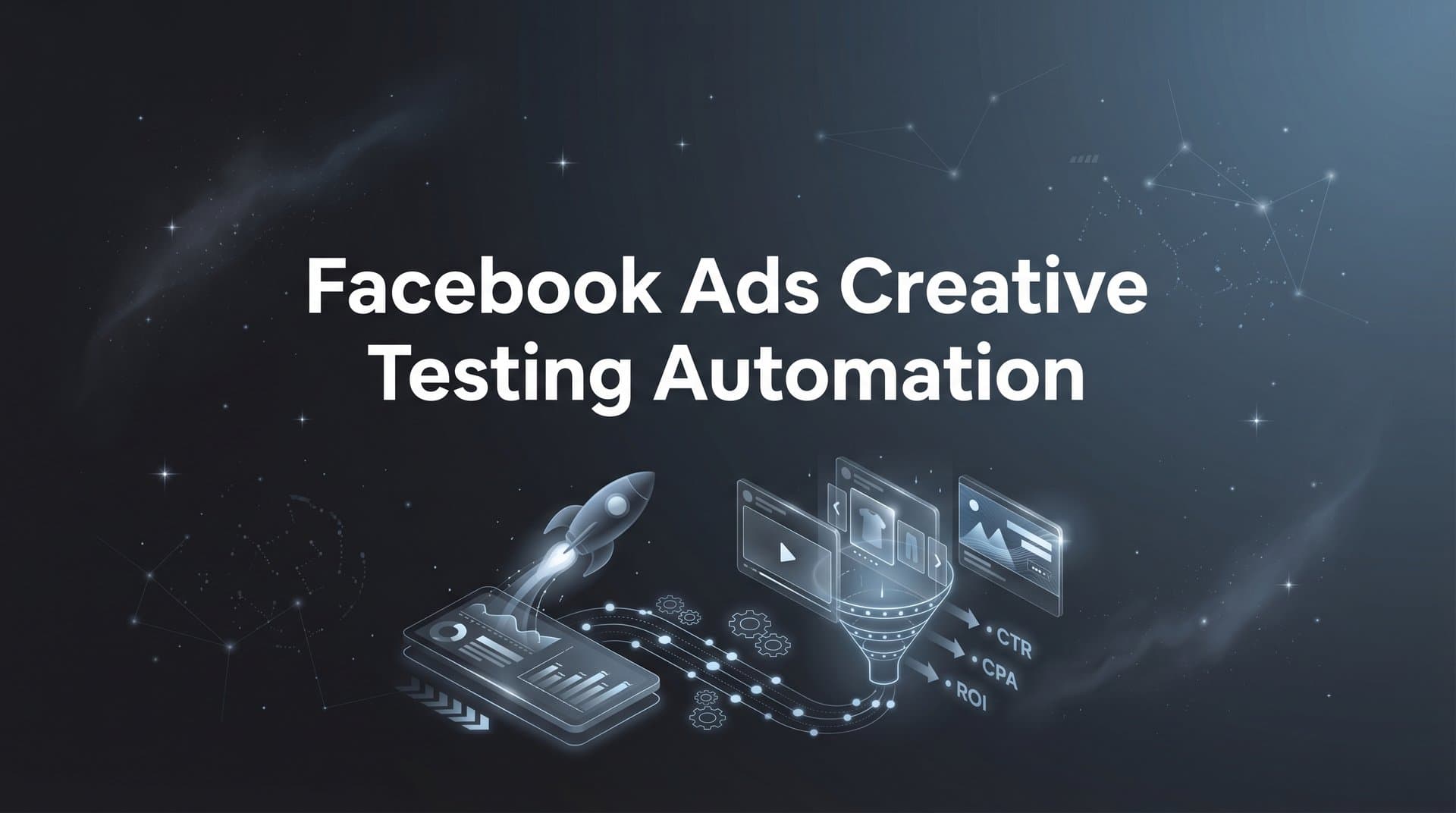
Manual creative testing is a time drain that holds back even the best performance marketers. You launch a handful of ad variations, wait days for meaningful data, then repeat the cycle hoping to find a winner before budget runs dry. Facebook ads creative testing automation changes this equation entirely. Instead of testing five creatives at a time, you can systematically evaluate dozens or hundreds of variations while AI handles the heavy lifting of analysis and optimization.
This guide breaks down seven battle-tested strategies for automating your creative testing workflow. Whether you are running campaigns for an ecommerce brand, a SaaS company, or a marketing agency managing multiple clients, these approaches will help you find winning creatives faster while freeing up hours of manual work each week.
1. Build a Systematic Creative Variation Framework
The Challenge It Solves
Most marketers test creatives randomly, changing multiple elements at once without any structured approach. This makes it impossible to identify which specific variable drove performance improvements or failures. You end up with data that tells you an ad worked or did not work, but provides zero insight into why.
A systematic variation framework isolates single variables so you can pinpoint exactly what resonates with your audience. This transforms creative testing from guesswork into a scientific process that compounds learning over time.
The Strategy Explained
Start by breaking down your ads into testable components: headline, primary text, image or video creative, call-to-action button, and landing page. For each campaign, decide which single variable you want to test while keeping all other elements constant.
Use clear naming conventions that make automated analysis possible. For example, name your ad sets with structured tags like "Audience_Creative_Headline" so reporting tools can automatically group and compare performance. This structure allows AI systems to identify patterns across hundreds of variations without manual sorting.
The key is consistency. When you test headlines, use the exact same creative and audience across all variations. When you test images, keep headlines and copy identical. This isolation principle is what separates productive testing from noise and addresses the common Facebook ads creative testing bottleneck that slows down most campaigns.
Implementation Steps
1. Create a testing matrix spreadsheet with columns for each variable (creative type, headline variation, audience segment, copy angle) and mark which element you are testing in each campaign batch.
2. Develop a naming convention standard for your team that includes campaign objective, test variable, and variation number (example: "Conversion_Image_V1" or "Awareness_Headline_V3").
3. Set up template campaigns with your control elements already in place so you can quickly swap in test variables without rebuilding campaigns from scratch.
Pro Tips
Document your testing calendar so you know which variables you have already tested and which need attention. Many performance marketers find that rotating through different test variables each week prevents testing fatigue while maintaining momentum. Start with the elements that typically have the biggest impact: creative format and headline variations.
2. Leverage AI-Generated Creatives at Scale
The Challenge It Solves
Creative production has traditionally been the biggest bottleneck in testing velocity. You need designers for image ads, video editors for motion content, and actors or creators for UGC-style videos. This production pipeline means you can only test as many creatives as your team can physically produce, which severely limits your optimization potential.
AI creative generation removes this constraint entirely. You can produce dozens of variations in the time it previously took to create one ad, dramatically increasing your testing throughput without expanding your team.
The Strategy Explained
Modern AI platforms can generate scroll-stopping image ads, video ads, and UGC-style avatar content directly from a product URL or brief description. You can also clone competitor ads from the Meta Ad Library to quickly test proven approaches in your own campaigns.
The real power comes from combining AI generation with your variation framework. Generate multiple image styles for the same product, create video variations with different hooks, or produce UGC-style content with different messaging angles. Using an AI creative generator for Facebook ads allows you to launch all variations simultaneously to identify what resonates fastest.
Think of AI creative generation as your testing fuel. The more variations you can produce, the more hypotheses you can test, and the faster you will find winners that scale.
Implementation Steps
1. Start by generating 10-15 image ad variations for your best-selling product or core offer, testing different visual styles (lifestyle shots, product close-ups, benefit-focused graphics).
2. Use competitor ad cloning to replicate successful approaches from your industry, then customize them with your brand elements and unique value propositions.
3. Create video variations with different opening hooks (first 3 seconds) while keeping the core message consistent to test which patterns stop the scroll most effectively.
Pro Tips
Use chat-based editing to refine AI-generated creatives without starting from scratch. If an image is 80% right but needs a background change or text adjustment, iterative editing is faster than regenerating. Many marketers find that combining AI-generated foundations with human refinement produces the best results while maintaining high testing velocity.
3. Implement Goal-Based Scoring for Objective Winner Selection
The Challenge It Solves
Subjective winner selection kills testing programs. One team member thinks the ad with the highest click-through rate won, another focuses on cost per acquisition, and a third prioritizes return on ad spend. Without clear benchmarks, you end up debating which metric matters most instead of scaling what works.
Goal-based scoring eliminates this ambiguity by defining success upfront and automatically ranking every creative element against your specific performance targets.
The Strategy Explained
Set concrete performance benchmarks for your key metrics before launching tests. For example, you might define a winning creative as one that achieves a $25 CPA or lower, a 2.5x ROAS or higher, and a 1.2% CTR minimum. AI scoring systems then evaluate every creative, headline, audience, and landing page against these thresholds.
This creates an objective leaderboard where you can instantly see which elements are hitting your targets and which are underperforming. No more spreadsheet analysis or gut-feel decisions. The data tells you exactly what qualifies as a winner based on the goals that matter to your business.
The real advantage comes when you apply these scores across multiple campaigns. You start to see patterns in which creative styles, messaging angles, or audience segments consistently score well, informing your entire creative strategy. Following Facebook ads best practices automation ensures these scoring systems work effectively at scale.
Implementation Steps
1. Define your primary success metric (ROAS, CPA, conversion rate) and set a specific numerical target that represents a winning performance level for your business model.
2. Add secondary metrics that provide context (CTR, CPM, engagement rate) with their own threshold values to create a multi-dimensional scoring system.
3. Configure automated scoring that updates daily so you can identify winners and losers as soon as statistical significance is reached, typically within 3-5 days of launching tests.
Pro Tips
Adjust your benchmarks as you accumulate data. Your initial targets might be conservative estimates, but as you discover what is actually achievable in your account, raise the bar. This continuous improvement approach prevents you from settling for "good enough" when better performance is possible.
4. Create a Winners Hub for Continuous Learning
The Challenge It Solves
Most marketers discover winning creatives, headlines, or audiences, then promptly forget about them when building the next campaign. They start from scratch each time instead of leveraging proven elements. This means you are constantly reinventing the wheel rather than compounding your learnings.
A centralized winners hub solves this by capturing your best-performing elements with real performance data so you can instantly reuse them in future campaigns.
The Strategy Explained
Think of your winners hub as a library of proven assets. Every time a creative scores above your benchmarks, it gets automatically added to the hub with its performance metrics attached. Same for headlines that drive conversions, audiences that engage, and landing pages that convert.
When you build your next campaign, you start by browsing your winners hub instead of brainstorming from zero. Effective Facebook ads creative library management means you can grab a proven headline from last month, pair it with a new creative variation, and test it against a winning audience from a different campaign. This mix-and-match approach dramatically increases your odds of launching winners because you are building on validated foundations.
The hub also reveals patterns over time. You might notice that benefit-focused headlines consistently outperform feature lists, or that lifestyle imagery beats product shots across multiple tests. These insights inform your entire creative strategy.
Implementation Steps
1. Set up automatic tagging rules that flag any creative, headline, or audience that exceeds your goal-based scoring thresholds and adds them to a centralized repository.
2. Organize your winners hub by category (creatives, headlines, audiences, copy angles) and include key performance metrics (ROAS, CPA, CTR) so you can quickly identify your strongest performers.
3. Review your winners hub weekly to identify patterns and refresh your creative production priorities based on what is actually working in-market.
Pro Tips
Date-stamp your winners so you can track how long elements remain effective. Some creatives have staying power for months, while others experience creative fatigue within weeks. Understanding these lifecycles helps you plan refresh cycles before performance drops.
5. Automate Audience and Creative Pairing Tests
The Challenge It Solves
A creative that crushes it with one audience segment might completely flop with another. Most marketers test creatives against a single broad audience, missing the nuanced insights about which messages resonate with which customer types. This leaves significant performance gains on the table.
Automated pairing tests solve this by systematically matching every creative variation with multiple audience segments, revealing resonance patterns you would never discover through sequential testing.
The Strategy Explained
Instead of testing five creatives against one audience, you test those same five creatives against four different audience segments simultaneously. This creates a matrix of 20 combinations that run in parallel, quickly revealing which creative-audience pairings deliver the best results.
You might discover that your benefit-focused creative performs best with cold audiences while your social proof creative converts better with retargeting segments. Or that younger demographics respond to UGC-style videos while older audiences prefer polished product demonstrations. These insights allow you to optimize creative selection at the audience level rather than using one-size-fits-all approaches.
Bulk launching capabilities make this practical. Using an automated Facebook ads testing platform allows you to generate every combination and deploy them to Meta in minutes rather than spending hours manually duplicating ad sets.
Implementation Steps
1. Identify 3-4 distinct audience segments to test (cold prospecting, website visitors, email subscribers, past purchasers) that represent different stages of customer awareness.
2. Select 5-8 creative variations that represent different messaging angles or visual approaches you want to evaluate.
3. Use bulk ad launching to create every possible combination of creative and audience at the ad set level, ensuring each pairing gets its own budget and can be measured independently.
Pro Tips
Start with your most important audience segments first. If retargeting drives 70% of your revenue, prioritize finding the best creatives for that audience before expanding to colder segments. Many performance marketers find that optimizing high-intent audiences first provides quick wins while you gather data on top-of-funnel tests.
6. Set Up Automated Performance Alerts and Reporting
The Challenge It Solves
Manual monitoring is impossible at scale. When you are testing dozens of creative variations across multiple campaigns, you cannot realistically check performance dashboards every few hours. Winners go unscaled and losers burn budget while you are focused elsewhere.
Automated alerts and real-time leaderboards surface critical changes the moment they happen, allowing you to capitalize on winners and cut losers without constant manual surveillance.
The Strategy Explained
Configure performance alerts that notify you when specific conditions are met. For example, get an alert when any creative exceeds a 3x ROAS after spending $200, or when an ad set drops below a 0.8% CTR. These triggers let you respond immediately rather than discovering opportunities or problems days later during your weekly review.
Pair alerts with automated leaderboard rankings that continuously update to show your top and bottom performers across every dimension: best creatives, worst audiences, highest converting headlines, most expensive landing pages. Implementing Facebook ads workflow automation creates a live performance dashboard that requires zero manual data manipulation.
The combination means you always know what is working and what is not, without spending hours in spreadsheets or analytics platforms.
Implementation Steps
1. Define your critical performance thresholds for both positive alerts (winner identified) and negative alerts (underperformer detected) based on your goal-based scoring benchmarks.
2. Set up real-time leaderboards that rank creatives, headlines, audiences, and copy by your primary success metric, updating automatically as new performance data flows in.
3. Configure alert delivery methods (email, Slack, dashboard notifications) that fit your workflow so you see important updates without alert fatigue from non-critical changes.
Pro Tips
Use different alert thresholds for different campaign objectives. Awareness campaigns might trigger alerts at different CTR levels than conversion campaigns. Customize your monitoring to match the goals of each campaign type rather than applying universal rules that create noise.
7. Build a Feedback Loop That Improves Over Time
The Challenge It Solves
Most creative testing programs treat each campaign as an isolated event. You launch tests, identify winners, scale them, then start fresh next month without systematically applying the lessons learned. This prevents your testing program from getting smarter over time.
Continuous learning systems solve this by analyzing historical campaign data to inform new creative decisions, creating a compounding improvement effect where each test makes future tests more effective.
The Strategy Explained
AI systems can analyze every campaign you have ever run to identify patterns in what works. They rank every creative element, headline variation, audience segment, and copy angle by performance, then use these insights to recommend the highest-probability approaches for new campaigns.
For example, if the AI notices that your ads featuring customer testimonials consistently outperform product-focused ads by 40%, it will prioritize testimonial-based creatives in future campaign builds. Understanding campaign learning Facebook ads automation helps you leverage these patterns effectively. If certain headline formulas repeatedly drive conversions, those patterns inform new headline generation.
This creates a self-improving system where your creative testing gets more accurate over time. Your tenth campaign benefits from the learnings of the previous nine, dramatically increasing your hit rate on new creative launches.
Implementation Steps
1. Ensure all historical campaign data is properly tagged and accessible so AI systems can analyze past performance patterns across your entire advertising history.
2. Enable AI analysis of your top-performing campaigns to identify common elements (visual styles, messaging angles, offer types) that consistently drive results.
3. Use AI recommendations when building new campaigns, starting with the highest-ranked creative approaches and audience combinations based on your historical data.
Pro Tips
Review the AI rationale for its recommendations to understand the patterns it is identifying. This transparency helps you learn what actually drives performance in your account rather than blindly following suggestions. The best results come from combining AI pattern recognition with human strategic thinking about market positioning and brand goals.
Putting It All Together
Implementing facebook ads creative testing automation is not about replacing human creativity. It is about removing the manual bottlenecks that prevent you from testing at the velocity your campaigns demand.
Start with strategy one by building your variation framework. This foundation ensures every test you run produces actionable insights rather than ambiguous results. Then layer in AI-generated creatives to increase your testing volume beyond what any human team could manually produce.
As you accumulate data, goal-based scoring and a winners hub will compound your learnings over time. You will stop starting from scratch with each campaign and begin building on proven foundations. Automated audience-creative pairing tests reveal nuances about message-market fit that sequential testing would take months to uncover.
Performance alerts keep you responsive without requiring constant monitoring, while continuous learning systems ensure each campaign improves on the last. The marketers seeing the best results are those who treat creative testing as a system rather than a series of one-off experiments.
With the right automation in place, you can test more variations, find winners faster, and scale what works without burning out your team or your budget. The velocity advantage compounds over time as your testing system gets smarter and your winners hub grows richer with proven assets.
Ready to transform your advertising strategy? Start Free Trial With AdStellar and be among the first to launch and scale your ad campaigns 10× faster with our intelligent platform that automatically builds and tests winning ads based on real performance data.