
In a world of fragmented user journeys, privacy changes, and countless channels, knowing what's truly driving growth is a massive challenge. Platform-reported metrics from Google and Meta are a starting point, but they don't tell the whole story. This creates a critical gap for marketers: How do you confidently allocate budget, optimize campaigns, and prove ROI? The right marketing analytics companies don't just provide dashboards; they deliver a source of truth.
They stitch together data from disparate sources, apply advanced attribution models, and give you the clarity needed to make smarter, faster decisions. This guide cuts through the noise, evaluating 12 of the top solutions-including Northbeam, Triple Whale, Funnel, and Supermetrics-to help you find the perfect fit for your business. For a foundational overview of the discipline, our guide to SMB marketing analytics covers essential strategies for growth.
We'll examine each platform's core features, ideal customer profile, and pricing to help you find the best partner whether you're a DTC brand, a B2B SaaS company, an agency, or a mobile-first app. Each entry includes direct links and analysis to make your evaluation process simple and effective.
1. AdStellar AI
AdStellar AI operates as a specialized intelligence layer for Meta advertising, making it a powerful tool for performance marketers and agencies. Rather than offering broad, multi-channel dashboards, it focuses entirely on automating the creation, testing, and scaling of Meta campaigns. This dedicated approach allows it to deliver significant speed gains, promising up to 10× faster campaign production by replacing tedious manual setup with repeatable, data-backed execution.

Its core function is to ingest historical performance data directly from your Meta Ads Manager via a secure OAuth connection. The platform’s AI then analyzes this information to identify your top-performing creatives, copy, and audiences. Among marketing analytics companies, AdStellar stands out by translating these insights directly into action. Its AI Launch feature automatically assembles new campaigns using proven winning combinations, removing guesswork from the equation.
Key Features & Use Cases
- Bulk Ad Generation: Quickly create hundreds of ad variations by combining different creatives, copy, and audience segments. This is ideal for A/B testing at a scale that is impractical to do manually.
- Performance-Ranked Insights: The AI Insights module ranks all campaign elements against key metrics like ROAS, CPL, or CPA. This helps you instantly see what works and redirect your budget accordingly.
- Automated Scaling: The system continuously monitors new campaign data, identifies high-performing variants, and can automatically scale them, ensuring you capitalize on emerging opportunities without delay.
- Centralized Workflow: All campaign components, including the media library, audience lists, and performance reports, are managed within a single interface, reducing errors and saving time.
Pros & Cons
| Pros | Cons |
|---|---|
| Massive speed and scale for campaign creation and testing. | Meta-only focus; not suitable for managing other channels like Google Ads or TikTok. |
| Data-driven optimization prioritizes assets based on actual performance (ROAS, CPA). | Results may depend on historical data quality; requires sufficient ad history to be effective. |
| AI Launch and auto-scaling automate the process of building and managing winning campaigns. | Opaque pricing and social proof; details are not publicly available on the website. |
Best for: E-commerce brands, digital marketing agencies, and performance-focused teams who invest heavily in Meta ads and need a faster, more data-driven way to test and scale their campaigns.
Learn more at AdStellar.ai
2. Rockerbox
Rockerbox offers a centralized measurement platform that combines multi-touch attribution (MTA), marketing mix modeling (MMM), and incrementality testing. It is designed for brands that manage complex, multi-channel advertising spends, including paid social, display, and offline media, and need to triangulate their measurement strategies for a complete view of performance. The platform unifies data from over 100 integrations to provide de-duplicated, user-level path analysis.
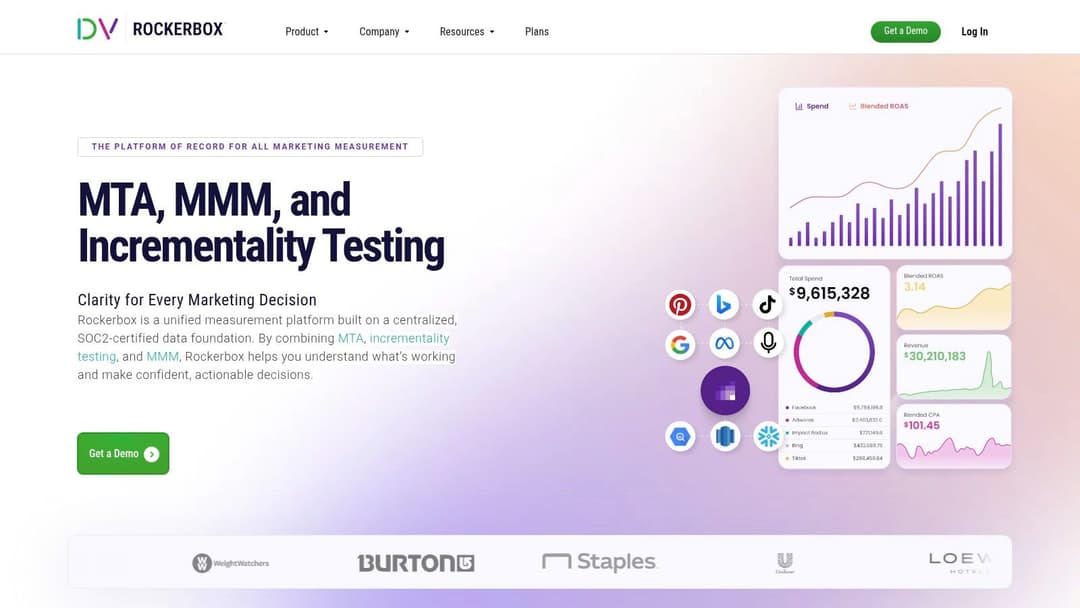
Among marketing analytics companies, Rockerbox stands out by merging multiple measurement models into a single product. This allows marketing teams to conduct high-velocity experiments and understand campaign effectiveness across the entire funnel. For example, a DTC brand can use MTA to see the customer journey and then validate those findings with an incrementality test to confirm a specific channel's true contribution. The platform also offers data-warehouse-friendly exports to services like BigQuery and Snowflake.
Key Details & Considerations
- Best For: E-commerce brands and multi-channel advertisers requiring a unified measurement view.
- Pricing: Not publicly available; pricing is determined through a sales-led process.
- Pros: Excellent for complex ad spends and continuous experimentation; strong documentation supports workflow.
- Cons: Implementation can be a significant undertaking; requires dedicated resources to operate effectively.
3. Northbeam
Northbeam offers a marketing intelligence platform focused on attribution for e-commerce and direct-to-consumer brands. It provides a centralized view of performance by tracking customer touchpoints across paid and owned channels, such as Meta Ads, Google Ads, and TikTok. The platform is built as a daily decision-support tool for media buyers, helping them understand the full customer journey and distribute credit accurately.
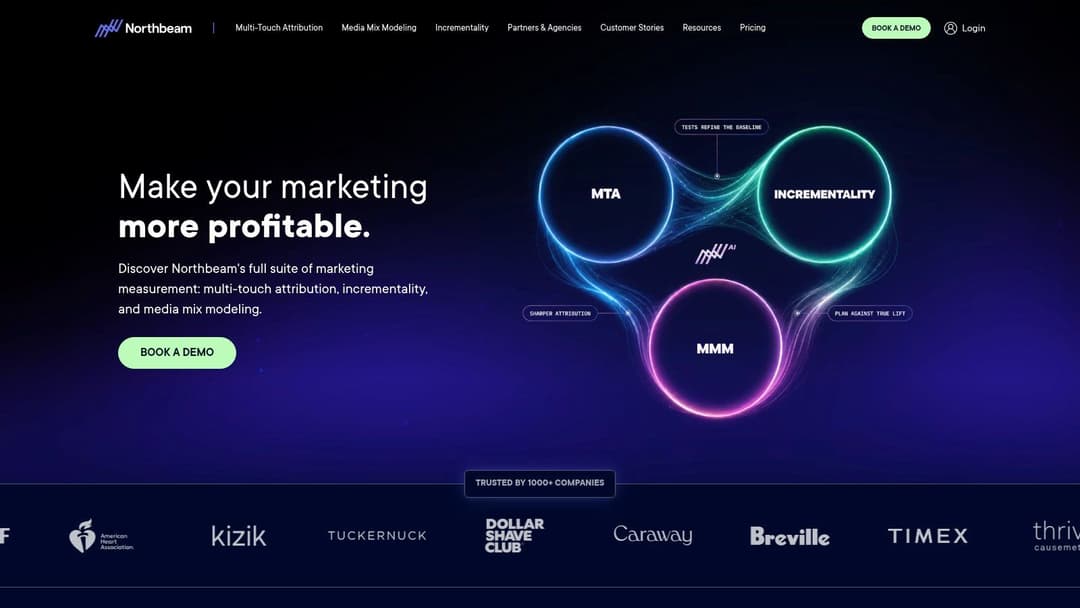
Among marketing analytics companies, Northbeam is noted for its clear, clicks-only attribution model that serves as a default, with other models available for comparison. This transparency helps teams reconcile data discrepancies between ad platforms and their own measurement. Its "Attribution Home" dashboard is designed for daily operational use, while features like benchmarks and forecasting assist with strategic budget allocation. The platform is particularly effective for teams managing significant paid media budgets.
Key Details & Considerations
- Best For: Scaling DTC brands, e-commerce stores, and agencies managing substantial paid media spend.
- Pricing: Not publicly available; custom pricing is provided through a sales-led process based on scale.
- Pros: Purpose-built for paid social and DTC workflows; clear methodology documentation helps interpret data.
- Cons: Pricing can be a barrier for smaller brands; delivers the most value for teams with meaningful ad budgets.
4. Triple Whale
Triple Whale offers an e-commerce-focused analytics suite that combines its first-party pixel with post-purchase surveys to create a blended source of truth. The platform is designed specifically for DTC brands, particularly those running on Shopify, to reconcile platform-reported ad results with first-party tracking and direct customer feedback. It provides dashboards that analyze creative, product, and campaign performance in one place.

Compared to other marketing analytics companies, Triple Whale's unique value is its hybrid model that merges its "Triple Pixel" data with zero-party survey responses. This approach helps fill attribution gaps where click data is unreliable, giving marketers a clearer signal on channels like Meta Ads. For a deeper dive into tools for this specific channel, you can explore other top Meta Ads analytics platforms. The platform's fast setup for Shopify makes it a popular choice for getting day-to-day paid social reporting up and running quickly.
Key Details & Considerations
- Best For: DTC e-commerce brands on Shopify needing a unified view of paid social and ad creative performance.
- Pricing: Revenue-tiered monthly or annual plans are available, with feature access scaling with each tier.
- Pros: Quick Shopify integration and strong daily reporting; the combination of pixel and survey data improves attribution signal.
- Cons: Primarily built for e-commerce, making it less suitable for lead-gen or B2B; costs and features scale with store revenue.
5. HYROS
HYROS provides ad tracking and revenue attribution built for direct-response marketers. It uses server-side tracking and identity resolution to minimize the signal loss often associated with browser-based pixels, especially from platforms like Meta and Google. The system is designed to provide granular, cross-platform reporting with a strong focus on return on ad spend (ROAS) to guide campaign optimization decisions.
Among marketing analytics companies, HYROS distinguishes itself with its deep tracking fidelity and conversion feedback loops. It sends verified conversion data back to ad platforms, which can help improve their native optimization algorithms. For performance marketers, this means more accurate decision-making when scaling campaigns. Getting started requires a full understanding of tracking which ads drive revenue to maximize the platform's value. Advanced automation add-ons like its AIR package further refine campaign management.
Key Details & Considerations
- Best For: Direct-response marketers, e-commerce brands, and agencies focused on ROAS-driven campaign management.
- Pricing: Not publicly available; pricing is custom and requires a demo with their sales team.
- Pros: Known for deep tracking fidelity across channels; strong focus on ROAS-driven campaign optimization.
- Cons: Implementation rigor is required to get full value; onboarding is sales-led and typically requires a demo.
6. Cometly
Cometly is a marketing attribution platform focused on the B2B customer journey, connecting marketing touchpoints with downstream sales and revenue data. It operates "beneath the CRM," stitching together data from ad platforms, your website, and your sales CRM to create a unified view of the account journey. This is particularly effective for B2B SaaS and lead-generation models where the path from initial click to closed-won deal is long and complex.
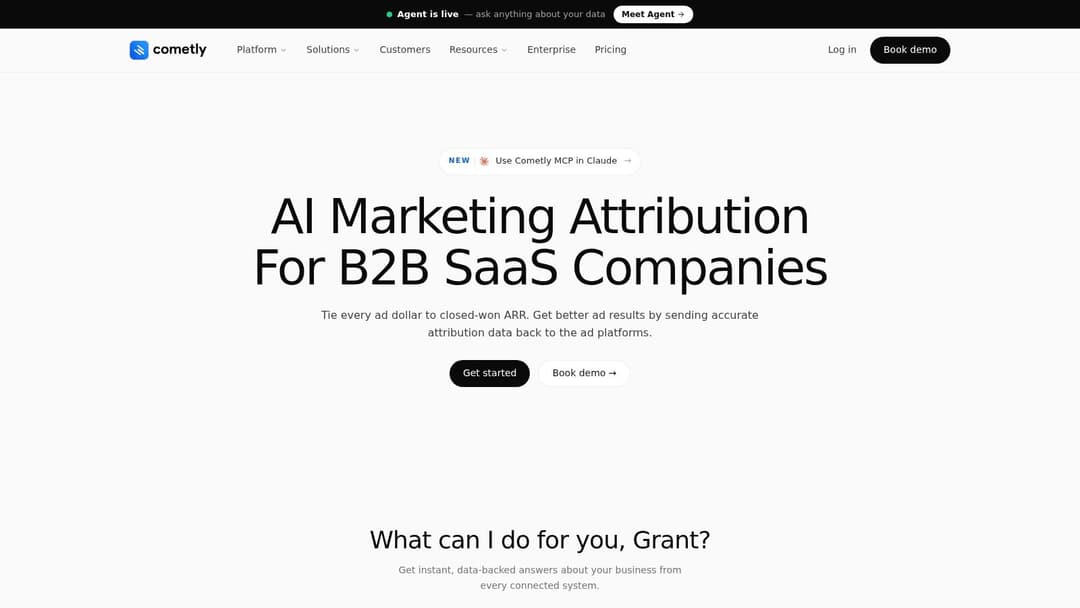
Unlike many marketing analytics companies that center on e-commerce, Cometly excels at mapping pipeline and revenue impact from specific campaigns. It uses multi-touch attribution models and syncs conversion events back to ad networks via their APIs, enabling better ad optimization based on actual revenue, not just lead submissions. For instance, a B2B marketer can see exactly which LinkedIn ad contributed to a high-value enterprise deal that closed three months later, providing true closed-loop reporting.
Key Details & Considerations
- Best For: B2B SaaS and lead-gen businesses needing to connect ad spend to CRM revenue.
- Pricing: Not publicly listed; pricing is customized through a sales consultation and depends on data volume.
- Pros: Strong fit for complex B2B sales cycles; clear documentation on attribution models.
- Cons: Requires end-to-end integration with CRM and product data to realize its full potential.
7. AppsFlyer
AppsFlyer is a leading mobile measurement partner (MMP) focused on app install and in-app event attribution. The platform is designed for mobile-first businesses that need precise measurement across iOS, Android, and CTV, with tools built for privacy-centric frameworks like Apple's SKAdNetwork. It provides detailed dashboards, fraud protection, and deep linking capabilities to help marketers understand the complete mobile user journey.

Among marketing analytics companies, AppsFlyer’s strength lies in its deep specialization in the mobile ecosystem. It is one of the most widely adopted MMPs, making it a standard for mobile growth teams. Its robust support for privacy and SKAdNetwork is essential for anyone advertising on platforms like Meta Ads, and it provides some of the best Meta Ads attribution tools available for mobile campaigns. The platform’s ability to attribute events post-install gives marketers the data needed to optimize for lifetime value, not just initial acquisition.
Key Details & Considerations
- Best For: Mobile app-focused businesses requiring granular install attribution and LTV analysis.
- Pricing: Offers a free "Zero" plan for getting started. Paid plans are based on conversion volume.
- Pros: Considered the industry standard for mobile attribution; broad integration support and mature feature set.
- Cons: Pricing can become expensive as conversion volume scales; less relevant for web-only businesses.
8. Branch
Branch provides enterprise-grade deep linking and mobile attribution for paid and owned channels. Its platform is built for marketers who need to create and measure seamless user journeys from web-to-app, app-to-app, and across various touchpoints like QR codes, email, and social media. Branch unifies cross-platform routing and measurement through a single SDK, making it a critical tool for mobile-first businesses.
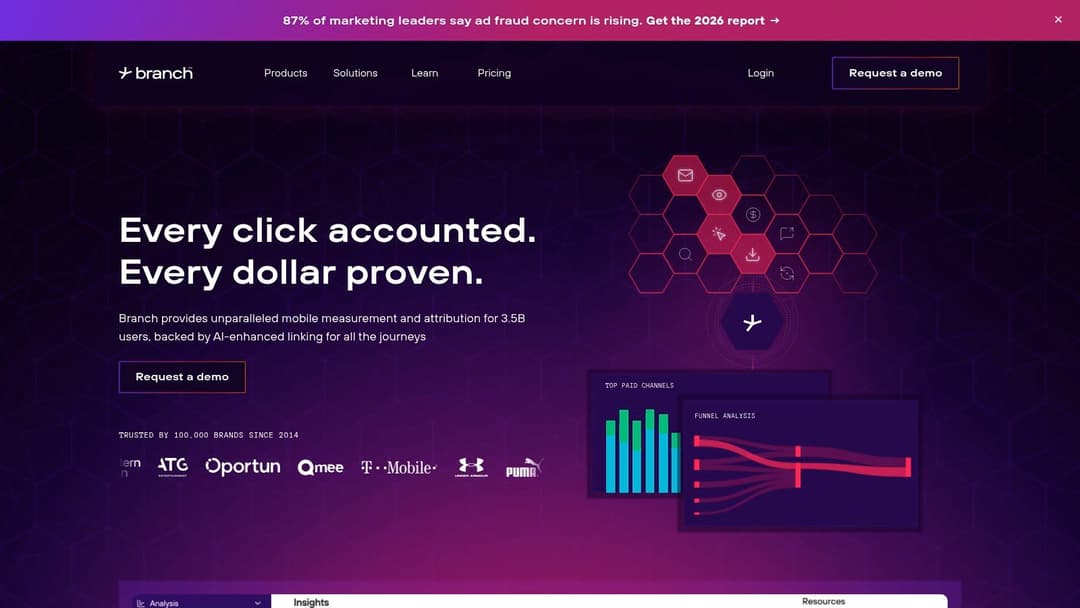
As one of the specialized marketing analytics companies, Branch excels at solving the complex challenge of mobile attribution where traditional web-based tools fall short. Its strength lies in reliable link routing and fallback experiences, ensuring users are directed to the correct in-app content or the App Store if the app isn't installed. This functionality is essential for accurately attributing installs and downstream events to specific marketing campaigns, providing a clear picture of mobile ROI from paid and owned media.
Key Details & Considerations
- Best For: Mobile-first companies or businesses with a significant web-to-app user flow.
- Pricing: An "Intro" plan is available for lower volumes, with a free sign-up option. Custom enterprise pricing is required for higher volumes and advanced features.
- Pros: Exceptional link routing and fallback logic; wide coverage across paid and owned channels.
- Cons: Most valuable for organizations with a mobile app; advanced capabilities are locked behind higher-tier plans.
9. Funnel
Funnel is a marketing data hub that automates the collection and preparation of advertising and marketing data. It extracts information from hundreds of sources, standardizes it into a clean, analysis-ready format, and then pushes it to destinations like BI tools, data warehouses, or spreadsheets. The platform is designed to eliminate the heavy data engineering work that often bogs down marketing teams.
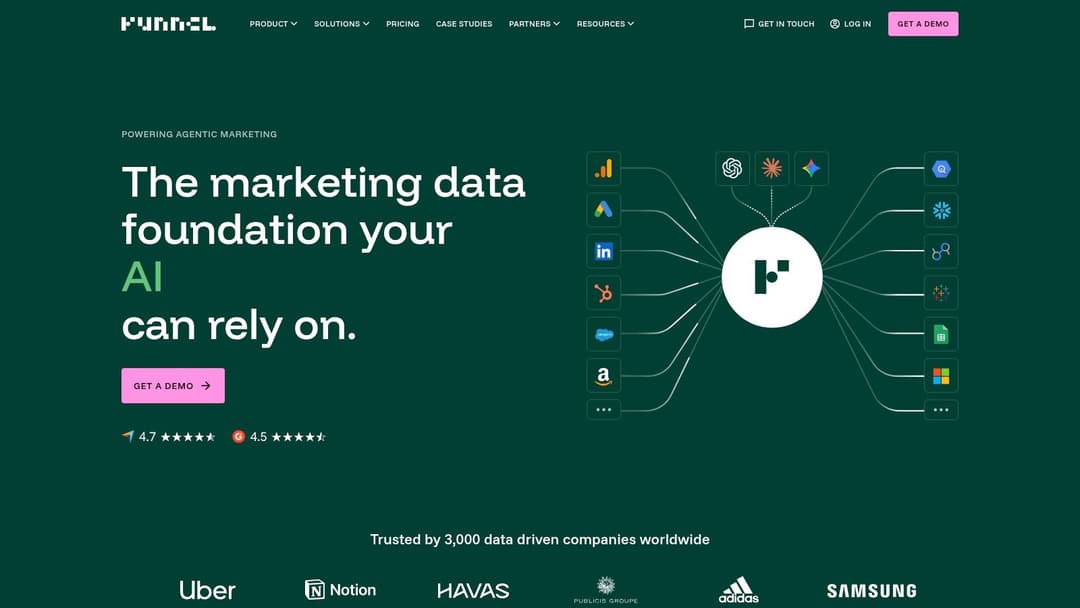
Among marketing analytics companies, Funnel's core strength is its robust data pipeline infrastructure. It doesn't perform attribution itself but provides the clean, harmonized dataset required for effective modeling in other tools. This makes it an ideal middleware for agencies managing multiple clients or brands with complex, multi-platform advertising stacks. By handling the data extraction and transformation, it frees up analysts to focus on deriving insights rather than cleaning data, a crucial step when working with various digital marketing tracking tools.
Key Details & Considerations
- Best For: Marketing teams and agencies needing to unify disparate data sources for reporting and business intelligence.
- Pricing: Capacity-based pricing with plans and flexible add-ons (flexpoints) based on data volume.
- Pros: Significantly reduces data engineering overhead; reliable and extensive connector library for marketing platforms.
- Cons: Pricing can become complex as data volume grows; it is not a standalone attribution tool and must be paired with a separate modeling layer.
10. Supermetrics
Supermetrics serves as a data connector platform, pulling information from advertising, analytics, and e-commerce sources directly into destinations like Google Sheets, Looker Studio, and Power BI. It is designed for marketers who need to create custom dashboards and automated reports quickly, bypassing the need for extensive engineering resources. The core function is to extract and load marketing data into a centralized reporting environment for analysis.
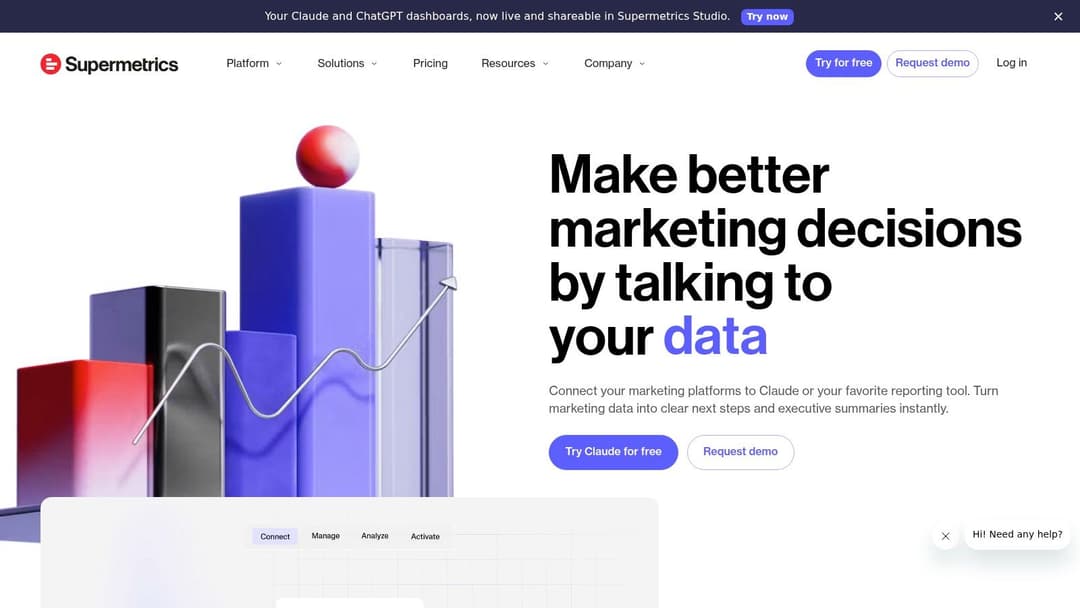
Unlike full-stack marketing analytics companies that offer attribution modeling, Supermetrics specializes in the data extraction and transfer process. Its strength lies in its extensive library of connectors, allowing an agency to quickly pull client data from Meta Ads, Google Analytics, and Shopify into a single spreadsheet for a consolidated performance view. This makes it a practical tool for recurring reporting without the complexity of a data warehouse, although it also supports warehouse destinations like BigQuery for more advanced needs.
Key Details & Considerations
- Best For: Agencies and marketing teams needing fast, automated reporting in spreadsheets or BI tools.
- Pricing: Publicly available with pricing tiers based on destination, number of users, and data sources.
- Pros: Very quick to set up for recurring reports; cost-effective for smaller scale needs.
- Cons: Not a true attribution or MMM solution; complex data pipelines may require a dedicated ETL tool.
11. Daasity
Daasity offers an omnichannel analytics platform for consumer brands, centralizing data from e-commerce, retail, marketplaces, and marketing channels into a single warehouse. It comes with ready-made dashboards and deep e-commerce models, making it ideal for operators in finance, merchandising, and marketing who need a standardized data framework without building one from scratch. The platform connects directly to sources like Shopify, Amazon, and various POS systems.
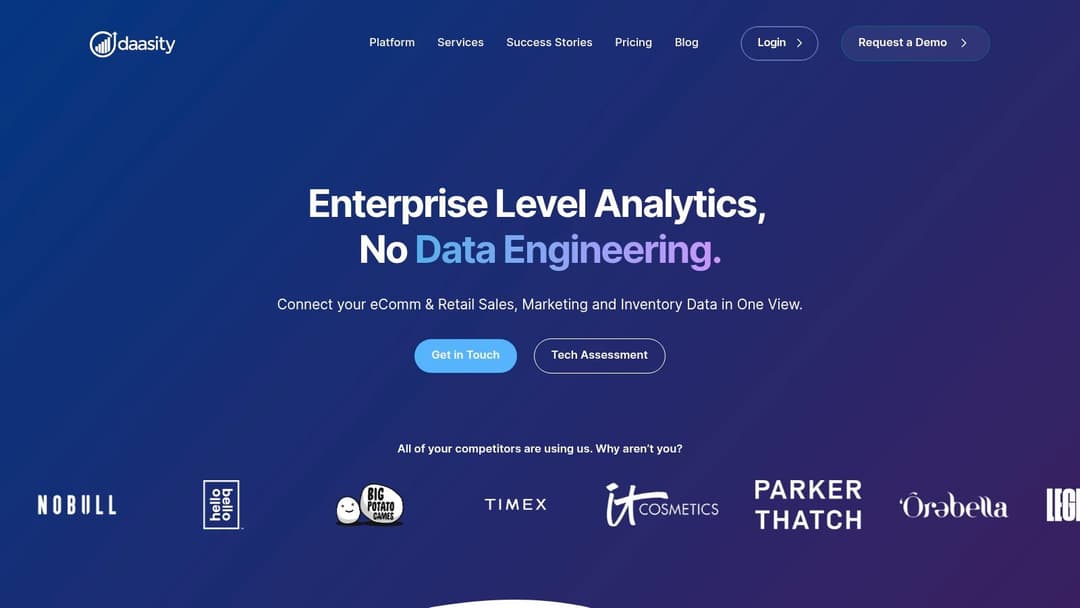
Unlike other marketing analytics companies that provide a blank slate, Daasity delivers a prebuilt, unified data model for key metrics like LTV, cohort performance, and channel-level analysis. This approach significantly shortens the time to value for direct-to-consumer brands that would otherwise spend months on custom business intelligence development. By unifying sales, inventory, and marketing data, teams can gain a complete picture of profitability. To optimize your channel strategy further, consider using dedicated ad performance analytics software in tandem.
Key Details & Considerations
- Best For: Consumer brands and operators needing a pre-configured e-commerce data model.
- Pricing: Varies by data scale and number of integrations; requires a sales consultation.
- Pros: Reduces custom BI build time; purpose-built for DTC operators across multiple departments.
- Cons: Best suited for brands willing to adopt Daasity's data model; requires confirming it fits your existing BI stack.
12. Kochava
Kochava is a mobile attribution and analytics platform built specifically for app marketers. It focuses on tracking install sources, measuring in-app events, preventing ad fraud, and ensuring user privacy. The platform provides a unified view of the entire mobile user lifecycle, from initial ad click to long-term retention, by integrating with a wide array of ad networks and marketing partners.
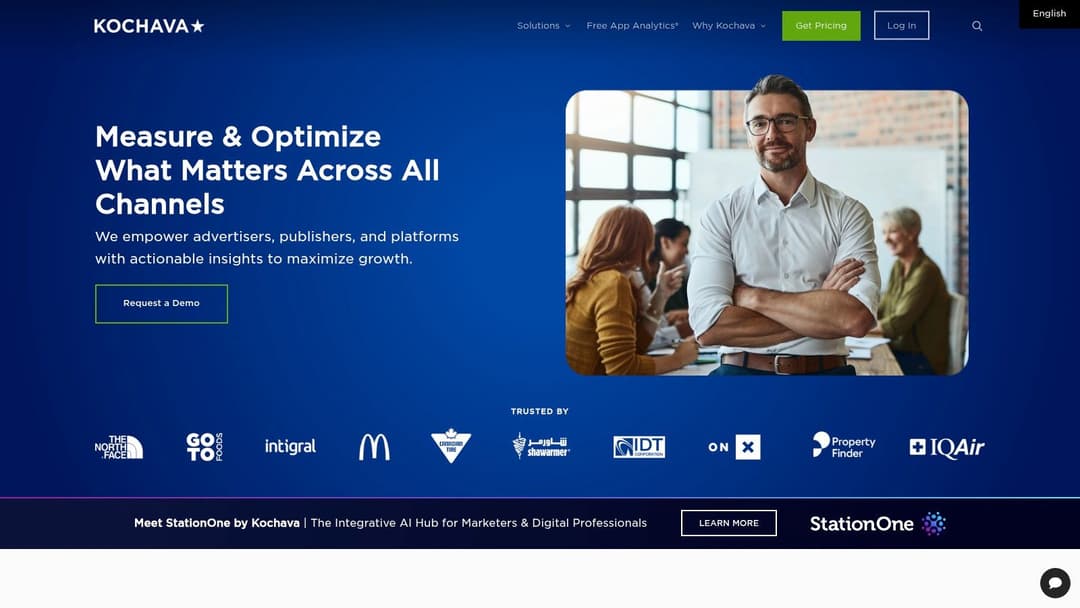
In the field of marketing analytics companies, Kochava’s primary differentiator is its deep focus on the mobile app ecosystem. While other platforms offer broader web and app analytics, Kochava provides specialized tools for app-first businesses. For instance, a mobile game developer can use Kochava to pinpoint which ad networks are driving the most valuable players, all while using its fraud detection to block fake installs. The free "App Analytics" tier also makes it accessible for early-stage apps to establish attribution before needing to scale to a paid plan.
Key Details & Considerations
- Best For: App-first businesses and mobile marketers who need granular attribution and fraud prevention.
- Pricing: Offers a free "App Analytics" tier; custom pricing for enterprise features and higher volumes.
- Pros: Free plan is great for startups and indie developers; extensive integrations with mobile ad networks.
- Cons: Primarily app-centric, offering limited value for web-only or non-app-focused brands; enterprise plans can be costly.
Top 12 Marketing Analytics Companies Comparison
| Product | Core features | Target audience | Unique selling point (value) | Pricing & setup |
|---|---|---|---|---|
| AdStellar AI | AI-driven bulk ad creation, Meta OAuth integration, AI Insights, auto-launch & auto-scale | Performance marketers, growth teams, e‑commerce brands, agencies | Up to 10× faster campaign production; auto-assembles & scales proven winners | Pricing not public; quick Meta connect via OAuth; built for high-volume variants |
| Rockerbox | Unified MTA + MMM + incrementality, user-level pathing, warehouse exports | Enterprise brands with multi-channel & offline media | Triangulates measurement approaches for complex media mixes | Sales-led pricing; heavier implementation and operations |
| Northbeam | Clicks-first MTA, cross-channel journey tracking, benchmarks & forecasting | DTC brands and agencies, media buyers | Practical daily decision support and clear methodology vs platforms | Sales-led pricing; best value with meaningful paid budgets |
| Triple Whale | First-party pixel, post-purchase surveys, creative & product analytics | Shopify/DTC ecommerce teams | Survey + pixel blend reconciles platform gaps; fast Shopify setup | Revenue-tiered plans (monthly/annual); features scale with plan |
| HYROS | Server-side tracking, identity resolution, conversion feedback, automation add-ons | Direct-response marketers, cross-platform advertisers | High-fidelity tracking and ROAS-driven optimization | Sales-led pricing; implementation requires technical rigor |
| Cometly | Multi-touch attribution, CRM/warehouse sync, pipeline dashboards | B2B SaaS and lead-gen teams | Built beneath the CRM for closed-loop revenue attribution | Sales-led pricing; best when CRM & product data are connected |
| AppsFlyer | Install & in-app attribution, SKAdNetwork, fraud protection | App marketers and mobile teams | Mature MMP ecosystem with wide integrations & privacy tooling | Plan tiers incl. free Zero; costs scale with conversion volume |
| Branch | Deep linking + attribution SDK, QR & routing, engagement products | Teams with apps or web→app flows, omnichannel journeys | Robust link routing/fallbacks and unified attribution SDK | Intro/free signup; advanced features & volumes on higher tiers |
| Funnel | Hundreds of connectors, schema harmonization, BI & warehouse destinations | Agencies, multi-brand operators, marketing data teams | Reduces data-engineering overhead; reliable pipelines to BI/warehouse | Capacity-based pricing; cost varies by data volume & connectors |
| Supermetrics | Large connector library, destinations (Sheets, BI, warehouse), API | Marketers/analysts needing quick dashboards & reports | Fast stand-up reporting with minimal engineering | Entry-level pricing for specific destinations; extraction-only focus |
| Daasity | Prebuilt ecommerce dashboards, unified data model, Shopify/Amazon/POS connectors | Consumer brands (finance, merchandising, marketing) | Standardized ecommerce data model with ready dashboards | Pricing varies by scale; best when standardizing BI stack |
| Kochava | Install & in-app attribution, fraud prevention, privacy controls | App marketers and early-stage mobile teams | Free App Analytics tier and broad mobile network integrations | Free analytics tier available; enterprise features on paid plans |
How to Choose Your Marketing Analytics Partner
Navigating the crowded market of Marketing analytics companies can feel daunting, but making an informed choice is a critical step toward unlocking scalable growth. As we've explored, the right partner depends entirely on your specific business context. There is no single "best" platform, only the one that best fits your goals, technical capabilities, and budget.
From dedicated attribution tools like Northbeam and Triple Whale for e-commerce to flexible data connectors like Funnel and Supermetrics, the spectrum of solutions is broad. The key takeaway is to move beyond feature checklists and focus on your primary business challenge. Are you burning budget on ads without a clear view of ROI? Or are you struggling to unify data from dozens of disconnected platforms for your BI team? Answering this question first will narrow your search significantly.
Creating Your Evaluation Framework
To make a confident decision, structure your evaluation process methodically. Don't get distracted by flashy dashboards or sales promises. Instead, build a practical framework tailored to your team's needs.
- Define Your Core Problem: Start by writing a one-sentence problem statement. For example, "We cannot accurately track customer journeys from their first touchpoint on Meta Ads to their final purchase, leading to inefficient ad spend." This clarity is your north star.
- Assess Implementation Realities: Be honest about your team's technical resources. A server-side tracking implementation like HYROS or Rockerbox provides incredible accuracy but requires developer involvement. In contrast, solutions with simpler pixel-based setups offer faster time-to-value. Map your internal skill set to the platform's requirements.
- Map to Your Business Model: Your business dictates your needs. A DTC brand with high-volume, low-consideration purchases has different attribution challenges than a B2B SaaS company with a six-month sales cycle. Match the tool to the customer journey you need to measure, whether it's e-commerce (Triple Whale, Daasity), lead generation (Cometly), or mobile apps (AppsFlyer, Branch).
- Run a Rigorous Demo Process: Once you have a shortlist of 2-3 vendors, schedule demos and come prepared with specific questions tied to your core problem. Ask them to show you how their platform solves your exact use case. Provide them with sample scenarios and data points to see how they handle real-world complexity.
Choosing from the leading Marketing analytics companies is a strategic investment in clarity. The objective is not just to acquire another tool, but to find a partner that delivers the actionable insights needed to make smarter marketing decisions. By focusing on your unique challenges and running a disciplined evaluation, you can select a platform that provides a clear, reliable view of performance and becomes the foundation for your growth strategy.
Ready to cut through the noise with a platform that unifies ad performance and attribution in one simple view? AdStellar AI is an analytics and optimization platform designed for performance marketers who need clarity and control. See exactly how your campaigns are performing and get actionable insights to scale your most profitable channels. Try AdStellar AI today and turn complex data into confident marketing decisions.