You're looking at a familiar report: thousands of sessions reached your pricing or product pages last week, many visitors scrolled past the demo button, and almost all of them disappeared. The traffic report looks healthy, but the pipeline doesn't reflect the interest. No reply email arrives, no second visit appears, and the original acquisition spend seems to end at the browser tab.
That's the gap retargeting is designed to address. It recovers attention that already exists, rather than trying to manufacture demand from people who've never encountered your brand. The practical challenge is making that recovery relevant, privacy-aware, and measurable, without paying to show the same ad to people who already converted.
The Real Problem Retargeting Solves
Retargeting works because a website visit contains more information than a basic impression. A visitor who reads a blog post, checks a pricing page, views several products, or begins checkout has left a different signal at each stage. Treating all of those people as one “website visitors” audience throws away that distinction.
The historical performance case for retargeting comes from its focus on people who've already shown interest. One commonly cited benchmark set recorded about 0.7% CTR for retargeted display ads versus 0.07% for standard display ads, roughly a 10× engagement difference (retargeting benchmark summary). The exact result will vary by market, creative, inventory, and measurement setup, but the strategic lesson remains useful. Warm traffic deserves a different message from cold reach.
Practical rule: Retargeting isn't a reach problem first. It's a sequencing problem.
Suppose a software company sees three types of visitors. A blog reader may need a comparison guide or proof that the product solves a relevant problem. A pricing-page visitor may need objection handling, implementation detail, or a clear path to a demo. Someone who initiated checkout probably needs reassurance about payment, delivery, setup, or the final unanswered concern.
That means the unit of work isn't “buy more impressions.” It's identify the last meaningful action, assign a recency window, and serve the next useful message.
Start with intent signals
Page views alone are weak segmentation. Combine page type with behavior wherever consent and platform policy allow:
- High-intent actions: Initiated checkout, submitted a form, requested a demo, or added a product to cart.
- Consideration signals: Repeat visits to a category, product, service, or pricing page.
- Research signals: Long-form content consumption, comparison-page visits, or repeated return sessions.
- Low-intent traffic: Short visits, irrelevant landing pages, careers-page activity, or users who never reached a meaningful product area.
The best retargeting audience is often smaller than the largest available audience. A tight cohort lets the creative answer a real question, while a broad pool encourages generic reminders that perform like weak prospecting.
This lens should guide every later decision. Tracking exists to preserve the signals, segmentation turns them into usable cohorts, creative moves each cohort forward, and measurement tests whether the ads caused anything beyond the conversion that was already likely.
Setting Up Tracking That Survives Privacy
A pixel installation isn't a measurement system. Many teams verify that one PageView event fires, then assume their retargeting foundation is complete. That setup can't distinguish a casual reader from a checkout initiator, and it becomes fragile as consent choices, browser restrictions, and identifier loss increase.
Build the stack in layers.
Layer one captures browser activity
Install the Meta Pixel and Google Tag on the pages and events that matter, not only on the homepage. Configure events such as ViewContent, AddToCart, InitiateCheckout, and Purchase, with the product, value, currency, content, and transaction parameters required by the relevant platform. Where supported and legally permitted, pass hashed identifiers through approved integrations rather than placing raw personal data into advertising events.
The browser layer remains useful for fast audience creation and page-level behavior. It shouldn't carry the entire system.

Layer two sends server events
Use Meta's Conversions API and Google Enhanced Conversions to send conversion data from your server or trusted backend. Browser and server events need a shared event_id so the platform can deduplicate them. If the same purchase arrives once through the browser and once through the server without a consistent identifier, reporting can inflate and optimization can learn from duplicate signals.
The server layer is especially important for conversion measurement and durable audience logic. It won't make consent requirements disappear, and it isn't a license to collect data without permission. It gives approved, consented signals a more reliable path when the browser can't provide the full picture.
For a detailed implementation comparison, see Conversions API versus Meta Pixel.
Layer three governs consent
Connect your tag manager to a consent management platform. Consent Mode v2 and equivalent controls should determine whether tags fire and what data platforms receive. Build audiences only from signals collected under the applicable consent rules, and make the privacy notice understandable enough that users can make an informed choice.
Layer four preserves first-party relationships
Send permitted customer and lead events into a CRM or CDP. That handoff lets you create customer-list audiences, suppress purchasers, distinguish leads from prospects, and maintain lifecycle logic when browser-based audiences become incomplete. First-party data won't replace thoughtful segmentation, but it gives your campaigns a durable source of truth.
A useful pre-flight review checks consent handling, event quality, deduplication, audience membership, and suppression behavior. Don't launch until a test purchase or lead produces the expected browser and server events, the event appears once in reporting, and the corresponding user leaves the wrong audience promptly.
Segmenting Audiences and Writing Exclusion Rules
Retargeting audiences are subtraction problems first and addition problems second. Before adding every visitor you can find, remove people who shouldn't receive the message. That includes purchasers from acquisition and conversion campaigns, existing customers from new-customer messaging, and users whose behavior indicates an internal or irrelevant visit.
Segment by funnel stage plus recency, rather than relying on a single all-time visitor list. A useful starting structure looks like this:
| Segment | Trigger Event | Window | Exclude | Frequency Cap |
|---|---|---|---|---|
| Cart abandoners | AddToCart or InitiateCheckout without Purchase | 1 day | Purchasers, completed orders | High, but controlled |
| Product viewers | ViewContent without AddToCart | 7 days | Cart abandoners, purchasers | Moderate |
| Blog readers | Qualified content visit without product action | 14 days | Converters, irrelevant page visitors | Low |
| Pricing visitors | Pricing-page return or high-intent page view | 30 days | Leads already in sales process, purchasers | Moderate |
The table isn't a universal campaign setting. It's a decision template. Your sales cycle, product category, consent rate, and audience volume should determine the final windows.
Write the exclusion ladder before the ads
Purchasers should leave every prospecting and conversion-focused retargeting audience immediately. Keep them in a separate post-purchase list for replenishment, onboarding, cross-sell, or renewal messaging.
Existing customers also need their own treatment. Exclude them from acquisition campaigns when the objective is new-customer growth, but retain them in approved upsell and lifecycle audiences. Email subscribers shouldn't automatically be removed from every campaign. Exclude them when overlap creates waste or when the message belongs in email, but preserve paid reach when the channels serve different roles and the consent basis supports it.
Users with careers-page activity or customer-service complaints deserve explicit suppression rules. A person researching jobs or trying to resolve an issue probably shouldn't receive a conversion offer just because a tracking system recorded a page view.
Pad thin audiences carefully
A short window is strongest when the action is strong. A one-day cart-abandoner audience will usually be more relevant than a seven-day cart audience, because the visitor's objection and product context are still fresh. A blog audience can tolerate more time because the user's intent is less immediate.
Low-traffic sites need a different compromise. Guidance for small service businesses recommends extending a 30-day audience toward 90 days when the pool is too thin, while adding customer lists, contextual activation, or CTV when site remarketing can't produce enough scale (small-business retargeting guidance). Padding a window to 45 or 60 days can also help, provided you separate recent visitors from older ones and reduce bids or creative pressure as intent decays.
For more detail on behavioral audience design, use this Facebook audience segmentation framework. The principle is simple: add people only after you've decided who must be removed.
Sequencing Creatives and Controlling Frequency
A retargeting campaign should feel like a conversation that advances, not a banner trapped in a loop. Someone who first viewed a product might see a clear explanation, then proof from a customer, then a direct offer. A cart abandoner can enter closer to the decision point, but still needs a message that addresses the reason they stopped.
Separate two kinds of rotation:
- Rotation within an ad set: Meta can distribute several assets through its delivery system, or you can use manual controls when even exposure matters more than automated allocation.
- Sequencing across recency buckets: Different ad sets or campaigns can represent recent, mid-window, and older visitors, with each bucket receiving a distinct message.
Use frequency caps as starting controls, not permanent laws. Product-page visitors might begin at 3 impressions per 7 days, while cart abandoners might tolerate 7 per 7 days because their intent is stronger. These example caps are operating choices, not benchmark claims. Review them against frequency, click quality, conversion timing, complaints, and incremental results.
Frequency should rise with intent, not because the platform wants more delivery.
Build enough variation to learn
Use 3 to 5 creative assets per rotation cell as a practical starting point. Give the system genuine differences, not five crops of the same image. Change the objection, proof point, format, opening frame, or call to action. For a product viewer, the sequence might be:
- A short explanation of the product's primary use.
- A testimonial or demonstration that answers a trust concern.
- A comparison or objection-handling asset.
- A direct conversion message.
A cart abandoner may skip the educational asset and start with reassurance about delivery, setup, returns, or payment. Dynamic product ads can show the item viewed, but the surrounding copy still needs a reason to complete the action.
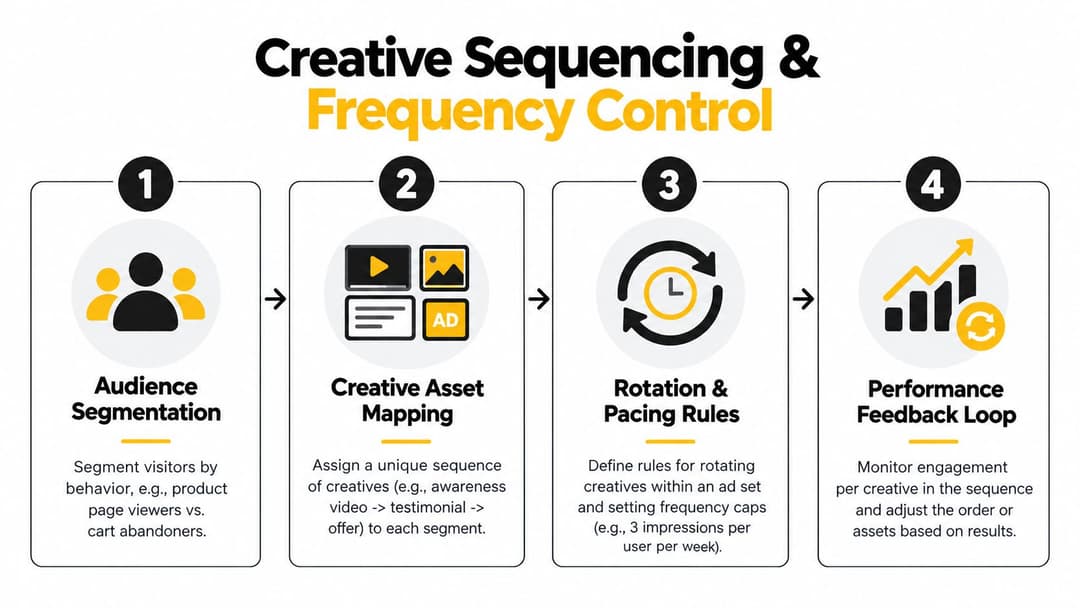
A frequent mistake is forcing variety at the wrong level. Shuffling several nearly identical ads inside one ad set doesn't solve fatigue. It only moves the same fatigue across different filenames. Tie the asset to the audience state, exclude converters from every incompatible campaign, and inspect frequency by ad set rather than relying on the campaign average.
For platform-specific controls, see this guide to frequency capping on Facebook Ads.
Choosing Channels Across Meta, Google, and Programmatic
Channel selection should follow the job you need the channel to perform. Meta is usually useful for visual storytelling and sequential messaging among warm visitors. Google Display and YouTube can reconnect users around search-adjacent intent, while remarketing lists for search ads can adjust bids or messaging when previous visitors return with a relevant query. Programmatic platforms such as DV360, The Trade Desk, and AdRoll add reach outside the major walled gardens, but identity quality, setup complexity, and fees require enough scale to justify them.
| Channel | Audience Size | Intent Strength | Typical CPM | Best Use Case |
|---|---|---|---|---|
| Meta | Broad inventory and strong social reach | Warm behavioral intent, with signal limitations | Often efficient for social delivery | Visual sequencing and product or service reminders |
| Often the smallest pool | Strong search-adjacent intent | Varies by inventory and placement | Display, YouTube, and returning-search activation | |
| Programmatic | Broadest cross-site reach | Depends on identity and audience construction | Varies by exchange, format, and buying model | Cross-device reach and activation beyond walled gardens |
The trade-off is straightforward. Google's pool may be smaller, but returning search behavior can place the user close to a decision. Meta offers substantial inventory and often efficient delivery, but post-iOS signal loss can make user-level intent less complete. Programmatic can extend coverage, though the additional reach may dilute the tight behavioral context that makes retargeting work.
Match the channel to available traffic
For sites with under 50,000 monthly sessions, a practical default is Meta and Google only. Spreading a small audience across multiple platforms can create fragmented delivery, unstable learning, and duplicated exclusion logic. A site with more than 200,000 monthly sessions may have enough audience depth for programmatic fees and cross-device reach to become reasonable, provided incrementality testing supports the spend. These thresholds are operating rules from the playbook, not universal market benchmarks.
A financial advisory firm evaluating paid social may also benefit from specialist guidance on how to run social ads for RIAs, especially when the conversion path involves education and lead qualification rather than immediate checkout.
Automation can reduce the operational burden when the same segments need to exist across platforms. For teams evaluating orchestration tools, this ad-tech platform overview is relevant because it addresses campaign workflow and cross-channel management rather than treating each ad account as a separate manual project.
Measuring Incrementality and Attribution Honestly
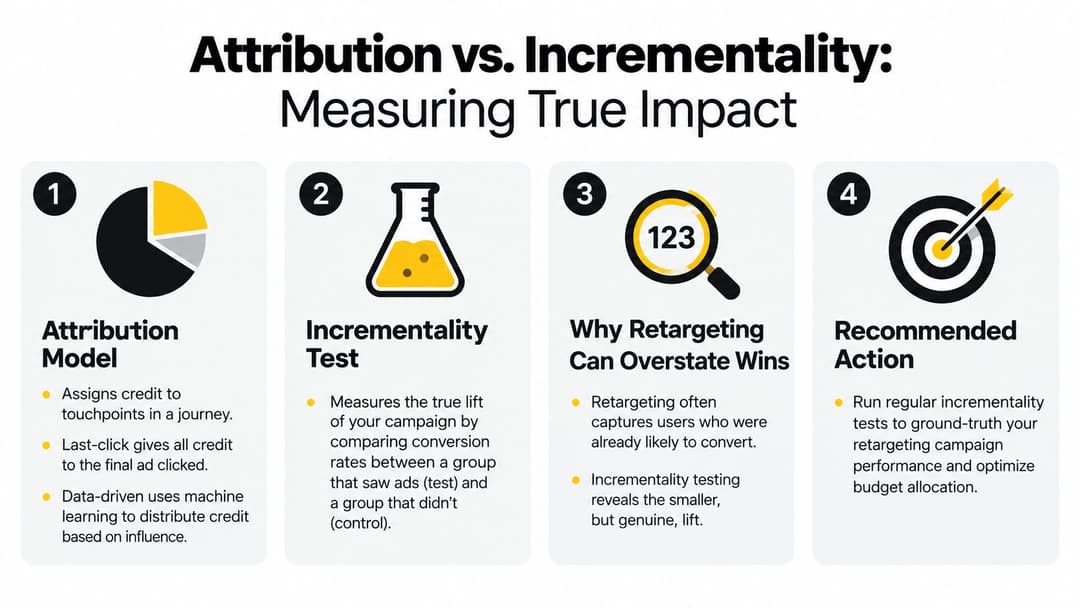
Attribution tells you which touchpoints received credit. Incrementality asks whether the advertising caused additional conversions that wouldn't have happened without it. Retargeting creates a large gap between those two questions because the audience already contains people who visited, considered, searched, or intended to buy.
Last-click attribution gives the final clicked ad all the credit. Data-driven attribution in Meta and Google attempts to distribute credit across observed interactions, but both approaches still depend on available platform signals and modeled assumptions. Neither automatically proves that a retargeted person needed the ad to convert.
That's why a retargeting campaign can report an attractive attributed CPA while producing a much weaker incremental CPA. In the failure pattern described in this playbook, the incremental CPA can be two to three times worse than the attributed CPA, because the ads harvest demand that was already likely to convert (retargeting measurement reference).
Test the lift, not just the credit
Use a holdout design when the budget and audience size allow it:
- Geo holdouts: Keep comparable geographic areas out of the campaign and compare outcomes over the same period.
- Ghost ads or public service announcement controls: In Display and Video 360, use control exposure methods that preserve auction conditions without delivering the commercial ad.
- Conversion lift studies: Meta's lift testing can compare an exposed group with a control group under a platform-managed experiment.
Track incremental ROAS, cost per incremental conversion, and the frequency-to-conversion curve. The last metric helps identify whether additional exposures create useful movement or only inflate reported reach.
A property marketer reviewing channel credit may find this explanation of how attribution boosts property sales useful for separating journey reporting from causal testing. The same distinction applies whether the conversion is a property inquiry, a SaaS demo, or an ecommerce order.
Before trusting a dashboard, ask whether converters were suppressed from the test audience, whether a genuine holdout existed, and whether the conversion window matches the channel's decision cycle. If the audience saw ads after converting, or if the control group could still receive the same campaign through another route, the result is harder to interpret.
Use incrementality testing methods to make this a recurring discipline. Judge retargeting on what it adds, not on what it claims.
Scaling Without Burning Out the Audience
Retargeting doesn't scale by forcing more impressions into the same small pool. When the audience is too small, frequency caps lose practical value, auction costs can rise, and one aggressive creative can make the campaign look active while users stop responding.
The first fix is audience depth. Guidance for thin site audiences recommends expanding a lookback window from 30 days toward 90 days, layering customer-list audiences, and using contextual or CTV activation when cookie-based visitor pools are weak (privacy-constrained audience guidance). Keep the recent cohort separate from the older cohort. Otherwise, the platform may spend on low-intent older visitors while neglecting people who took a meaningful action yesterday.
Expand the signal before expanding spend
Use hashed CRM lists where permitted to seed Meta Advantage and Google Customer Match. Build lookalikes or similar audiences from qualified converters rather than every site visitor. A purchaser, retained customer, or sales-qualified lead usually provides a cleaner modeling signal than a shallow page view.
Hard exclusions should include:
- Recent converters: Remove them from conversion-focused retargeting immediately, then keep them in post-purchase or lifecycle campaigns.
- Customer-service complainers: Don't serve a sales message while the relationship is unresolved.
- Irrelevant internal visitors: Suppress users who repeatedly visited careers or other non-commercial areas.
- Overexposed users: Use recency and frequency rules to stop delivery before fatigue becomes the primary signal.
Rotate assets on a defined operating cadence, such as every 7 to 10 days, while checking frequency at the ad-set level. Watch for rising CPM alongside falling CTR. Impressions can remain stable while the audience becomes less responsive, so delivery volume alone won't reveal burnout.
AI automation can compress the production loop by generating creative variants, organizing audience combinations, ranking performance, and pruning weak assets. AdStellar AI is one option that connects with Meta Ads Manager, supports bulk creative and audience workflows, and uses historical performance to surface combinations against objectives such as ROAS, CPL, or CPA. It can help a small team maintain a testing cadence, but it doesn't replace consent controls, exclusion logic, or incrementality testing.
Scale the signal first, the message second, and the budget third. That order keeps retargeting focused on recovering demand instead of paying repeatedly for the same attention.
AdStellar AI can help you organize Meta retargeting audiences, generate creative variations, and identify which messages and combinations deserve more testing. Visit AdStellar AI to connect campaign execution with a more repeatable, measurement-led workflow.