A paid social manager can open Meta Ads Manager and see a healthy return, then open the finance dashboard and find a very different story. Reported conversions look strong, blended efficiency is flat, and nobody can answer the question that matters most: how much revenue did the ads cause that wouldn't have happened anyway?
That gap is why incrementality testing has moved from an advanced measurement exercise to an operating discipline. Attribution tells you where a platform assigned credit. Incrementality testing estimates the causal difference between advertising and a credible no-ad counterfactual. In 2026, that distinction determines which audiences deserve budget, which creative angles deserve another iteration, and which campaigns are harvesting demand that already existed.
Why Paid Social Teams Are Re-Running Incrementality Testing in 2026
A paid social team can see Meta reporting strong conversion volume while finance sees efficiency stall as media spend rises. Privacy changes, signal loss, browser restrictions, and platform-specific conversion rules make the path from exposure to purchase harder to reconcile. Before adjusting another dashboard, teams should fix broken ad spend tracking and verify that the underlying event data is trustworthy.
Clean tracking still cannot answer the counterfactual question. A click, view, or attributed conversion records an observed relationship. An experiment compares results for a treatment group with a comparable group that did not receive the advertising treatment. That comparison estimates incremental lift, rather than assigning credit across touchpoints.
Three pressures are driving repeat tests:
- Attribution is less complete. Marketers have fewer deterministic signals connecting exposure to purchase, particularly across devices and privacy-constrained environments.
- MMM now influences executive planning. Marketing mix modeling helps finance and leadership assess channels in aggregate, but simultaneous media changes can make individual effects difficult to isolate. Guidance on incrementality testing notes that a well-designed experiment supplies a stronger causal check than correlation-based measurement when the design is rigorous.
- Creative production has accelerated. AI systems can generate more audience, copy, and visual combinations than a team can review consistently. The operating challenge is identifying which messages create additional demand, then returning that evidence to production systems such as AdStellar AI.
The design must match the decision. User-level holdouts suit addressable audiences and controlled exposure, geo tests fit broader delivery when regional cells can be matched, and synthetic controls help when randomized allocation is impractical. Low-budget teams should choose the smallest design that can change a real budget decision, rather than run a test whose precision exceeds the decision's value.
A test earns trust only when its assignment rules, exposure window, measurement events, and analysis plan agree. Incrementality testing methodology guidance from Analytical Alley recommends randomized treatment and control allocation, an A/A or pre-period validation, a 4 to 8 week execution window, and post-test comparison with confidence intervals. It also describes holdout sizing of 5% to 20% for user-level tests or 20% to 30% of addressable revenue for geo tests, depending on the design.
The practical question is which design can produce a decision before the campaign, budget, or creative system changes.
Incrementality Test Designs That Actually Fit Paid Social
No single design works across every paid social account. Choose based on audience addressability, geographic reach, channel behavior, and the size of the decision you need to make.
Four designs, four different jobs
User-level randomized holdouts split eligible users into treatment and control groups. Meta's Conversion Lift is a natural fit for app retargeting, CRM-matched audiences, and campaigns where the platform can enforce exposure rules. It offers strong internal validity, but it's less comfortable for broad prospecting where identity resolution and reach-scale delivery are weaker.
Geo holdouts assign matched regions or markets to treatment and control. This approach often has stronger external validity for Meta and TikTok because delivery occurs within defined geographic boundaries. The trade-off is operational complexity. Regional demand, inventory, promotions, and local competition can create noise, so matched cells and a stable pre-period matter.
Ghost ads or public service announcement holdouts are useful for display and YouTube environments where audience-level randomization isn't available. The platform or measurement partner observes users who qualify for the campaign but receive a neutral substitute instead of the commercial ad. This is practical, but the control experience must remain comparable and exposure leakage must be monitored.
Synthetic controls and causalImpact-style models are fallback options when a holdout is politically impossible, the audience can't be randomized, or volume is too low for a clean experiment. They can help estimate a counterfactual from historical or parallel-market behavior, but they depend more heavily on modeling assumptions. Treat the result as directional unless the pre-period fit and sensitivity checks are persuasive.
| Design | Minimum Paid Social Spend | Best Channel Fit | Typical Runtime | Strongest Use Case |
|---|---|---|---|---|
| User-level holdout | Sufficient addressable audience and conversion volume | Meta retargeting, CRM audiences, apps | Multi-week window | Causal read on reachable users |
| Geo holdout | Sufficient revenue across matched regions | Meta, TikTok, multi-market campaigns | Multi-week window | External validity and channel-level decisions |
| Ghost ads or PSA | Enough eligible impressions for stable comparison | Display, YouTube, some video environments | Multi-week window | Exposure control without user randomization |
| Synthetic control | Enough historical and comparison data | Fragmented or low-volume channels | Varies by model and data quality | Directional estimate when holdouts fail |
Teams managing smaller accounts shouldn't force a user-level test because the interface offers one. The most useful implementation guidance often sits in the details of control group testing, especially how the excluded group is constructed and whether the treatment can be isolated.
A practical rule is to use ghost ads or a carefully designed small-cell geo test when total paid social spend is under $50,000 per month, and consider CRM-based Conversion Lift when spend is over $250,000 per month. Those thresholds are decision heuristics, not laws. Volume, conversion rate, audience size, and the business cost of a wrong budget decision matter more than the spend label alone.
Sample Size, Power, and Holdout Sizing for Meta Campaigns
A Meta team can spend weeks running a lift test and still learn nothing if the account cannot detect the effect that would change the budget decision. Statistical power is the probability that the test identifies a real effect of the chosen size. A practical planning target is 80% power, but that target only has meaning alongside the minimum detectable effect, or MDE.
Define the MDE in business terms. If the decision concerns a Meta line generating $250,000 per month, the team may need to detect a 5% incremental lift, rather than a small academic effect that would not alter allocation. A narrower MDE requires more users, more conversions, or a longer runtime. If the account cannot provide that volume, widen the MDE, extend the test, or choose a design suited to the available audience.
A rough planning formula is:
Users per cell ≈ 16 × p × (1 − p) ÷ MDE²
Here, p is the baseline conversion rate and MDE is an absolute proportion. With a 2% baseline conversion rate and an absolute two-point MDE, the approximation is about 38,000 users per cell. Use this as an early feasibility check, not as a substitute for a power calculation that reflects the outcome, allocation, variance, and analysis method. The same planning principles are covered in this guide to sample size planning for testing.
The holdout trade-off
Holdout size controls the balance between learning precision and foregone exposure. A 5% holdout keeps more reachable users eligible for ads, but gives the control group fewer observations. A 10% holdout is a workable middle position for many user-level tests. A 20% holdout can tighten control estimates when volume supports it, while withholding more potential ad exposure and reducing treatment reach.
The right setting depends on the design. User-level holdouts need enough conversions in both cells, while geo tests depend on the number and quality of revenue or market cells. For low-budget teams, a larger holdout is not automatically better. It can make the estimate more stable while leaving too little treated volume to represent the campaign's normal delivery.
| Baseline Conversion Rate | MDE (Absolute %) | Users per Cell | Recommended Holdout % | Suggested Runtime |
|---|---|---|---|---|
| 2% | 2 percentage points | Approximately 38,000 | 10% | 14 to 28 days |
| 2% | Smaller than 2 points | More than the example above | 10% to 20% | Multiple full weeks |
| Higher baseline | Business-defined | Recalculate with the formula | 5% to 20% | Multiple full weeks |
Do not choose a seven-day runtime because the dashboard reports a result after seven days. One week can contain an unusual promotion, payday pattern, delivery anomaly, or learning-phase transition. Use complete calendar weeks. Consider 14, 21, or 28 days when weekly seasonality or delayed conversion behavior affects the outcome.
For a $300,000 monthly Meta prospecting campaign aiming to detect a 4% lift at 80% power, define the baseline outcome, eligible audience volume, and whether 4% means relative lift or absolute percentage points. Calculate the required users per cell, choose a holdout that preserves sufficient treatment scale, and confirm that the observation window covers complete weeks.
If the available volume cannot support the MDE, change the decision threshold, extend the runtime, or postpone the test. Do not present an underpowered result as conclusive. For smaller 2026 budgets, a directional geo test or synthetic control may produce a more useful planning signal than a user-level holdout that cannot accumulate enough conversions. Use the design that can answer the funding decision, not the one that looks most rigorous in a template.
Running the Test Without Breaking the Data
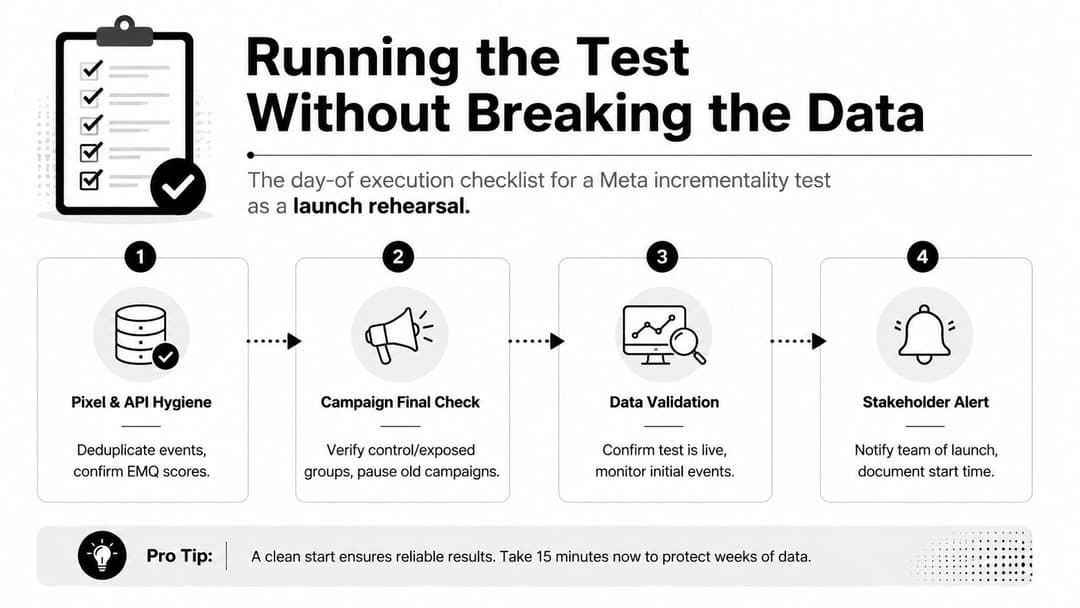
Treat launch day like a measurement rehearsal, not a routine campaign activation. The first failure usually happens before randomization, when event duplication, audience contamination, or an unrecorded site change makes the treatment and control comparison ambiguous.
The pre-launch checklist
Start with event hygiene. Deduplicate browser and server events, verify that purchase and conversion definitions match the business outcome, and inspect Event Match Quality. The execution plan should also include a review of Meta Conversions API implementation, because server-side event quality affects both observed outcomes and the ability to reconcile platform reporting with internal revenue.
Freeze landing-page redirects and tracking changes before randomization. If the destination, checkout flow, attribution window, or purchase event changes during setup, record the change and decide whether the test needs to restart. The control group can't provide a stable counterfactual if the measurement system changes underneath it.
Build the eligible audience from a deterministic purchaser suppression list, then create the random holdout inside the experiment framework. Don't rely on ad-set exclusions or manually maintained custom audiences. Lookalikes, overlapping retargeting pools, and campaign-level delivery can expose supposed controls.
The live run-of-show
Use one ad set per cell where the platform setup requires it, keep creative rotations identical, pace budgets evenly, and prohibit mid-flight budget shifts unless the protocol explicitly allows them. Treatment and control should differ in advertising exposure, not in creative eligibility, landing page, bid logic, or optimization event.
During the run, inspect delivery and data quality without interpreting the outcome early:
- Exposure check: Confirm the control group remains unexposed and investigate overlap with other campaigns.
- Delivery check: Compare CPM and reach patterns for unexpected divergence. A 5% monitoring tolerance is a practical operational flag when reviewing treatment and holdout delivery, not a significance threshold.
- Event check: Verify that conversions, revenue, and other primary outcomes arrive consistently in both cells.
- Change log: Record budget edits, creative replacements, promotions, tracking changes, and outages.
Don't peek at lift and then decide whether to stop. Set the analysis date before launch, name the primary outcome, and require sign-off from measurement, media, analytics, and finance. The independent guidance on in-house testing highlights insufficient sample size, weak randomization, control leakage, slow turnaround, and poor scalability as recurring reasons results become inconclusive or misleading when statistical power is weak.
Common Pitfalls That Quietly Invalidate Your Results
A lift test can look scientific while answering the wrong question. The dangerous errors are usually mundane: overlapping audiences, uneven delivery, a seasonal promotion, or an analysis plan that changes after the numbers arrive.
| Pitfall | Diagnostic Signal | Specific Fix |
|---|---|---|
| Holdout leakage | Control users appear in campaign reach or overlap with adjacent audiences | Use experiment-level holdouts and audit overlap reports throughout the run |
| Novelty or priming effects | Conversion behavior changes immediately after the test ends | Pre-register a post-period and observe it for an additional period |
| Weak statistical power | Wide confidence interval or unstable result after the planned window | Size to a realistic business MDE, often 5% to 10%, rather than a vanity 1% target |
| Treatment budget starvation | Treatment receives materially less spend or reach | Pace budgets evenly and cap daily variance |
| Seasonal contamination | Lift changes sharply during BFCM, launches, or unusual promotions | Avoid the window or use matched-pair geo cells |
| Peeking and p-hacking | The readout date or metric changes after early results | Seal the analysis script and keep the pre-registered readout date |
The first diagnostic is exposure. Meta's audience exclusion isn't a guarantee that a user remains untouched across every campaign, partner, or lookalike. If the control group sees the tested message elsewhere, the measured difference shrinks and the result can falsely suggest that the campaign had little value.
Novelty creates a different distortion. A user who was withheld from ads during the experiment may react after the test ends, especially if the campaign has primed an audience through adjacent activity. Define the post-period in advance and examine it rather than declaring victory from an immediate readout.
Practical rule: If you can't explain exactly who was eligible, who was exposed, which outcome was primary, and when the result became final, you don't have a decision-ready test.
Budget pacing deserves more attention than it gets. A treatment cell that loses delivery because of a bid constraint or budget cap may show weak lift because it received less of the intended intervention. Check spend, reach, frequency, CPM, and optimization status daily, but don't alter the hypothesis to rescue a weak result.
Promotional periods are valid business moments, but they answer a different question from business-as-usual media efficiency. BFCM, product launches, price changes, and major inventory shifts can overwhelm the advertising effect. Run a separate test or use matched geographies if the seasonal decision itself matters.
Reading Lift, Reconciling With Meta and MMM, and Making Decisions
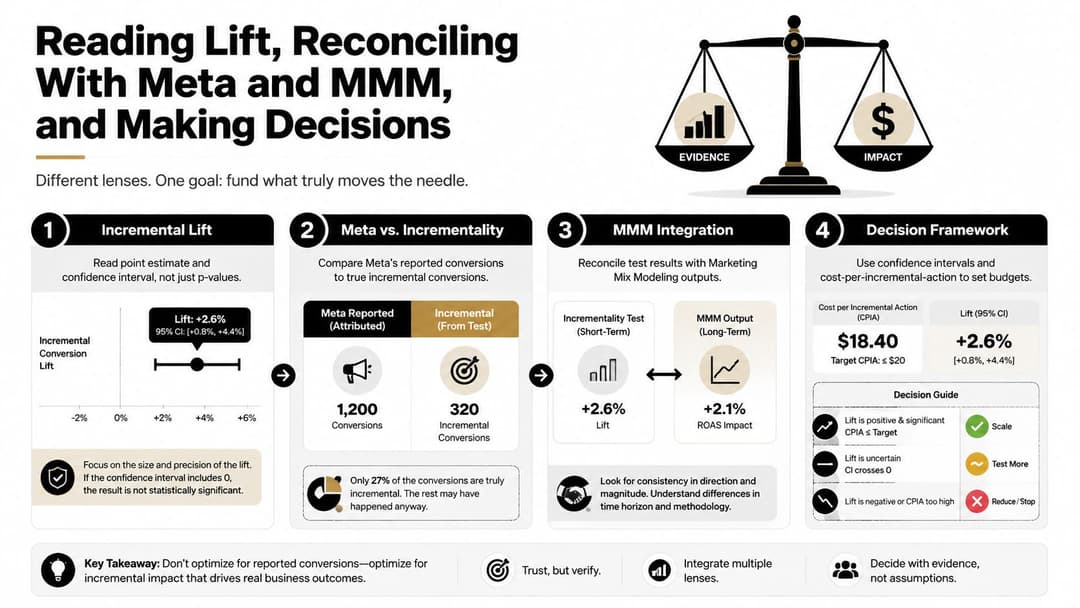
Read the point estimate and confidence interval together. A reported 4% lift with a plus or minus 3% confidence interval spans a range that may include a small effect or no reliable effect. Calling that a win because the point estimate is positive is a category error.
Calculate incremental economics from the experiment, not from the platform dashboard:
Incremental revenue = baseline revenue for the eligible population × estimated incremental lift
iROAS = incremental revenue ÷ true incremental cost
Meta's reported ROAS can remain useful for delivery optimization, but it isn't automatically the number finance should use for budget allocation. The gap between platform-attributed and experimentally incremental outcomes can be substantial. Independent market coverage describes attribution disagreements as an operational challenge and notes that platforms are adding more incrementality-oriented measurement and optimization options as adoption expands.
Three reconciliation scenarios
Lift agrees with Meta. Keep the campaign's audience and creative structure, scale cautiously, and log the validated message angle. The test confirms that the reported performance has a meaningful causal component.
Lift is positive while Meta-reported conversions are flat. The platform may be under-attributing the campaign, or internal reporting may classify the outcome differently. Reconcile event definitions, then consider reweighting model inputs and revisiting budget caps.
Lift conflicts with MMM. Don't automatically discard either result. MMM may absorb correlated seasonality, pricing, distribution, or concurrent media changes. Use the experiment as a calibration point, document the difference, and re-estimate the model rather than forcing the test to match the prior.
For teams using MMM, media mix modeling fundamentals provide useful context, but the operating decision still depends on the quality and scope of each measurement method.
| Result pattern | Confidence | Recommended action |
|---|---|---|
| Positive lift with a tight interval above zero | Strong | Scale within the tested audience and monitor marginal efficiency |
| Positive point estimate with a wide interval | Weak | Iterate creative or run a better-powered retest |
| Near-zero or negative lift with a reliable interval | Strong | Reduce spend or reallocate to a validated channel |
| Conflicting results across methods | Mixed | Reconcile definitions, calibrate MMM, and retest before a major shift |
Use a worked calculation, not a platform label. If a campaign produces $40,000 in experimentally incremental revenue from $20,000 of tested spend, its iROAS is 2.0. Compare that figure with Meta's reported ROAS, then apply the confidence interval to determine whether scaling is justified. The exact action depends on margin, payback, and the cost of being wrong.
Operationalizing Incrementality With AdStellar AI and a 30-Day Plan
A validated lift result has no value if it stays in a slide deck. The useful handoff converts the experiment into constraints for the next audience, message, and creative decision.
Start by exporting the test's treatment and control definitions, primary outcome, lift estimate, confidence interval, spend, and exposure notes. Segment the learning into validated incremental audiences, uncertain audiences, and audiences that produced attributed conversions without reliable causal lift. Keep those labels separate. Feeding every high-ROAS audience into the next campaign recreates the attribution problem the test was designed to solve.
Then map the winning creative variables, not just the winning ad ID. Record the claim, proof point, offer, visual structure, opening hook, audience context, and landing-page promise. In an AI creative workflow, these components become reusable inputs for briefs and variant generation. AdStellar AI's AI Insights can support the workflow by centralizing performance breakdowns and helping teams organize creative and audience signals from Meta campaigns.
A practical 30-day operating cycle
Week 1, transfer the evidence. Add the test hypothesis and result to the creative brief. Import the validated audience tiers, mark uncertain segments as exploratory, and place winning message components in the asset library. Set exclusions for claims or audiences that the test didn't support.
Week 2, launch a focused retest. Produce a smaller group of variants around the validated angle. Keep the audience and conversion event stable where possible, and change one meaningful creative dimension at a time. The purpose isn't to manufacture a positive result. It's to check whether the learning survives a new execution.
Week 3, review causal behavior. Compare the new variants against the selected control structure. Separate creative performance from delivery artifacts such as uneven spend, frequency changes, or audience overlap. If the signal weakens, diagnose the execution before rewriting the conclusion.
Week 4, codify and schedule. Promote durable winners into the production library, document the conditions under which they worked, and set the next experiment date. Teams with large budgets or fast creative turnover should retest more often than teams with stable spend and slower audience change. Retest when the audience, offer, auction conditions, or creative system changes materially, not merely because a calendar reminder appears.
AdStellar AI should sit downstream of measurement, not replace it. Let incrementality determine which audience and message signals deserve priority, then use AI to generate and manage the next set of controlled variations. Keep guardrails around claims, offer terms, brand rules, landing-page consistency, and the tested incremental envelope.
That creates a closed loop: experiment, interpret, encode, generate, retest, and update. It also prevents a common failure mode in fast-moving teams, where AI accelerates production while the optimization system returns to platform-attributed conversions as its only definition of success.
AdStellar AI helps paid social teams organize Meta campaign data, generate creative and copy variations, and turn validated audience and message learnings into repeatable campaign workflows. Visit AdStellar AI to connect your incrementality findings with a faster, more disciplined creative testing process.