You launch a new Meta campaign, wait for delivery to stabilize, and then see a CPM that looks wrong. Maybe it's far higher than the number in your planning sheet. Maybe it's surprisingly cheap, but clicks and sales haven't followed. The natural reaction is to change the bid, narrow the audience, or blame the creative.
That reaction often misses the issue. CPM on Facebook Ads is an auction signal, not a performance score. It tells you what you're paying for impressions in a particular market, objective, placement, and moment. It doesn't tell you whether those impressions are valuable on their own.
Introduction to CPM on Facebook Ads
CPM matters even when your campaign optimizes for traffic, leads, or purchases. Every click and conversion begins with an impression, so the price of impressions influences how efficiently your budget can generate downstream actions. A high CPM can be perfectly acceptable if it buys access to people who are more likely to become customers. A low CPM can waste money if it reaches people who rarely click or convert.
The first step is separating price from outcome. CPM answers, “What did it cost to deliver 1,000 impressions?” CPC answers, “What did each click cost?” CPA answers, “What did each acquisition cost?” Those metrics connect, but they measure different stages of the journey.
The market also changes around your campaign. One benchmark reported a global average Facebook CPM of $1.12, compared with $4.29 in the United States in 2024, making the US figure about 3.83 times higher. The same benchmark reported that CPM fell 5% year over year in Q2 2025, showing how quickly auction pricing can move with geography and demand (Facebook Ads statistics and CPM benchmarks).
This guide will help you read that movement instead of reacting to it blindly. You'll learn how Meta calculates CPM, how current benchmarks differ by objective and vertical, why auction pressure pushes prices up or down, and how to test creative and audience combinations for cheaper reach without sacrificing business results.
Core idea: CPM is the market price of attention. It's useful only when you interpret it alongside intent, engagement, and conversion quality.
What CPM Means and How It Is Calculated
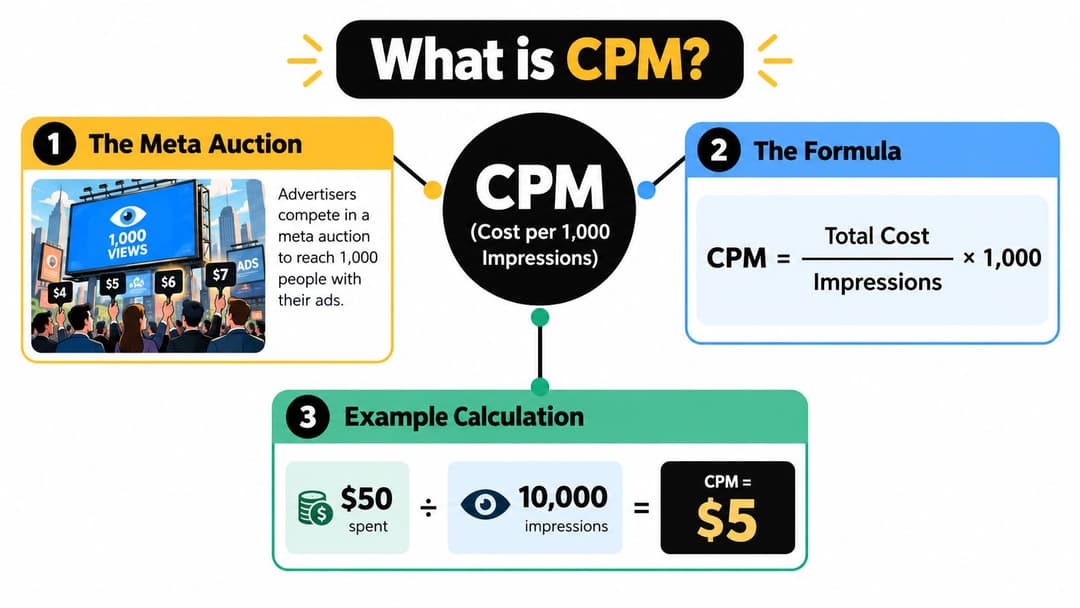
Think of Meta's auction as a crowded billboard market. Advertisers compete for opportunities to show an ad when someone scrolls through Facebook, Instagram, Messenger, or another available placement. CPM expresses the cost of winning enough of those opportunities to generate 1,000 impressions.
The calculation is straightforward:
CPM = Total ad spend ÷ Total impressions × 1,000
Suppose a campaign spends $50 and records 10,000 impressions. The calculation is $50 ÷ 10,000 × 1,000, producing a $5 CPM. The metric doesn't mean 1,000 unique people saw the ad, because impressions can include multiple views from the same person. For unique exposure, check reach and frequency separately.
CPM compared with CPC and CPA
These three metrics answer different buying questions:
- CPM: How expensive was the delivered reach?
- CPC: How much did each click cost?
- CPA: How much did each conversion cost?
A campaign can have a high CPM and still produce an efficient CPA if the impressions reach people with strong purchase intent. Conversely, cheap impressions can produce weak results when the audience is broad but poorly matched to the offer. For a wider explanation of how these metrics fit together, see this guide to Facebook ad performance metrics.
You'll find CPM in Ads Manager by opening the campaign, ad set, or ad view and customizing the columns to include CPM (cost per 1,000 impressions). Review it at the same reporting level each time. Comparing a campaign-level CPM with an ad-level CPM can create a false sense of movement because the underlying delivery mix may differ.
For additional background on the mechanics and uses of CPM, Boocoo's CPM advertising insights provide a useful complementary explanation. The important operating rule is simple: don't treat CPM as a verdict on your ad. Treat it as the price Meta charged for the inventory your campaign won.
Current CPM Benchmarks by Objective and Industry
A CPM benchmark becomes useful only after you identify the campaign objective, market, and vertical behind it. A reach campaign and a lead campaign aren't buying the same type of opportunity, even when they target similar people.
In 2026 benchmark data, awareness and reach campaigns typically sit around $7 to $15 CPM, while traffic and engagement campaigns are commonly around $8 to $25. Sales campaigns generally fall around $14 to $30, and lead-generation campaigns in major markets such as the US can reach $22 to $45 (Meta Ads CPM benchmarks by objective).
| Campaign Objective / Vertical | Typical CPM Range | What Drives the Range |
|---|---|---|
| Awareness and reach | $7–$15 | Broad delivery and abundant inventory |
| Traffic and engagement | $8–$25 | Click or interaction signals shape delivery |
| Sales and conversion | $14–$30 | Higher-intent users attract stronger competition |
| Lead generation in major markets | $22–$45 | Narrower eligible audiences and valuable actions |
| Leads campaigns in one benchmark | About $3.36 | Different dataset, market, and campaign mix |
| Health and wellness e-commerce | Up to $20.70 | Competitive category and commercial intent |
| Conversion-focused campaigns | About $14.68 | Objective and auction pressure |
| B2B, fintech, or retargeting | Materially higher than broad traffic | Smaller, more valuable audience segments |
A separate 2025 benchmark covering nearly 35,000 brands reported an average Facebook Ads CPM of $14.19, up 20.03% year over year. That dataset also showed large category variation, from about $3.36 for leads campaigns in one study to $20.70 for health and wellness e-commerce (Facebook Ads benchmarks by industry).
How to read the spread
The range is not a contradiction. It reflects different auction conditions. A broad awareness campaign may have many eligible impressions, while a lead campaign asks Meta to find a smaller group that's more likely to submit information. The second audience can cost more because several advertisers may be competing for the same high-intent users.
Industry adds another layer. B2B and fintech audiences may be smaller and commercially valuable, while health and wellness advertisers can face dense competition. A high CPM is justified when the resulting audience produces stronger lead quality, sales efficiency, or customer value.
You can use the Meta Ads performance benchmarks guide to add context, but don't select a target from a table and treat it as a pass-fail threshold. Compare your CPM with the objective, location, placement distribution, frequency, and conversion metrics that produced it.
The benchmark history supports that caution. One independent dataset reported an all-industry median near $14.19, while another showed the global median fluctuating from $15.74 to $25.22 over 13 months (Facebook Ads benchmark analysis). A useful CPM target is therefore a range tied to your business outcome, not a universal number.
Why Your CPM Rises or Falls on Meta
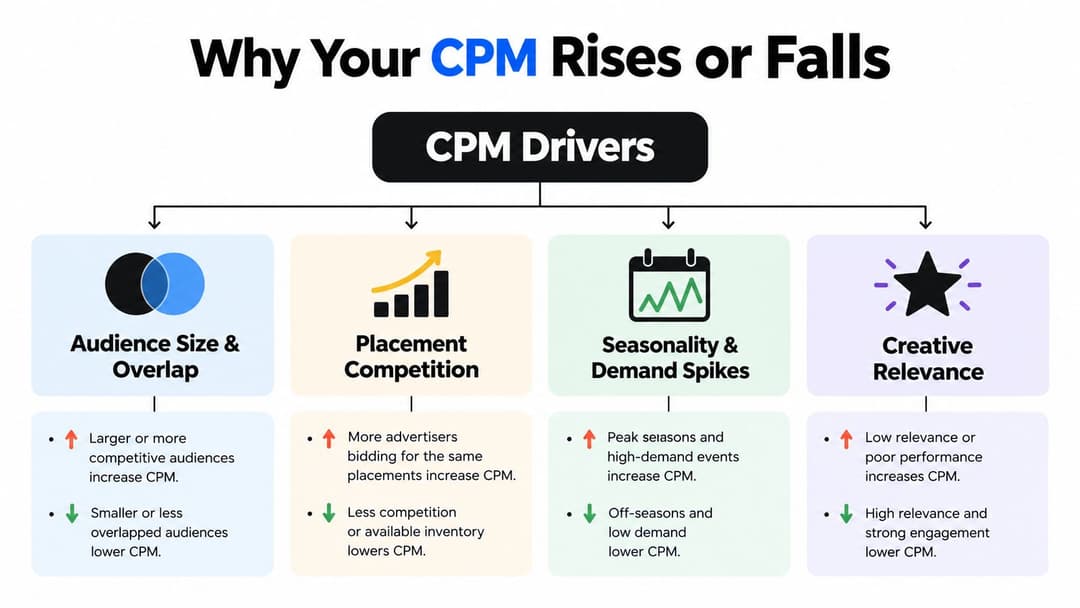
CPM changes because the auction changes. Meta evaluates available inventory, advertiser demand, estimated action rates, and ad quality while deciding which ads to deliver. Your campaign can therefore see a different price even when the budget and audience settings remain unchanged.
Audience pressure
A narrow audience gives Meta fewer eligible impressions to work with. If several advertisers target the same users, they compete more aggressively for that limited inventory. Overlap can create the same problem inside your own account when multiple ad sets chase similar people.
Broadening doesn't mean abandoning relevance. It means giving the system more qualified people to evaluate rather than forcing delivery into a tiny segment. Look at audience size, overlap, frequency, and delivery by ad set before assuming the bid is the problem.
Placement competition
Feed, Stories, Reels, and other placements have different inventory conditions. A campaign restricted to one placement has fewer chances to find affordable impressions. Automatic or Advantage placements can give Meta more room to distribute delivery, although the creative still needs to fit each format.
Placement mix can also disguise the reason CPM moved. A campaign that shifts toward more expensive inventory may show a higher blended CPM even if the underlying ad quality hasn't changed. Break down performance by placement before making a campaign-wide decision.
Timing and advertiser demand
Advertisers don't enter the auction at a constant rate. Retail promotions, industry launches, and seasonal buying periods can increase competition. The benchmark data cited earlier reported that CPM fell 5% year over year in Q2 2025, a reminder that short-term market conditions matter even on a large platform (Facebook Ads pricing context).
Creative relevance
Meta has more incentive to deliver ads that people engage with and act on. A tired hook, weak first frame, or mismatch between the ad and landing page can reduce the quality signals around delivery. You may see CPM rise alongside falling click-through rate and weaker conversion behavior.
Creative fatigue isn't proved by CPM alone. Check whether frequency is increasing, whether engagement is declining, and whether one format or message is carrying most of the spend.
Objective and auction thinning
Objective choice changes who Meta tries to reach. As the objective narrows toward higher-intent actions, the eligible inventory becomes thinner. More advertisers may then bid for the same users, pushing CPM upward even when click or conversion efficiency improves.
Diagnostic rule: A rising CPM is concerning when it arrives with weaker downstream results. By itself, it's evidence that the cost or mix of impressions changed, not proof that the campaign failed.
The ranking logic behind delivery is more complex than a simple highest-bid contest. Meta ad ranking fundamentals can help you understand why bid, estimated action rate, and ad quality work together in the auction.
Proven Tactics to Lower CPM Without Hurting Results
Lowering CPM is useful only when the campaign keeps producing qualified actions. Run controlled tests and pair the CPM change with a business metric. A cheaper impression that reduces lead quality or purchase rate isn't an efficiency win.
Start with audience access
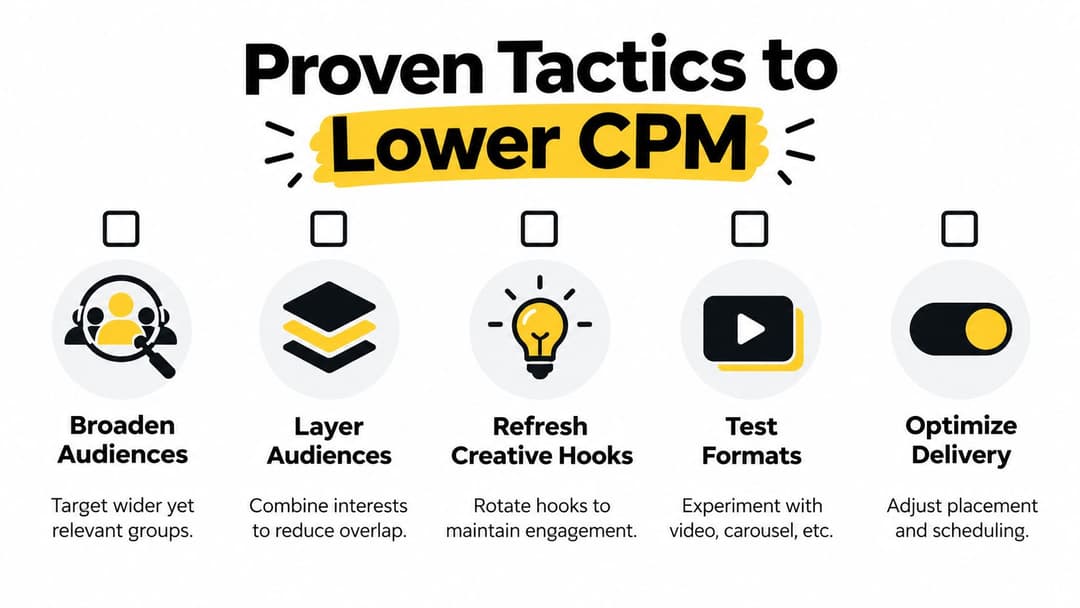
Test a broader audience against your current narrow setup while keeping the creative, objective, budget, and conversion event consistent. If CPM falls, compare CTR and conversion rate before deciding whether the new audience is better. A wider pool can lower auction pressure, but it may also change intent.
Layering can help when separate ad sets overlap heavily. Consolidate closely related segments or use a clearer audience structure so the system has more room to learn from delivery. Watch frequency and conversion quality during the test, not just the headline CPM.
Refresh the reason to stop scrolling
Create new hooks, opening frames, offers, and messages rather than making only cosmetic edits. Test a problem-led concept against a product demonstration, testimonial-style explanation, or direct offer. Keep the audience stable so you can judge whether the creative changed delivery.
A practical seven-day review should include:
- CPM: Did the cost of impressions move?
- CTR: Did more people respond to the message?
- Frequency: Is the same audience seeing the ad repeatedly?
- Conversion metric: Did leads or purchases remain qualified?
Expand placement access carefully
Run Advantage placements against a manual placement setup when your assets support multiple formats. The test should compare blended CPM with cost per qualified result, not CPM alone. If one placement consumes spend but produces poor downstream action, separate it for a cleaner decision.
Use format-native creative. A vertical video designed for Reels shouldn't be treated as interchangeable with a Feed asset. Placement expansion works best when each surface receives an ad that fits the way people use it.
Manage fatigue and delivery
If frequency rises while engagement weakens, rotate the concept before making drastic targeting changes. A new creative angle can restore relevance without forcing the campaign into a smaller audience. For delivery controls, test the bidding approach that matches your need for scale, cost control, or predictable volume.
Practical test: Change one major input at a time, run the comparison long enough to gather meaningful delivery, and judge CPM beside the metric that defines success for the campaign.
For more ideas on connecting creative, targeting, and conversion signals, see this practical guide to improving ad performance. The strongest test plan doesn't chase the lowest CPM. It finds the cheapest combination that still produces the right action.
How AdStellar AI Helps You Test and Scale Low CPM Winners
Manual testing becomes difficult when you need to compare many combinations of creative, copy, audience, placement, and objective. The problem isn't only production time. It's also the difficulty of identifying which combinations produce an attractive CPM without weakening ROAS, CPL, or CPA.
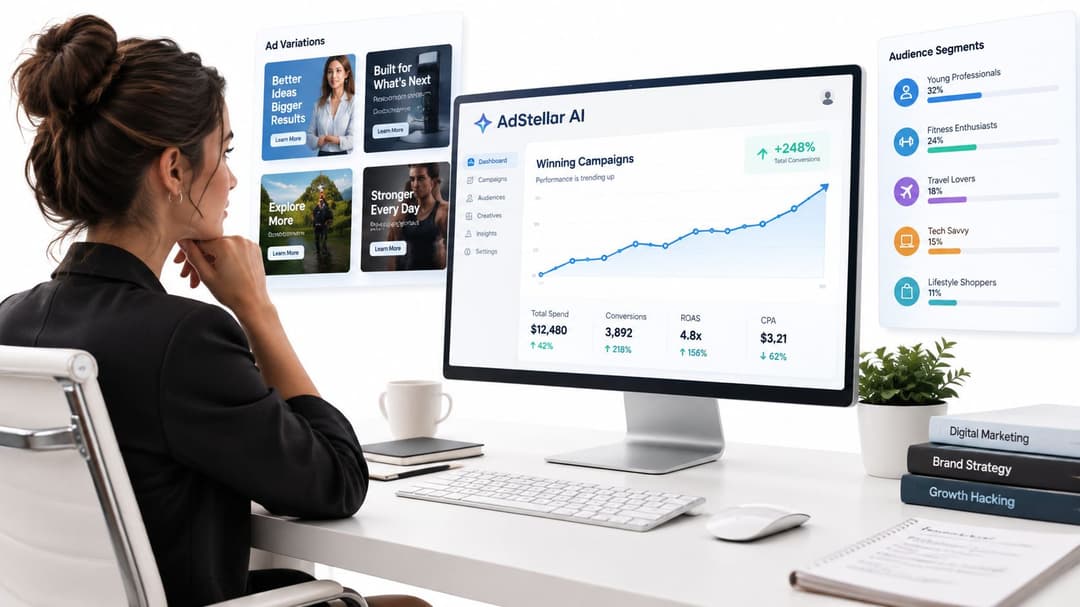
AdStellar AI connects to Meta Ads Manager through secure OAuth and can use historical performance data to organize campaign, creative, audience, and message testing. Its bulk generation workflow creates combinations for structured experiments, while AI Insights ranks performance against the business metric you choose, such as ROAS, CPL, or CPA. CPM can remain part of the diagnostic view, rather than becoming the only optimization target.
From testing to repeatable scaling
The useful workflow is not “generate more ads and hope.” It's:
- Create controlled combinations of hooks, formats, audiences, and messages.
- Launch them through a connected workflow rather than rebuilding each setup manually.
- Rank results by business outcome, with CPM used to diagnose reach costs.
- Use proven winners to assemble new campaigns through AI Launch.
- Let fresh results update the learning process as delivery continues.
This approach helps a growth team distinguish a low-CPM awareness winner from a low-CPM sales winner. Those are not interchangeable. The first may excel at affordable reach, while the second must also support efficient conversion.
Teams evaluating this workflow can review the AdStellar AI media buyer to understand how campaign building, performance analysis, and scaling fit into one operating process. The value comes from preserving the relationship between auction cost and business result, not from reducing every campaign to a single CPM target.
Measuring CPM Correctly and Next Steps for Growth
Review CPM in context. At minimum, pair it with frequency, CTR, and the conversion metric tied to your objective. A rising CPM with stable CPA may be acceptable if Meta is reaching more valuable users. A falling CPM with worsening conversion quality deserves investigation, not celebration.
Use a simple weekly review:
- Check delivery: Compare CPM by campaign, ad set, placement, and audience.
- Check fatigue: Review frequency, creative engagement, and the share of spend going to older ads.
- Check intent: Compare CTR and conversion rate with the prior period.
- Check economics: Decide using CPA, CPL, ROAS, or another business outcome.
- Choose one test: Change the audience, creative, placement, or delivery setting, but keep the comparison interpretable.
Your next month can follow four decisions: benchmark, diagnose, test, and scale. First, record the CPM range for each objective and market. Then identify whether movement comes from audience pressure, placement mix, timing, creative fatigue, or objective. Test one change, measure the downstream result, and scale only combinations that earn both efficient reach and acceptable business performance.
Verification checklist: Never approve a CPM change without checking what happened to frequency, CTR, and qualified conversions.
A high CPM is sometimes the correct price for a smaller, more valuable audience. The right question isn't “How do I make CPM as low as possible?” It's “What impression cost can this campaign support while still meeting its business goal?”
AdStellar AI helps you generate and compare Meta campaign combinations, connect performance data, and identify low-CPM winners without losing sight of ROAS, CPL, or CPA. Visit AdStellar AI to explore a more repeatable way to test, learn, and scale your Facebook advertising.