You launch a campaign with a polished creative, a carefully chosen audience, and a bid that looks competitive. A few hours later, delivery slows, CPM rises, and an ad you considered weaker keeps winning impressions. The platform isn't judging your campaign by brand taste or the time your team spent on the concept. It's evaluating predicted value in a live auction, impression by impression.
That distinction makes ads ranking easier to diagnose. Meta's total value model and Google's Ad Rank system use different mechanics, while Google's Quality Score is often mistaken for the auction signal itself. Once you separate those inputs and connect them to creative testing, conversion data, and landing-page quality, auction losses stop looking random. They become optimization problems with practical levers.
Why Your Best Ad Is Not Always the One That Wins
A performance marketer notices the problem during the morning pacing review. One video has the strongest opening, the cleanest product demonstration, and the approval of everyone in the creative review. Yet another ad is receiving more delivery. The “better” ad has a higher CPM and fewer impressions, so the team considers raising the bid.
That instinct is understandable, but it skips the question the auction is asking: Which eligible ad is expected to create the most value in this impression? Meta says its auction selects the ad with the highest total value, subject to a price floor, rather than selecting the advertiser willing to pay the most (Meta's explanation of the ad auction). Google uses its own live Ad Rank calculation, and Google explicitly separates that auction-time system from Quality Score, a diagnostic estimate (Google's Quality Score documentation).
Craft is only one part of the decision
A creative can be attractive to your internal team and still produce a weak predicted action rate for a particular person. The audience may not understand the offer, the first frame may lack context, or the landing page may fail to continue the promise made in the ad. A competitor with simpler creative can rank higher because its message is more relevant to that user and its predicted outcome is stronger.
That doesn't mean creative quality is irrelevant. It means quality is evaluated through user and business signals, not through a subjective brand score. Engagement, relevance, conversion feedback, eligibility, bid strategy, placement, and auction competition all affect what happens next.
Practical rule: Treat an auction loss as a signal to inspect the inputs, not as proof that the platform “doesn't understand” your creative.
This article focuses on three practical distinctions. First, Meta balances bid, estimated action rate, and ad quality in a total-value score. Second, Google's Quality Score helps diagnose account and keyword conditions, while Ad Rank operates in the live auction. Third, AI-driven creative testing can help improve the predicted outcomes behind both systems, but only when the underlying conversion signals are reliable.
How the Meta Ad Auction Actually Decides a Winner
Meta's auction is easier to understand if you stop thinking of it as a simple bidding contest. Think of three coffee buyers competing for the same valuable morning spot. One offers the most money, another attracts more customers to the café, and the third creates a better experience for people sitting nearby. The café owner weighs all three forms of value.
Meta describes its winning-ad calculation through three inputs:
- Advertiser bid, the value the advertiser is willing to offer for the desired result.
- Estimated action rate, Meta's prediction that a particular person will take the optimized action.
- Ad quality, signals related to relevance and the experience the ad creates for the person seeing it.
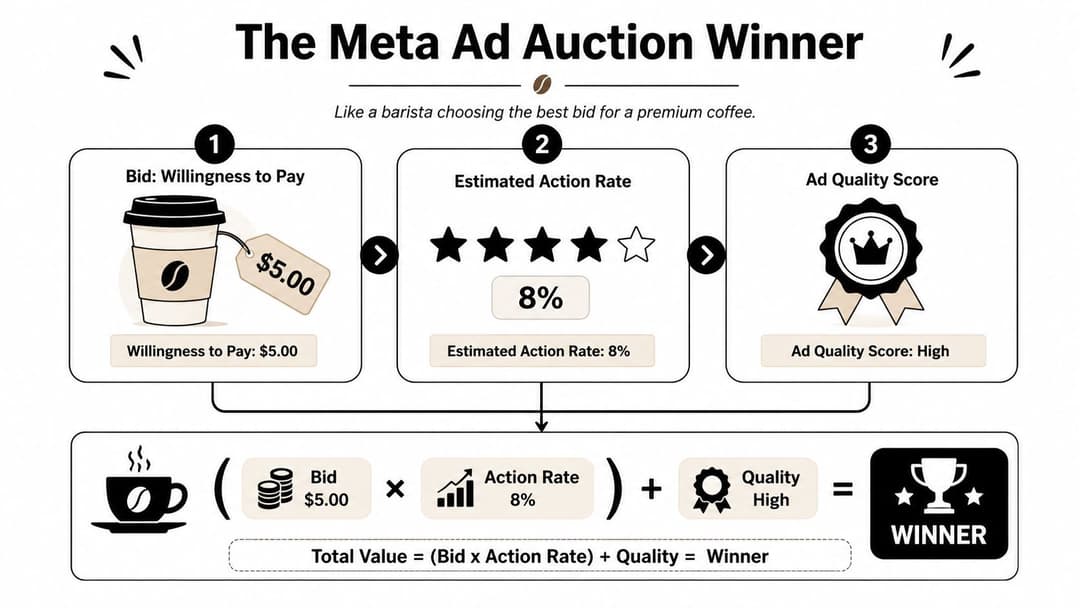
The three inputs in plain language
Your bid represents the economic value of the result you want. If you optimize for a purchase, Meta considers the bid strategy and value assigned to that outcome. A higher bid can make an ad more competitive, but it doesn't erase weak relevance or poor predicted response.
The estimated action rate is user-specific. Meta isn't asking whether your ad has performed well in general. It's estimating whether this particular person is likely to take the selected action after seeing it. A product demo might work for someone actively researching the category but underperform for a person unfamiliar with the problem.
Ad quality captures how the experience is likely to be received. Meta-style ranking explanations describe quality as incorporating user feedback and other experience signals, which means an ad that feels misleading, repetitive, or poorly matched to the audience can lose value even with a strong bid (an independent explanation of Meta auction ranking).
Meta's public explanation describes total value as combining advertiser value and ad quality. It also explains advertiser value through the relationship between bid and estimated action rate (Meta's overview of improving ad value). The practical conclusion is simple: paying more is only one route to competitiveness.
A useful workflow is to ask three questions before changing budget:
- Is the selected event valuable and tracked consistently?
- Does the creative make the intended action clear to the right audience?
- Does the landing experience confirm the ad's promise?
A Meta Ads learning phase explanation can help connect these auction inputs to delivery behavior, especially when frequent edits prevent the system from learning cleanly.
The auction doesn't reward the ad with the highest production budget. It rewards the eligible ad with the strongest predicted value for that impression. Research on quality-score auctions also finds that quality scoring can move higher-quality advertisers toward the top while reducing price pressure in the auction (research on quality-score auctions).
Google Quality Score vs Ad Rank and Why Marketers Confuse Them
Google marketers often open a keyword report, see a Quality Score change, and assume they've watched their ranking move in real time. That interpretation is wrong. Quality Score is a diagnostic estimate. Ad Rank is the live auction mechanism.
Google describes Quality Score as a 1–10 diagnostic metric based on expected click-through rate, ad relevance, and landing-page experience (Google's official Quality Score guidance). It helps advertisers identify areas to improve, but Google says it isn't used as the auction-time signal itself.
Ad Rank, by contrast, is recalculated in each auction. It determines whether an ad is eligible, where it can appear, and how the auction may price the click. Its outcome depends on bid and quality-related signals, along with assets, competition, search context, and eligibility conditions.
The practice field and the game
Quality Score is useful because it gives marketers a structured diagnosis. A weak expected click-through rate points toward copy, keyword intent, or message alignment. A weak ad-relevance component may indicate that the ad group contains mixed themes. A weak landing-page experience suggests that the destination doesn't provide a clear, useful continuation.
Ad Rank is the actual contest under current conditions. The same keyword and ad can face different competitors, user intent, device context, and available assets across searches. That's why a stable Quality Score doesn't guarantee stable position or cost.
| Dimension | Quality Score | Ad Rank |
|---|---|---|
| Role | Diagnostic estimate | Live auction-time calculation |
| Main use | Helps identify improvement areas | Determines eligibility and position |
| Timing | Reported as a broader account or keyword diagnostic | Recalculated for each auction |
| Inputs highlighted by Google | Expected CTR, ad relevance, landing-page experience | Bid, quality signals, assets, competition, context, eligibility |
| How to use it | Find problems to investigate | Understand current auction outcomes |
For a fuller explanation of how the diagnostic metric relates to campaign performance, this Quality Score guide for PPC provides useful practitioner context. The key operating principle remains: don't optimize a dashboard number in isolation.
Improve the things Quality Score helps expose. Write specific ads for tightly related intent, make the landing page useful and fast, and choose a bid strategy that matches the business outcome. Then evaluate Ad Rank through position, impression share, cost, conversions, and auction behavior. If you're building or restructuring campaigns, this guide on how to create an ad on Google offers a practical starting point.
Meta vs Google Ranking Side by Side
Meta and Google both estimate value, but they encounter users in different environments. Meta places ads into feeds and other social placements where the system predicts a person's likely response from audience, creative, placement, and conversion signals. Google responds to an active query, where relevance to the search and the usefulness of the destination carry immediate weight.
That difference changes how a media buyer should diagnose a weak result. On Meta, the central question is whether the system predicts enough action and user value to win the impression. On Google, the question is whether the ad is eligible and competitive under the current query context through Ad Rank.
| Auction component | Meta ads | Google ads |
|---|---|---|
| Primary ranking idea | Total value | Ad Rank |
| Bid role | One input in advertiser value | A major auction input, not the only factor |
| Predicted behavior | Estimated action rate for the optimized action | Expected CTR and broader context-dependent quality signals |
| Relevance and experience | Ad quality and user feedback signals | Ad relevance and landing-page experience |
| Diagnostic metric | Delivery and performance signals must be interpreted together | Quality Score helps diagnose, but isn't the auction signal |
| Main creative challenge | Earn attention and action from a person who didn't necessarily ask for the product | Match ad language to the user's intent |
| Common mistake | Raising bid without fixing weak predicted outcomes | Treating Quality Score as live Ad Rank |
A higher bid on Meta can improve competitiveness, but it can also increase cost without repairing a weak action prediction. On Google, a stronger landing page or more relevant ad can improve auction competitiveness without requiring the highest bid.
Conversion setup matters on both platforms. If Meta receives noisy optimization events, its action prediction has a weaker foundation. If Google receives vague keyword-to-ad-to-page alignment, the account may show acceptable diagnostics while still losing valuable query-level auctions.
Auction density also varies by platform and inventory. Kantar's 2025 Media Reactions findings show that marketers and consumers express different preferences across media brands and platforms, reinforcing that ad quality can't be treated as one universal, portable score. Diagnose Meta and Google separately, even when the same creative, offer, or audience strategy appears on both.
Optimization Tactics That Move Estimated Action Rate and Ad Quality
The fastest way to improve ranking usually isn't to raise the bid first. A bid can make an eligible ad more competitive, but estimated action rate and ad quality determine whether the platform expects that spend to create useful outcomes.
Start with the conversion signal. Choose one primary optimization event that reflects the business objective, such as Purchase or qualified lead, instead of combining unrelated low-value actions. Check that the event fires consistently, excludes obvious noise, and represents the outcome you want the system to find.
Make the prediction easier
A product ad for first-time buyers needs a different opening from a retargeting ad for people who already know the brand. Match the first frame, headline, proof point, and call to action to the audience's level of awareness. If the ad promises a solution, the landing page should make that solution immediately clear.
Use structured creative testing rather than changing everything at once. Test one meaningful variable at a time where possible:
- Hook: Lead with a problem, outcome, demonstration, or objection.
- Format: Compare static images, short video, product demonstrations, and creator-style explanations.
- Proof: Test reviews, product details, comparisons, guarantees, or use cases.
- Call to action: Match the requested action to the page and buying stage.
For video-specific testing, this practical boost video CTR framework can help teams examine the opening, pacing, message clarity, and action prompt. Don't judge a variation by clicks alone. Compare cost per result, conversion rate, frequency, quality indicators, and downstream value.
On Meta, test broad targeting against carefully defined audience groups, but avoid building many tiny segments that compete with one another. On Google, organize keywords and ad groups around closely related intent, write specific copy, and ensure the landing page fulfills the query rather than merely repeating it.
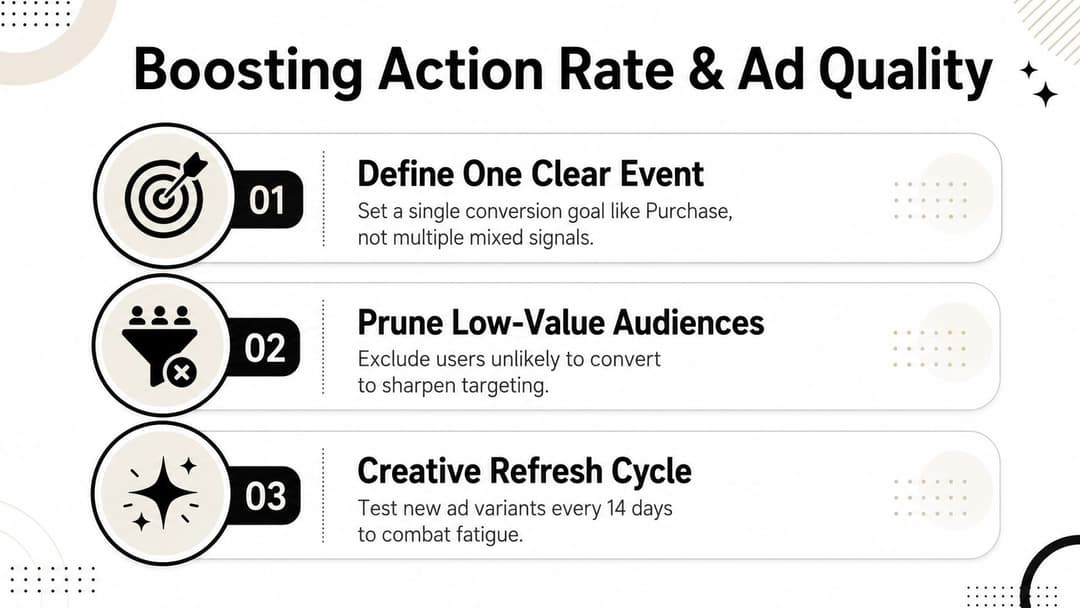
A practical lever map
| Lever | What to improve |
|---|---|
| Conversion event | Signal quality and business relevance |
| Audience-message fit | Predicted response from the intended user |
| Creative variation | Hooks, formats, proof, and calls to action |
| Landing page | Continuity, usefulness, clarity, and trust |
| Account structure | Relevance between intent, ad, and destination |
| Fatigue management | Freshness before engagement and conversion efficiency weaken |
| Bid strategy | Economic competitiveness after the core inputs are sound |
A useful ad delivery optimization guide can support the operational side of these changes. The principle is more important than the tool: refresh the experience before trying to buy your way out of a relevance problem.
How AI Uses Historical Performance to Improve Ranking Outcomes
AI influences ads ranking through the evidence it helps marketers produce, not by overriding Meta's total-value calculation or replacing Google's Ad Rank. Its practical role is to form better hypotheses, test them faster, and provide cleaner signals to the systems that predict action and ad quality.
A useful historical dataset links each creative with its audience, placement, conversion event, spend context, and downstream result. Without those connections, an AI system may treat a high-click ad as a winner even when it attracts low-intent visitors. It may also credit the format for results caused by a different audience, offer, or landing experience.

From old results to new tests
An AdStellar-style workflow can group creatives by concept and compare patterns across reasonably similar audiences. It may show that demonstration-led hooks perform better for one product category, that a proof point supports qualified leads, or that a format earns attention without generating enough conversion feedback.
The output should be a test plan, not a claim of certainty:
- Cluster the evidence. Group ads by hook, offer, format, message, audience, and placement.
- Separate outcomes. Review CTR, conversion rate, CPA, CPL, and ROAS separately instead of treating engagement as the objective.
- Generate variants. Create new combinations that retain a useful pattern while changing the execution.
- Test under controls. Record budget, audience mix, placement, seasonality, and attribution conditions.
- Review with judgment. Keep human oversight for brand safety, compliance, positioning, and commercial context.
AI can also flag fatigue when engagement or conversion efficiency weakens as exposure rises. That signal can prompt a new angle before the original message becomes expensive to deliver. Historical winners still need scrutiny because markets change, offers expire, and audiences learn.
The machine learning in advertising overview explains how predictive systems can support campaign decisions. The boundary remains clear: AI accelerates learning, but it can't compensate for broken tracking or an unclear business objective.
Historical performance improves future ranking when it produces stronger creative relevance, better audience matching, clearer landing experiences, or more reliable conversion feedback. The advantage is a shorter learning loop, not an automated promise that every past winner will win again.
Ranking Is Not a Spending Problem but a Value Problem
A campaign can stall even after the budget and bid increase. More spending creates additional auction opportunities, but it does not automatically improve the value generated by each impression.
Meta's total-value model makes that distinction clear. An ad with a higher bid can lose when another combines a stronger estimated action rate with better ad quality. Google's system separates historical Quality Score diagnostics from auction-time Ad Rank, yet the underlying lesson is similar: relevance can influence both visibility and the pressure on price. The sponsored-search auction research examines this relationship in sponsored-search auctions.
Three better reframes
A cheap impression that produces no useful action isn't efficient, whereas a more expensive one can be valuable if the user is well matched and the conversion signal is strong. CPM describes the cost of delivery, not the commercial value of that delivery.
Creative refresh is a ranking lever. A new hook, clearer demonstration, or stronger proof can improve the predicted response without changing the bid. In 2026, AI-driven creative testing makes this lever more practical by helping teams produce and compare variations quickly. It still cannot decide whether a message fits the offer, audience, or brand without informed review.
Separate position from business value. A top placement may attract attention while generating little qualified demand. If the message draws the wrong intent, greater visibility can increase waste. Auction position is an output of predicted value, not proof of profitable performance.
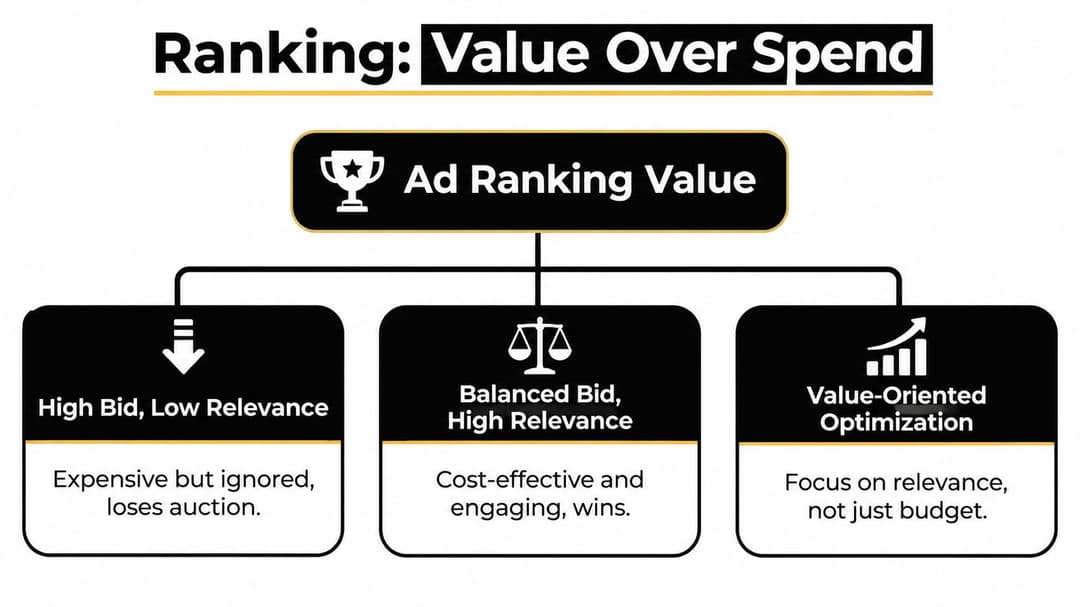
The strongest ranking strategy improves what the platform predicts, not just what the advertiser pays.
The same reasoning applies when teams assess growth partners or acquisition plans. The seed to Series C blog offers a broader lens for considering how stage, positioning, and commercial goals shape marketing decisions. Auction ranking should remain connected to the economics of the business.
Set the north-star question accordingly: “How do we create more value per impression?” That directs attention toward conversion quality, useful landing pages, audience signals, and creative relevance before additional spend.
A 30 Day Plan to Climb the Auction Ladder
A practical month begins with a clean baseline, not a rushed bid change.
Week 1, audit. Review Google Quality Score diagnostics, Meta relevance and delivery signals, conversion-event quality, landing-page continuity, and CPA by audience segment. Record which creatives attract attention, which produce qualified actions, and where tracking creates uncertainty. This Meta Ads campaign optimization guide can help organize the audit around campaign structure and delivery decisions.
Week 2, test. Build a controlled set of creative variations around hooks, offers, proof, formats, and calls to action. Keep the conversion event and core measurement rules stable so the results can inform the next decision.
Week 3, learn. Feed clean historical patterns into your AI workflow. Ask it to identify creative clusters, audience-message matches, fatigue signals, and combinations worth testing. Review every recommendation for compliance, brand fit, seasonality, and business intent.
Week 4, reallocate. Move budget toward ads that create stronger value per impression, pause clear underperformers, and document the reasons. Look for declining cost per result at a stable position, stronger quality diagnostics, and stable or rising conversion volume at lower CPMs. Treat those as evidence of improved efficiency, not as proof that one dashboard metric controls the auction.
Run the cycle again with the new evidence. Ranking gains compound when each test improves the next hypothesis instead of resetting the account to guesswork.
AdStellar AI helps teams create and test Meta creative, copy, and audience combinations, then use historical performance to rank options against goals such as ROAS, CPL, or CPA. Visit AdStellar AI to turn your next auction diagnosis into a structured testing and optimization workflow.