Your Meta account probably isn’t failing because you missed one secret setting. It’s failing because Meta changed the game and your inputs didn’t keep up.
That’s the pattern behind a lot of unstable performance. A campaign looks efficient for a few days, then CPA spikes, delivery shifts, and nobody on the team can explain whether the issue is audience saturation, weak creative, broken tracking, fragmented structure, or just normal auction noise. People respond by making more manual edits. Usually that makes the account less stable, not more.
Modern meta ads campaign optimization is less about micromanaging delivery and more about building a system the algorithm can use. Meta’s own direction has made that clear. In 2024, AI-driven optimization on Meta coincided with stronger performance benchmarks, including 1.25% CTR and 2.25% conversion rate for prospecting campaigns, plus 2.86% CTR for retargeting, according to Lebesgue’s Meta ads performance analysis. The practical takeaway isn’t “trust automation blindly.” It’s that teams who align creative, tracking, and campaign structure with automation have a better operating model.
A lot of marketers also undercount what happens outside Ads Manager. Paid social rarely works in isolation. If you’re trying to tighten blended efficiency, this guide on pairing ads with organic growth is a useful companion because it frames how paid demand capture and organic content support each other.
Introduction The End of Guesswork in Meta Advertising
The old Meta playbook rewarded people who loved switches, exclusions, tiny audience segments, and daily bid tinkering. That version of the platform is fading. You can still make manual decisions, but the highest impact decisions have moved upstream.
The account quality questions now sound different. Is the campaign objective aligned with the business goal? Is the event setup clean enough for reliable learning? Is the structure simple enough to accumulate signal? Are the creatives varied enough to help delivery find efficient pockets of demand?
Practical rule: Stop treating performance swings as isolated ad-level problems. Most of them start higher up, in structure, signal quality, or creative strategy.
That shift is uncomfortable because it removes the illusion of control. Narrow targeting used to feel precise. Manual placement edits used to feel disciplined. Today, those habits often fragment data and slow learning. The best operators still optimize aggressively, but they optimize the parts that feed the machine instead of fighting it.
A good optimization process should answer three things quickly:
- What’s broken: Tracking, structure, budget distribution, creative fatigue, audience overlap, or message-market fit.
- What’s fixable now: Naming, consolidation, exclusions, event priorities, creative rotation, and budget allocation.
- What needs testing: New concepts, new hooks, different conversion events, broader audience setups, and cleaner mid-funnel paths.
That’s the practical lens for the rest of this playbook. Less superstition. More diagnosis. More disciplined inputs. Better decisions from the same spend.
Your Foundation A Pre-Launch Audit and Health Check
Most account rebuilds start too late. The team has already launched, performance is unstable, and everyone is trying to troubleshoot while spend is active. A better move is to audit the account before touching budgets or building new tests.

A clean audit does two things. It tells you whether Meta has enough signal to optimize properly, and it shows whether your structure is helping or blocking learning. According to AdStellar’s audit methodology for Meta ads, keeping daily budgets above $50 per ad set, audiences in the 500,000 to 2M range, and structures simplified can cut CPA by 18% on average and help campaigns exit the learning phase within 7 days.
Start with objective alignment
The first check is brutally simple. Are you asking Meta to optimize for the business outcome you care about?
If a brand wants purchases but runs traffic because traffic looks cheaper, the account starts learning toward the wrong behavior. You might get more clicks, but not the kind of downstream actions that support revenue. That mismatch poisons everything that comes after it, including audience learning and creative evaluation.
Use this audit prompt:
- Compare business goal to campaign goal: If the KPI is revenue or qualified pipeline, the objective should reflect that intent.
- Check optimization event depth: Don’t optimize for a shallow event if the account can support a deeper one.
- Review reporting habits: If the team celebrates CTR while margin or qualified conversion quality is slipping, the optimization standard is off.
Audit campaign structure before ad creative
Most account problems aren’t hidden in copy. They’re visible in the architecture.
When I audit struggling accounts, the common pattern is fragmentation. Too many campaigns doing similar jobs. Too many ad sets splitting the same audience. Too many ads competing for too little data. Meta can’t learn efficiently when the account is constantly dividing signal into smaller and smaller buckets.
Look for these structural red flags:
- Too many ad sets per campaign: Once a campaign gets crowded, each ad set receives less signal and budget stability.
- Low-budget conversion ad sets: If a conversion ad set is below the threshold noted in the audit benchmark above, it often struggles to gather enough learning data.
- Single-ad ad sets: These remove useful comparison and make it harder to separate message quality from delivery luck.
- Heavy overlap across similar audiences: If prospecting segments are too close to each other, your own campaigns can compete in the same auction.
A lot of “bad performance” is just a data allocation problem wearing a creative disguise.
Check audience size and targeting pressure
Audience setup matters more now because over-constraining targeting can choke learning. Review the estimated reach for each conversion-focused ad set and ask whether it gives Meta room to work.
A practical audit pass should include:
- Reach sanity check: Compare potential reach against your conversion goal and budget.
- Interest stacking review: Remove unnecessary layers that shrink the audience without adding meaningful intent.
- Geo consistency: Make sure campaign geography matches fulfillment reality, sales team capacity, or shipping coverage.
- Retargeting windows: Confirm they’re sensible and not so narrow that they starve delivery.
Many teams still treat narrow targeting as “efficient.” Often it’s just brittle. It may look good briefly, then performance fades because the system keeps hitting the same small pool.
Validate tracking and event quality
Optimization is only as good as the event stream going into Meta. If Pixel firing is inconsistent or Conversions API isn’t configured well, the platform learns from partial or delayed information. That hurts attribution and delivery.
For a practical setup review, check your Pixel and Conversions API implementation together. This walkthrough on Meta Conversions API setup is a useful reference for validating the server-side side of your measurement stack.
Use a health checklist like this:
| Audit area | What to verify | Why it matters |
|---|---|---|
| Pixel events | Core conversion events fire on the right pages or actions | Prevents optimization toward the wrong behavior |
| CAPI coverage | Server-side events support browser tracking | Improves resilience when browser tracking is limited |
| Event naming | Standardized and readable events | Reduces confusion in reporting and optimization |
| Deduplication logic | Browser and server events aren’t double counted | Protects reporting integrity |
| Custom conversions | Business-critical actions are clearly mapped | Gives you cleaner analysis later |
Decide what to fix first
Don’t rebuild everything at once. That’s how teams lose the ability to tell which change helped.
Fix issues in this order:
- Measurement gaps
- Objective misalignment
- Structural fragmentation
- Audience constraints
- Creative volume and quality
If you make one disciplined round of corrections in that order, the account becomes easier to read. And once an account is readable, optimization gets faster.
Building for Success Campaign Structure and Naming Conventions
There’s a reason simplified accounts outperform messy ones in the AI-driven version of Meta. The machine needs concentrated signal, not elaborate campaign trees built to satisfy human preferences.
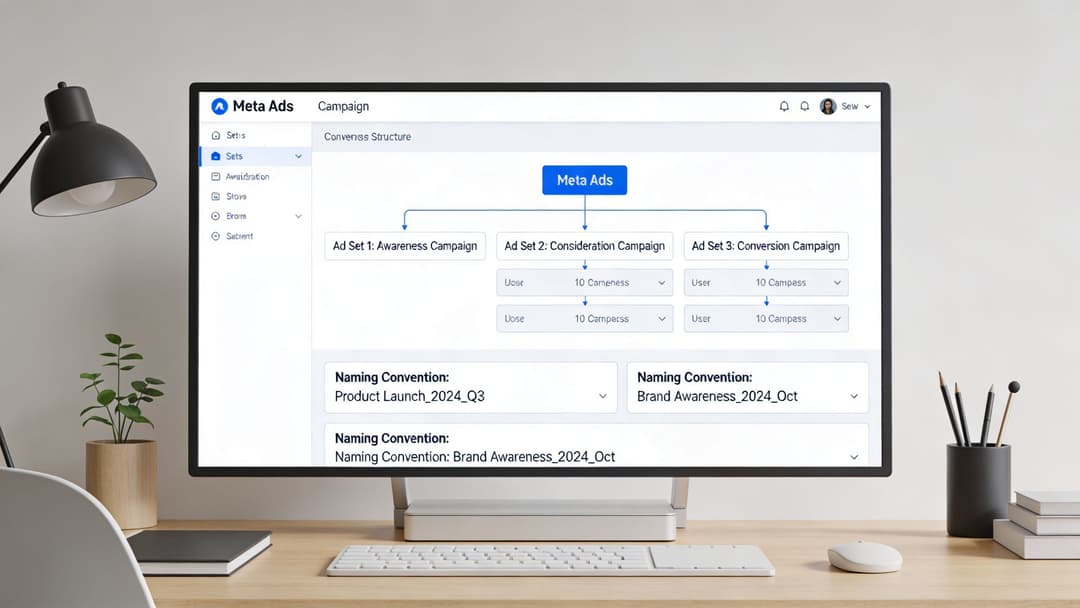
As of March 2025, Meta removed many detailed targeting exclusions and pushed advertisers further toward broader targeting, Campaign Budget Optimization, and Automatic Placements, according to Bir.ch’s breakdown of Meta marketing updates. That shift matters because it makes consolidated structure less of a preference and more of a requirement.
Why fewer campaigns usually win
A sprawling account looks organized on the surface. In practice, it often creates budget inefficiency, duplicated tests, and weak learning density.
A tighter structure does the opposite. It gives Meta more conversion history inside fewer decision buckets. Budget moves more fluidly. Winners collect signal faster. Reporting becomes clearer because you aren’t comparing ten near-identical campaigns with tiny differences in setup.
I prefer asking one question before building anything new: does this deserve its own campaign, or does it just need its own creative angle inside an existing one?
If the answer is “same objective, same geography, same core business goal,” the default should be consolidation.
A practical structure model
There isn’t one perfect architecture for every account, but advertisers generally do well with one of these two approaches:
A simplified funnel model
Use separate campaign groups only when the audience intent is meaningfully different.
- Top of funnel: Broad prospecting, new customer acquisition, creative testing.
- Middle of funnel: Product viewers, engaged audiences, softer conversion events when purchase volume is sparse.
- Bottom of funnel: Cart abandoners, high-intent visitors, recent engaged users with exclusion logic to avoid redundancy.
This works well when the business has enough spend and enough demand stages to justify separation.
A consolidated CBO model
Run fewer campaigns with broader ad sets and let CBO distribute spend based on actual performance. This model is often better for smaller teams, leaner budgets, or brands that need faster signal accumulation.
The mistake isn’t choosing one model over the other. The mistake is creating complexity without a clear reason.
Broad targeting only works when the rest of the account is disciplined. Broad plus chaos isn’t a strategy.
Naming conventions aren’t admin work
Poor naming slows optimization because nobody can see patterns quickly. You shouldn’t have to click into every asset to understand objective, audience, market, offer, and creative type.
A naming system should make three things obvious at a glance:
- What this campaign is for
- Who it’s trying to reach
- Which creative angle is running
For teams that need a reference point, this guide to Meta ads campaign naming conventions lays out a structured approach that works well for reporting and automation.
A practical naming formula might include:
| Level | Include | Example style |
|---|---|---|
| Campaign | Objective, funnel stage, geo | Sales | TOF | US |
| Ad set | Audience type, placement logic, optimization event | Broad | AutoPlace | Purchase |
| Ad | Concept, format, hook, version | Testimonial | Reel | Price Hook | V2 |
The exact format matters less than consistency. If one buyer names by angle, another names by date, and a third names by audience only, analysis becomes guesswork.
What not to build anymore
Some structures still show up in accounts even though they create more noise than insight.
Avoid these habits:
- Interest micro-segmentation by default: It inflates setup effort and often starves each segment of meaningful data.
- One campaign per creative idea: Creative belongs inside a testing framework, not a silo.
- Manual placement splits without evidence: The control gained often doesn't justify the signal loss.
- Endless duplicate ad sets: Duplicating without a hypothesis creates auction clutter and messy reporting.
Good structure is boring in the right way. It removes accidental complexity so the account can do its actual job.
Fueling the Algorithm Creative Testing and Audience Strategies
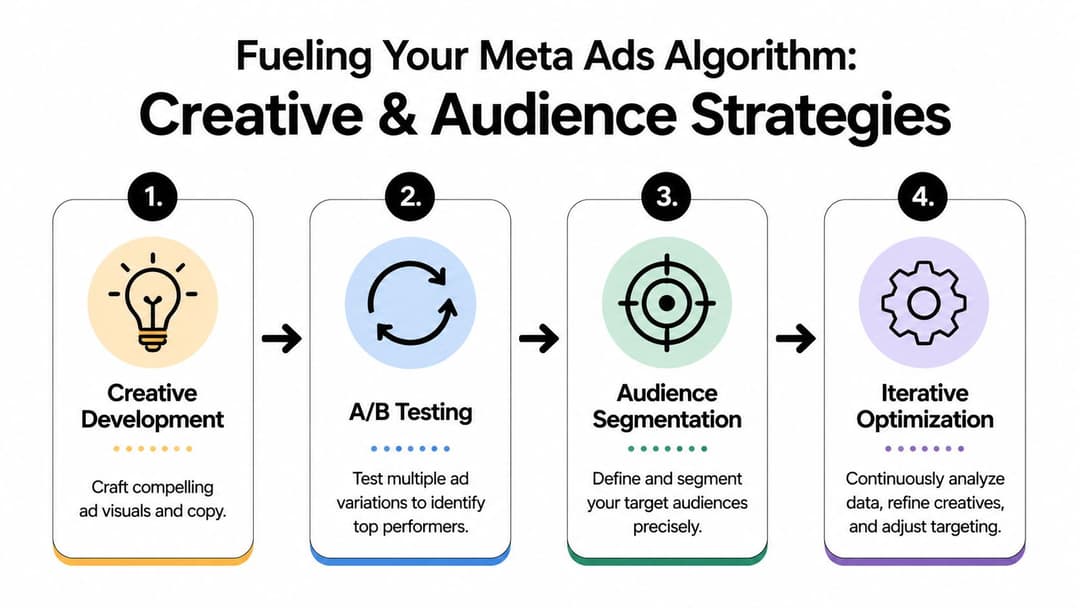
In the current Meta environment, creative does more of the targeting work than most advertisers want to admit. That doesn’t make audiences irrelevant. It changes their role.
Your job is to give Meta strong signals and enough creative variation to identify where those signals perform best. If creative is weak, broad targeting gets blamed for a problem that started in the ad itself.
Build a repeatable creative testing loop
Creative testing shouldn’t mean uploading random variants and waiting for Meta to tell you what happened. It should start with a hypothesis.
Good hypotheses usually come from one of four places:
- Customer language: Reviews, sales calls, support tickets, objection logs.
- Offer tension: Price, guarantee, speed, ease, quality, social proof.
- Format fit: Static images for feed, looser UGC-style videos for Reels, direct demos for product-led offers.
- Stage of awareness: Cold audiences need a different angle than retargeting pools.
A simple testing loop looks like this:
- Pick one angle at a time: For example, speed of setup versus product quality.
- Express it in multiple formats: Static, short-form video, testimonial, founder clip.
- Hold the destination constant: Keep the landing page or post-click experience stable while the test runs.
- Judge by business relevance: Don’t let a flashy CTR hide poor downstream quality.
This is where workflow matters. Teams that create assets one-by-one usually test too slowly to learn much. In higher-volume accounts, bulk production becomes a practical advantage. One option is Facebook ad creative best practices from AdStellar, which focuses on how teams can structure and scale creative inputs more systematically.
Get the audience strategy right for today’s Meta
The post-iOS version of Meta punishes overconfidence in manual targeting. Broad audiences often work well when paired with strong creative and clean event tracking. But “go broad” is incomplete advice unless you know when to narrow with intent signals.
A useful mental model is this:
- Broad audiences are for discovery.
- Custom Audiences are for recapturing intent.
- Lookalikes are for expansion when seed quality is strong.
- Mid-funnel optimization events are for accounts that don’t yet have enough purchase depth.
That last one is still underused. For brands with fewer than 5,000 weekly purchases, optimizing for mid-funnel events like Add to Cart can outperform direct purchase optimization and produce stronger post-campaign lift plus halo effects across other channels, based on Haus’s Meta optimization playbook. That matters for scaleups and DTC brands that keep trying to force purchase optimization before the account has enough data to support it.
If purchase volume is thin, don’t pretend the account has purchase-level signal depth. Pick an event the algorithm can actually learn from.
A lot of content teams can also borrow testing discipline from SEO workflows. This review of Surfer SEO software insights is useful for thinking about structured experimentation, where inputs are standardized and evaluated against clear performance outcomes. The channel is different, but the operational mindset transfers well to paid social.
A short creative review can help before launch:
| Creative question | What to look for |
|---|---|
| Hook clarity | Does the first second or first line create a reason to keep watching or reading? |
| Message specificity | Is the value proposition concrete, or is it generic brand language? |
| Format match | Does the asset look native to the placement where it’s likely to serve? |
| Offer relevance | Is the CTA appropriate for cold, warm, or hot traffic? |
A good explainer on the mechanics of Meta campaign inputs and testing can help teams align on process before they scale changes:
Avoid the two audience mistakes that waste the most spend
The first mistake is chasing precision through interest layering when the creative is still unresolved. The second is relying on broad automation without enough creative diversity to prevent fatigue.
A better approach is to let the account learn from a smaller number of cleaner audience frameworks, then use creative variation to access different pockets of demand. That’s also where a tool like AdStellar AI can fit operationally. It connects to Meta Ads Manager, ingests historical performance data, and helps teams generate and launch many creative, copy, and audience combinations without rebuilding everything manually.
The algorithm doesn’t need more busywork. It needs better inputs.
Managing Performance Bidding Budgeting and Measurement
Once campaigns are live, the quality of optimization comes down to decision discipline. Most accounts don’t drift because one metric moves. They drift because the team reacts to the wrong metric at the wrong time.

Choose bidding based on campaign maturity
Bidding strategy should match how much confidence you have in the account’s signal quality and conversion pattern.
If a campaign is new, unstable, or entering a new audience segment, flexibility usually matters more than control. In that situation, looser optimization settings often give Meta more room to find pockets of efficiency. As the campaign matures and result quality becomes more predictable, tighter controls may become useful.
A practical decision frame looks like this:
- Use flexible delivery when learning is still forming: This gives the system room to explore.
- Apply tighter efficiency controls only after stable signal exists: Otherwise you can choke delivery.
- Use value-based approaches carefully: They can work, but only if the value data reflects real business quality.
The biggest error is forcing cost controls too early, then blaming Meta when delivery stalls.
Budgeting is really a stability problem
Budget decisions aren’t only about scale. They’re about preserving learning while increasing output.
One useful operating rule is to avoid constant small budget edits across too many places. If you’re using a consolidated structure, budget management becomes cleaner because fewer campaigns hold the signal. If you’re using fragmented ABO setups, every budget change creates another chance to disrupt delivery.
This resource on how to optimize Meta campaign budgets is useful if your team is trying to decide when to centralize budgets and when to keep tighter controls at the ad set level.
For smaller brands, budget planning often breaks before campaign optimization does. If you need a baseline planning lens outside the platform, this guide to a small business social media ad budget can help frame spend decisions before you map them into Meta.
Small technical details affect big outcomes
This is the part many teams overlook because it feels tactical rather than strategic. But tactical sloppiness compounds fast.
According to PPC Land’s review of common Meta campaign mistakes, running more than 15 ads per ad set can hurt learning, while limiting variations to 3 to 5 ads per set creates cleaner comparison. The same analysis notes that failing to manually choose thumbnails can cause a 15% to 25% CTR drop.
That changes how I review active campaigns. I don’t just ask whether the creative concept is good. I ask whether the ad set is overloaded and whether the visual presentation is undermining an otherwise solid message.
A blurred auto-thumbnail can make a good ad look weak before the user ever reads the copy.
Measurement has to extend beyond Ads Manager
Meta’s attribution is useful, but it isn’t the whole truth. Use it as an optimization interface, not as your only source of business reality.
A solid measurement rhythm includes:
- Platform metrics for speed: CTR, cost per result, CPM, frequency, conversion rate.
- Business metrics for truth: Revenue quality, lead quality, margin, close rate, retention, and blended efficiency.
- Attribution consistency: Keep the account’s reporting window stable enough to interpret trends properly.
If the account says performance improved but your sales team sees worse lead quality, you don’t have a winning campaign. You have a reporting mismatch.
Scaling and Automation Advanced Playbooks for Growth
The hard part of scaling isn’t finding one winning ad. It’s preserving what made it work while spend increases.
Most campaigns break during scale because the team treats growth like a switch instead of a sequence. Budget goes up too quickly, audiences get duplicated unnecessarily, and creative variety doesn’t keep pace with reach. The result looks like a sudden performance drop, but the underlying cause is usually strain on the system.
Know when a campaign is ready to scale
A campaign is more scale-ready when three conditions are true at the same time:
- Results are stable across multiple days, not just one spike
- The winning pattern appears in more than one creative or placement context
- Measurement confidence is high enough to trust the signal
If only one ad is carrying the whole campaign, I usually treat that as a fragile win. It might still scale, but it needs support. Add adjacent creative concepts before forcing more spend through one asset.
Vertical scaling means increasing budget inside the same structure. Horizontal scaling means extending the winning logic into new markets, new audience pools, or new creative versions. Both can work. The right choice depends on what constraint you’re dealing with. If spend is limited by budget, vertical scaling may help. If performance is limited by fatigue or saturation, horizontal scaling is usually safer.
Troubleshooting and scaling are the same job
A lot of people separate these into two workflows. In practice, they’re connected. The signals that tell you when to scale are often the same signals that warn you a campaign is about to stall.
Meta itself has warned that narrowing audiences too aggressively can raise costs through repeated exposure, and broader industry guidance has highlighted the risk of creative fatigue and auction overlap when advertisers lean too hard on Advantage+ audience expansion without enough structural discipline. The more reliable fix is often fewer campaigns with denser signal and more creative diversity by placement, such as UGC-style assets for Reels and static creative for Feed, as discussed in Meta campaign optimization guidance.
That point matters because many teams react to fatigue by making the audience more complex. Usually the better move is the opposite. Consolidate delivery, refresh the creative mix, and stop your own campaigns from competing with each other.
Common Meta ad performance issues and solutions
| Symptom | Likely Cause | Recommended Action |
|---|---|---|
| CPA rises after budget increase | Budget scaled faster than the campaign could absorb | Increase in smaller steps and monitor whether the same creatives still carry delivery |
| Frequency climbs while CTR softens | Creative fatigue | Introduce new hooks, formats, and visual treatments before expanding audience complexity |
| Multiple prospecting ad sets underperform at once | Auction overlap and fragmented structure | Consolidate into fewer campaigns or ad sets to improve signal density |
| Strong click volume but weak conversion quality | Objective or event mismatch | Revisit optimization event and align it with the real business outcome |
| Retargeting stalls suddenly | Audience pool is too small or exclusions are off | Check window length, exclusions, and whether prospecting is feeding enough qualified traffic |
| One ad dominates then fades | Overdependence on a single creative winner | Build adjacent variants from the same angle before the asset burns out |
Build an automation layer around what already works
Automation should take repetitive execution off the team, not replace strategic judgment. The best use case is standardizing what you already know is effective.
That usually includes:
- Launching structured variations faster
- Reusing proven naming and hierarchy logic
- Ranking creative and audience combinations based on actual account history
- Identifying winners early enough to support scale decisions
If your team is trying to reduce manual duplication, this overview of Facebook ads automation workflows is a useful place to compare what should still be handled by a buyer and what can be systematized.
The big shift in meta ads campaign optimization is that scale now depends on operational consistency as much as media buying instinct. The buyers who win aren’t the ones making the most edits. They’re the ones who create the cleanest feedback loop between structure, signals, creative, and spend.
If your team wants a more systematic way to launch tests, manage large volumes of creative variations, and scale winning Meta campaigns without rebuilding everything by hand, AdStellar AI is worth evaluating. It’s built to connect with Meta Ads Manager, organize campaign inputs, and help operators turn repeatable patterns into faster execution.