Monday, 9:07 a.m. A buyer opens Ads Manager to find spend drifting, yesterday's losers still live, and the only thing moving faster than CPMs is the list of manual fixes waiting to happen.
That used to be manageable. On a modern Meta account, it is a tax on performance.
Teams still treating fb ads automation as a few saved rules usually hit the same wall. They pause ads after waste has already piled up. They raise budgets after momentum is gone. They trust outputs from weak inputs, then wonder why automated decisions feel erratic. The problem is not automation itself. The problem is trying to automate an account that was never designed to run as a system.
The accounts that scale cleanly are built differently. The optimization target is clear. Conversion signals are clean through Pixel, CAPI, and event prioritization. Creative production is steady enough to keep testing without gaps. Rules sit on top of that foundation and enforce discipline at account speed.
That is the key shift in fb ads automation. Stop treating it like a collection of switches inside Ads Manager. Build a machine that can make good decisions without needing constant rescue from a human buyer.
I have seen this play out across large spend accounts. If data quality is weak, automation spends faster on bad assumptions. If the creative pipeline stalls, even smart bidding has nothing fresh to work with. Tools like AdStellar AI help operationalize the system by turning naming, monitoring, testing flow, and decision logic into repeatable processes, but the underlying structure still has to be right.
Teams trying to cut repetitive account work can start with a practical framework for reducing manual work in Facebook advertising. The time savings show up when the account is built to run on reliable signals and repeatable creative inputs, not constant manual intervention.
Moving Beyond Manual Ad Management
At 9:12 a.m., CPA looks healthy. By lunch, frequency has climbed, one ad set has spent through its guardrails, and the winning creative from yesterday is already fading. If the account depends on someone checking dashboards a few times a day, those gaps turn into wasted spend fast.
That is the primary limit of manual management. It is too slow for how Meta delivery shifts now, and too inconsistent once spend scales across campaigns, offers, and creative angles.
A buyer working manually usually follows the same pattern. Check performance on a schedule. Nudge budgets after the move already happened. Pause losers late. Miss the moment when a strong ad should get more room. The account ends up reacting to volatility instead of controlling it.
Teams that want to reduce manual work in Facebook advertising need more than a few saved rules inside Ads Manager. They need an operating system for the account.
Automation isn't just rule setting
Rule libraries are the visible part. The harder part, and the part that drives results, is system design.
Strong fb ads automation rests on four working parts:
- One clear business target so budget decisions are aligned with CPA, ROAS, qualified leads, or another defined outcome.
- Clean conversion signals so Meta is optimizing from timely, accurate event data instead of partial Pixel tracking or delayed attribution.
- A repeatable creative pipeline so the account keeps producing new variations to test, rotate, and scale.
- Decision logic with guardrails so budget increases, pauses, and alerts happen consistently.
If one of those breaks, the rest of the setup gets weaker. Good rules cannot save bad inputs. Fast automation with weak signal quality usually loses money faster.
Manual control often feels safer because the buyer is involved in every choice. In practice, that creates noise. Constant edits reset learning, introduce inconsistency between operators, and pull attention toward account maintenance instead of actual growth decisions.
The job changes as spend grows
At lower spend, a sharp media buyer can keep a lot of this in their head. At larger scale, that stops working.
The role shifts from operator to architect. The work is less about clicking through campaigns all day and more about designing a system that makes routine decisions correctly without supervision. That includes naming rules, performance thresholds, escalation paths, creative intake, and data checks. Tools like AdStellar AI help enforce that structure across monitoring, testing flow, and decision logic, which is why they matter more in scaled accounts than in small ones.
The payoff is not just time savings. It is cleaner execution. Budgets move faster. Underperformers get cut with less hesitation. Winning ads get support before the window closes. Performance becomes less dependent on who happened to log in at the right moment.
Build Your Automation Foundation Strategy and Data
Most automation problems start before the first rule is turned on.
When advertisers say automation "doesn't work," the issue usually isn't the rule engine. It's the setup underneath it. The system was told to optimize for the wrong goal, fed weak signals, or trapped inside a bad campaign structure.
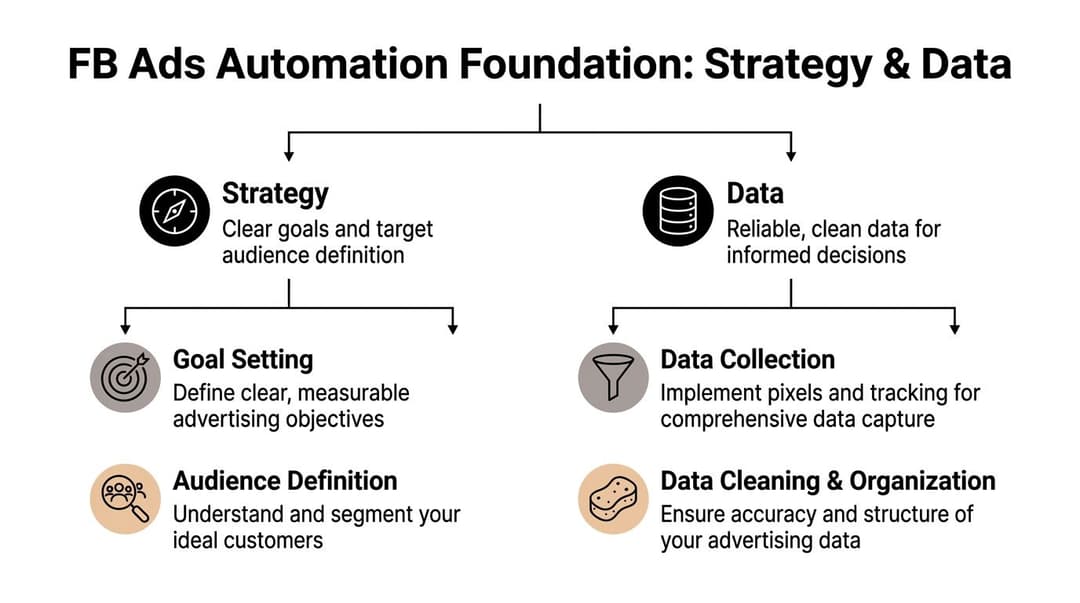
Start with one success definition
Don't automate around vague account goals like "better performance." That's how you get conflicting rules and bad budget movements.
Pick the primary business outcome first. In practice, that usually means one of these:
- Target CPA if the business has tight acquisition economics.
- Target ROAS if margin and order value vary enough to matter.
- Lead volume with quality controls if the handoff to sales matters more than front-end efficiency.
- Blended account efficiency if multiple campaigns support the same funnel.
The point is focus. If one rule scales on ROAS while another pauses on CPL and a third is trying to protect spend pacing, the account ends up fighting itself.
Data quality decides whether automation helps or hurts
This is the most neglected part of fb ads automation.
Meta can only optimize against the signals it receives. If events are delayed, duplicated, missing, or disconnected from real business outcomes, the platform doesn't become neutral. It becomes misinformed.
That's why Pixel-only setups often fall apart when spend rises. The visible symptom is unstable performance. The root cause is weak signal quality.
A good starting point for teams cleaning this up is understanding how tracking works at the source, including what Meta Pixel does and where it falls short on its own.
What clean signal design looks like
The strongest setups treat tracking as part of campaign strategy, not a technical afterthought.
That means:
- Track the events that reflect value, not just the easiest events to fire.
- Use CAPI alongside pixel-based tracking so Meta has stronger event inputs.
- Verify event quality in Events Manager before trusting automation to act on conversion data.
- Align reporting with the actual funnel, especially if lead quality or downstream revenue matters.
The biggest trap is optimizing to cheap front-end activity that doesn't translate into profitable outcomes. Automation will happily find more of whatever signal you give it, even if that signal is low quality.
Practical rule: if you're not confident in the event stream, don't add more automation yet. Fix the signal first.
Campaign structure still matters
Automation doesn't rescue broken structure.
One common issue is audience overlap. According to The Ad Firm's guidance on Facebook ads structure, overlapping ad sets can inflate CPMs by 25-40%, and this shows up in 60% of suboptimal accounts. That's not a bidding problem. That's a setup problem.
Budget also needs enough room for learning. The same source notes that successful automation requires a campaign budget of at least 50x the target CPA for the learning phase, such as $2,500 for a $50 CPA.
A simple decision table helps:
| Structural element | Good setup | What breaks |
|---|---|---|
| Goal alignment | One primary optimization target | Conflicting rule logic |
| Audience design | Distinct segments with exclusions where needed | Overlap and internal competition |
| Budgeting | Enough budget for learning relative to CPA target | Stalled learning and false negatives |
| Event tracking | Verified events tied to business outcomes | Automation optimizing noise |
The foundation checklist I use before enabling rules
Before adding automation, check these questions:
- Business goal: Does the account have one primary success metric?
- Event health: Are key conversion events present, accurate, and usable?
- Signal quality: Is CAPI in place and aligned with the events that matter?
- Audience architecture: Are ad sets clearly separated, or are they cannibalizing each other?
- Learning runway: Does each campaign have enough budget to learn?
- Creative supply: Is there enough asset variation to support optimization later?
If any of those answers are weak, more automation won't fix the account. It will only speed up the consequences.
Automate Creative Production and Audience Discovery
Advertisers often don't lose on Meta because they lack a pause rule. They lose because they don't feed the system enough inputs.
Automation performs best when it has options. That means more creative combinations, more controlled variation, and enough audience freedom for the algorithm to find demand you didn't predict.

Build a creative factory, not a creative bottleneck
The old workflow was slow by design. Write a few ads, upload them one by one, wait, then make changes after performance drops.
That doesn't hold up when you're trying to test at scale.
A better model is to treat creative production like a system:
- Create modular assets such as headline sets, primary text variants, static images, videos, and calls to action.
- Tag them clearly by angle, offer, audience, and format.
- Launch combinations in bulk instead of building ads one at a time.
- Refresh on a schedule so the account doesn't depend on stale winners.
The practical reason this matters is simple. Meta's delivery system now does a better job when it has more creative paths to test. Limiting the account to a tiny set of ads doesn't create control. It creates scarcity.
One practical resource for that workflow is this breakdown of creative automation tools, especially if your team is still stuck in manual build-and-upload cycles.
Dynamic Creative works when the inputs are intentional
Dynamic Creative isn't magic. It's a sorting engine.
If you feed it weak headlines, repetitive visuals, and nearly identical hooks, it has nothing meaningful to learn from. If you feed it strong variation, it can identify combinations that would've taken a human buyer much longer to isolate.
What tends to work:
- Different hooks, not just slight copy edits
- Different visual styles, not just resized versions of the same asset
- Different proof types, such as demonstration, testimonial, offer-led, and problem-solution
- A healthy mix of video and static
What usually fails:
- Uploading near-duplicate assets and expecting insight
- Letting one creative concept dominate every test
- Reading results at the ad level without checking what assets served
Audience automation is where Meta surprises you
Many advertisers still cling to tightly defined ICPs and overly rigid lookalikes. That's understandable, but it often blocks growth.
According to AdStellar's analysis of Facebook advertising automation rates, post-iOS14 broad targeting combined with AI automation outperforms lookalike audiences by 22% in e-commerce tests, and AI-driven systems can improve conversions by 15-30% by uncovering unexpected winning audiences that manual A/B testing misses.
That matches what strong accounts often show in practice. The best audience isn't always the one the team guessed at the start. It's the one the system discovered after seeing enough conversion and creative data.
Broad targeting isn't reckless when the signal quality is strong and the creative angles are differentiated.
How to let audience discovery happen without losing control
You don't need to hand the account over blindly. You need guardrails.
Use this operating model:
- Keep exclusions clean. Recent purchasers and low-value repeat traffic shouldn't pollute prospecting.
- Use broad targeting where the account has signal depth.
- Separate prospecting from retention logic so budgets don't blur intent.
- Judge audience performance over enough time for learning to settle.
- Read breakdowns for hidden pockets of strength before forcing a narrow audience reset.
Later in the cycle, video can help your team tighten production and testing discipline. This walkthrough is useful when you're trying to operationalize that process:
Where a platform layer helps
Native Meta tools can handle a lot, but creative scale usually breaks first at the workflow level.
In these instances, teams start using platforms that support bulk generation, structured variation, and faster launch workflows. AdStellar AI fits that use case by letting teams generate large sets of creative, copy, and audience combinations, push them live in bulk, and use historical performance data to rank what to keep testing.
That kind of tooling doesn't replace strategy. It removes the production drag that keeps strategy from getting executed.
Implement Bidding Rules for Smart Scaling and Pausing
Bidding and budget automation should behave like account protection, not account chaos.
The job of rules isn't to make every decision. The job is to handle the decisions that are repetitive, time-sensitive, and easy to standardize. Pausing losers, protecting CPA, and scaling winners fit that description well. Rewriting strategy doesn't.
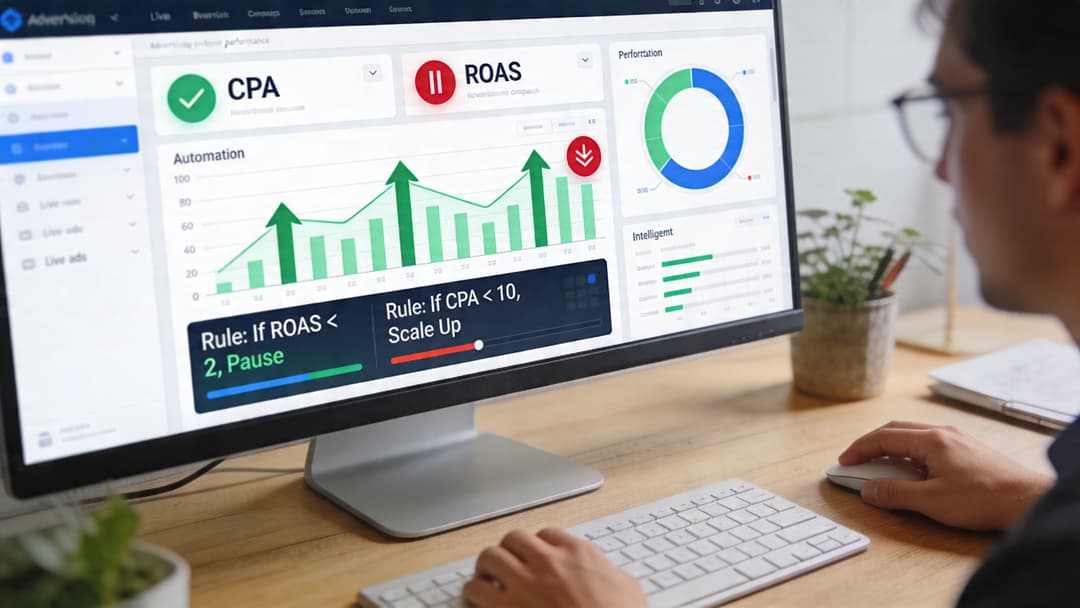
The pause rule most advertisers should have
One of the most dependable rules in fb ads automation is still the simplest one.
A proven setup is to pause an underperforming ad set when spend reaches 1.5x the target CPA without a conversion over a 3-7 day window, and accounts using rules like that see 20-30% ROAS improvement because automation reacts much faster than manual checks, according to Bir.ch's guide to Facebook ads automation.
That rule works because it does three things right:
- It ties decisions to your economics, not generic platform metrics.
- It waits long enough to avoid killing delivery too early.
- It removes emotional decision-making from loss control.
If your target CPA is known, this rule should be one of the first automations you implement.
Smart scaling needs guardrails
Scaling is where many native rule setups get sloppy. People tell the platform to increase budget when performance looks good, but they don't define what "good" means tightly enough.
A scaling rule is safer when it includes all of these conditions:
- A performance threshold tied to ROAS or CPA
- A minimum data threshold so the account isn't scaling noise
- A stable lookback window rather than reacting to a few good hours
- A budget change size that won't shock delivery
The point isn't aggression. It's consistency.
A useful companion to this process is this guide on automated Facebook budget allocation, especially when several campaigns are competing for the same spend pool.
Native tools versus platform-level automation
Meta gives you two main automation layers: standard automated rules and campaign types like Advantage+. Those are useful, but they don't cover every operational need.
| Feature | Meta Automated Rules | Meta Advantage+ Campaigns | AdStellar AI Platform |
|---|---|---|---|
| Rule-based pausing | Strong for basic threshold actions | Limited as a direct rule system | Supports complex conditional logic |
| Budget movement | Works for simple increases or decreases | Budgeting is handled within campaign automation | Built for multi-step budget logic and workflow control |
| Creative launch speed | Manual setup burden remains | Optimized delivery after launch | Designed for bulk creation and launch workflows |
| Audience discovery | Limited to what you set in rules | Strong native AI-driven discovery | Adds workflow and insight layers on top |
| Cross-account operational control | Basic | Basic | Better suited for teams managing many moving parts |
The right choice depends on what problem you're solving.
- Use Meta Automated Rules when you want lightweight controls inside Ads Manager.
- Use Advantage+ when you want Meta to handle more of the delivery logic.
- Use a platform layer when your bottleneck is operational complexity across creative, audiences, and scaling logic.
Bidding strategy isn't separate from analytics
Strong rule systems only work when the reporting behind them is trustworthy. Teams that want cleaner decision support should spend time with broader thinking on AI and advanced analytics, because bidding logic gets better when it connects back to margin, product performance, and actual business outcomes rather than isolated ad metrics.
Don't automate every possible response. Automate the actions you'd want a disciplined buyer to make every single time.
What usually breaks
The most common failure modes aren't hard to spot:
- Rules conflict with each other. One rule pauses while another scales.
- Lookback windows are too short. The account reacts to noise.
- Scaling steps are too large. Delivery destabilizes.
- Rules trigger on weak data. Bad tracking turns clean logic into bad execution.
If a rule doesn't map back to one business objective, it probably shouldn't be live.
Build a Framework for Automated Testing and Scaling
Single automations help. A testing framework compounds.
The difference is important. A rule can pause an ad. A framework decides how ads get created, tested, judged, promoted, and replaced in a repeatable cycle. That's what turns fb ads automation into an operating system instead of a bag of tactics.

Treat testing like a pipeline
A mature account separates testing from scaling.
Testing campaigns answer specific questions. Does one hook beat another? Does testimonial video outperform product demo? Does broad prospecting beat a more constrained audience with the same creative set?
Scaling campaigns do something else. They take proven inputs and push volume with fewer variables changing at once.
That distinction matters because mixed-purpose campaigns muddy the read. If you're testing three audiences, five offers, and multiple creative formats inside one structure, the result usually isn't insight. It's confusion.
A cleaner framework looks like this:
| Stage | Primary job | What to keep controlled |
|---|---|---|
| Test | Isolate variables and learn | Change one major variable at a time |
| Validate | Confirm early signal is stable | Keep budget and setup steady |
| Scale | Push spend into proven combinations | Limit new changes during expansion |
| Refresh | Replace fatigue and reopen exploration | Feed new variants from prior learnings |
Signal quality determines whether scaling sticks
Many automated systems often fail after early success.
Meta's Advantage+ Shopping Campaigns can deliver an average 17% lower CPA and 32% higher ROAS, but those gains depend on clean signals. Without a solid tracking framework and high-quality inputs, AI can optimize against bad information and performance degrades as spend grows, according to M1-Project's write-up on FB ads automation and signal quality.
That's why "it worked at low spend but broke at scale" is such a common complaint. The system didn't suddenly stop working. It ran into noisy data, weak conversion definitions, or a testing process that couldn't supply reliable next winners.
Build your feedback loop
Good testing doesn't end when you find a winner. It produces the next hypothesis.
The loop should look like this in practice:
- Launch controlled variations
- Read results at the right level, including asset breakdowns
- Promote only the combinations that support your main metric
- Feed the winning elements back into the next creative brief
- Retest with a new angle, audience, or format
For teams formalizing that process, this resource on how to test ads is a useful operational reference.
A winning ad isn't the finish line. It's source material for the next round of controlled tests.
What to analyze after every test cycle
Many advertisers stop at surface-level winners. That's not enough.
After each cycle, review these layers:
- Creative angle: What message drove the outcome?
- Format behavior: Did static, video, or another format carry the result?
- Audience interaction: Did the same creative win across segments, or only in one pocket?
- Economic fit: Did the winner improve your target metric, or just a proxy?
- Durability: Did performance hold long enough to deserve scaling?
Account maturity becomes evident through these actions. The strongest teams don't just ask which ad won. They ask why it won, under what conditions, and whether that pattern is repeatable.
The framework that holds up under pressure
A reliable automated system usually has these traits:
- Stable tracking
- Dedicated test environments
- Promotion rules for winners
- Clear thresholds for pausing fatigue
- A documented creative refresh process
- A habit of translating insights into the next launch
When those pieces are connected, the account stops relying on random bursts of performance. It starts learning on purpose.
Conclusion Your Path to Smarter FB Ads Automation
The manual media buyer isn't gone, but the manual workflow should be.
That's the true shift in fb ads automation. Success on Meta doesn't come from watching dashboards all day and making endless hand edits. It comes from building a system that knows what to optimize for, receives clean signals, gets fresh creative inputs, and follows rules that protect downside while scaling what's working.
The order matters.
Start with strategy. If the account doesn't have one clear success definition, automation turns messy fast. Then fix data. Weak signal quality is one of the fastest ways to poison delivery, especially once you ask Meta to make more decisions on your behalf. After that, solve the creative supply problem. Most accounts need more useful variation, not more manual tweaking. Then layer in rules for pausing and scaling so the account can react faster than your team can.
What changes after that is bigger than workflow.
You stop managing ads like isolated tasks. You start operating an engine. Tests produce insights. Insights shape the next launch. The next launch scales faster because the structure is already there. That loop is what separates automation that saves a little time from automation that materially improves account performance.
There's also a practical leadership benefit. A well-designed system is easier to audit, easier to hand off, and easier to scale across brands, offers, or client accounts. It reduces random decision-making. It makes account behavior more consistent. It gives teams a better reason for every action.
That matters in 2026 because Meta rewards advertisers who can work with its machine learning systems, not against them. The brands and agencies that win won't be the ones doing the most manual work. They'll be the ones building the best systems.
If you're ready to operationalize this approach, AdStellar AI gives teams a practical way to launch, test, and scale Meta campaigns faster with bulk ad creation, structured variation, historical-performance learning, and AI-driven insights that help turn a solid automation strategy into a repeatable workflow.