You’re probably staring at the same mess most performance marketers deal with every week. Too many creatives. Too many audience ideas. Too many campaign combinations. Not enough time to test them properly before budget gets wasted.
One tab has Meta Ads Manager open. Another has a spreadsheet full of naming conventions. A third has performance notes from last month. You know there are patterns in the data, but finding them manually is slow. Acting on them is even slower.
That’s why the phrase performance auto ia matters. It sounds technical, and it is. But the practical meaning is simple. It’s about using Intelligent Automation to handle the repetitive campaign work that keeps smart marketers stuck in execution mode.
The Crossroads of Performance Marketing
A paid social lead at an agency might start the day with a reasonable plan. Build fresh creative tests for two clients. Refresh copy for a retargeting set. Duplicate the winning ad set structure into a new campaign. Adjust budgets by hand based on yesterday’s spend.
By lunch, the work has turned mechanical. Rename files. Rebuild audiences. Check whether the same headline already ran last month. Export results. Compare them manually. Push changes live one by one.
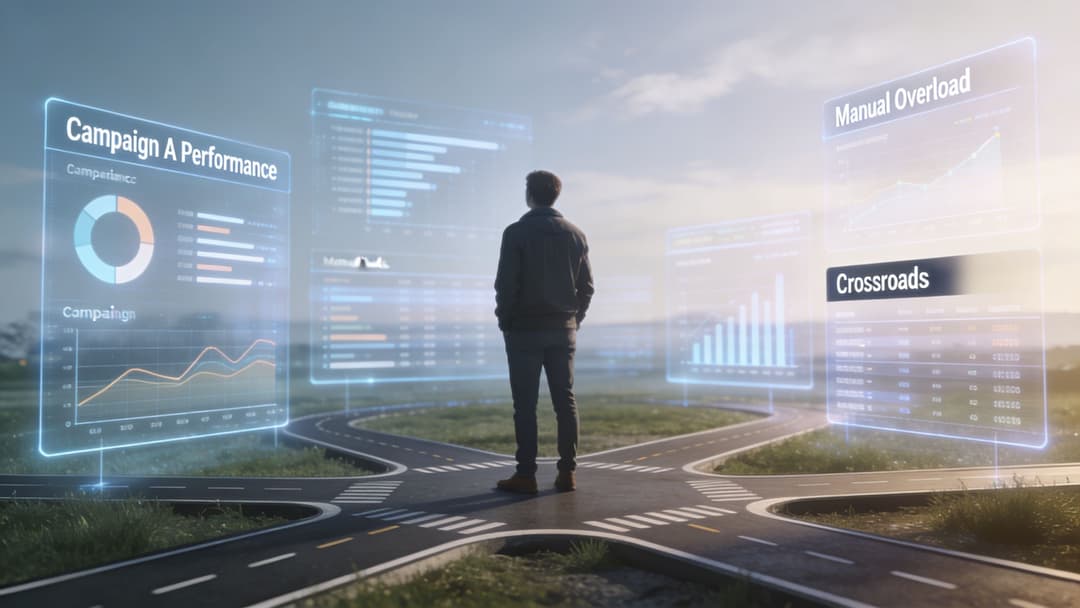
When people search for “performance auto ia,” they often encounter a strange fork in the road. In automotive circles, IA often means Included Angle, a wheel alignment concept tied to Steering Axis Inclination. That topic matters for tuners and performance car owners. In fact, discussion around performance optimization in that world is active enough that aftermarket suspension mods were noted as having surged 22% in 2025 in the source material tied to this discussion on SAI and Included Angle in enthusiast forums.
For marketers, though, the more useful meaning is different. Here, IA means Intelligent Automation. Not wheel geometry. Campaign geometry.
Why the confusion is useful
The overlap in language is helpful.
Automotive people care about getting the setup right so a car responds better under pressure. Marketers care about getting the setup right so a campaign responds better under pressure. In both cases, small decisions compound. A bad setup creates drag. A smart setup creates control.
Practical rule: If a term sounds technical and vague, translate it into a workflow question. In this case, ask, “What work should software handle for me so I can focus on strategy?”
That’s the useful lens for performance auto ia. It’s not a buzzword. It’s a way to reduce the hours spent on tasks that software can repeat more reliably than a human can.
What marketers are actually trying to solve
Many teams don’t have a thinking problem. They have a throughput problem.
They know they should test more angles, spin up more combinations, and react faster to what’s working. But manual campaign management creates bottlenecks:
- Creative bottlenecks: Teams have ideas but can’t launch enough variations fast enough.
- Analysis bottlenecks: Reports exist, but nobody has time to compare creative, audience, and message combinations at scale.
- Execution bottlenecks: Even when winners are clear, rebuilding campaigns and reallocating budgets still takes manual effort.
If you need a quick refresher on the broader discipline behind this shift, this overview of performance marketing fundamentals gives useful context.
Performance auto ia sits at that crossroads. It’s where performance marketing stops being a chain of repetitive tasks and starts becoming a system that learns, prioritizes, and executes.
What Is Performance Auto IA
The easiest way to understand performance auto ia is to borrow a car analogy and keep it grounded in ad operations.
A modern turbo engine doesn’t waste fuel blindly. It uses engineering systems to squeeze more output from the same input. In the same way, performance auto ia uses data and decision logic to squeeze more results from the same media budget. The source phrase says it well: just as a 1.5L turbocharged DOHC engine uses direct injection and variable turbos to optimize power from fuel, performance auto ia uses data ingestion and algorithmic decisioning to optimize ROAS from ad spend, with the same goal of maximum efficiency and output from a given input, as described in this inventory context from The Performance Auto Group.
The simple definition
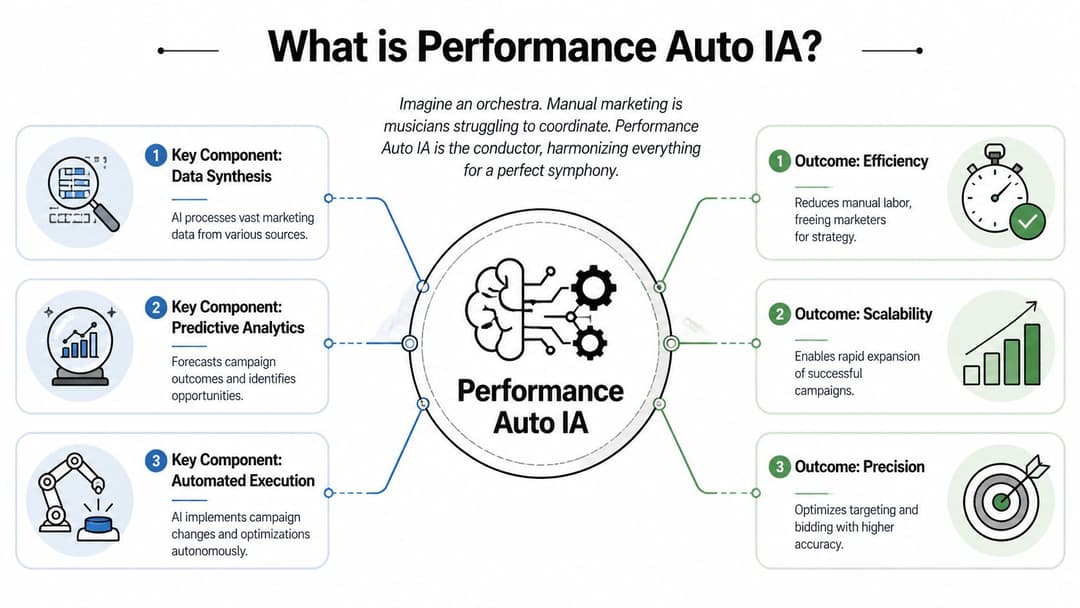
Performance auto ia is the use of AI-guided automation to launch, test, evaluate, and improve paid campaigns with less manual effort and better decision speed.
That definition has two parts.
First, there’s automation. This is the machinery. It handles repeatable work such as assembling ad variations, pushing campaigns live, organizing assets, and applying rules.
Second, there’s intelligence. This is the judgment layer. It studies historical and live performance data, spots patterns, ranks likely winners, and helps the system make better choices over time.
Without automation, the work is too slow.
Without intelligence, the work is fast but dumb.
The three working parts
A practical mental model looks like this:
- Data synthesis: The system pulls in campaign inputs and performance signals from places marketers already use.
- Predictive logic: It evaluates which combinations of message, audience, placement, or format are more likely to meet the goal.
- Automated execution: It turns those insights into action instead of waiting for a person to rebuild everything manually.
Good performance auto ia doesn’t replace the marketer’s judgment. It gives that judgment leverage.
Where this matters in real work
Consider an e-commerce team managing paid social and retail media at the same time. One person may need to compare image variants on Meta while also thinking about optimizing D2C Amazon ad spend for product-level efficiency. The challenge isn’t just channel knowledge. It’s operational speed.
That’s why AI systems matter more now. They help teams run more combinations without drowning in setup work.
If you want a focused look at how AI fits the discipline itself, this guide to AI in performance marketing is a useful next read.
The Engine Behind Automated Performance AI
The “AI” part of performance auto ia can sound like a black box. It isn’t magic. It’s a loop.
Data goes in. The system evaluates patterns. Then it acts on what it learns.
Data in and context first
An automated campaign system starts by gathering context from your existing operation. That usually includes campaign history, audience structures, creative metadata, spend patterns, and outcome data tied to the goal you care about most.
If your target is ROAS, the system looks for combinations associated with stronger return. If your target is CPL or CPA, it searches for the combinations that produced more efficient acquisition.
The key point is sequence. AI doesn’t start with genius. It starts with inputs.
Ranking what matters
Once enough data is available, the system can begin ranking variables that humans usually review one by one.
It can compare:
- Creative themes: Which visual directions consistently pull stronger downstream performance.
- Message angles: Which value propositions attract qualified clicks instead of cheap clicks.
- Audience structures: Which segments work best for prospecting, retargeting, or expansion.
- Campaign architecture: Which combinations of objective, ad set logic, and asset mix produce cleaner results.
A strong primer on operating this process well is Rebus’s guide to marketing automation, especially if your team is trying to move from scattered workflows to repeatable systems.
Decisions out and action next
This is the part that separates reporting from real automation.
A normal reporting workflow tells you what happened. A performance auto ia workflow uses that information to trigger the next move. That may mean launching new combinations based on top performers, shifting budget toward stronger assets, or suppressing weak variations before they waste more spend.
Here’s the contrast in plain terms:
| Phase | Manual Approach (The Old Way) | Performance Auto IA (The New Way) |
|---|---|---|
| Planning | Marketer chooses a small test set based on time limits | System supports broad variation building from the start |
| Setup | Team duplicates campaigns and enters details by hand | Workflows assemble campaigns automatically |
| Analysis | Buyer exports reports and compares results manually | System ranks creatives, audiences, and messages continuously |
| Optimization | Budget and asset changes happen after delayed review | Decisions can be applied quickly as fresh data comes in |
| Scaling | Winners are rebuilt into new campaigns one at a time | High-performing patterns can be expanded systematically |
That’s the operational shift many teams are really after.
For a concrete view of this kind of optimization layer, the overview of AI campaign optimization workflows shows how the logic is applied in practice.
Measurable Benefits That Drive Growth
Marketers don’t care whether a platform sounds advanced. They care whether it helps them waste less budget and find winners faster.
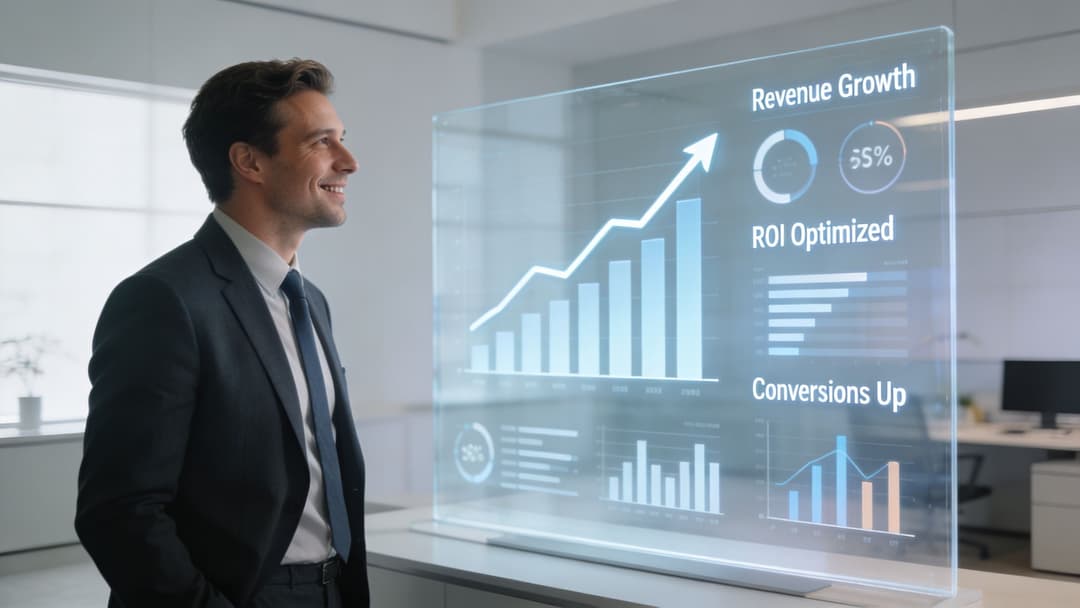
That’s where performance auto ia earns its keep. It changes the speed and quality of campaign decisions, which is what eventually shows up in metrics like ROAS, CPA, and CPL.
Faster testing means less dead spend
Manual teams usually test less than they should. Not because they lack ideas, but because every extra variable creates setup and reporting overhead.
Automation changes that equation. When systems can generate and organize more combinations, teams stop overprotecting budget around a few “safe” ideas. They can test broader sets and identify weak assets sooner.
That matters more in large markets. Performance Automotive Network reports annual revenue of $211.1 million according to its ZoomInfo company profile. In a market operating at that scale, even modest improvements in advertising efficiency can have meaningful revenue impact. You don’t need an exaggerated promise to see the point. Better allocation matters more when spend and revenue are already large.
Better ranking improves selection
A lot of performance waste comes from choosing the wrong winner.
A marketer sees a strong clickthrough rate and scales the ad. Later, they learn it attracted poor-fit traffic. Another creative had fewer clicks but stronger downstream conversion quality. Manual review often catches that too late.
Performance auto ia is useful because it can rank assets against the metric that is most important. Not the loudest signal. The right one.
The biggest lift often comes from reducing false positives. Not every ad that looks good early is worth scaling.
Efficiency creates strategic time
There’s another benefit people underestimate. AI automation changes who does what on the team.
When buyers spend less time rebuilding campaigns, renaming assets, and pulling fragmented reports, they can spend more time on:
- Offer strategy: refining the message behind the ad
- Creative direction: finding fresher hooks and angles
- Funnel diagnosis: identifying where post-click conversion breaks down
- Budget design: deciding how aggressively to scale across segments
If your team wants a better framework for tying performance changes back to real outcomes, this guide on how to measure advertising effectiveness is worth reviewing.
The practical takeaway is simple. Performance auto ia improves growth by making testing broader, selection smarter, and execution faster. The value isn’t in the label. It’s in the compounding effect of better decisions.
How AdStellar Automates the Entire Workflow
Most discussions about AI in advertising stay abstract. The real question is what the workflow feels like when the system is doing useful work instead of generating noise.
A strong implementation starts where performance teams usually feel the most friction. Production.
From combinations to live campaigns
AdStellar is built around a simple operational reality. High-performing campaigns rarely come from a single perfect ad. They come from testing enough creative, copy, and audience combinations to uncover patterns.
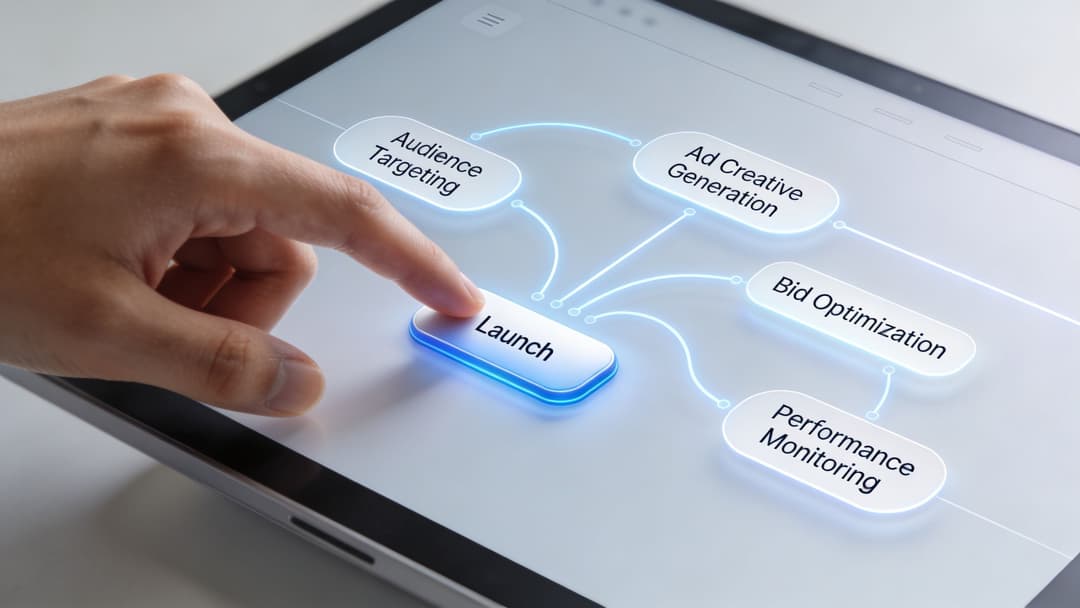
That means the workflow begins with bulk generation. Teams can produce large sets of variations in minutes instead of assembling them one by one. This is especially useful for agencies, DTC brands, and growth teams managing multiple offers or audience angles at once.
The next step is launch. Instead of manually rebuilding every combination inside Meta Ads Manager, the platform lets teams push those variations live quickly through a centralized workflow. If you want a sense of how these broader spreadsheet-to-ad-system processes connect operationally, resources like this guide to connect Amazon Ads to Sheets are useful because they show the same underlying principle: reduce handoffs, reduce copy-paste work, and keep data flowing into action.
The learning layer
Once campaigns are live, speed alone isn’t enough. The platform has to learn from the results.
AdStellar connects to Meta Ads Manager through secure OAuth and ingests historical performance data. Then its AI Insights layer evaluates which creatives, audiences, and messages are outperforming against goals such as ROAS, CPL, or CPA. Instead of forcing a buyer to manually compare dozens of ad combinations, the system surfaces what’s holding up best under real performance conditions.
Operational advice: Don’t judge automation by how fast it launches. Judge it by how clearly it helps you decide what to scale next.
Performance auto ia becomes practical. The platform doesn’t just make more ads. It creates a feedback loop between production, launch, and evaluation.
A closer look at the workflow helps: bulk campaign launching on AdStellar
Scaling what already works
The final piece is automation after insight.
AdStellar’s AI Launch uses proven winners to assemble new campaigns, while auto-learning models continue identifying high performers as fresh data comes in. That matters because many teams can discover a winning combination once, but they struggle to operationalize that learning across the next wave of tests.
The short walkthrough below gives a good visual sense of that process in motion.
The bigger shift is role design. Buyers stop acting like campaign assembly specialists and start acting like performance operators. They choose goals, shape hypotheses, review rankings, and guide strategy while the platform handles the repetitive mechanics.
That’s what mature performance auto ia should do. Not replace the marketer. Remove the production drag that keeps the marketer from doing higher-value work.
Common Pitfalls to Avoid When Implementing AI
AI automation fails for boring reasons much more often than dramatic ones. The software isn’t usually the main issue. The setup is.
That matters because adoption is rising. The source material notes that AI integration in marketing saw a 35% rise in 2025, while AI-driven predictive maintenance in the auto industry is projected to cut downtime by 40%, but those gains depend on avoiding poor data quality and weak strategic oversight, as described on Performance Auto Center.
Bad input leads to bad guidance
A team imports messy campaign history and expects clean recommendations. But if naming is inconsistent, conversion tracking is incomplete, or old campaigns mixed different goals together, the system learns from noise.
The symptom is familiar. Rankings look impressive on the surface but don’t hold up when you scale.
The fix is practical:
- Clean goal mapping: Make sure campaigns are tied to the business outcome you want the AI to optimize for.
- Audit tracking: Confirm event quality before asking software to find patterns in it.
- Remove junk history: Old experiments with broken setup can distort the learning process.
Over-automation creates blind spots
Some teams swing too far in the other direction. They set rules, turn on automation, and step back completely.
That’s a mistake. AI can process more variables than a human can, but it still needs strategic boundaries. It won’t know your margin constraints, product seasonality, legal limitations, or brand sensitivities unless you define them in the workflow and review the outputs.
Automation should handle repetition. Humans should still own priorities, constraints, and judgment.
Unrealistic expectations kill good systems early
Another common failure happens in the first few weeks. A team expects the platform to immediately outperform their best manual operator in every campaign.
That’s not how most implementations work. Systems need useful data, stable goals, and enough consistency to learn. If marketers change offers, audiences, and success metrics all at once, they make the learning environment unstable.
A better rollout looks like this:
- Start narrow: Pick a campaign group with clear goals and clean data.
- Review often: Watch what the system is surfacing and compare it with operator intuition.
- Expand gradually: Scale automation breadth after the workflow proves reliable.
Performance auto ia works best when marketers treat it like an operating system, not a magic trick.
From Manual Labor to Strategic Command
Performance auto ia becomes much easier to understand once you strip away the vague language. It isn’t about obscure car terminology, even though the keyword can point people there first. In marketing, it means using Intelligent Automation to reduce repetitive work, improve campaign decisions, and scale what’s already proving itself in market.
That shift changes the marketer’s role. Less time gets spent assembling campaigns by hand and chasing scattered reports. More time goes to creative direction, offer strategy, budget design, and sharper decision-making.
The teams that benefit most won’t be the ones chasing automation for its own sake. They’ll be the ones using it to create a cleaner loop between testing, learning, and scaling. That’s where the next phase of performance marketing is headed.
If your team wants to launch, test, and scale Meta campaigns with less manual setup, AdStellar AI is built for that workflow. It helps marketers generate large creative and audience combinations, launch them fast, learn from live performance, and focus their time on strategy instead of repetitive execution.