You're probably looking at campaigns that aren't technically broken, but aren't scaling cleanly either. Spend goes out. The platform says it's learning. Some ad sets look efficient for two days, then fall apart. Creative tests blur together, audiences overlap, and every manual change feels like it resets progress.
That's where ad delivery optimization stops being a platform feature and starts becoming an operating discipline. The advertisers who get stable performance don't just “run Meta ads” or “launch display campaigns.” They align goals, bids, audiences, creative, and automation so the platform gets clear signals and enough room to act on them.
Most underperformance comes from mismatch. The business wants purchases, but the campaign is optimized for traffic. The account needs stable learning, but the structure is fragmented. The team wants scale, but testing is chaotic and budgets are still being managed like line items instead of probabilistic systems.
Aligning Campaign Goals with Platform Algorithms
A common failure pattern looks like this. The business cares about sales quality or revenue, but the campaign is set to drive traffic because clicks appear faster and cheaper. Meta and Google then do exactly what they were asked to do. They find more people likely to click, not more people likely to buy.

Choose the business outcome first
Campaign objectives are not admin settings. They are instructions to a prediction system.
On Meta, optimizing for Link Clicks trains delivery toward users with a history of clicking ads. Optimizing for Purchase shifts delivery toward users with a higher probability of converting. In Google Ads, the same principle shows up in bidding and conversion setup. If the primary conversion is a newsletter signup, Smart Bidding will chase more signups, even if those users rarely become pipeline or revenue.
That trade-off matters early. Higher-funnel events can help an account get enough signal, but they also shape who enters the learning pool. If the proxy event is weak, the system gets better at finding the wrong people.
Use a simple decision sequence:
- Start with the commercial KPI. Purchases, qualified leads, booked demos, subscriptions, or revenue.
- Choose the closest platform event to that KPI. Purchase in Meta. A properly defined primary conversion in Google. Qualified Lead or Complete Registration if those events reflect real progression.
- Move up-funnel only when the account cannot support stable optimization on the final outcome. Add to Cart, Initiate Checkout, or MQL can work as interim signals if they are strong predictors of downstream value.
The goal is not more conversion volume at any cost. The goal is to give the algorithm an event that is both meaningful to the business and frequent enough to learn from.
Event selection determines delivery quality
Many accounts drift off course. A lead gen team uses Meta's Lead event, then realizes half the submissions are junk. An ecommerce brand optimizes for Add to Cart because Purchase volume feels too low, then sees cheap carts with weak checkout intent. The platform is still working correctly. The event definition is the problem.
I usually ask one question before changing anything else: if this event doubles next week, would the business be happy?
If the answer is no, do not optimize toward it.
For B2B, that often means sending better offline or CRM-qualified signals back into the ad platform instead of stopping at raw form fills. For ecommerce, it usually means holding the line on Purchase optimization longer than the team is comfortable with, provided volume is not too thin. AI has made these systems better at pattern recognition, but it has not fixed bad instructions. It can scale a strong signal fast, and it can scale a weak signal just as fast.
Translate strategy into platform setup
Good media buying requires clean translation from business goal to platform configuration. A local agency evaluating expert Meta Ads campaigns for Dundalk needs the same discipline as a multinational in-house team. Define the outcome in commercial terms first, then configure the objective, conversion event, and reporting around that outcome.
Ethics matter here too. Algorithmic delivery does not just optimize efficiency. It also decides who gets more exposure and who gets excluded based on predicted behavior. If a low-quality proxy event correlates with accidental bias, the system can keep reinforcing it. Performance teams should review delivery through both a profit lens and a fairness lens, especially in housing, employment, credit, and other sensitive categories.
Frequent edits make this harder because every significant change can disrupt how the system calibrates. If your Meta campaigns keep resetting after audience, creative, or budget changes, this explanation of the Meta Ads learning phase is useful for deciding which edits are worth making and which ones should wait.
Mastering Bidding Strategies and Budget Allocation
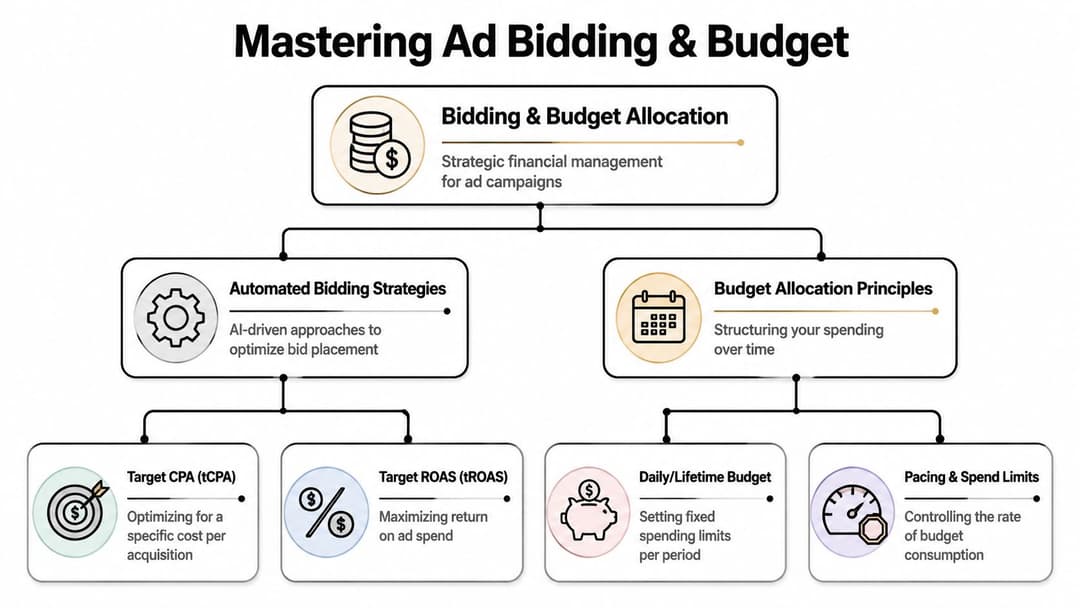
Most advertisers don't lose efficiency because they chose the “wrong” bidding label. They lose it because the bid strategy, budget structure, and campaign maturity don't match. Ad delivery optimization works best when the platform has enough flexibility to pursue the outcome you asked for, but not so much ambiguity that it burns budget on low-confidence impressions.
The budget question is really a control question. How much do you want to constrain the system, and when?
When to use tCPA versus tROAS
Use target CPA when the business values a consistent acquisition cost and conversion value doesn't vary much between customers. That's common in lead generation, fixed-price offers, and many subscription funnels.
Use target ROAS when order values vary materially and the platform needs permission to pay more for higher-value conversions. That's common in e-commerce catalogs, upsell-heavy funnels, and mixed product margins.
A simple comparison helps:
| Strategy | Best fit | Main advantage | Main risk |
|---|---|---|---|
| tCPA | Lead gen, uniform conversion value | More predictable cost control | Can suppress volume if target is unrealistic |
| tROAS | E-commerce, variable basket value | Better value-based allocation | Can become unstable if value tracking is poor |
| Lowest-cost automation | Early testing and broad exploration | Gives the platform room to learn | Less predictable unit economics at first |
The biggest mistake is setting aggressive targets before the account has enough stable conversion data. Teams often inherit a target from finance or from a prior quarter and force it into a new campaign. The platform then struggles to spend, skews toward narrow inventory, or finds low-quality edge cases that technically meet the target.
Budget structure should match campaign intent
Meta and Google have spent years pushing more automation into delivery. Meta reported that about 90% of eligible ad impressions were being optimized automatically by 2019, and its automated delivery improved performance by roughly 20 to 30% on key metrics like cost per action compared with static delivery for many advertisers. Google also reported a 20% average increase in conversion volume for Performance Max campaigns in early rollouts through Smart Bidding, as summarized in this review of automated ad delivery optimization data.
That's why manual micromanagement usually underperforms after a certain point. The systems are built to allocate in real time.
Still, budget structure matters:
- Use campaign-level budget optimization when the audiences are comparable, the goal is the same, and you want the platform to shift spend toward stronger ad sets automatically.
- Use ad set budgets when you need forced distribution for testing, market segmentation, or distinct audience pools that shouldn't compete for the same spend.
- Use spend limits and pacing discipline when seasonality, inventory constraints, or sales-team capacity make over-delivery a business problem.
Later in the section, this is worth watching if you want a visual explanation of the mechanics behind bid control and delivery trade-offs:
A practical framework for control
The fastest way to simplify budget decisions is to ask three questions:
- Is this campaign learning or harvesting? Learning campaigns need more flexibility. Harvesting campaigns can tolerate tighter guardrails.
- Are audiences competing with each other? If yes, centralizing budget often reduces internal friction.
- Is the target based on recent reality? If not, the bid constraint is probably fiction.
If spend won't move, don't assume the audience is too small. Check whether your target is simply too strict for current auction conditions.
Teams that want a clearer Meta-specific budget framework can use this guide to optimize Meta campaign budgets. It's especially useful when deciding whether budget centralization will help or hide problems.
Structuring Audiences for Efficient Learning
Audience setup is where many accounts become harder than they need to be. Not because targeting is unimportant, but because too many layers create fragmented learning. When every ad set has a slight variation of age, interest, lookalike percentage, placement, and exclusion logic, the platform doesn't get one strong pool of data. It gets a series of small, competing pockets.
That's bad for efficiency and bad for diagnosis. You can't tell whether performance differences are real or just artifacts of limited delivery.
Consolidation usually beats cleverness
In most mature paid social accounts, simpler audience architecture performs better than intricate targeting trees. Broad prospecting, clean retargeting, and sensible exclusions usually give Meta and Google better room to find outcomes than stacks of narrow interest combinations.
That doesn't mean broad is always right. It means structured simplicity is usually right.
A practical audience design looks like this:
- Prospecting lives in one clear lane. Broad, lookalike, or high-intent contextual expansion can work, but don't create five versions of the same customer profile unless you're testing a real hypothesis.
- Retargeting gets its own budget logic. People who viewed product pages, added to cart, or engaged with video are in a different decision stage. They shouldn't cannibalize prospecting budget inside the same muddled structure.
- Exclusions stay intentional. Exclude recent purchasers where appropriate, suppress current leads from acquisition campaigns, and avoid overlapping retargeting windows that fight for the same user.
Overlap hurts more than most teams think
A common failure pattern is this: one campaign targets broad audiences, another targets lookalikes, a third targets page engagers, and none exclude one another properly. Meta then tries to resolve that conflict in auction. You pay for internal competition, delivery becomes noisy, and reporting starts attributing success to whichever campaign happened to touch the user last.
Use segmentation only when it creates a meaningful operational difference. Segment by market, product line, sales motion, or regulatory need. Don't segment because the Ads Manager interface makes it easy.
A useful reference here is this guide on Meta lookalike audiences, especially if you're deciding whether a lookalike should stand alone or sit inside a broader audience strategy.
Narrow targeting feels safer. In practice, it often just hides poor signal quality.
Delivery can skew even when targeting is neutral
There's another reason to audit audience structure carefully. Delivery systems can create demographic skew without explicit targeting choices. Academic research on Facebook delivery found that even with neutral targeting parameters, housing and employment ads can be shown disproportionately to certain demographic groups because the platform's own relevance predictions shape who sees them. That creates potential fairness and compliance issues, particularly in regulated categories, as discussed in the Northeastern research on Facebook ad delivery bias.
For practitioners, that means audience strategy isn't only about performance. It's also about governance.
A simple audit routine helps:
- Review demographic delivery patterns. Don't just check results by audience. Check who received impressions.
- Separate regulated-category logic. Housing, employment, and finance need stricter controls and more careful creative review.
- Compare delivery against intent. If the campaign brief says “broad access” but delivery clusters heavily, investigate the creative, event, and bidding setup.
The strongest audience structures don't just improve learning. They make the account easier to trust.
A Framework for Creative Testing and Sequencing
A campaign can hit spend targets, clear learning, and still stall because the team tested ten things at once. Meta reports one ad as the winner, Google favors one asset group, and nobody can say whether the lift came from the promise, the format, the first three seconds, or the offer framing. That is not a testing system. It is a content pileup.
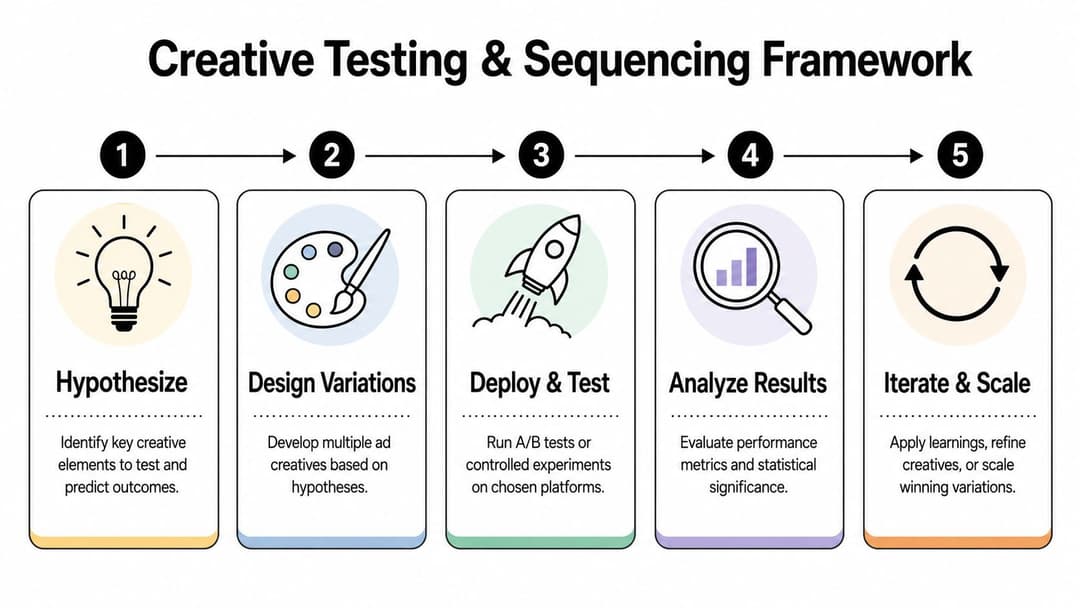
Creative testing works best when it follows the same logic as delivery optimization. Control one layer, learn, then promote the signal into the next environment.
Test angles before assets
Start with the argument, not the asset.
An angle is the reason someone should care. Lower cost. Faster setup. Better results. Less manual work. Stronger proof. An execution is the packaging. Founder video, UGC clip, static image, product demo, carousel, comparison graphic.
That distinction matters because platforms optimize toward response patterns, not creative theory. If the message is wrong, a polished edit just helps the algorithm find the wrong user faster. If the message is right, even a rough first pass can produce enough signal to justify deeper production.
A practical sequence looks like this:
- Write message hypotheses first. Define the belief you want to test, such as trust, price, urgency, product proof, identity, or problem severity.
- Build multiple assets for each angle. One weak video should not eliminate a strong market insight.
- Keep the test frame stable. Hold audience, bid strategy, landing page, and optimization event constant while you test the message.
- Move proven angles into their own ad environment. Then test format, hook, CTA, and pacing inside that winning narrative.
On Meta, that often means testing three to five distinct hooks inside one conversion objective, then splitting the best-performing theme into fresh variations once it earns enough purchase or lead volume. On Google, the equivalent is less about ad IDs and more about message architecture inside asset groups. Test the claim first. Then improve the asset mix around it.
Match the test to the platform's learning behavior
Creative tests fail when teams ask the algorithm to learn from unstable inputs. A campaign cannot tell you much if the audience changes, the conversion event changes, and five new concepts enter rotation before the first set has enough delivery.
Patience matters here.
During early testing, the job is to find message-market fit. During validation, the job is to isolate why a concept worked. During scaling, the job is to refresh without breaking the pattern that produced efficient delivery in the first place.
Use this operating model:
- Discovery: Test different hooks, offers, problem framings, and proof styles.
- Validation: Keep the winning angle and test one variable at a time, such as the opening frame, headline, CTA, or edit style.
- Expansion: Introduce new versions that preserve the same core promise while broadening format coverage across Reels, Stories, Feed, YouTube Shorts, or Display.
At this stage, teams often grow impatient. They kill a concept after a small spend pocket, or they keep adding new ads into the same ad set until delivery becomes unreadable. Both mistakes distort the feedback loop between creative and algorithmic distribution.
Sequence winners instead of endlessly remixing them
A winning ad should graduate.
If one concept repeatedly drives qualified leads or purchases, stop forcing it to compete with every new draft in a crowded test cell. Give it a dedicated campaign or ad set where budget, bidding, and creative rotation support that specific pattern. That makes scaling cleaner and diagnosis easier when performance shifts.
I also recommend a simple testing log. Not for process theater. For pattern recognition across accounts.
| Layer | What changed | Why it matters |
|---|---|---|
| Angle | Core promise or pain point | Shows what triggers response |
| Format | Video, static, carousel, collection | Shows how the message is best consumed |
| Execution detail | Headline, first frame, CTA, body copy | Improves the winning concept without changing the strategy |
That log becomes more useful once AI enters the workflow. AI can produce variant volume fast, especially for short-form video, but speed creates a new risk. Teams start testing surface-level differences that look new to humans and read as the same signal to the platform. Use AI to multiply executions around a proven angle, not to flood the account with random novelty. For brands pushing short-form production, tools in the AI video generator for TikTok content category can help create iterations quickly, but the testing logic still has to come from the marketer.
There is also an ethical side to sequencing that gets missed. Delivery systems reward what they predict will convert. If one message pattern systematically pulls impressions toward a narrower demographic than the campaign intended, a "winner" may create a governance problem even when CPA looks strong. Review who is seeing the creative, not just which ad reports the best result.
For teams that need a more operational template, this guide to Facebook ad creative testing methodology is a useful reference.
Good creative testing answers a harder question than "which ad won?" It shows which message deserves more budget, which variation deserves production time, and which patterns should be avoided even if the platform likes them.
Scaling Winners with Automation and AI
Manual scaling breaks down for the same reason manual bidding eventually does. The account produces more combinations than a human team can evaluate cleanly. More audiences, more creatives, more placements, more messages, more budget shifts. Past a certain point, spreadsheets and naming conventions turn into a bottleneck.
That's why ad delivery optimization has moved toward automation for more than a decade. The shift began scaling around 2012 to 2013 with real-time bidding, and by 2017 global programmatic display ad spend had grown from roughly $40 billion in 2014 to more than $70 billion, which made automated impression evaluation the operating infrastructure of digital media rather than a niche tactic, as outlined in this history of delivery optimization and RTB.
Why manual scaling stalls
Once a campaign finds traction, teams usually do one of three things. They raise budget too aggressively, duplicate winning sets without a clear reason, or keep piling new creatives into the same environment until performance data becomes unreadable.
Automation solves a different problem than bidding alone. It reduces operational lag.
A solid scaling system should handle these tasks consistently:
- Pattern recognition. Which creative themes, audience types, and offer framings keep repeating among top performers?
- Variation production. Can the team produce enough new assets around those patterns without rebuilding everything from scratch?
- Launch speed. Can validated iterations go live quickly enough to capitalize on fresh signal before the market shifts?
- Performance triage. Can weak combinations be identified early without constant manual checks?
AI works best when the strategy is already clear
AI won't rescue a confused account. It amplifies a coherent one. If the campaign objective is wrong, if the event quality is poor, or if the audience structure is chaotic, automation just accelerates disorder.
Used properly, AI helps in two places. First, it expands testing capacity by generating and organizing more creative and audience combinations than a team would build manually. Second, it helps rank those combinations so budget and attention move toward stronger patterns sooner.
For creative-heavy channels, adjacent tools can also speed production. Teams building short-form assets for paid social often use workflows like an AI video generator for TikTok content to produce more variations around proven hooks without slowing the media team down.
What scalable automation looks like in practice
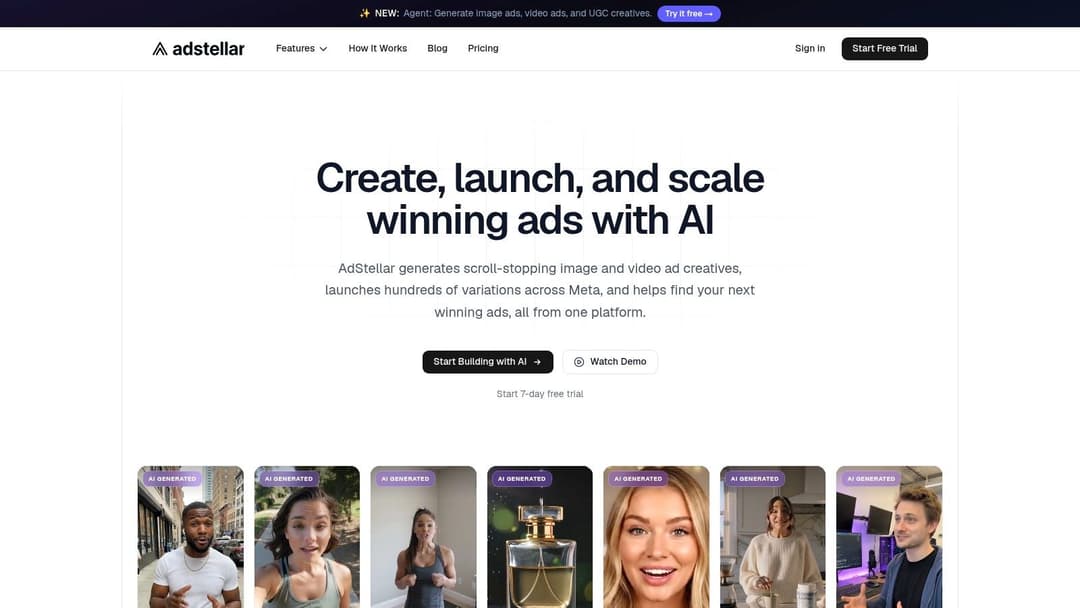
In Meta specifically, tools that connect campaign creation, variation management, and performance analysis tend to be more useful than isolated dashboards. One example is AdStellar AI, which automates bulk ad creation, launches multiple creative and audience combinations, ingests historical Meta performance, and surfaces which messages, audiences, and creatives align best with outcomes like ROAS, CPL, or CPA.
That kind of setup matters because scaling isn't just “increase budget.” It's selecting what deserves more budget, producing the next round of variations around it, and removing weak branches before they absorb spend.
If your team is already testing regularly and wants a clearer system for expanding winners, this guide on scaling Meta ads with automation is a practical next step.
Your Ad Delivery Optimization Philosophy
The cleanest way to think about ad delivery optimization is this. Your job is to feed the algorithm.
Not blindly. Not passively. Deliberately.
Feed it clear goals
Platforms can only optimize toward the outcome you define. If the business needs revenue and the campaign is optimized for clicks, the account will drift toward cheap traffic. If the sales team needs qualified pipeline and the campaign is optimized for raw lead volume, the platform will oblige and quality will suffer.
The first discipline is translation. Business KPI into platform objective. Platform objective into reliable event.
Feed it stable structure
Algorithms learn faster when the account is understandable. Clean audience architecture. Budget logic that matches campaign maturity. Bidding constraints grounded in reality, not wishful targets. Creative tests built around hypotheses rather than random asset swaps.
That doesn't mean hands off. It means your interventions should improve signal quality, not create fresh noise every day.
A good account feels boring in the right places. Objectives stay stable. Audience overlap is controlled. Testing follows a sequence. Budget changes have a reason.
Feed it better inputs than your competitors
Many strong teams separate themselves from average ones in this aspect. They don't just use automation. They give automation something useful to work with. Better conversion signals. Better creative variation. Better segmentation logic. Better auditing for skewed delivery and compliance risk.
The platform isn't a black box you defeat. It's a system you train through your choices.
That mindset also helps with the ethical side of delivery. Performance and responsibility aren't separate tracks. If algorithmic delivery can skew access even under neutral targeting, then auditing who sees your ads is part of doing the job properly, not an optional add-on.
Ad delivery optimization works when every layer reinforces the next. Goal. Event. Bid. Budget. Audience. Creative. Automation. When those pieces align, the platform stops feeling unpredictable and starts feeling legible.
If your team wants a faster way to build, test, and scale Meta campaigns without drowning in manual setup, AdStellar AI is built for that workflow. It helps marketers generate ad variations in bulk, launch campaigns quickly, and identify which creative, audience, and message combinations deserve more budget based on actual performance signals.