A client asks why a campaign is late. The strategist is waiting for creative, the designer is waiting for a complete brief, the account manager is searching through email for the latest approval, and nobody knows whether the extra requests belong to the original scope. Work is moving, but margin is leaking at every handoff.
That's the operating reality behind agency workflow management. It isn't just a board of tasks or a cleaner project calendar. A useful workflow connects scope, ownership, approvals, billable time, capacity, quality, and automation so the agency can deliver consistently without relying on memory or heroic effort.
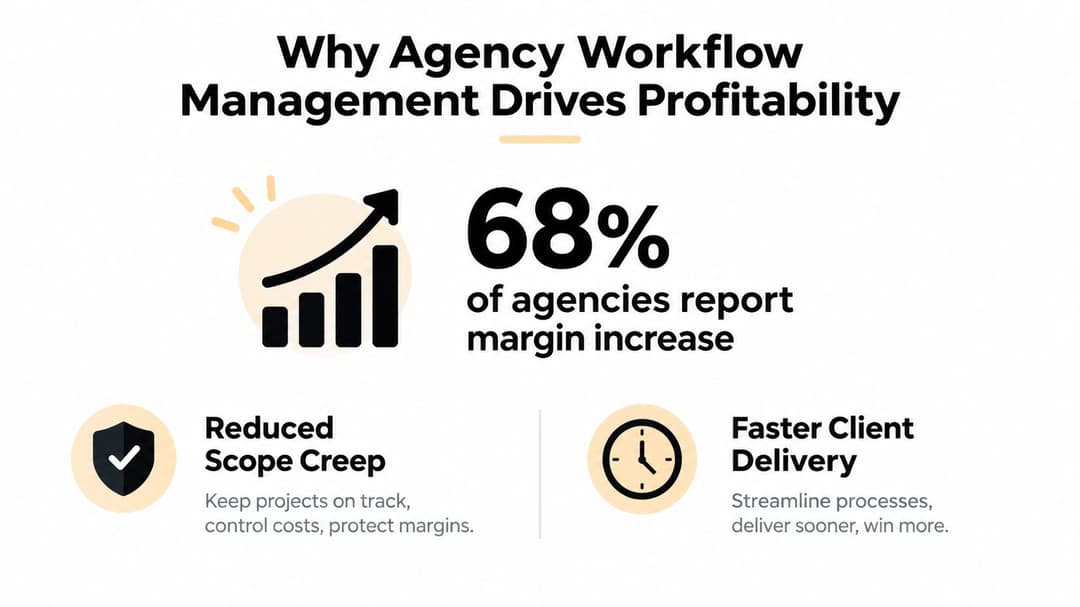
Why Agency Workflow Management Now Drives Profitability
The shift from manual coordination to formal workflow platforms accelerated through the 2010s and 2020s. Agencies grew more complex, clients expected faster responses, and delivery teams had to coordinate media, creative, analytics, strategy, and account management across multiple engagements. Spreadsheets and inboxes could record activity, but they rarely protected the agency from unbilled work, unclear scope, or late approvals.
The financial pressure is direct. In a 2026 agency project-management survey, 57% of agencies reported losing $1,000 to $5,000 per month to unbilled work, while 30% reported losing more than $5,000 monthly. The same findings showed that 52% struggle to reach even a 50% billable-utilization benchmark. These figures are reported in the agency project-management survey and automation case study.
That changes the definition of productivity. A team can complete tasks quickly and still underperform if staff spend time on requests they can't invoice, repeat work caused by missing information, or wait for approvals that nobody owns. Workflow control turns that hidden effort into something visible and manageable.
The cash-flow problem behind delivery chaos
Scope and collections create a second layer of risk. 78% of agencies rarely or only sometimes charge for out-of-scope work, and 71% say at least one in four invoices is paid late, according to the same 2026 agency workflow findings. A team that doesn't record change requests at the moment they occur has little evidence to support a revised estimate later.
This is why a mature workflow includes commercial controls. The brief should define what the team agreed to deliver. The task should show who owns it and how much effort it requires. A change request should create a decision point before the team commits more production time.
Practical rule: If a workflow can't show what was requested, who approved it, and whether it fits the contract, it isn't protecting margin.
A platform such as AdStellar's workflow optimization framework can support better coordination, but software won't correct an undefined process. The agency must first decide which work is billable, where approvals happen, and what happens when the client changes direction.
The strongest agencies therefore treat workflow management as recoverable-capacity infrastructure. They aren't optimizing only for speed. They're protecting invoicing discipline, making utilization legible, and giving managers an early warning when delivery effort is moving beyond the commercial agreement.
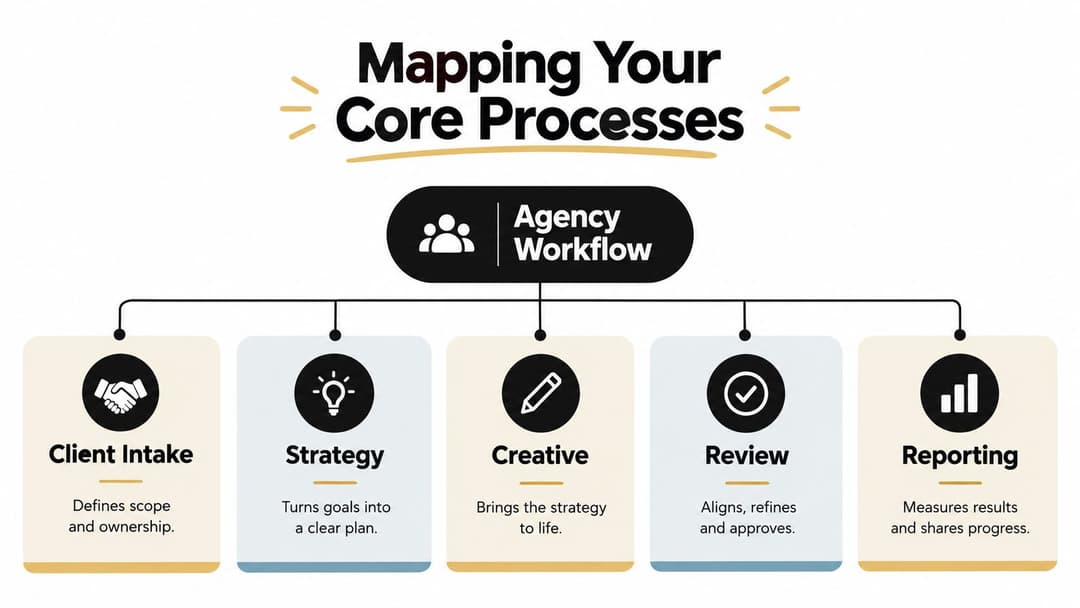
Mapping Your Core Processes and Defining Clear Ownership
Before choosing a platform, document how work moves. Don't map the ideal process described in an old SOP. Follow a recent client engagement from signed agreement to final report and record every handoff, wait state, rework loop, and informal decision.
Start with the processes that repeat across accounts. Most agencies can begin with a focused map covering:
- Client intake: Capture goals, services, scope, contacts, access needs, and commercial assumptions.
- Strategy: Turn business objectives into channel plans, audience decisions, measurement requirements, and priorities.
- Creative production: Convert approved direction into briefs, drafts, revisions, and final assets.
- Review and approval: Route internal QA and client sign-off through a visible sequence.
- Launch and optimization: Move approved work into the relevant advertising or marketing platform, then monitor changes.
- Reporting: Gather performance information, explain the result, and define the next action.
Keep the first map small. A review of workflow-system adoption cited BPM implementation failure rates of 60% to 80% and said only 15% of firms were satisfied with outcomes, while recommending that teams audit pain points, start with one process, involve users, and measure consistent use rather than feature complexity. Those figures and recommendations appear in this workflow-management implementation review.
Make ownership explicit at each handoff
A process map becomes useful when it answers four questions for every stage:
- Who is responsible for completing the work?
- Who is accountable for the outcome?
- Who must be consulted before the team proceeds?
- Who needs to be informed after the decision?
Use those roles as a practical RACI model, but don't treat the acronym as the deliverable. The deliverable is a clear decision record. For a paid social brief, for example, the strategist may own the recommendation, the account lead may approve client-facing positioning, the media buyer may validate setup requirements, and the client may approve the final direction.
Define entry and exit conditions in plain language. “Creative production starts when the brief is approved, the destination URL is confirmed, the audience is identified, and required brand assets are available” is operational. “Creative production starts when the project is ready” isn't.
Design with the people who carry the work
Invite the designer, media buyer, account manager, and analyst into the audit. They know which fields teams skip, which approvals arrive through private messages, and which templates create more work than they remove.
Use project management for agencies as a reference point, but keep the implementation grounded in your own delivery environment. A lightweight process that the team follows beats a complex system that requires constant explanation.
Test one painful workflow first, such as campaign launch or client onboarding. Watch whether people use the required fields without repeated reminders, then adjust the process before expanding it to every service line.
Building Repeatable Client Onboarding and Campaign Delivery Flows
A repeatable flow shouldn't make every client feel identical. It should make the agency's internal obligations predictable while leaving room for strategic differences. The most reliable design uses entry criteria, owner assignments, approval gates, and exit criteria for each major stage.
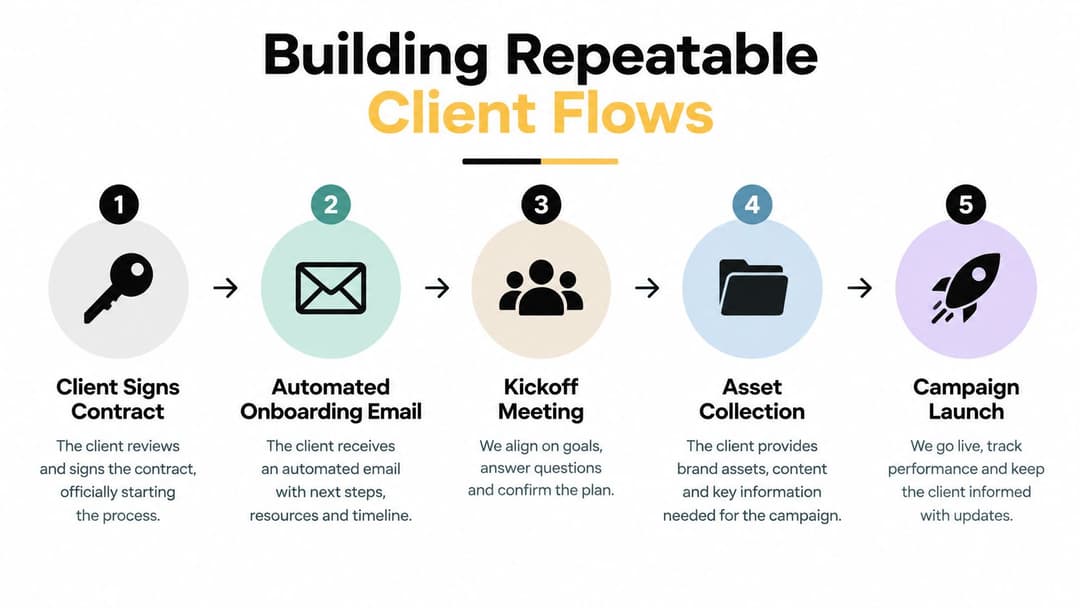
Client onboarding flow
The first workflow begins when the agreement is signed and ends when the delivery team can start without reconstructing the sale from scattered messages.
- Contract confirmation: Record services, scope, commercial assumptions, primary contacts, renewal terms, and known exclusions.
- Welcome and information request: Send a structured request for access, brand materials, analytics details, product information, and approval contacts.
- Internal handoff: The account lead translates the sale into a delivery brief. The team should flag unclear promises before the kickoff.
- Kickoff: Confirm goals, communication rules, decision-makers, meeting cadence, dependencies, and the definition of an approved deliverable.
- Readiness check: Mark the account ready only when the required access, assets, measurement inputs, and client contacts are available.
The exit condition matters. A kickoff meeting can happen while the account remains blocked. If access is missing, the workflow should show the blocker and its owner rather than moving work into production.
Campaign delivery flow
Campaign production needs a different sequence because the risk shifts from missing client information to rework, launch errors, and uncontrolled iteration.
- Brief: Define the objective, audience, offer, channel, budget context, message, format, destination, measurement plan, and owner.
- Strategy approval: Confirm the recommendation before creative production begins.
- Production: Build the assets against the approved brief and track versions in one location.
- Internal QA: Check copy, links, formats, tracking, naming, brand requirements, platform settings, and policy-sensitive elements.
- Client review: Give the client one clear approval route and record the approved version.
- Launch: Assign a named operator, launch checklist, and verification task.
- Optimization: Log meaningful changes with the reason, date, owner, and expected effect.
- Reporting: Connect results to the original objective and identify the next decision.
Use a scope-change trigger whenever a request alters the agreed audience, deliverable count, channel mix, revision expectation, or reporting requirement. The account lead can then estimate the impact before production continues.
The Meta Ads agency workflow automation task list can help teams translate this sequence into repeatable tasks. The important point is that the checklist should reflect real decision gates, not just generate a long list of boxes to tick.
A short walkthrough can help teams visualize how such a flow operates:
Keep templates service-specific. A paid media launch, brand campaign, SEO engagement, and lifecycle program may share intake and approval principles, but their QA requirements and evidence of readiness differ.
Where Automation Actually Saves Time Without Adding Chaos
Automation pays back fastest where the work is repetitive, rules are clear, and errors are easy to detect. It creates fragility when the underlying process is ambiguous, the source data is incomplete, or several tools can independently change the same record.
A 2026 industry analysis estimated that roughly 40% to 50% of standard marketing-agency administrative and operational work is automatable with available tools. It also reported the following adoption rates across common workflow categories in its marketing-agency automation analysis:
| Workflow Area | Share of Agencies Automating |
|---|---|
| Social media scheduling | 82% |
| Email marketing sequences | 76% |
| Client reporting dashboards | 54% |
| Invoice generation | 41% |
| Client onboarding | 38% |
| Proposal generation | 29% |
The pattern is useful. Agencies automate recurring administration before they automate strategic judgment. Scheduling, reporting, invoicing, onboarding, and routine communication have defined inputs and repeatable outputs. Positioning, audience strategy, creative direction, and client interpretation still require context and accountability.
Build the backlog in risk order
Start with tasks that remove coordination overhead without making irreversible decisions:
- Reporting preparation: Pull approved data sources into a consistent dashboard and create a review task for interpretation.
- Onboarding reminders: Trigger requests for missing access or assets, while keeping a human owner for exceptions.
- Invoice preparation: Generate draft invoices from approved work records, then require review before sending.
- Routine status updates: Create notifications from workflow states instead of asking account managers to rewrite the same update.
- Quality checks: Flag missing fields, absent approvals, broken links, or incomplete naming conventions.
Don't automate a broken approval chain. If three people can approve a campaign and nobody knows whose decision controls launch, a rule-based system will only move the confusion faster.
Prepare for AI agents by standardizing first
A cited Deloitte projection said that by 2025, 25% of enterprises using generative AI would deploy AI agents for routine marketing tasks, as described in this analysis of agency workflow maturity and AI adoption. The projection points to an operational prerequisite: agents need centralized data, documented procedures, stable permissions, and clear definitions of success.
That makes standardization the foundation of AI readiness. An agent can route a complete brief, summarize an approved report, or alert a manager when a rule is breached. It can't reliably infer undocumented scope, resolve contradictory versions, or decide whether a client request changes the commercial agreement.
Use one source of truth for each critical record. Define which system owns the client brief, asset version, approval, time record, and performance result. Then automate the handoffs that have become predictable.
Choosing Tools and Templates That Teams Will Actually Use
Tool selection should follow workflow maturity, not precede it. An agency with unclear ownership needs process design and a simple shared workspace. An agency with stable processes may need integrations, automated triggers, capacity views, approval controls, and reporting that spans client accounts.

Compare the main operating choices
A general project-management platform is often the right starting point when the agency needs tasks, owners, deadlines, comments, and basic templates. It keeps adoption manageable and gives managers visibility without forcing every service line into a specialized structure.
A connected operations stack becomes more useful when the agency needs time tracking, finance workflows, CRM data, creative review, reporting, and advertising-platform records to interact. The trade-off is maintenance. Every integration introduces permissions, field mapping, failure points, and a need to decide which system remains authoritative.
A specialized campaign platform can reduce repetitive setup for paid media teams. For example, AdStellar AI centralizes campaigns, creatives, audiences, a media library, and performance breakdowns, and supports bulk Meta ad creation, secure OAuth connection to Meta Ads Manager, AI-assisted insights, and automated rules such as scheduled checks, alerts, pausing underperformers, and scaling winners. It should still sit inside a broader agency workflow with defined approvals and commercial ownership.
Choose for behavior, not feature count
Ask the team to complete a real workflow in the proposed tool. Can a strategist create a brief without training? Can a designer find the approved asset? Can an account manager see what is blocked? Can a manager identify work that is outside scope? If the answer depends on custom fields nobody maintains, the system is overbuilt.
Your starter kit can stay small:
- Brief template: Objective, audience, offer, deliverables, inputs, owner, deadline, and approval criteria.
- Change-request form: Requested change, reason, impact, estimate, approver, and decision.
- Launch checklist: Asset validation, tracking, links, naming, budget, settings, approval, and post-launch verification.
- Reporting template: Objective, result, interpretation, action, owner, and follow-up date.
- Retrospective record: What worked, what failed, root cause, and process adjustment.
Store templates centrally and control versions. A template that changes without a visible owner creates inconsistent delivery, even when every team member is trying to follow the process.
For broader selection criteria, compare platforms through a practical digital marketing software guide for agencies, then test the shortlisted option against your actual client work rather than a vendor demonstration.
Measuring Performance and Keeping Workflows Healthy at Scale
A workflow is healthy when it protects delivery quality and commercial control under pressure. Deadline compliance matters, but it doesn't tell you whether the team worked profitably, whether clients received consistent output, or whether capacity is being consumed by avoidable rework.
Track a small operating set:
- Billable utilization: Compare recorded billable effort with available delivery capacity. Use the result to investigate patterns, not to punish isolated weeks.
- On-time delivery: Separate delays caused by the agency from delays caused by missing inputs or client approval.
- Revision rate: Record how often work returns for changes and classify the cause, such as unclear brief, internal error, new direction, or preference.
- Blocked work: Review age, blocker type, and accountable owner.
- Scope movement: Log requests that alter deliverables, channels, revision rounds, or reporting.
- Quality signals: Check brand consistency, tracking accuracy, approval completeness, and launch defects.
A 2025 creative workflow report found that 47% of respondents linked rising workload to increased consumer demands, 42% linked it to personalization demands, and 51% identified time constraints as their biggest challenge. It also reported 56% delayed product launches because of limited capacity and 35% said workload pressure contributed to branding inconsistencies, according to the creative workflow report. These findings make quality control a capacity issue, not a cosmetic add-on.
Run a weekly operating rhythm
Use one short review to inspect the system rather than asking for status updates one project at a time.
- Monday capacity review: Compare active commitments with available owners. Reassign work before deadlines become emergencies.
- Midweek blocker review: Escalate missing inputs, stalled approvals, and scope decisions.
- Friday delivery review: Confirm completed work, unbilled effort, upcoming invoices, and unresolved risks.
- Regular retrospective: Select one recurring failure and change the template, ownership rule, or approval gate that allowed it.
Keep the review evidence-based. If a campaign missed launch because the client supplied assets late, record that dependency. If the agency began production before confirming the offer, fix the entry criteria.
A healthy workflow makes problems visible early enough for a manager to act.
Personalization and channel growth will continue to increase variation in agency work. The answer isn't to add more status meetings or force every engagement into one rigid template. Use a stable core process, service-specific checklists, clear decision rights, and automation only where the team has demonstrated consistent execution.
AdStellar AI helps performance teams turn campaign production and optimization into a repeatable workflow by centralizing creatives, audiences, campaign setup, performance insights, and automated advertising rules. Visit AdStellar AI to see how it can fit into an agency operating system built for controlled, scalable delivery.