Monday morning at a mid-size agency rarely starts with a clean project dashboard. Three account managers are chasing status updates, a strategist is reworking last week's creative, and a producer is reconciling timesheets that don't match the statement of work. Everyone looks busy. The agency is still losing margin.
That gap comes from unpriced scope creep, unbilled rework, and idle utilization. Hours logged don't automatically equal value delivered. The difference between activity and profitable delivery is where agency project management earns its place in the P&L.
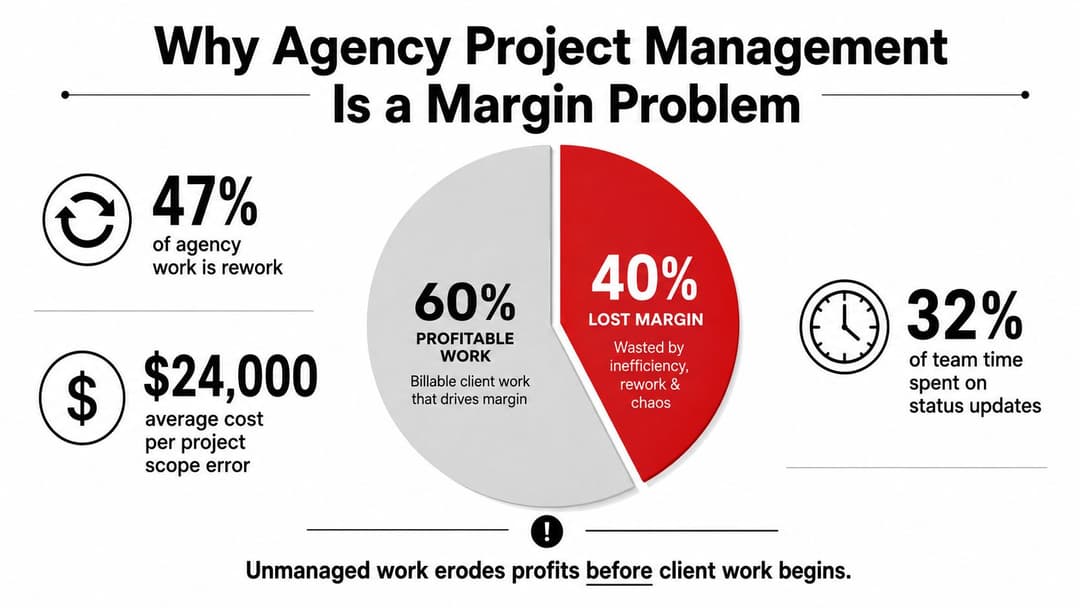
Why Agency Project Management Is a Margin Problem
A project can appear healthy because tasks are moving, meetings are happening, and the client is receiving updates. Yet the team may be spending time on revisions nobody priced, waiting for approvals, or repeating work because the brief changed without the schedule changing with it.
An industry summary reported that 57% of agencies lose $1,000 to $5,000 per month to unbilled work, while 30% lose more than $5,000. The same agency project management statistics summary found that 78% rarely or only sometimes charge for out-of-scope work, 71% say at least one in four invoices is paid late, and 52% struggle to reach a 50% billable-utilization benchmark. The source places average agency margins at about 13%, which leaves little room for uncontrolled delivery costs.
The three numbers that deserve attention
Scope control tells you whether the agency is delivering what it sold. Track requested additions, approved changes, and work completed outside the SOW. A task that appears minor can still consume specialist capacity and delay work that was priced.
Utilization tells you whether available team capacity is producing billable client value. It should never be treated as a vanity target. A high utilization figure can hide unhealthy rework if people are billing time against tasks that should have been completed correctly the first time.
Rework rate tells you how much delivery effort gets repeated because of unclear briefs, weak QA, or late feedback. It connects operational friction to margin more directly than a polished status report.
Practical rule: If a project dashboard doesn't show scope variance, utilization, and rework together, it can't explain why margin moved.
The discipline has historical roots. The UK government published the PRINCE method in 1989, and it became the UK standard for government information projects, a milestone in formalized project control documented by Civil Service World. Modern agencies need the same principle in a more commercial form: explicit gates, accountable owners, and decisions made before costs accumulate.
That's why better presentation decks won't fix a delivery problem. A seven-stage operating model will: scope, intake, planning, production, approval, launch, and reporting. Each gate should protect the P&L before the next team commits more hours. Agencies building predictable demand can also pair delivery discipline with scalable lead generation for agencies, because a full pipeline only helps when the agency can fulfill it profitably. For a practical example of how disconnected execution creates waste, see this analysis of an inefficient agency Facebook ad workflow.
Client Intake and Scoping That Prevents Rework
Kickoff shouldn't be the first time the agency discovers what the client wants. It should be the point where an already-defined project moves from commercial agreement into delivery.
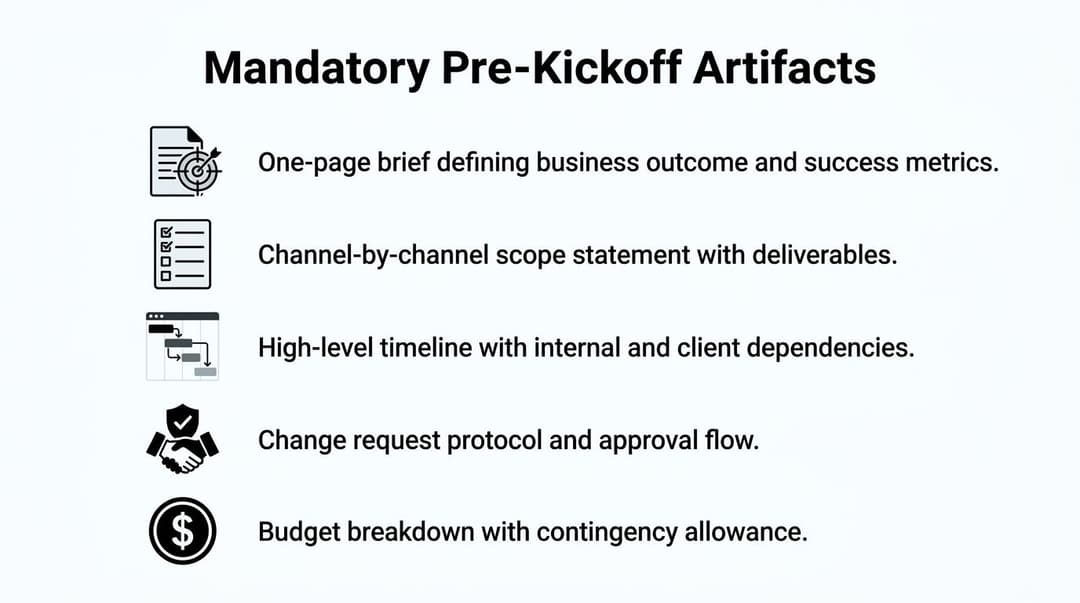
Before scheduling it, require a small set of artifacts. Each one should answer a different delivery risk.
The pre-kickoff evidence
- One-page brief: State the business outcome, audience, offer, constraints, and success metrics. The brief is ready when it names one client-side decision-maker and a realistic budget band, not a collection of wishes.
- Channel scope statement: List each channel, deliverable, format, quantity, owner, and exclusion. A paid social engagement should distinguish creative development, media setup, trafficking, optimization, and reporting instead of placing them under one vague campaign label.
- Assumptions log: Record dependencies such as access, source files, legal review, client data, and turnaround expectations. The kickoff can proceed only when unresolved assumptions have an owner and a decision date.
- Change-order matrix: Define what stays in scope, what requires a revised SOW, and who can approve it. “Small” isn't a useful category. The trigger should be an added deliverable, new channel, additional review round, material timeline shift, or new technical requirement.
- Signed estimate: Map fees and allocated hours to named deliverables. If the estimate can't tell the producer which work is funded, it isn't ready for scheduling.
A written change request should describe the requested work, its impact on timing and budget, and the decision required. Set an internal rule that approval must arrive within 48 hours, then pause the affected task rather than absorbing the cost. This isn't about punishing clients. It gives both sides a visible choice between more scope, more time, or more budget.
The strongest scope document is the one a producer can use during a difficult conversation without improvising.
Every meeting should update one of these artifacts. If a call produces no decision, revised requirement, approved change, risk response, or assigned action, question whether the agency can bill it as project work. Meetings consume capacity even when they don't create a deliverable, so “alignment” needs a traceable operational outcome.
Use a single intake workspace rather than allowing requirements to scatter across email, chat, and presentation files. The Facebook campaign planning workflow offers a useful reference for turning campaign inputs into a more explicit planning sequence.
The kickoff itself should confirm the artifacts, not recreate them. Leave the meeting with a named decision-maker, agreed review path, client dependencies, escalation route, and the first production milestone.
Planning, Resourcing, and the Creative Production Pipeline
A creative plan is credible only when it accounts for the work surrounding the asset. Production time is visible. Review queues, revisions, trafficking, naming, tracking, and client latency are where schedules usually break.
Start each deliverable with four fields: one owner, allocated hours, dependencies, and a due date. Then place the work into five gates:
- Brief: The team confirms the audience, offer, message, format, and success criterion. The gate closes when the strategist and reviewer agree that production can begin.
- Concept: Hooks, visual directions, and copy routes are developed. The gate closes when the selected concept matches the brief and fits the approved scope.
- Production: Design, copy, editing, and motion work happen against the selected route. The owner records actual effort against the estimate.
- Edit: Internal QA and client review occur through the defined approval path. The gate closes only when material changes are resolved.
- Package: Final files receive correct formats, naming conventions, tracking details, and trafficking instructions. The media buyer confirms that the package is usable.
A worked production plan
Consider a $4,000 monthly retainer covering eight ad concepts, three hooks per concept, and four final assets. The numbers below are a planning example, not a performance benchmark. The point is to connect commercial scope to actual capacity.
| Deliverable | Owner | Hours | Dependency | Gate |
|---|---|---|---|---|
| Message brief and audience angles | Strategist | 6 | Approved intake brief | Brief |
| Eight concepts and hook routes | Strategist | 12 | Message brief | Concept |
| Four static and motion assets | Designer | 20 | Selected concepts | Production |
| Motion edits and format adaptations | Motion editor | 14 | Source designs | Edit |
| Platform packaging and trafficking | Media buyer | 8 | Approved final assets | Package |
The production plan needs review capacity as well. The strategist may own the brief, but an account lead or creative director must review it. The designer may own the asset, but the media buyer should verify that the format works for its intended placement. Client approval is a dependency, not an invisible gap between “ready for review” and “approved.”
The common failure is planning outputs while ignoring approvals and trafficking. That creates a false schedule where the team finishes the creative but misses the launch window because nobody reserved time to package, check, and publish it.
Scheduling rule: A task without one owner, one reviewer, and one deadline isn't scheduled. It's a hope.
Review your production system with a process lens, not just a task-board lens. This workflow optimization guide is useful when the agency needs to identify handoff friction rather than add more tasks to a board.
Approval and QA Flows That Don't Kill Velocity
Approval design directly affects agency margin. Each review gate trades speed for error detection, while late feedback increases rework and reduces utilization. Set the control level according to campaign risk, decision speed, and the cost of another production cycle.
| Structure | Throughput | Rework Rate | Cycle Time | Best For |
|---|---|---|---|---|
| Single approver | Fast when available | Can be inconsistent | Short until overloaded | Small, decisive workstreams |
| Tiered approval | Slower through multiple checkpoints | Stronger error detection | Longer, but more controlled | Regulated or high-risk campaigns |
| Asynchronous comment rounds | Flexible across time zones | Accountability can dilute | Variable and feedback-dependent | Distributed client teams |
A single approver protects throughput because the decision owner is clear. That person can also become a bottleneck when unavailable or overloaded. Tiered review catches brand, performance, and legal issues earlier, but each added gate increases latency. Asynchronous comments support distributed teams, yet unranked feedback often creates another revision cycle.
A practical hybrid default
Assign a named primary approver for each workstream, a backup, and a 24-hour SLA for feedback. Run internal QA in sequence: verify brand compliance first, confirm performance requirements second, and request legal review when the engagement requires it. Cap client feedback at two rounds, then treat additional material changes as a scope decision, not free production capacity.
The QA checklist should use direct, testable actions:
- Brand compliance: Verify logo use, colors, typography, tone, and approved claims.
- Tracking: Test pixels, events, URLs, UTMs, and conversion mapping.
- Naming: Apply the agreed campaign, ad set, asset, and version conventions.
- Platform specifications: Confirm dimensions, formats, text limits, placements, and file behavior.
- Brief alignment: Compare copy and creative with the approved audience, offer, and objective.
- Accessibility basics: Review contrast, captions, readable text, and meaningful visual communication.
Require every comment to reference the brief or an explicit acceptance criterion. “Make it stronger” gives the team no decision rule. “The headline does not state the approved offer” identifies the required change and keeps the review usable.
If the client submits a third round with 12 unranked comments, issue a change order for the additional review cycle and note the SLA breach in the project log. If the new request adds a concept, channel, audience, or deliverable, record it as scope before assigning production time.
Attach a one-page approval matrix to every SOW. Name the approver, backup approver, review window, feedback channel, QA owner, and escalation path. Client approval is a scheduled dependency with an owner and a due date. That clarity protects utilization, limits rework, and keeps the delivery forecast tied to margin.
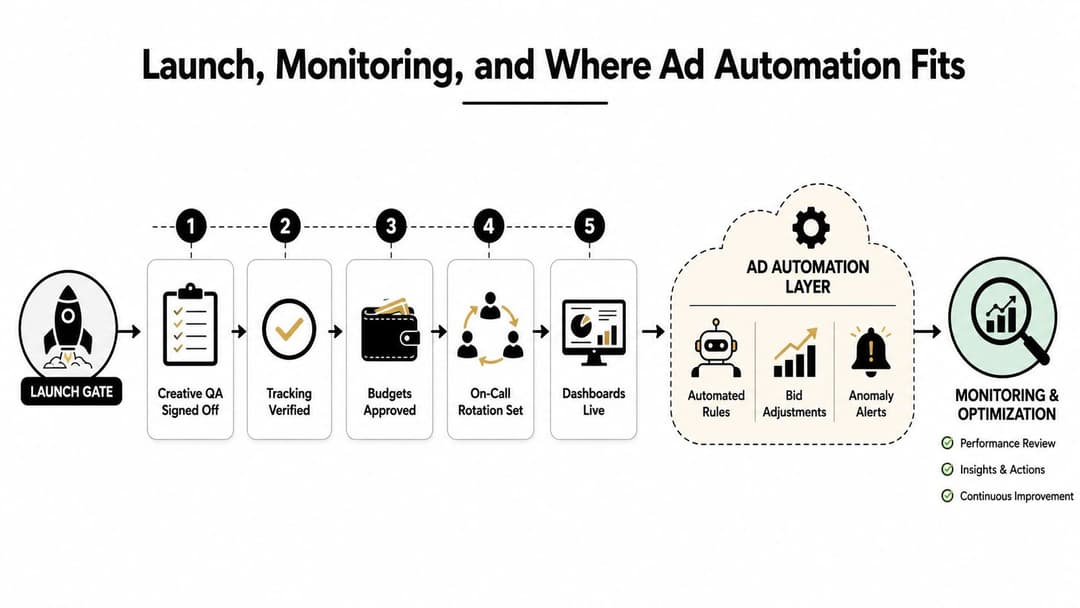
Launch, Monitoring, and Where Ad Automation Fits
A launch date isn't a launch gate. Campaigns should go live only after the conditions for safe operation are true.
Run the final readiness check 48 hours before go-live:
- Creative QA signed off: Final files match approved versions and platform requirements.
- Tracking verified: Events, URLs, UTMs, and conversion signals have been tested.
- Budgets approved: The client has confirmed spend allocation and pacing assumptions.
- On-call rotation set: A named person owns launch monitoring, with an escalation backup.
- Dashboards live: The team can see spend pacing, CPA trend, creative fatigue signals, and delivery anomalies.
Monitor events, not just dates
The first 72 hours deserve an explicit operating rhythm. Check delivery early after launch, review the agreed performance and pacing signals throughout the initial period, and define in advance what triggers intervention. A kill switch might be activated by a tracking failure, unexpected spend behavior, broken destination, policy issue, or a material deviation from the approved launch conditions.
Automation belongs inside this workflow, not beside it. Tools such as Revealbot, Madgicx, and other ad-automation systems can support bid adjustments, budget pacing, creative rotation, and anomaly alerts, but each rule needs a project owner and a documented purpose. The project plan should contain the automation task, the SOW should describe the trigger and decision boundary, and a human should review the automation log weekly.
Keep a manual fallback. If an automation tool becomes unavailable, the media buyer should know which checks to run, which changes to make, and who must approve them. Automation should reduce repetitive intervention, not become the only place where campaign knowledge exists.
Agencies also need to explain the operating model to clients considering different levels of paid media support. A practical guide to choosing PPC packages can help frame the difference between media execution, monitoring, reporting, and strategic ownership.
The weekly review should turn dashboard signals into decisions. Rising CPA creates a creative refresh task. Uneven spend pacing creates a budget or bid review. Fatigue signals create a rotation plan. The dashboard is useful only when someone owns the response.
Recurring Reporting as a Retention Engine
A monthly report should make the next decision easier. If it only records what happened, the agency has produced a status update. If it connects performance to actions, risks, and funded priorities, it becomes part of the renewal conversation.
Use a stable structure:
- Executive summary: Write three bullets the CMO can forward to the CEO. Lead with business movement, not platform activity.
- Performance against contracted KPIs: Show the agreed measures, the relevant period, context, and decision attached to each result.
- Spend and pacing: Explain whether delivery matched the approved budget and what action follows from any variance.
- Creative learnings: Identify which messages, formats, hooks, or audiences deserve more testing.
- Next-month plan: Name the work, owner, dependency, and expected decision.
- Risks: List unresolved approvals, tracking concerns, budget constraints, and scope questions.
For a paid social engagement, the KPI set might include ROAS, CPA, CTR, frequency cap, creative velocity, and share of voice where it applies. Each metric must connect to a project-health choice. Rising CPA should create a creative refresh or audience review task. Weak CTR should prompt a message or hook test. Low creative velocity should expose a production bottleneck rather than appear as a neutral chart.
Use cadence to reduce reporting waste
Send a weekly snapshot email for exceptions, pacing, and immediate decisions. Use a monthly deep-dive deck for performance interpretation and the next work plan. Hold a quarterly business review around the roadmap, budget, commercial priorities, and risks.
Keep the deck 80% reusable structure and 20% engagement-specific narrative. That balance gives the team consistency without making every client presentation feel copied. It also reduces the temptation to rebuild the same reporting logic manually every month.
The final slide of every QBR should propose what the agency will do next quarter with the already approved budget. That proposal can include new tests, creative production, audience work, tracking improvements, or reporting changes. The report then does more than defend past activity. It gives the client a concrete reason to continue.
A structured automated client reporting workflow can help the team protect time for interpretation, provided the agency still owns the narrative and recommendations.
Scaling PM Without Adding Headcount
Agency growth usually exposes missing documentation before it exposes missing software. If only one senior PM knows how scope is approved, how recurring work is assigned, or how delivery risks escalate, the agency hasn't built a system. It has built a dependency on one person.
Commit three artifacts to writing:
- Scope template: Include fixed assumption lines, exclusions, client responsibilities, review rounds, and change triggers.
- RACI: Assign responsibility, accountability, consultation, and notification for every recurring deliverable type.
- Post-mortem rubric: Record the planned margin, actual effort, rework causes, approval delays, scope changes, and the process adjustment required.
These artifacts convert tribal knowledge into repeatable operating decisions. They also make onboarding more practical because a new account lead can follow a defined path rather than reconstructing it from old messages.
A workable 90-day rollout
Days 1 to 30: Lock the templates, assign owners, and retire shadow spreadsheets. Don't launch a grand software migration before the agency agrees on the workflow. A tool can centralize a bad process just as efficiently as a good one.
Days 31 to 60: Instrument the key delivery measures in one dashboard. Review scope variance, utilization, rework, and margin weekly. The purpose isn't to rank employees. It's to find projects where commercial assumptions and delivery behavior have separated.
Days 61 to 90: Introduce a lightweight governance cadence. Hold a Monday pipeline review for upcoming work, capacity, dependencies, and intake quality. Hold a Friday risk review for late approvals, budget variance, blocked tasks, and escalation decisions. Gate new business on expected margin and delivery capacity, not on the hope that another hire will solve a weak process.
The broader maturity problem is visible in current project-management data. A 2026 survey reported that 22% of organizations still rely on Excel for planning and 11% use no project-management solution, while benefits realization, resource management, and project prioritization remained among the hardest processes to embed, as summarized by PMwares. The implication for agencies is practical: adoption alone doesn't create maturity. Connected workflows and governance do.
Industry data also reports that 82% of organizations run at least one PMO, while only 34% mostly or always complete projects on time, according to the project-management summary cited in the brief. That gap reinforces the point. A PMO, dashboard, or task platform can exist without changing how decisions get made.
Delegation guardrail: A senior PM can't remain the single point of contact for every escalation. Assign decision rights to account leads, producers, and channel owners during the rollout, then review the decisions rather than reclaiming them.
For agencies managing many paid accounts, the same principle applies to multi-account management. Central visibility helps, but each account still needs an owner, an escalation rule, and a documented fallback.
AdStellar AI helps agencies turn paid social execution into a repeatable delivery workflow by automating bulk creative production, campaign setup, performance analysis, and optimization across Meta accounts. If you're rebuilding project gates around scope, utilization, rework, and accountable launch tasks, visit AdStellar AI to see how the platform can fit into that operating model.