Most Facebook campaigns fail before they even launch. Not because the creative is wrong or the audience is off, but because there was no real plan in the first place. Marketers throw together ads, guess at targeting, set a budget that feels about right, and cross their fingers. Then they wonder why one campaign crushes it while the next one burns money.
The difference is not luck. It is workflow.
A Facebook campaign planning workflow is your blueprint for consistent performance. It is the difference between reacting to whatever happens and proactively building campaigns designed to win. With a structured approach, you eliminate the scrambling, reduce costly mistakes, and create a system that gets smarter with every campaign you run.
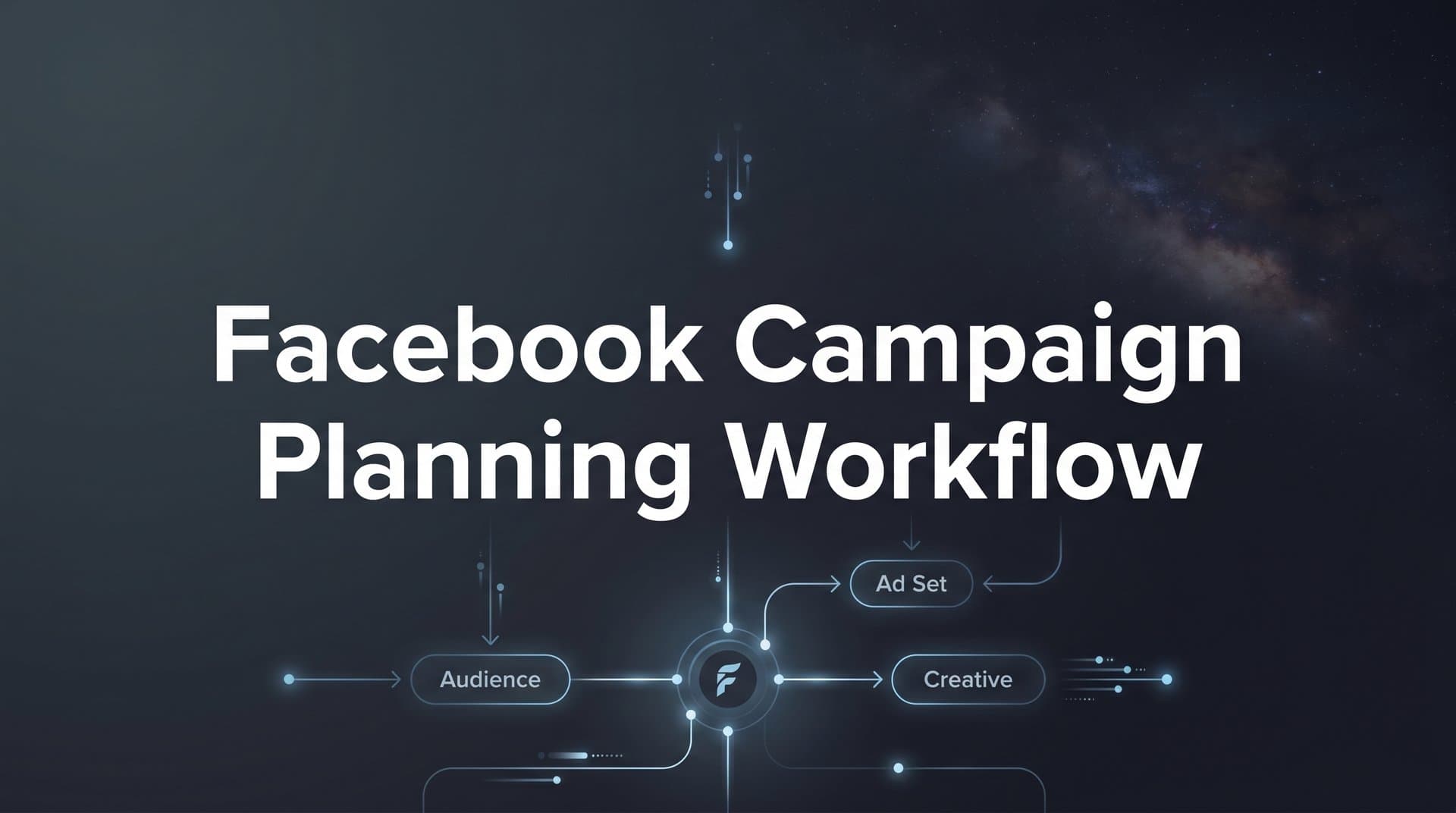
This guide shows you how to build a complete Facebook campaign planning workflow from scratch. You will learn how to define objectives that actually align with business goals, research and segment audiences strategically, plan creative assets that test the right variables, structure campaigns for clear insights, and establish measurement systems that drive real optimization decisions.
By the end, you will have a documented workflow you can use for every campaign. No more starting from zero. No more forgetting critical steps. Just a repeatable system that makes launching campaigns faster, analysis clearer, and results more predictable.
Step 1: Define Your Campaign Objective and Success Metrics
Your campaign objective is not just a dropdown selection in Meta Ads Manager. It is the instruction set you are giving Facebook's algorithm about what to optimize for. Choose wrong, and you will spend money driving the wrong outcomes.
Start by identifying your actual business goal. Are you trying to build brand awareness? Drive traffic to a new product page? Generate qualified leads? Close sales? Your Meta campaign objective should directly align with this goal, not just approximate it.
Meta offers campaign objectives across awareness (reach, brand awareness), consideration (traffic, engagement, app installs, video views, lead generation, messages), and conversion (conversions, catalog sales, store traffic). The algorithm optimizes differently for each one. If you select "Traffic" but really want purchases, you will get clicks from people unlikely to buy. If you select "Conversions" but your pixel does not have enough data, the algorithm will struggle to find buyers.
Once you have matched objective to goal, define your success metrics before you launch. What target CPA makes this campaign profitable? What ROAS threshold means you can scale? What CTR indicates your creative is resonating? What lead volume do you need to hit revenue targets?
Write these numbers down. Create a simple campaign brief template that captures: campaign name, objective, target audience summary, budget allocation, timeline, and success metrics. This becomes your reference point for all optimization decisions. Using Facebook advertising campaign templates can standardize this process across your team.
Document your budget constraints and timeline upfront. If you have $2,000 to spend over two weeks, that informs how many audiences you can test, how many creative variations you can run, and how quickly you need to make optimization decisions. A $10,000 monthly budget allows for more experimentation. A $500 test budget requires tighter focus.
This brief also serves another purpose: it creates institutional memory. When you are running multiple campaigns or working with a team, documented objectives prevent confusion about what each campaign was supposed to accomplish. Three months later, when you are analyzing historical performance, you will know exactly what you were testing and why.
The brief does not need to be elaborate. A simple one-page document with objective, audience, creative approach, budget, timeline, and success metrics is enough. The act of writing it forces clarity before you start building.
Step 2: Research and Segment Your Target Audiences
Audience research is where most workflows get lazy. Marketers default to broad interest targeting or a single lookalike audience and call it a day. Then they wonder why performance is inconsistent.
Start by auditing your existing customer data. Who are your highest-value customers? What characteristics do they share? Look at demographics, purchase behavior, average order value, and lifetime value. This analysis reveals patterns you can translate into targeting strategies.
Build your audiences in layers based on funnel temperature. Cold audiences have never heard of you. Warm audiences have engaged with your content but have not converted. Hot audiences are past customers or active prospects.
For cold audiences, create multiple targeting hypotheses to test. If you sell fitness equipment, do not just target "fitness enthusiasts." Build separate audiences around different interest clusters: home workout enthusiasts, CrossFit followers, yoga practitioners, marathon runners. Each segment likely responds to different messaging and creative.
Lookalike audiences based on your customer list are powerful cold audience options, but build multiple percentages. A 1% lookalike is highly similar to your customers but limited in size. A 5% lookalike is broader but less precise. Test both to find the sweet spot between similarity and scale.
For warm audiences, layer engagement data. Create audiences of people who watched 75% of your videos, engaged with your Instagram profile, visited your website in the last 30 days, or added to cart but did not purchase. These segments show intent and typically convert at higher rates with lower CPAs.
Hot audiences include past purchasers, email subscribers, and high-intent website visitors. These are your retargeting segments. Plan creative and messaging specifically for people who already know your brand.
Document each audience hypothesis you want to test. Do not assume one audience will win. Write down why you think each segment might perform well and what you expect to learn from testing it. This creates a testing roadmap rather than random audience experiments. A comprehensive Facebook ads campaign planning tutorial can help you structure this documentation effectively.
Plan your exclusions strategically. Exclude existing customers from acquisition campaigns to avoid wasting budget. Exclude people who already converted from lead generation campaigns. Exclude irrelevant traffic sources if you have data showing certain audiences never convert.
Check your audience sizes before finalizing. Meta recommends at least 1,000 people per audience for effective delivery. Audiences that are too small will struggle to exit the learning phase. Audiences that are too broad will dilute your messaging. Aim for the goldilocks zone where your targeting is specific enough to be relevant but large enough to deliver at scale.
Create a master audience document that lists every audience you have built, its size, its purpose, and its historical performance if available. This becomes your audience library for future campaigns.
Step 3: Plan Your Creative Strategy and Asset Requirements
Creative is not an afterthought you throw together the day before launch. It is the variable that often has the biggest impact on performance. Your workflow needs a systematic approach to creative planning.
Start by mapping creative formats to funnel stages. Top-of-funnel awareness campaigns benefit from video content that tells a story and builds brand recognition. Middle-funnel consideration campaigns work well with carousel ads that showcase product features or customer testimonials. Bottom-funnel conversion campaigns perform with user-generated content style ads that feel authentic and trustworthy.
Define the creative variables you want to test. These might include different hooks in the first three seconds, visual styles (lifestyle vs product-focused), copy angles (problem-focused vs benefit-focused), or calls-to-action (shop now vs learn more). Each variable you test should have a hypothesis behind it.
Create a creative production checklist that includes technical specs, production deadlines, approval workflows, and who is responsible for each asset. This prevents last-minute scrambling and ensures you have everything ready before launch day.
Technical specs matter more than you think. Facebook recommends 1080x1080 for feed placements, 9:16 for stories and reels, and 1:1 or 4:5 for most other placements. Video should be H.264 compression, square pixels, fixed frame rate, and progressive scan. Text overlays should stay within the safe zones to avoid getting cut off on different devices.
Plan for creative fatigue upfront. Ads lose effectiveness over time as your audience sees them repeatedly. Frequency increases, engagement drops, and CPAs rise. The solution is having enough creative variations ready to rotate in before fatigue sets in.
How many variations do you need? It depends on your budget and audience size. A small budget targeting a niche audience might exhaust creative quickly. A large budget targeting broad audiences needs a deeper creative bench. Plan for at least 3-5 variations per audience segment to start. Tools for Facebook ads bulk campaign creation can help you generate these variations efficiently.
Document your creative testing framework. If you are testing hooks, keep everything else constant so you know the hook drove any performance difference. If you are testing visual styles, use the same copy and CTA across variations. Isolating variables gives you clear learnings rather than ambiguous results.
Consider how creative connects to your landing page experience. If your ad promises free shipping, your landing page better deliver on that promise. If your ad features a specific product, do not send traffic to a generic homepage. Message match between ad and landing page significantly impacts conversion rates.
Build a creative asset library that organizes all your ads by format, theme, performance, and audience. This makes it easy to find and reuse winning creative elements in future campaigns. Tools like AdStellar's AI Creative Hub can generate multiple ad variations from a product URL or by cloning competitor ads, dramatically speeding up this process while maintaining quality.
Step 4: Structure Your Campaign Architecture for Testing
How you structure your campaigns determines what you can learn and how quickly you can optimize. Poor structure creates confusion. Smart structure creates clarity.
Your first decision is between Campaign Budget Optimization (CBO) and Ad Set Budget Optimization (ABO). CBO lets Facebook distribute budget across ad sets automatically, favoring better performers. ABO gives you manual control over budget allocation to each ad set.
Use CBO when you want Facebook to find winners quickly and you have enough budget to test multiple ad sets simultaneously. It works well when you trust the algorithm and want to scale efficiently. Use ABO when you want tight control over testing, need to ensure equal spend across test groups, or are working with smaller budgets where you need predictable spend.
Design your ad set structure to isolate the variables you want to test. If you are testing audiences, put each audience in its own ad set with the same creative. If you are testing creative, use one ad set with multiple ads. If you are testing both, you need separate ad sets for each audience-creative combination. Understanding the Facebook ads campaign hierarchy is essential for building effective test structures.
Avoid the temptation to test everything at once. Testing three audiences with five creative variations creates fifteen combinations. You will need significant budget to get meaningful data on each combination. Start with fewer variables and expand as you identify winners.
Plan your naming conventions before you build anything. A clear naming system makes reporting and analysis straightforward. Include campaign objective, audience type, creative theme, and test variable in your names.
For example: "Conversions_Lookalike1%_UGCCreative_HookTest" immediately tells you this is a conversion campaign targeting a 1% lookalike audience with UGC-style creative testing different hooks. Three months later, you will understand exactly what this campaign was without digging through settings.
Set minimum budget thresholds per ad set to ensure statistical significance. Meta recommends spending at least 50 times your target CPA per ad set to exit the learning phase and get stable performance. If your target CPA is $20, budget at least $1,000 per ad set. Spreading a small budget across too many ad sets prevents any of them from learning effectively.
Plan your placement strategy. Automatic placements let Facebook show your ads wherever they perform best. Manual placements give you control but require more budget to test each placement separately. For most campaigns, start with automatic placements and review placement performance data after a few days. Then exclude placements that are not performing.
Document your campaign structure in a simple spreadsheet before you build in Ads Manager. List each campaign, ad set, target audience, budget, and creative. This becomes your build guide and ensures you do not forget anything during setup. Dedicated Facebook ad campaign planning software can streamline this documentation process.
Step 5: Build Your Launch Checklist and Quality Assurance Process
The gap between planning and launching is where mistakes happen. A pre-launch checklist catches errors before they cost you money.
Start with pixel verification. Confirm your Facebook pixel is firing correctly on all relevant pages: landing pages, add-to-cart events, purchase confirmations, lead form submissions. Use the Meta Pixel Helper Chrome extension to verify events are tracking. If your pixel is not working, your campaign cannot optimize properly and your attribution will be broken.
Check your UTM parameters. Every ad should have UTM tags that track source, medium, campaign, and content in your analytics platform. This allows you to connect ad performance to downstream behavior and revenue. Use a consistent UTM structure across all campaigns so your reporting stays clean.
Review your audience sizes one more time. Audiences that are too small will not deliver efficiently. Audiences that overlap too much will cause your ads to compete against each other in the auction. Use Meta's Audience Overlap tool to check for significant overlap between audiences and adjust if needed.
Verify creative specs match Meta's requirements. Images should be high resolution, videos should meet technical specifications, and text should be clear and readable at small sizes. Preview your ads on different placements to ensure they look good everywhere they might appear.
Review ad copy for policy compliance. Meta's ad policies prohibit certain claims, language, and targeting. Read through your copy to ensure you are not using restricted language or making claims you cannot substantiate. Policy violations lead to rejected ads and wasted time.
Check brand consistency across all creative and copy. Your ads should feel like they come from the same brand with consistent visual style, tone, and messaging. Inconsistency confuses audiences and dilutes brand recognition. Maintaining Facebook ads campaign consistency is critical for building trust with your audience.
Set up your A/B test documentation before launch. Create a simple spreadsheet that lists what you are testing, why you are testing it, what you expect to learn, and how you will measure success. This forces clarity about your testing strategy and creates a record for future reference.
Schedule your launch timing strategically. Do not launch campaigns at 5 PM on Friday when you will not be monitoring performance over the weekend. Launch early in the week when you can watch initial performance and make quick adjustments if needed. Consider your audience's active hours. If you are targeting professionals, launching Monday morning might work well. If you are targeting parents, evening hours might be better.
Do a final budget check. Confirm your daily or lifetime budgets are set correctly, your billing information is current, and you have enough budget to run the campaign through its planned duration. Running out of budget mid-campaign disrupts learning and wastes the data you have collected.
Once everything checks out, launch your campaign and immediately verify it is delivering. Check that ads are approved, ad sets are active, and spend is starting to flow. Catching delivery issues in the first few hours prevents wasted days. Facebook campaign launch automation can help you deploy campaigns faster while maintaining quality checks.
Step 6: Establish Your Measurement and Optimization Cadence
Launching the campaign is just the beginning. Your workflow needs a systematic approach to measurement and optimization that turns data into decisions.
Define your review intervals upfront. Daily quick checks catch major issues: disapproved ads, delivery problems, budget pacing issues, or obvious performance outliers. These reviews take five minutes and prevent small problems from becoming expensive ones.
Weekly deep dives analyze performance against your success metrics. Look at each ad set's CPA, ROAS, CTR, and conversion rate. Compare audiences to identify winners and losers. Review creative performance to spot fatigue. Check frequency to ensure you are not oversaturating your audience.
Monthly strategic reviews zoom out to campaign-level insights. What patterns emerged across multiple campaigns? Which audiences consistently perform well? Which creative themes drive the best results? What optimizations had the biggest impact? These reviews inform your overall strategy and planning for future campaigns.
Create a decision framework for when to pause, scale, or iterate. Do not make changes based on gut feeling or impatience. Set clear rules: if an ad set spends 2x your target CPA without a conversion, pause it. If an ad set delivers conversions at 50% below target CPA, increase its budget by 20%. If frequency exceeds 3 without performance decline, prepare new creative. Learning how to scale Facebook advertising campaigns requires this disciplined approach to optimization.
Having rules prevents emotional decision-making. You are not guessing whether to pause an underperformer. You are following the framework you established based on your success metrics.
Set up reporting dashboards that surface your defined KPIs automatically. Meta Ads Manager has built-in reporting, but connecting your data to a centralized dashboard that includes website analytics, CRM data, and revenue attribution gives you a complete picture. The goal is seeing performance at a glance without manual data pulling.
AdStellar's AI Insights feature automatically ranks your creatives, headlines, audiences, and landing pages by performance metrics like ROAS, CPA, and CTR. It scores everything against your target goals so you can instantly identify winners without manual analysis. The Winners Hub organizes your top performers in one place with real performance data, making it easy to reuse proven elements in future campaigns.
Document your learnings systematically. After each campaign, write down what worked, what did not, and why you think that happened. Which audiences exceeded expectations? Which creative angles fell flat? What optimization moves had the biggest impact? This documentation ensures insights actually inform your next campaign rather than getting forgotten.
Create a testing log that tracks every experiment you run. Record your hypothesis, the test setup, the results, and the conclusion. Over time, this log becomes your playbook of proven strategies specific to your business, audience, and offer.
Build feedback loops between campaigns. Winning audiences from Campaign A should inform targeting for Campaign B. High-performing creative themes should get expanded in future campaigns. Underperforming segments should be excluded or approached differently. Each campaign makes the next one smarter.
Review your workflow itself periodically. Are there steps that slow you down without adding value? Are there gaps where mistakes keep happening? Is there new data or tooling that could improve your process? Your workflow should evolve as you learn what works for your specific situation.
Turning Workflow Into Competitive Advantage
A Facebook campaign planning workflow is not bureaucracy. It is the system that makes everything else work better. When you have a documented process, campaigns launch faster because you are not reinventing the wheel every time. Analysis becomes clearer because you built structure that isolates variables. Optimization decisions become easier because you defined success upfront.
The real power comes from iteration. Your first campaign using this workflow will teach you something about your audience, your creative, or your offer. Your tenth campaign will be exponentially smarter because you have been documenting learnings and feeding them back into the system.
Start with the basics: define clear objectives and success metrics, research and segment audiences strategically, plan creative with testing in mind, structure campaigns for clear insights, quality check everything before launch, and measure consistently with a decision framework. Each step builds on the previous one to create a complete system.
Tools can accelerate this workflow significantly. AdStellar uses AI to generate creative variations, build campaigns from historical performance data, and surface winners automatically. The AI Campaign Builder analyzes your past campaigns, ranks every creative, headline, and audience by performance, and builds complete Meta Ad campaigns in minutes with full transparency about every decision. Bulk Ad Launch creates hundreds of ad variations by mixing multiple creatives, headlines, audiences, and copy at both the ad set and ad level, launching them to Meta in clicks rather than hours.
Whether you use automation or manage everything manually, the workflow principles stay the same. Plan deliberately. Test systematically. Measure consistently. Learn continuously.
Build your workflow template today. Document each step with enough detail that someone else could follow it. Run your next campaign through it. Refine based on what you learn. Over time, this workflow becomes your competitive advantage, the system that consistently delivers results while others are still scrambling to figure out what to test next.
Ready to transform your advertising strategy? Start Free Trial With AdStellar and be among the first to launch and scale your ad campaigns 10× faster with our intelligent platform that automatically builds and tests winning ads based on real performance data.