You've just spent a week testing new ad concepts. One variation generated a promising click-through rate, another produced cheap leads, and a third looked polished enough to earn internal approval. Then you check a competitor's ad library and find a familiar pattern: the same problem angle, proof style, and offer structure appear across multiple formats and have stayed live far longer than the rest.
That discovery is useful, but only if you can tell whether it reflects a durable strategy or a short-lived test. Competitor ad analysis works when it turns public advertising activity into comparable evidence, not when it becomes a folder of screenshots and creative envy. The practical job is to separate noise from signals, score repeated patterns, and convert only the strongest observations into test briefs your team can launch.
Why Competitor Ad Analysis Beats Guesswork
A performance team rarely wastes time because it lacks ideas. It wastes time because it tests ideas without enough context. A copywriter creates a broad benefit angle, a designer produces several formats, and a media buyer launches them with uncertain expectations. When the results disappoint, the team learns only that the concept failed in its current form. It doesn't know whether the problem was the hook, offer, audience, landing page, or channel role.
A disciplined competitor ad analysis gives that work a starting point. Public ad libraries reveal the messages, formats, offers, and visual territories competitors have chosen to expose in-market. They don't reveal exact spend or conversion results, so the analysis must remain directional. Still, repeated activity can help you form better hypotheses before you commit production and media budget.

From occasional browsing to an operating discipline
The broader competitive intelligence market was valued at about USD 49.5 billion in 2024, according to an independent market summary cited by Luminix's competitive intelligence market data. The same source presents much smaller software-only estimates, including a projection from US$29.3 million in 2026 to US$57.4 million by 2033, with a 10.1% CAGR. The estimates use different market definitions, but they point to the same operational change: organizations increasingly use software to collect and interpret competitive signals.
Digital advertising makes that shift especially relevant. The OECD report on competition in digital advertising markets describes a sector whose concentration and structural importance warrant close scrutiny. Public ad-transparency data has made recurring observation practical for agencies, e-commerce brands, and B2B advertisers that need to adjust creative and offers continuously.
Practical rule: A live ad is an observation. A repeated pattern across time, formats, and funnel stages is evidence worth testing.
What mature analysis looks like
A mature team doesn't ask, “Which competitor ad should we copy?” It asks:
- What problem appears repeatedly? Look for recurring customer tension, not isolated wording.
- Which promise survives creative rotation? A durable promise matters more than one visual treatment.
- What changes across platforms? The same positioning may use different proof or calls to action depending on channel.
- What happens after the click? The landing page can reveal whether the ad is designed for education, qualification, or immediate conversion.
This approach beats inspiration browsing because it preserves uncertainty while improving decision quality. You're not claiming that a competitor's ad works. You're identifying a pattern strong enough to deserve a controlled test, then letting your own results determine whether the insight transfers to your brand.
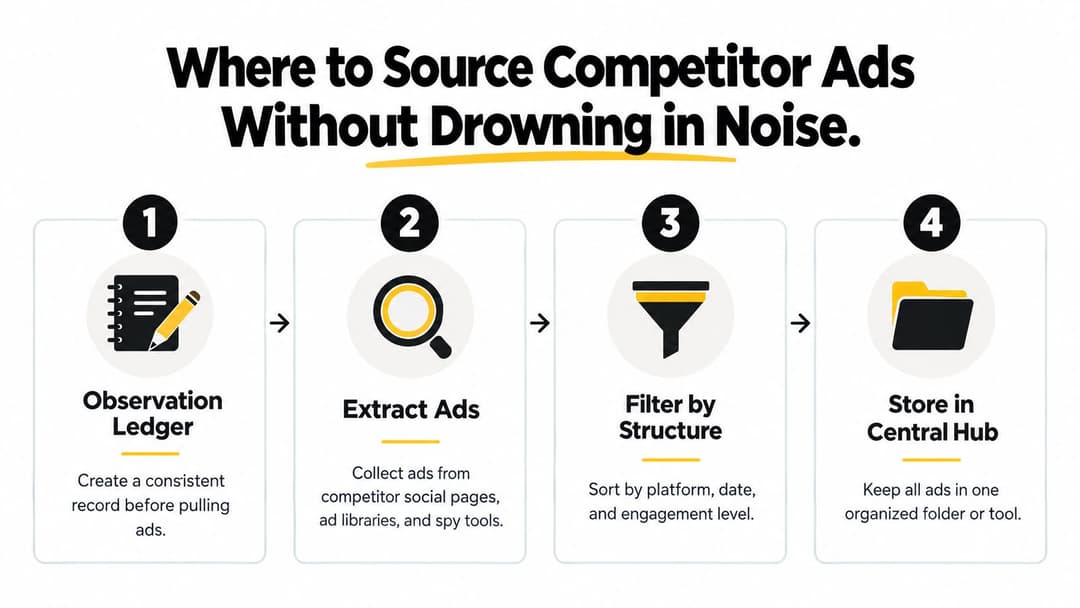
Where to Source Competitor Ads Without Drowning in Noise
The fastest way to ruin competitor research is to collect before defining what you'll record. Without a consistent ledger, one competitor gets evaluated through screenshots, another through copy notes, and a third through vague impressions. You can't compare inconsistent observations, and you'll overvalue whatever ad you happened to see most recently.
Start with a fixed record. Create one row per ad or meaningful variation, then preserve the original platform, URL, and observation date. The ledger should describe what's visible, not what you assume about performance.
Build the ledger before collecting
Use the same fields for every competitor:
- Identity: Brand, platform, ad-library reference, and date observed.
- Duration: First visible date if available, latest observation, and whether the ad appears persistent.
- Creative: Visual subject, format, aspect ratio, opening frame, and production style.
- Message: Hook, primary promise, supporting proof, objections addressed, and CTA.
- Commercial structure: Offer, price framing if visible, urgency, guarantee, or lead qualification.
- Funnel context: Destination page, message match, form or checkout path, and the next obvious action.
- Variation density: Number of related versions using the same core angle, with changes in copy, visual, audience cue, or format.
A useful collection benchmark is roughly 10 to 15 ads per competitor, logging the hook, visual subject, format, aspect ratio, CTA, offer, run duration, and variation density. That structure comes from the AdMapix competitor ad analysis framework, which emphasizes comparability over isolated creative examples.
Filter for signal before you interpret
Use public ad libraries first, then supplement them with competitor social pages and specialized monitoring tools when your workflow requires broader coverage. Filter by platform, format, date, and apparent longevity before you start judging creative quality. The Ad Library manual for competitor ad analysis recommends prioritizing ads live for 3+ weeks, because persistence can provide a more durable signal than a short-lived launch.
That doesn't mean a persistent ad is profitable. It may support awareness, retargeting, or a narrow audience. Treat longevity as evidence strength, not proof.
The newest ad is often the least informative entry in the library. It may be a deliberate experiment, a seasonal message, or an asset that the advertiser will remove quickly. Compare it with the competitor's older and related variations. If the same angle appears in several formats and survives multiple observations, it deserves more attention than a visually striking one-off.
You can also use AdStellar's guide to viewing competitor ads as a practical reference for organizing that discovery process. Refresh the ledger at a cadence that matches how quickly your category changes, and record every observation using the same rules. Consistency is what turns collection into competitor ad analysis.
Decoding Creative and Messaging Patterns That Actually Matter
A useful teardown begins with intent, not aesthetics. A beautifully edited video may be doing awareness work, while a plain product image handles retargeting. If you compare them as though they compete for the same job, you'll draw the wrong conclusion about the creative.
Categorize the job before judging the execution
Assign each ad a likely funnel intent:
- Awareness: Names a problem, creates recognition, or introduces a category.
- Consideration: Explains a mechanism, demonstrates a product, or uses proof to reduce doubt.
- Conversion: Presents an offer, urgency, qualification step, or direct purchase path.
Then code the creative consistently. Record whether the primary visual is a product, person, customer, interface, or lifestyle scene. Note whether the ad uses a single image, video, carousel, or another visible format. Aspect ratio matters because a concept designed for a vertical placement may rely on different framing and pacing than one built for a square feed.
For messaging, separate the hook from the complete argument. A question, story, problem statement, demonstration, or specific customer tension can all function as hooks. After that opening, map the sequence:
- Headline: What promise or problem receives immediate attention?
- Body: What mechanism, benefit, proof, or objection follows?
- CTA: What action does the advertiser request?
- Offer: What makes the action easier, safer, faster, or more valuable?
This prevents a common mistake: calling an ad “benefit-led” when the benefit appears only after a long product explanation. Message order often matters as much as the individual claims.
Look for repetition across dimensions
A single testimonial is an example. Multiple testimonial-led variations, paired with the same pain point and proof structure, indicate a possible strategic preference. The same applies to formats. If a competitor repeatedly adapts one promise into short video, carousel, and static versions, the durable insight may be the promise rather than any single production style.
Use timeline notes to track when a change appears. A new visual with the old promise suggests creative iteration. A new promise accompanied by a new landing page, offer, and audience cue suggests a more meaningful repositioning. That distinction is central to pattern recognition in marketing analysis, because the useful unit isn't always the ad. It may be a coordinated change in the whole conversion path.
Landing-page review completes the picture. Check whether the headline repeats the ad promise, whether the proof type continues after the click, and whether the CTA asks for the same level of commitment. A competitor may use broad education on Meta, feature comparison in Google, creator proof on TikTok, and detailed qualification on LinkedIn. Cross-platform similarity at the ad level can hide different funnel jobs downstream.
For teams refining visual systems, a resource on high-converting banner designs can help separate layout principles from competitor-specific execution. Borrow the strategic structure, not the protected asset or exact copy.
How to Score and Prioritize What to Test Next
A scoring model should reduce ambiguity, not create a false sense of precision. Rate each competitor across five dimensions on a 1–5 scale, using the same definitions every time. The framework in AdStellar's AI ad performance scoring system provides a useful reference for treating creative, messaging, channel, budget, and funnel signals as distinct inputs.
Start with the base score:
| Signal Type | Evidence Strength | Test Priority |
|---|---|---|
| One new ad with no related variations | Low | Observe, don't prioritize |
| Repeated hook across several creatives | Moderate | Consider a controlled test |
| Persistent angle with multiple formats | Strong | Prioritize if brand-relevant |
| Coordinated change across ad, offer, and landing page | Very strong | Test as a strategic hypothesis |
| Pattern repeated across competitors | Strong market signal | Test with differentiated execution |
The table is a decision aid, not a performance report. Public data can show what competitors publish and how their activity changes, but it can't confirm their ROAS, CPA, or conversion rate.
Separate testing noise from a pivot
Use three weighting questions:
- Longevity: Does the pattern remain visible across observations?
- Variant density: Does the core idea appear in multiple executions?
- Launch timing: Did the change coincide with a seasonal period, product launch, market event, or landing-page update?
A short-lived ad with low variation density is probably a test signal. A new angle that replaces an older message across formats, changes the destination page, and introduces a different offer is more likely to represent a strategic pivot. You still won't know whether the pivot succeeded, but you can recognize that the competitor is making a coordinated bet.
Don't score the ad you like. Score the evidence supporting the reason you think it matters.
Turn scores into a queue
For each repeated pattern, write one sentence that could become a test hypothesis. “If we lead with the onboarding pain point, show the product solving it in the first frame, and align the landing-page headline, then qualified prospects may respond better than they do to our feature-first concept” is testable. “Use more competitor-style videos” isn't.
Prioritize hypotheses where the strategic signal is strong and your adaptation is credible. Deprioritize ideas that depend on copied brand language, unverified spend assumptions, or a visual trend with no repeated message behind it. The best roadmap often contains fewer bets, each with a clear reason for existing.
Turning Insights Into Tests and Scaled Campaigns With AdStellar
The analysis becomes valuable when it changes what gets built. Convert each prioritized pattern into a compact brief with six fields: hypothesis, angle, format, audience, destination, and success metric. Add the evidence behind the hypothesis, including the observation dates, related variations, and the reason you classified it as a durable pattern rather than a one-off.
AdStellar can fit into this execution layer as an AI-powered platform for launching, testing, and scaling Meta campaigns. Its workflow supports bulk creation of creative, copy, and audience combinations, connects to Meta Ads Manager through secure OAuth, and uses historical results to inform AI Insights ranked against goals such as ROAS, CPL, or CPA.
Make the brief specific enough to produce
A useful brief might say:
- Hypothesis: A problem-first opening will create stronger qualified interest than a feature-first opening.
- Angle: Reduce uncertainty during the first use.
- Format: Vertical demonstration video and static product-led adaptation.
- Audience: The existing prospect segment associated with that problem.
- Destination: A page whose headline and proof continue the same promise.
- Success metric: The account's primary acquisition metric, such as CPA, CPL, or ROAS.
That structure gives production and media buying a shared interpretation. It also protects the team from copying a competitor's exact execution. You're testing a market signal through your own product, proof, visual identity, and landing-page experience.
For teams that need to turn ideas into videos, video-production support can help translate a strategic angle into multiple opening frames or demonstrations. Keep the variations meaningfully different. Changing a background color while leaving the hook, proof, and pacing untouched doesn't create a useful learning plan.
Keep platform roles separate
Cross-platform comparison needs post-click discipline. Meta may introduce a problem through broad creative, Google may capture explicit intent with feature or comparison language, TikTok may depend on creator credibility, and LinkedIn may require more professional proof or qualification. Similar-looking ads can therefore support different conversion strategies.
After the click, compare:
- Message match: Does the page repeat the ad's core promise?
- Proof escalation: Does the page offer stronger evidence for a higher-intent visitor?
- Friction: Does the CTA ask for a purchase, form fill, demo, or lower-commitment action?
- Audience fit: Does the page speak to the segment implied by the ad?
- Offer logic: Does the incentive make sense for that platform and funnel stage?
AdStellar's AI Campaign Builder can support the production and launch workflow once the brief is approved. After launch, use the platform's performance breakdowns and AI Insights to identify winning combinations, then feed those results into new iterations rather than treating the first test as a final answer.
A competitor pattern earns scale only after your own data supports it. The correct sequence is evidence, brief, controlled variation, measurement, and then expansion.
Keep Your Analysis Sharp and Compounding Over Time
Competitor ad analysis loses value when it becomes a quarterly presentation. By the time a static report reaches the creative team, the competitor may have changed its offer, landing page, or channel mix. A living ledger keeps observations connected to dates, variations, and decisions.
Use a simple operating rhythm:
- Observe: Add new ads and meaningful changes to the same ledger.
- Filter: Separate persistent patterns from fresh launches.
- Decode: Classify intent, hook, message structure, format, offer, and funnel.
- Score: Weight evidence through longevity, variant density, and launch timing.
- Test: Write only the strongest patterns into briefs.
- Scale: Promote winners, document losses, and update the next observation cycle.
Keep failed interpretations in the record. If you assumed a persistent ad represented a conversion winner but your adapted test failed, mark that result rather than deleting the hypothesis. Over time, your team learns which competitor signals transfer to your market and which merely reflect differences in brand, audience, offer, or media strategy.
The main trap remains over-indexing on the newest creative. Isolated screenshots can make a competitor look better than it is, while repeated patterns can look boring even when they reveal the clearest strategic commitment. Timeline-based review gives both kinds of evidence their proper weight.
The broader competitive intelligence tools market is growing under varying definitions, with one cited estimate projecting growth from USD 0.71 billion in 2025 to USD 4.03 billion by 2034, at a 21.17% CAGR in that estimate's category, as reported in the Luminix market summary. The practical implication isn't that software replaces judgment. It's that collection and comparison are becoming easier, so the differentiator shifts toward interpretation and execution.
Use continuous learning for marketing as the standard: every cycle should make the next brief sharper, not merely produce more observations. Run the next ledger review, identify one repeated pattern, and test it with a clearly aligned landing page before you expand the idea across your campaign.
AdStellar AI helps performance teams turn competitor ad observations into structured Meta creative, copy, and audience tests, then use AI Insights to identify combinations that align with ROAS, CPL, or CPA goals. Visit AdStellar AI to connect your research workflow with faster campaign production, launch, and ongoing optimization.