You're in Ads Manager, comparing two creatives that look almost identical.
Same offer. Same audience. Same budget range. Same landing page. Yet one ad keeps finding purchases, and the other keeps spending with nothing to show for it. You change the headline, swap the thumbnail, test a new hook, and the results still feel unpredictable.
That gap between “these ads look similar” and “this one works” is where pattern recognition matters.
For performance marketers, pattern recognition isn't an abstract AI term. It's the discipline of finding the signal inside messy campaign data. It helps you notice that people respond differently to a product demo than a lifestyle image. It helps platforms decide which users are more likely to click, convert, or ignore. It helps tools surface which combinations of message, format, and audience are repeatedly tied to stronger outcomes.
If you've ever wanted to move from instinct-led testing to evidence-led scaling, you're already asking the right question: What is Pattern Recognition? The useful answer isn't “a branch of computer science.” The useful answer is that it's how machines, and smart marketers, turn raw observations into better decisions.
The Hidden Engine Behind Every Winning Ad
A media buyer launches two Meta ads on Monday morning.
By Wednesday, one ad is clearly carrying the account. The click quality is better. The conversion rate looks healthier. The spend is moving in the right direction. The other ad looks fine at a glance, but it's not creating momentum.
The old way to explain this is vague. “The market liked it more.” “The creative hit harder.” “The audience was warmer.”
Those phrases aren't useless, but they're not enough. Teams that scale reliably get more precise. They look for repeated relationships between inputs and outcomes. That's pattern recognition.
What marketers are actually trying to find
When you review campaign data, you're not just looking for winners. You're trying to identify the underlying structure behind those winners.
That structure might include:
- Creative signals like a human face, a fast product reveal, or a direct first-line hook
- Audience signals like prior engagement, purchase behavior, or interest clustering
- Message signals like urgency, social proof, or problem-first copy
- Context signals like placement, device behavior, or time-based demand shifts
On the surface, ad analysis looks like reporting. Underneath, it's a search for patterns that explain why one combination keeps outperforming another.
Practical rule: Strong marketers don't stop at “what won.” They ask, “what repeated across multiple wins?”
That shift matters because paid social is noisy. A single campaign can produce a flood of partial clues. Pattern recognition helps you sort those clues into something useful.
Why this gives you an edge
A marketer who thinks in patterns doesn't treat every test as an isolated event. They build a mental model.
They notice that certain visual styles work with cold traffic but stall on retargeting. They see that one message angle keeps pulling higher intent clicks. They start connecting creative performance to audience response instead of judging ads on appearance alone.
This is one reason AI has become so relevant to media buying. Tools can scan far more combinations than a human can hold in their head at once, then help surface recurring signals worth acting on. If you want a broader view of how that fits into campaign execution, this guide to AI in performance marketing is a useful next read.
Pattern recognition is the hidden engine because it sits underneath almost every good optimization decision. Better targeting, better creative iteration, better scaling discipline. All of it starts with seeing the right pattern before your competitors do.
What Pattern Recognition Really Means
The phrase “pattern recognition” often evokes thoughts of spotting similarities. That's only part of the story.
In machine learning terms, pattern recognition is about assigning a class to an observation based on patterns extracted from data. In plain English, it means taking messy input and turning it into a useful decision. A machine sees a bundle of signals and sorts it into a category like “likely buyer,” “low intent click,” “spam,” or “high-performing creative type.”
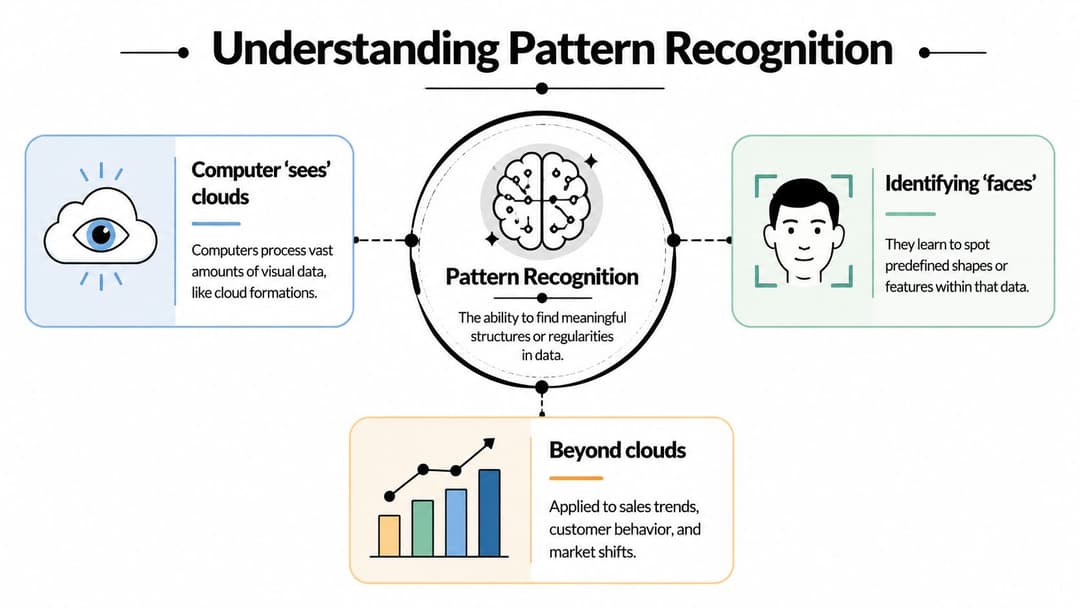
A simple analogy helps. Think about looking at clouds.
You glance up and say, “That one looks like a face.” Your brain isn't measuring every pixel. It's detecting a familiar arrangement of shapes. A machine does something similar with data, except the “cloud” might be campaign performance history, and the “face” might be a recurring combination of hook, image style, and audience traits that tends to produce conversions.
It's really about classification
At its core, pattern recognition is a sorting problem.
A system looks at an input and decides where it belongs. For marketers, that might sound like:
| Marketing input | Possible classification |
|---|---|
| New ad creative | Likely to perform well or likely to underperform |
| User behavior | High purchase intent or low purchase intent |
| Comment stream | Positive sentiment, negative sentiment, or mixed sentiment |
| Search query | Research mode or buying mode |
That's why pattern recognition matters so much in advertising. Campaigns generate too much raw information for anyone to evaluate manually with consistency. Machines help by converting that raw information into categories you can act on.
Why the idea became so important
Pattern recognition didn't appear out of nowhere with modern AI tools. It has deep roots in statistics, engineering, and computer science. One widely cited review notes that modern pattern recognition is usually traced to the statistical approach that classifies observations by learning from examples, and the same review described statistical pattern recognition as the most intensively studied and practically used framework, central to applications such as data mining, web searching, face recognition, and cursive handwriting recognition, as discussed in the ACM review by Jain, Duin, and Mao.
That history matters for marketers because it reframes pattern recognition as a practical decision system, not academic jargon.
Pattern recognition is what turns “we collected a lot of data” into “we know which signal matters.”
If your team is already using tools that generate copy, visuals, or testing ideas, it helps to connect that output back to the logic underneath. This overview of AI ad creation is useful for that next step.
Where readers often get confused is this: pattern recognition is not the same as prediction, and it's not the same as creativity. It's the layer that identifies meaningful regularities in data so prediction and decision-making can happen in the first place.
How Machines Learn to See Patterns
Machines don't “see” patterns the way a marketer sees a trend in a dashboard. They follow a pipeline.
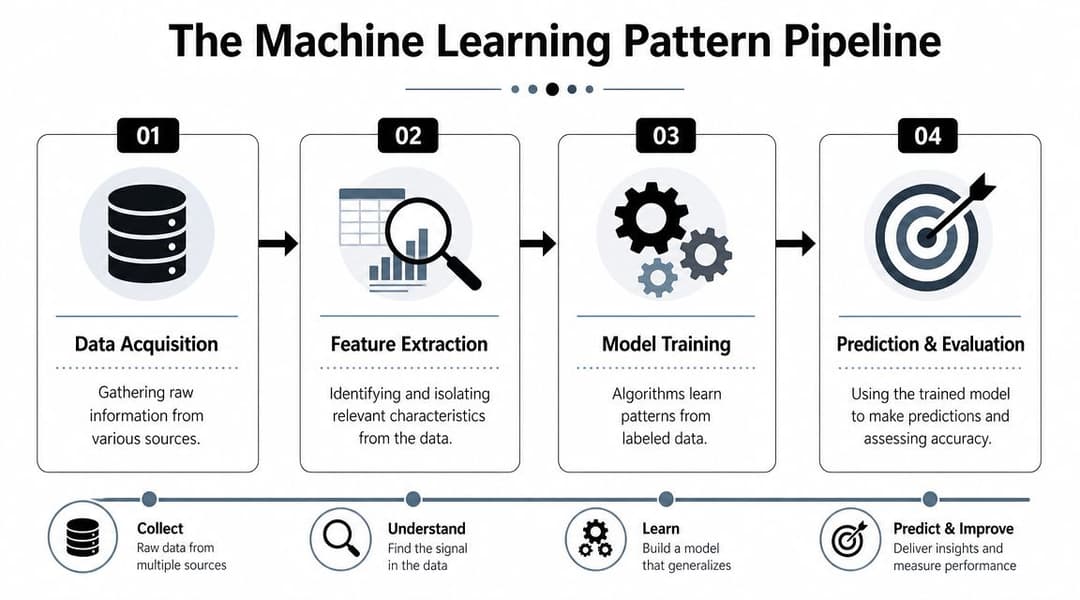
The process is usually described as data acquisition, feature extraction, model training, and inference, with feature extraction doing the important work of reducing complex raw inputs into a compact representation a system can learn from, as explained in this overview of machine pattern recognition.
That sounds technical, but the marketing version is straightforward.
The four-step pipeline in marketer language
Data acquisition
The system gathers raw inputs. In paid social, that could include creative assets, audience traits, click behavior, conversion events, comments, placements, and purchase signals.Feature extraction
This is where the machine simplifies the chaos. Instead of treating a video ad as an overwhelming blob of pixels and sound, it pulls out usable characteristics. Think visual style, text themes, object presence, pacing, or user interaction patterns.Model training
The system studies examples and tries to learn which features are associated with which outcomes. It's looking for relationships, not opinions.Inference and decision-making
Once trained, the model evaluates new inputs and makes a judgment. It might score a user as more likely to convert, or classify a creative as closer to known winners than known losers.
Why feature extraction matters so much
Many marketers often misunderstand this point. They hear “AI analyzed the ad” and assume the system understood the ad exactly like a human would.
It didn't.
It translated the ad into features it could work with. That could mean shapes, objects, phrasing patterns, sentiment cues, or behavioral markers. Feature extraction is the bridge between a rich creative asset and a machine-usable signal set.
If you create content for algorithm-driven environments, this same idea shows up everywhere. These insights for content creators are useful because they show how platforms respond to detectable signals rather than creative intent alone.
A machine doesn't start with taste. It starts with detectable attributes.
That's why teams often get better results when they test with discipline. Cleaner naming, clearer hypotheses, and tighter creative variants give the system better material to learn from.
Supervised and unsupervised learning
These two terms sound more intimidating than they are.
Supervised learning
This is the labeled-data version. You show the system examples and tell it what happened.
For a performance marketer, that might mean handing the model a set of ads and outcomes:
- Known winners with strong conversion behavior
- Known underperformers with weak downstream action
- Audience groups tagged by whether they purchased or bounced
The system learns from those labels. It tries to detect what separated one class from another.
Unsupervised learning
This is the unlabeled-data version. You don't tell the system what to look for. You ask it to find structure on its own.
That's useful when you suspect your current audience buckets are too broad or too simplistic. The model might find clusters of users who behave similarly even though your team hadn't grouped them together before.
A marketer might use supervised learning to predict likely converters, but unsupervised learning to discover hidden segments inside site visitors, email engagers, or repeat customers.
For campaign workflows, that distinction matters. Labeled data can support sharper prediction, but collecting labels takes time and effort. Unlabeled data is easier to gather, but the insights may need more human interpretation. Platforms built around continuous learning for campaign optimization are designed to keep updating that understanding as new performance data comes in.
Pattern Recognition in the Wild
Marketers already interact with pattern recognition every day. They just don't always call it that.
You upload a video, and a platform generates captions. You review comments at scale and notice a sentiment trend. You scan user-generated content and detect which product shots keep appearing in high-engagement posts. Those aren't isolated product features. They're examples of machines finding recurring structure in different kinds of data.

Computer vision in creative analysis
Computer vision deals with images and video.
From a marketer's point of view, this can mean detecting whether a creative includes a face, a product close-up, text overlays, a logo, or a specific visual composition. It can also mean scanning large sets of social content to identify repeated visual themes tied to engagement or conversion quality.
A beauty brand might notice that tutorial-style clips create stronger response than polished studio visuals. A DTC brand might learn that messy, lived-in product footage feels more credible than clean catalog images. Pattern recognition helps systems detect those repeated visual signatures across many assets.
Language patterns in comments and copy
Natural language processing works on text.
That includes ad copy, search terms, product reviews, comments, support tickets, and community replies. The useful question for a marketer isn't “can the system read?” It's “what recurring language patterns can it surface?”
For example:
- Customer feedback can reveal repeated objections
- Comment sentiment can expose confusion before it hurts performance
- Review analysis can highlight product benefits customers keep mentioning in their own words
Sometimes the strongest creative angle is already hiding in your comment section.
This becomes especially valuable when campaigns scale. A team can't manually read every response across every ad set forever. Pattern recognition helps condense thousands of language signals into clearer strategic direction.
Audio and speech signals
Audio often gets ignored in ad analysis, but it matters.
Speech recognition can transcribe voiceovers for subtitles, make video libraries searchable, and help teams review customer conversations for recurring phrases, objections, or product questions. That gives marketers another layer of pattern data to work with.
If your acquisition strategy depends heavily on Meta, it's worth seeing how these ideas intersect with platform execution in practice. This guide to AI-powered Meta ads connects those signals to campaign management more directly.
Pattern recognition in the wild doesn't look futuristic. It looks like faster review cycles, sharper creative learning, and fewer blind spots.
Putting Pattern Recognition to Work in Your Campaigns
The concept now stops being theoretical and starts affecting ROAS.
A performance marketer doesn't need to build models from scratch. The key skill is knowing how to use pattern-based insights to make smarter choices about creative, targeting, and spend.
Creative intelligence
Most creative review meetings are still too subjective.
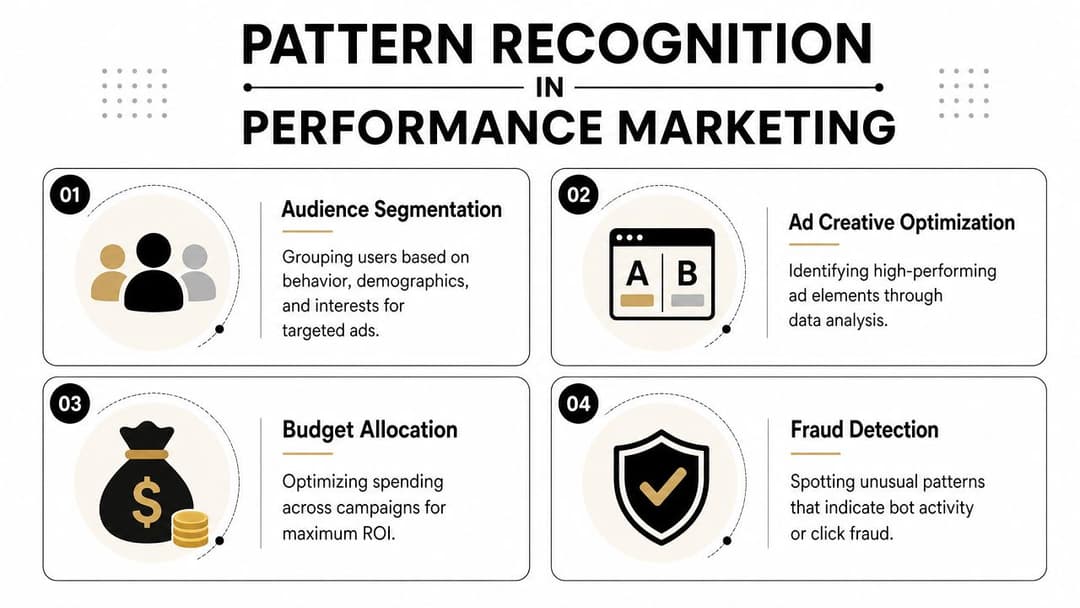
One person likes the UGC angle. Another prefers the polished product demo. Someone else wants to rewrite the hook because it “feels stronger.” Pattern recognition adds discipline. It helps you compare creative elements against actual performance history and identify what keeps recurring inside effective ads.
That can include patterns like:
- Visual openings that hold attention better
- Message angles that align with stronger intent
- Calls to action that pair well with certain audiences
- Formats that work differently by funnel stage
A platform like AdStellar's guide to using AI for Meta ads sits in this part of the workflow. One tool in this category is AdStellar AI, which analyzes historical Meta performance to rank creatives, audiences, and messages against goals such as ROAS, CPL, or CPA, then uses those patterns to help assemble and launch new campaign combinations.
Audience patterning
Audience strategy improves when you stop treating people as static demographic boxes.
Pattern recognition helps reveal behavioral groupings that matter more than age or interest labels alone. Two customers may look different on paper and still respond to the same buying trigger. Another group may share a demographic profile but behave completely differently after the click.
One helpful perspective is:
| Old audience thinking | Pattern-based audience thinking |
|---|---|
| Women 25 to 34 interested in skincare | Users who repeatedly engage with ingredient education and convert after creator-style demos |
| Broad lookalike audience | Cluster of buyers with similar pre-purchase browsing and repeat product-view behavior |
| Retargeting site visitors | Segments based on product depth, session intent, and return frequency |
Pattern recognition begins to uncover pockets of demand your standard setup can miss.
Predictive campaign decisions
Good teams don't just ask what happened. They ask what's likely to happen next.
Pattern recognition supports that by helping systems compare new combinations against known performance signatures. No model can eliminate uncertainty, but it can reduce blind guessing. If a new ad resembles past winners in meaningful ways, that's a stronger starting point than launching from pure instinct.
A short explainer helps tie the workflow together:
The practical takeaway is simple. Pattern recognition doesn't replace testing. It improves the quality of your tests. You stop throwing random variations into the market and start launching combinations informed by observed signals.
Better pattern detection leads to better hypotheses. Better hypotheses lead to cleaner scaling decisions.
Why Machines Still Make Mistakes
Pattern recognition is powerful, but it isn't magic. Machines still misclassify things, overread weak signals, and carry the flaws of the data they learn from.
A core statistical principle in pattern recognition is that systems are judged by classification error, and a central design objective is to make that error as small as possible. The classic formulation also emphasizes representation, generalization, and evaluation, meaning the system must encode observations, infer rules from examples, and estimate performance on new data without overfitting, as described in this explanation of statistical pattern recognition.
Three reasons results go wrong
Bad training data
If the system learns from incomplete, biased, or messy data, its output will reflect those weaknesses.
For marketers, this can happen when conversion tracking is inconsistent, campaign naming is chaotic, or “winning” ads are labeled without enough context. The model can only learn from the evidence it receives.
Overfitting
This happens when a system learns the training examples too narrowly.
Think of a student who memorizes the practice test answers but can't solve a new version of the same problem. In ad terms, a model may lock onto accidental details from old campaigns and fail when the next batch of creatives behaves differently.
Black box decisions
Some modern systems are hard to interpret in plain language.
You may get a recommendation or classification without a satisfying explanation of why the model made that call. That creates a trust problem. Marketers still need to pressure-test outputs against common sense, business context, and real customer understanding.
What smart teams do about it
- Audit the inputs before trusting the outputs
- Validate on new campaign data instead of relying only on historical fit
- Keep human review in the loop for major creative and budget decisions
Machines are useful pattern detectors. They are not accountable decision-makers. That part still belongs to the team.
Start Thinking in Patterns Today
You don't need to become a data scientist to benefit from pattern recognition.
You need a better operating habit. Start treating campaign performance as evidence, not mystery. When an ad wins, don't just duplicate it. Break it apart. Ask which signals may have mattered. When an ad fails, don't just turn it off and move on. Look for the mismatch between message, creative format, audience context, and offer timing.
A practical way to start:
- Run cleaner tests so your data tells a clearer story
- Ask “why” repeatedly when performance jumps or drops
- Group winners by shared traits instead of judging each ad alone
- Use tools that surface patterns rather than tools that only dump metrics
The marketers who gain the most from AI won't be the ones who know the most jargon. They'll be the ones who know how to combine machine-detected signals with human judgment.
That's the answer to what is pattern recognition for a performance marketer. It's a way of seeing. Once you develop it, campaign data becomes less random, creative testing becomes more strategic, and scaling gets a lot less emotional.
If you want help turning scattered Meta ad results into clearer creative and audience insights, AdStellar AI gives teams a structured way to launch variations, analyze historical performance, and spot repeatable patterns that inform the next campaign decision.